
Hello,
Welcome (back)! Wherever you are, I hope you’re well and have had a good week. I’ve spent some of this week figuring out what I’ll be teaching in the coming two trimesters, from October to December and January to March/April here at Krea. Expect posts coming up later in the year about what money is and what people do with it, about ancient India and the Western Indian Ocean in the first millennium CE, and about maps and how people in the past imagined their world and perhaps other worlds beyond. I love designing courses that get me excited and I hope the students will feel the same way!
I’ve also been reading for a couple of publication projects and this week I want to talk about something pretty big that has come out of that. A while ago I wrote a post here, which is still one of my favourites, called ‘Dating Tips from a Historian’. It had nothing to do with my love life, or anybody else’s. It was a look at how scholars work out when things happened and when sources were made. It might seem simple but it isn’t, and of course, it is hugely important. If you don’t know whether something happened before or after or at the same time as something else it is pretty much impossible to come up with sensible hypotheses about how things happened. One thing, after all, could not have caused something that happened before it. Whether two things happened at exactly the same time or within, say, the same century, might not matter much for one kind of argument, about slow tranformations of fashion or the development of cultural patterns, but it might be absolutely vital to plotting the history of a battle or a revolution.
I won’t repeat what I wrote then, but a thing I want to pick up on again is the difference between relative and absolute dating. Relative dating simply means knowing what order a particular set of things happened in, in relation to one another. For example, you might know that the following things happened within the rough timeframe of a few years and in the same area:
Somebody became king
A battle was fought
A plague broke out
A letter was written about how bad the king was
The order that those things happened in might make all the difference. Imagine story 1:
Somebody becomes king and a person with a grudge against them writes a letter about how terrible they are and how doomed the kingdom is now they are in charge. Then a plague breaks out. People decide that the king is, indeed, incompetent or unlucky or just plain terrible, and fight a battle to try to replace him.
Compare that with story 2:
A plague broke out that caused people to be unhappy about their government (because of how they handled it or because they thought it was a sign of divine disfavour or whatever), so they fought a battle and replaced the government with a new king. Then somebody who disagreed with this decision wrote a letter saying how bad that king was.
Relative dating techniques usually look for clues shaped like ‘X must have happened before Y because…’. So, if the letter about how terrible the king is doesn’t mention the plague then you might suggest that story 1 is more likely. Surely, somebody who thought a king was terrible would say something about how they had mishandled a plague or even caused it by being ungodly? So, if the letter doesn’t say anything about a huge outbreak of disease then perhaps it makes sense to think that happened later and maybe confirmed in people’s minds the judgement that the letter writer had already made. In terms of my equation: ‘The letter must have been written before the plague because the plague isn’t mentioned in the letter’.
I like this argument better when it involves things that are mentioned, rather than things that aren’t. For example, a text written in the first century CE by a Greek-speaking Roman, called the Periplous of the Erythreian Sea (which I’ve written a little about here), is all about sailing and trading in the Indian Ocean. Its date, in the first century CE, was established mainly on the basis of two kings who are mentioned in the text and who we also and can date know from other sources. Therefore, the text could not be earlier than those kings. Luckily, it also explicitly says that these men were kings at the time when the author was writing, so it can’t date from a long time later than them, either. Other efforts to pin down the date of the text, though, have tried to argue that it must date from before another Roman writer, Pliny the Elder (who I have also written about, here), wrote his enormous book, the Natural History. Why? Becasue the Periplous doesn’t mention the Natural History. Surely, the argument goes, the author of the Periplous would have been interested in many of the things Pliny wrote about (which included spices and gems available from the Indian Ocean region) and would have known about Pliny’s work if it already existed because Pliny was very famous. I don’t like this argument very much because, while it might be plausible that one author would be interested in another, there are also lots of good reasons why that might not show up as a direct mention or quotation. For example,
The version of the text of the Periplous that we have is almost certainly missing some of its beginning and end, so what if the reference to Pliny was there?
The author of the Periplous wrote in Greek. Maybe he read Latin, which Pliny wrote in, but maybe he didn’t! Greek was the everyday language of the whole eastern Mediterranean and, although he was clearly literate and fairly well educated, the author of the Periplous does not seem to have been a highly trained scholar (who would have learned Latin in the Roman Empire).
The author of the Periplous got his information about Indian Ocean trade from his own experience and from talking to other merchants. Pliny got his information about the Indian Ocean from… talking to merchants. If the author of the Periplous simply thought that he was better informed than Pliny about the things he was interested in, why would he have mentioned Pliny?
The Periplous is all about doing business. It is practical and focussed. Pliny was interested in everything and in taking all of the information he could gather and turning it into a single, abstract picture of the world as a whole. While the Periplous author might have consulted Pliny (or might not), he might not have mentioned it, as it wouldn’t relate to his immediate concerns.
There was probably a huge gulf between the two authors in terms of wealth, class, education and regional identities. Pliny may have been very famous, among the other super-rich, upper-class Romans who wrote his work, but that didn’t mean he was a household name all over the Roman Empire.
I don’t think we can plausibly say that the Periplous was written before Pliny’s Natural History. We can say that they were both written around the same time, though, when Romans were more interested than ever before in the Indian Ocean world. That is another issue for relative chronology: establishing that things happened at about the same time is not the same as being able to establish possible sequences of cause and effect.
Coincidence and Causation
In both of the stories I sketched above about a king, a battle, a plague and a letter, it would be difficult to prove from the evidence I’ve put into the mix, whether the plague really happened before the battle. In story 1, some people already thought the king was lousy, so maybe a plague was the nudge everybody else needed to agree and rise up against him. BUT, if some people already thought the king was terrible anyway, then maybe they rose up and defeated the king in a battle and THEN a plague broke out. The plague could have been completely coincidental. We know it happened and we know it happened at roughly the same time as the other things, but it didn’t actually have anything to do with the letter, the king or the battle. In story version no. 2, where a plague caused people to be unhappy, fight a battle and choose the new king, who somebody then wrote a nasty letter about, we have the same issue. Unless the letter goes into detail about what happened when, then it is possible that people fought a battle to replace their government with a new king for some entirely different reason (high taxes, marital scandal, regional political uprising, palace conspiracy gone wrong… being king was dangerous for lots of reasons!). Then a plague broke out and the letter writer, focussed on how bad the king was, lumped the plague in there but it wasn’t really the cause for the king coming to power or the letter writer not liking him.
In this case, we might want to look for other clues to help lock the plague into our relative chronology. Perhaps another source says that the new king had survived a bad case of an infectious disease before becoming king. It might not have been the plague but perhaps it was... Perhaps some handy document says that there weren’t many people available to fight in the battle because so many people had died of plague beforehand or, the other way around, maybe a gravestone or some other memorial for a veteran of the battle also records that he subsequently died of plague.
These are all hypothetical cases, and exactly what kinds of sources you might have and how detailed they are will all vary across time and space: some societies put up inscribed memorials to their dead, others don’t. Documents survive (or were made) in larger numbers in some times and places, meaning that you can hope to find stray mentions of the same thing, like a plague, in lots of different texts, while in other places you might just have one single source - that letter - that is the only thing even to mention the king at all. Even how societies described or understood things like diseases can influence how easy they are to find out about later. In the sixth century, for example, a plague, probably a very virulent bubonic plague, broke out and spread around the Mediterranean. Several sources mention it but they don’t all describe the symptoms in quite the same way. Other sources don’t mention it at all, even though we are pretty sure they must have experienced it. That just wasn’t what they were writing about. The same is true of how societies treat the dead. So-called ‘plague pits’ in the UK, for example, stand out archaeologically, because for most of the Middle Ages people were buried in individual or family graves, so when you have a large number of people buried together in a single mass grave, and especially when they don’t also have marks of injuries (which might indicate the aftermath of a battle), then it is a fairly safe bet that this was some sort of sudden disease outbreak. In this case, that can then be correlated with written sources about plague. In a culture that mainly cremates people after their death, it might be harder to spot a moment of pressure like an epidemic in the archaeological record.
Whatever the specific hypotheticals in your particular case study, in any relative dating scenario it is possible to imagine that you can know things about what order specific events happened in or that they happened around the same time, without knowing when that was. We might, for example, have evidence to prefer Story 1 for the Letter>Plague>King>Battle sequence but still not know when, within a 500 year window, any of it happened.
The more we know, the less we don’t
It may seem obvious, but the more we know, the less we don’t. What do I mean? If our Letter>Plague>King>Battle sequence happened in a period and region when not very much is known, then we might really be looking at a 500-year window when those events could have happened. If, though, our Letter>Plague>King>Battle sequence happened in a period and region for which we know quite a lot then even if none of our sources specify a date, we might still be able to pin it down to, say, a 2-3 year window. Just by knowing who was king across most of those 500 years and when, and when there are gaps or uncertainties in the record, we can know that our floating chunk of events can only have fitted into one of those gaps or uncertain periods.
One of the oddest conversations I have had a couple of times as a historian is with people asking me about so-called ‘missing years’ theories. These crop up now and again, mostly about times and places for which we have quite a lot of evidence but not a really dense, detailed record. As with most conspiracy theories, there is a sweet spot. (And missing years theories are conspiracy theories, even if they are sometimes a bit vague about who is conspiring to hide things and why.) The sweet spot matters because if you were to say to, e.g. somebody working on Neanderthal archaeology, ‘Hey, can you imagine a whole other society of Neanderthals living in some cave we haven’t found yet in c. 50,000 BCE?’ (so roughly between two of our best clusters of Neanderthal evidence, from c. 70,000 BCE and 40,000 BCE), I imagine that archaeologist would reply with something along the lines of, ‘Er, yeah. Really easily. We have literally tens of thousands of years in which people, including Neanderthals, must have been doing something, probably in lots of caves all over the place that we haven’t found yet.’ It isn’t much use for a conspiracy theory because there is so much we know we don’t know! Likewise, if somebody said, ‘What if a whole decade happened between 1970 and 1980 and The Government just decided to cover it up?’, the reaction would probably be pretty underwhelming. Lots of people would just shrug: ‘I was there, my friend. I’m pretty sure I didn’t forget about a whole decade and the government certainly didn’t hide my tax bills from me!’ Even people who weren’t around then would, I hope, have the sense to say, ‘We have so much material from those decades, from so many plces and people and perspectives that it would be pretty much impossible for any government to just ‘hide’ ten whole years: every movie, song, birth record, photograph, flight itinerary, the accounts of every corner shop and food stall...
‘Good’ slots for missing years theories seem to be ancient Egypt and parts of the Middle Ages: we know really quite a lot, but often not down to individual years or decades for some events or cultural changes. Even more importantly, these periods and regions might be quite well known by scholars who work on them but they aren’t regularly taught in schools and they aren’t super popular (in comparison to, say, the Roman Empire or the Second World War) among film makers or public history writers, so it is hard for somebody who isn’t a specialsit to have a good handle on what really is ‘unknown’, versus ‘not widely known’. As a result I’ve been asked if there could have been a ‘missing’ millennium in Ancient Egypt when, maybe, some extra advanced ancient Egyptians (who may or may not have been aliens) might have done stuff that then got forgotten or systematically hidden (by somebody for some reason, in some way). There are also people who have written books claiming that some centuries of history in Central Europe didn’t happen at all and were later made up (with adjustments to the calendar). In both of these cases, this could not have happened. We know enough to know roughly what we don’t know and there are no missing years, but the conspiracy fits well into somewhere that seems a bit… mysterious.1
Most of the work that I do fits into periods and regions that could be characterised in this way: they are not necessarily best-selling. There are plenty of uncertainties, but we do have a pretty good handle on what we don’t know. They are candidates for conspiracy theories but good scholarship mostly fits into well established frames. But at the edges of my time and region of interest are some more mysterious areas.
The AMS shift and the ‘Early Historic’
Recently, the Archaeological Survey of India for the southern state of Tamil Nadu (just south of where I live), published a new book:
K. Rajan and R. Sivanantham, Inscribed Potsherds of Tamil Nadu - Graffiti and Tamiḻi, 2 vols (Department of Archaeology, Government of Tamil Nadu, 2026)
It is really a book, as the title implies, about things that people scratched into clay pots in Tamil Nadu, more than 2000 years ago, but in order to study those, the authors collect and document the sites from which most of those scratched pieces of pot were excavated. And this raises a really exciting question: how much more than 2000 years ago were most of those pots buried? You see, the authors bring together in one publication lots of smaller studies, some from hard-to-find journals, that all seem to be showing the same thing. A lot of sites, or levels at sites, traditionally dated to around 200 BCE, might actually date to closer to 600 BCE.
The evidence is stacking up, in particular, from the use of AMS or Accelerated Mass Spectrometry dating. This is a technique that helps to refine standard radio-carbon dating, which in turn examines how much atoms of carbon-14 have decayed since the living thing they were part of died. (Radiocarbon dating can only be done on organic remains, like wood, natural textile fibres or bone.) Tests done at different labs and using samples from different sites are all suggesting the same results. Different labs are important because it makes the possibility of a faulty piee of equipment or a systematic analytical error by a single laboratory’s staff much less likely. Different sites are important because they rule out something weird happening in just one place and point to a real, systematic error in our existing chronology.
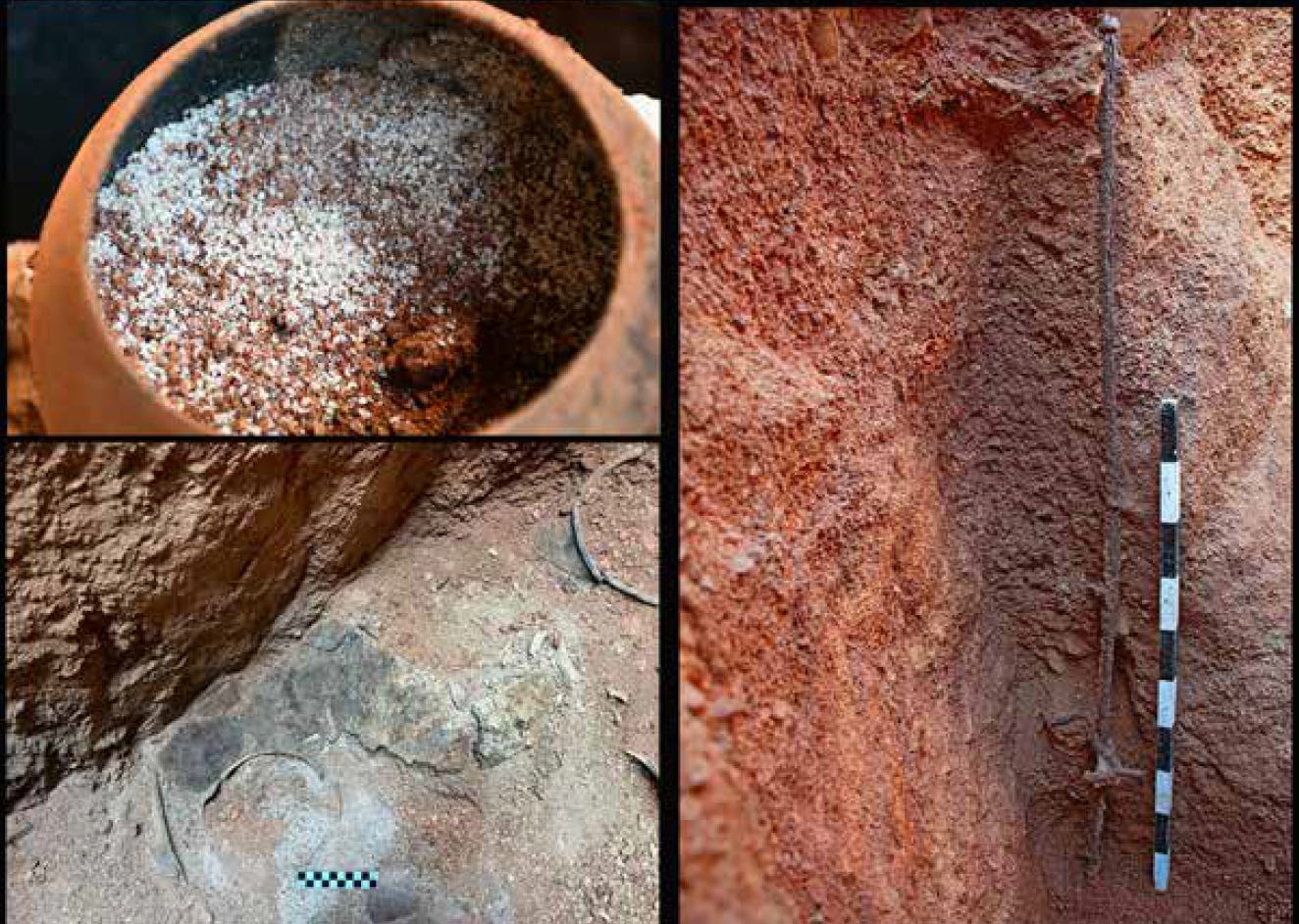
These results are surprising but they aren’t wacky, like the missing years theories. We know that we don’t know all that much about the first millennium BCE in southeast India. We don’t know nothing! Even placing these sites in relation to earlier and later cultures was possible because of what was already established, but we don’t, for example, have tight narratives at the scale of human lives. Instead, archaeological excavations lay out changes in culture and economy over centuries. As a result, re-dating specific kinds of pottery or buildings or beads or metalwork 400 years based on organic remains found in the same layers with them, isn’t impossible, but it is very interesting. It raises new questions:
since we do have a clearer idea of the ‘when’ and the ‘what’ for the period from c. 200 CE onwards, does that mean that the period or cultural phase beforehand, which we used to think was roughly 400 years long, just lasted much longer than we knew, or should we now be looking for divisions within that now-800-year period, to identify new phases of transformation that we hadn’t recognised before?
if arguments for why things changed from c. 200 CE depended on what had been going on for the previous 400 years, does this alter if we now think we mean the previous 800 years? It might mean that things that looked as if they were changing gradually were really very stable and not changing very much at all. And if that is the case, then why did they then change c. 200 CE?
what was going on elsewhere in the world at the same time as the layers and sites in Tamil Nadu, if they were being laid down in c. 600 BCE not c. 200 BCE? For example, many of these sites show signs of bead making and connection to long-distance trade routes. When that evidence fitted into the period c. 200 BCE, it looked as if it might have to do with the rise of several big empires around the Western Indian Ocean, including the Kushan Empire in northern South Asia and the Roman Empire in the Mediterranean (with indirect connections to the Indian Ocean at that time). If those beads were being made c. 600 BCE, though, then they definitely weren’t anything to do with possible customers in the Kushan Empire (which didn’t exist yet) or the Roman Empire (which did exist, but was still in the process of conquering the Italian peninsula).
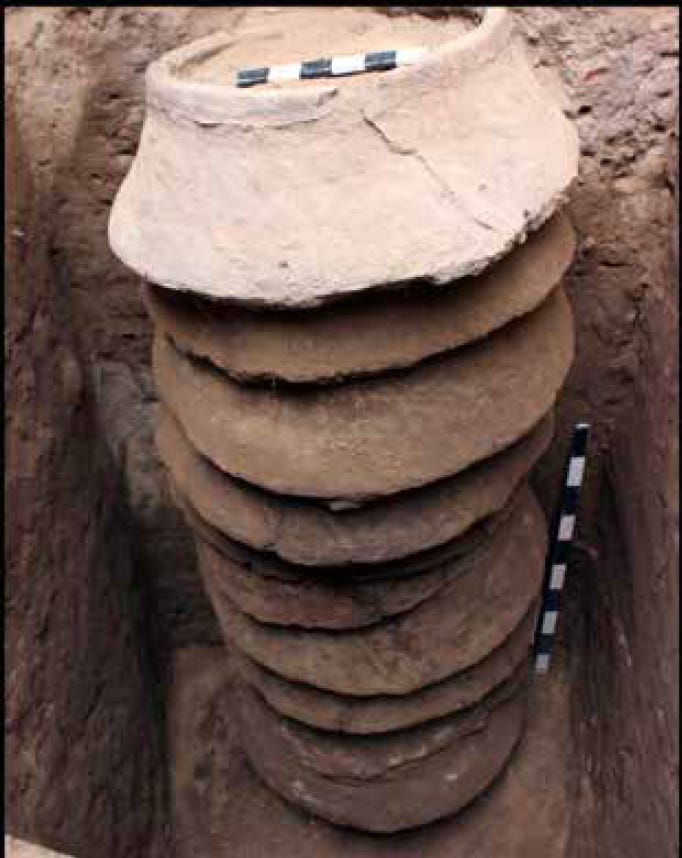
I don’t have all the answers I would like yet. Time to do more reading, more thinking and more poking at the details of which dates have moved for which specific bits of what sites! But I’m delighted for two reasons. First, I like thinking, so this keeps things interesting. Second, and more importantly, if these dates turn out to reset our timeline, then we will know more than we did before. There will still be lots we don’t know but we will be surer of what and how much we don’t know. Debates about the past never stop, nor does finding out more, but the information we do have should keep getting better and better - more full and more accurate. That is historical progress.
I am not giving references here because I don’t want to spread these theories further. I do, however, blame Netflix for giving airtime to at least one of the (Egypt) and presenting it as if the idea had any credibility whatsoever!
Comments
Nothing yet. Say the first thing.
Sign in to join the conversation.