
Hello,
Happy Friday! Wherever you are, I hope you’re well. I can’t believe I’ve only been in India for two weeks. It already feels like home in the flat, especially as we unpack our books. And there is one particular book I want to talk about this week.
Back when I was in Istanbul (September 2025-June 2026), I got an invitation to chair a discussion with one of the editors of a new book on liminal spaces and spatial practices in Byzantium.
Kitapçı Bayri, Buket, and Myrto Veikou (eds), Liminal Spaces and Spatial Practices in Byzantium, Birmingham and Byzantine Ottoman Studies (Routledge, 2026), doi:10.4324/9781032697888
I was absolutely thrilled because I already knew the book very well… Back in 2025, before Istanbul, I spent a year freelancing as an editor, proofreader, writer and tour guide. I wasn’t quite sure if this was going to be a career break or a career change. It turned into the former and as happy as I am to be back on campus and planning classes, I’m also grateful for the space it gave me. History was never the issue though, so I pitched myself as an editor and proofreader of books about history. And so it came to pass that one day I was invited to copy edit a new book on liminal spaces and spatial practices in Byzantium.
More on liminality later, but from what I already knew about it, you could perhaps describe my reaction as mixed. On the one hand, I was very grateful for the work and glad to be working on something so close to my own research interests (not that I haven’t had great fun proofreading work very far away from what I usually work on!). On the other hand, I remember when ‘liminality’ first became a big thing in historical research, or at least in medieval history. It was around when I was beginning my PhD, back in the late 2000s and I have memories of many graduate papers talking about liminality. It all got a bit much. Some of it, as with all new trends, wasn’t that exciting: it turns out you can apply almost any ‘lens’ or perspective you like to the past. ‘What happens if we look at [period/region] for things to do with [insert favoured trend/perspective: gender/materiality/ephemerality/labour relations/disability/age…]?’ There will always be an answer to that question, however you phrase it, because people in the past were as complex and multi-faceted as us. Many of the answers will be exciting and important. If the perspective is new, so will be some of the answers. But there will also be times when it feels a bit forced. Liminality sometimes felt a bit forced to me.
Welcome to the Twilight Zone…
And that is probably the point to say a bit more about what liminality is. for a more detailed background, including references, see the Introduction in Buket and Veikou (eds), but to summarise here, it began as an anthropological theory in the early 20th century. It was related to the notion of ‘rites of passage’ (and, indeed, began life in a book called exactly that). The term ‘limen’ means ‘threshold’ in Latin and Arnold van Gennep, the first theorist of liminality, was interested in those times in a peron’s life when they seem (to themselves and their community) to stand at the threshold between different roles or social identities. He noticed that lots of cultures (most, maybe even all?) have rituals dedicated to those ‘crossings’ and often they involve people temporarily inhabiting an identity that is neither one thing nor another. He pointed to societies in which young men might be sent for days or weeks away from the community into desert land or forest or somewhere else that would normally be on the ‘edge’ of everyday life before returning and taking part in ceremonies that marked them (sometimes literally with tattoos, scars, or temporary body art) as having ‘become’ men, or passed from boyhood to manhood.

Many societies have rituals involving infants reaching certain milestones and being ceremonially recognised with things like names, circumcision or presentation to the wider community. Especially in worlds without modern medicine, these rituals recognised that newborns were crossing the dangerous threshold between whatever a society thinks exists before birth and a full member of the society. Simply surviving birth was a big step but it didn’t represent being through the danger zone or across the limen. Other thresholds are often also related to birth and death: menstruation for girls, whatever marks the ‘official’ onset or end of puberty for boys in a particular culture (whether that is a particular age, the sprouting of hairs in new places, the voice breaking…); marriage, parenthood, menopause. Again, early anthropological literature focussed mainly on rituals in societies defined by their onlookers as ‘traditional’ (though really, all societies are always changing to meet the world as it finds them!). Rites of passage and states of liminality aren’t all that hard to find closer to home, though, for those of us whose ‘home’ includes electricity, the internet, penicillin and supermarkets and who would not usually be described as ‘traditional’.

For modern rituals of liminality, think school proms, with all of their dress-up conventions and, very often, the rituals of disorder that go with them, when departing students for a day or a week mess the place up and generally cause a bit of good-natured havoc. Rites of passage and states of liminality often hide in the language of luck: it is considered unlucky in many communities in Britain for the bride to be seen by the person they are marrying on the day (or even the day before) their wedding until they actually arrive at the ceremony. In a time and a place where couples marrying almost always know each other beforehand and have often lived together, sometimes for years, this short, almost absurd convention of separation still marks a transition: before, a fiancée, a girlfriend, a lover, a friend; after, a wife. University graduations usually involve walking across a stage, literally walking into a ritual space (stages aren’t a big part of the everyday of life at university - they are ‘special’, and so often are the halls where graduations take place) as one person, an undergraduate, and leaving it as another, a graduate.
Over the decades, the idea of liminality has morphed and grown. People have debates whether liminality refers to moments in a human life when somebody is ‘between’ states or whether it can refer to the places that make somebody ‘between’ as well. Take airports, for example, or land borders, where for a few hundred yards or in the airside lounge, you aren’t quite anywhere: you’ve crossed the threshold (passport control) of one country and not yet crossed into another. A place or an ocean-going liner is even more a liminal space, where many of the usual rules don’t quite apply. This can mean an 18-30 cruise where people feel free to let their hair down but it can also mean people crossing into international waters to do things that would be illegal wherever they are, from broadcasting pirate radio to organising floating casinos or exchanging drugs. These days, liminality is used to mean both places in between and people in a state of in between, unless a scholar wants to specify for their own purposes.
Anyway, all of this is hugely interesting, I think, and liminality gave me much to think with about how we explain our lives to ourselves, but when the new editing project came my way I still had a shadowy memory of it all being a bit over-used. There was a point in the 2000s when it felt like anything at all could be liminal, and indeed, if you want it to be, it can! We are all living in between, with birth on one side and death on the other. Every place we go is between wherever we were before and where we are going next. I remember a paper I heard long ago (and I will be vague because my point here is not to be mean to somebody I met once over 15 years ago, whose work was probably much better than that 15-minute presentation) that talked about how doorways are liminal because you are standing between one room and another and I thought then and still do now, okay… So what? By any literal definition, a doorway is liminal. That is pretty much what the term means in Latin, but unless you can show me that people feel themselves or see others as being fundamentally changed every time they walk through a doorway or as being in a state of not-quite-being-who-they-are when they are in the doorway, then I’m not sure liminality is getting us very much. Now, talk to me about a church door in Rome that if you walk through it on a specific day as a Catholic will redeem you of some or all of your sins, and we’re back in business! But every doorway? Everywhere?
Liminal Spaces in Byzantium
With this slight trepidation, I began reading the chapters I had been sent for the copyediting job and my doubts melted away. Editors can make or break a collection of essays on a theme with how much they inspire, cajole and bully their contributors to actually think about the shared theme versus writing about whatever the author is interested and then tagging on a paragraph about how this is so relevant to [whatever the theme is] honest! The editors this time have, in my opinion, pulled off a blinder. Every chapter convinced me more and more that there was a distinctive Byzantine conception of ‘in betweenness’ that went far beyond us as historians looking at things (like doorways) and saying, ‘well, I guess that could be liminal…’. My scepticism and, dare I say it, a hint of ennui in the midst of a tiring year, peeled away case study by case study.
There were the miraculous crocodiles of the Nile delta, for example. Monasteries in Egypt were often located just outside towns and villages on raised ground. For most of the year, this meant they were a short walk away from local communities and, often, other monasteries. When the Nile flooded, though, bringing its annual deluge of nutrient rich sediment that helped to feed successive empires in the Mediterranean, those patches of raised ground became islands and with the water came not just nutrients but also crocodiles. What had been ground, indistinguishable from other ground now became a powerful and dangerous threshold separating monks from each other and the world. Crocodiles came to represent both danger and power. Since ancient times in Egypt, crocodiles had been associated with another ‘limen’, the threshold between life and death and, with Christianity, their ancient symbolism was re-worked. In stories written, usually by monks and for monks to encourage better monkish behaviour, those with little faith were exposed by their fear to cross the water in case of crocodiles. Those strengthened by their faith crossed without hesitation, one even doing so by walking on the water, so great was his holiness. In other stories crocodiles did catch unwary monks only to release them at the command of a more pious brother. Crocodiles might even carry the most faithful and spiritually powerful on their backs. The threshold was literal - a strip of water to be crossed - and symbolic - whether it was seen as a threshold at all depended on the holiness of the viewer. For the truly faithful, the stories said, neither the water nor death were truly boundaries or changes of state.
There was the politically liminal - large islands in the Mediterranean, like Sicily, Cyprus, Sardinia and the Balearics, where people for centuries lived under changes of rule, now Byzantine now one of the Muslim governments that controlled either the southern or eastern coast of the Mediterranean. Sometimes the islands seem to have been under a strange mix of power that never applied anywhere else. Rather than being constant battlegrounds or empty wastelands, though, they became sites of experimentation in politics and compromises in everyday life. They became places where conversations between great powers could happen - thresholds that were never quite fully Christian or Muslim. It was particularly exciting watching a group of scholars working on the Mediterranean and the North Sea combine forces to uncover life in these liminal places through mainly archaeological evidence.
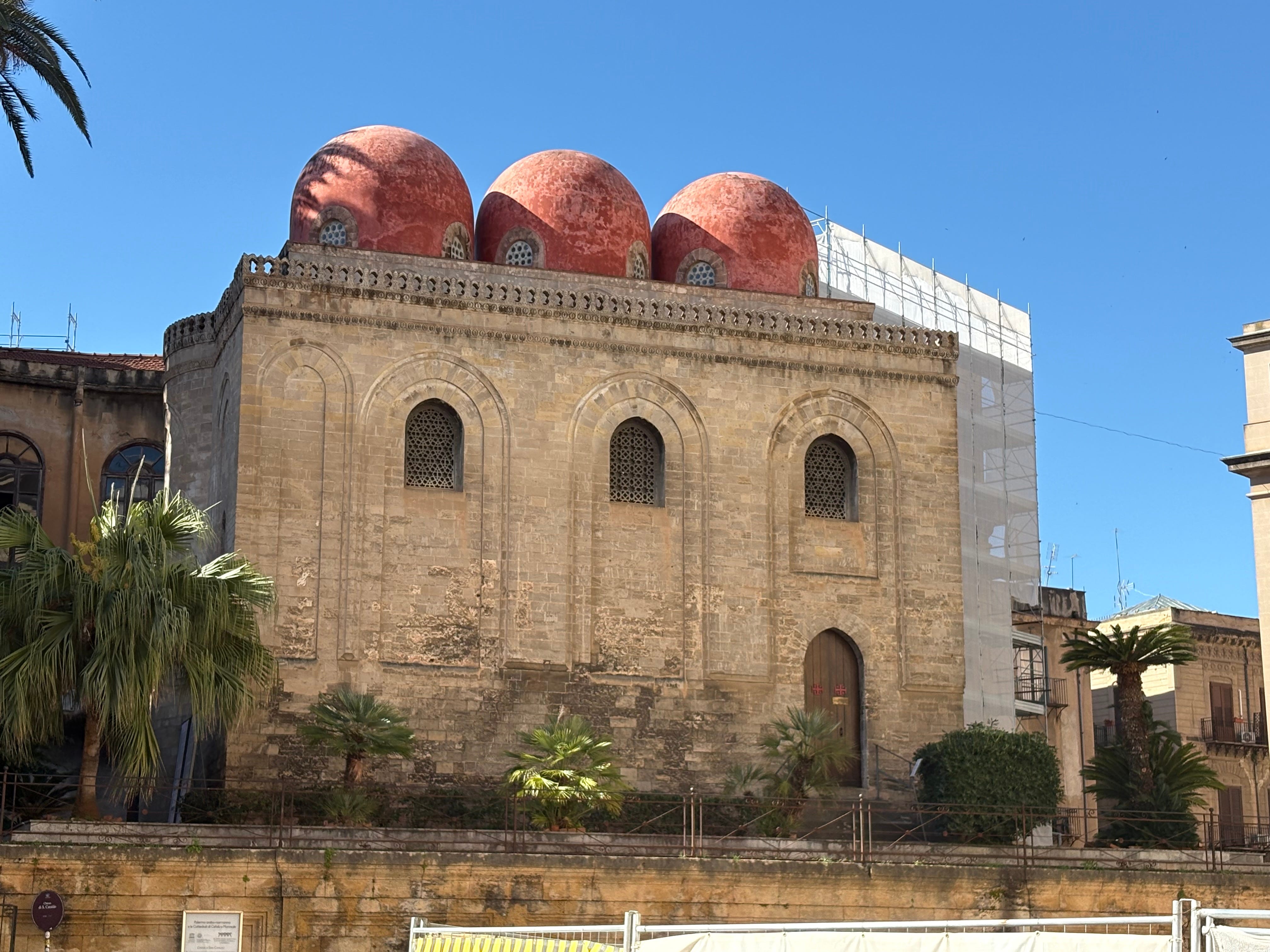
I absolutely loved a chapter about bridges. This one really ignited my initial cynicism. It just seemed to easy to argue that bridges are liminal - they are, after all, about as literally liminal as you can get, suspending the person on them between two different places, but doesn’t that all sound a bit… hooey? I mean, sure, you can look at them that way, but that doesn’t mean people did. Except that, in Byzantium, they did! Inscription after inscription carved onto bridges made the same point over and over again. Usually they were religious, biblical verses asking for protection while in a state of danger or while being suspended between states. By the end of the chapter, I was about as convinced as if somebody had shown me a time-travel recording of a Byzantine pedestrian standing on a bridge saying, ‘of course this is a liminal space!’ just like the crocodiles, for the Byzantines, liminality was always read in two dimensions, the literal and the spiritual (another chapter about lighthouses revealed a similar pattern).
Actual bridges were dangerous because they could fall down, or you could fall off them or they might be inadequate to the task and be washed away or submerged when water rose quickly. In the 6th century a courtier to the emperor Justinian I, by the name of Procopius of Caesarea, wrote among other things, a celebration of Justinian’s many building projects. (Not all of them were actually Justinian’s. Some were done by his predecessor but that didn’t suit Procopius’ agenda and isn’t really relevant to my point here.) Among the lists are many bridges built, strengthened or enlarged, as well as descriptions of how dangerous the crossings were before. One of my favourite descriptions is of a large bridge with brick and stone arched piers near the city of Adana in modern Türkiye. Over centuries, Procopius says, the parts of the piers that were under the water had gradually been worn away so that
‘it had come to be always the prayer of each man who crossed the bridge that it might remain firm if only during the moment of his crossing.’
Buildings V.5.8-14
Of course, Justinian fixed it right up and thereby saved people the worry, but bridges were also symbols of liminality, used in Byzantine literary descriptions of the passage to Heaven. Like the crocodiles, what came through in this volume was a distinctive way of seeing physical and moral or spiritual danger as in some sense occupying the same space, especially. As a result, spaces that placed the body in danger or uncertainty or in betweenness became symbols of the dangers facing a Christian soul, and then, of course, those spiritual ideas fed back into how people perceived the physical places, hence bridges in Byzantium often being carved with prayers or verses that talked about the dangerous uncertainty of the person in their passage through life.
Every chapter had something new to offer and there were lots of perspectives on liminality but none lost sight of that critical factor: it isn’t just about what we might see as liminal. It is about what people in the past saw as liminal. I hope I contributed to the overall polish of a great study but honestly, it was easy work with material that kept me thinking. And it reminded me, as every brush with the things people in the past made and thought and left behind, why it is such a special thing to connect with them across time and get a glimpse into their lives, that were so distinctive yet in fundamental ways, so relatable. Especially over the last year or so, observing a hundred tiny rituals or superstitions connected with getting married, moving house, taking long journeys, starting new jobs and finding out how people in other countries do some of the same things, I’ve been finding myself feeling that liminality and ruing my own scepticism!
At the talk about Liminal Spaces and Spatial Practices in Byzantium it was also a huge pleasure to meet one of the editors in person, a year after we first began emailing each other back and forth about editorial details, and to see the book in print. And this week, it was wonderful to be sent a link to a video of our discussion. I’ve tried to capture what excited me about the project in this post, but if you aren’t done, then here is the talk and if that still isn’t enough, I strongly recommend the book itself!
Comments
Nothing yet. Say the first thing.
Sign in to join the conversation.