
I’m adding a content warning about fatphobia and body shaming.
I was always told that, eventually, if I tried hard enough, if I was good enough, I would lose weight and everyone would start accepting me and things would just be so, so much better. Let me explain.
The first time I remember understanding that I was fat was when I was sitting on the toilet seat, lid closed. I used to sit on the toilet while my mom took one of her age-long luxury baths, just so we could talk. I knew that I was fat then because I could fill my bottom spill over the side of the lid, just a little.
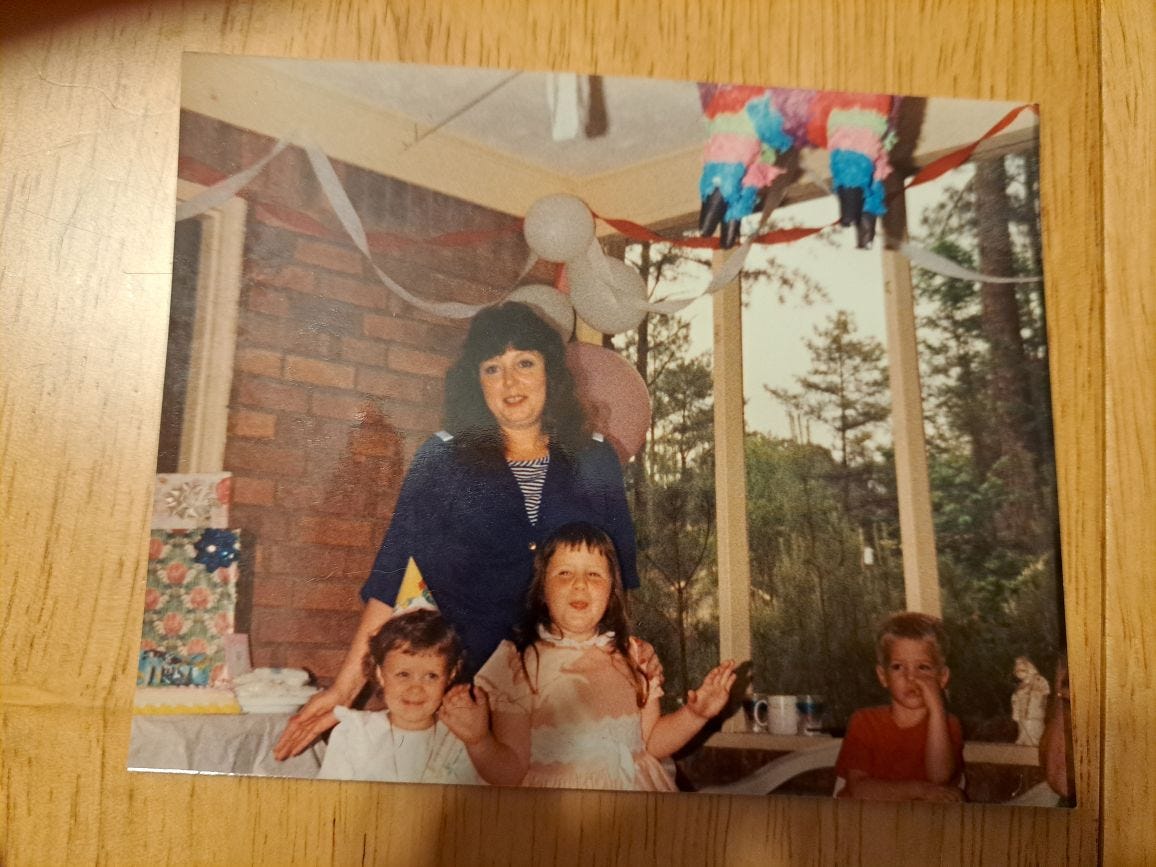
The truth is, though, even though that was maybe when I was eight years old, I have always been fat. No pictures exist of me when I was not fat. All photographic evidence points to pudgy, chunky, and fat, fat, fat.
In the 1990s, there was no such thing as body positivity. I could have benefited from some reassurance that my body wasn’t the insufferable and disgusting flesh prison that would make me unsightly for the rest of my life unless I was able to change it. But no, we didn’t have body positivity. We had a heck of a lot of fat shaming.
At 40 years of age, one of my earliest memories of bullying was in the fifth grade. Everyone was dressed up for an awards ceremony. My mom had me wear an outfit she called culottes, that consisted of a thing that kind of looked like a dress but also kind of looked like shorts? So, imagine a skort, but you have to wear it with the top, as they are combined.
This was no big deal for me, mind you. I’d worn such items before without any care or distress. I wore, basically, whatever my mom wanted me to wear, whether that be a green velvet dress that made me look like a creepy Victorian doll, or an oversized Lion King shirt that emphasized the rolls and the pudge. In saying, the honors ceremony and the day after should have been another day of wearing clothes.
If it had not been for the boy.
I don’t even remember his name now. If I met him today, I would not know who the hell this former kid was. But I remember his words. He told me, quite matter of fact, “You look like a whale.”
I was sitting or reclining on the floor, trying to read, no doubt, and he told me that I looked like a whale, perhaps making a “Free Willy” reference. I told him that wasn’t a nice thing to say, or maybe didn’t even say anything, flabbergasted that someone would say that, but absolutely certain that it wasn’t a compliment, because while whales are pretty cool, he had nothing good to say about them.
At my non-response, he followed up by saying that I should at least have a good retort. I couldn’t say anything, but I never wore culottes or a skort or anything similar since. My mother wondered why I didn’t want to wear them, but for some reason, I decided to never, ever tell her.
The Fat Body in the 1990s
The 1990s were not a great time for a fat girl to grow up. There was always the assumption, carried on from the 80s, I think, that if you were fat, you had built your body that way, yourself. Every doctor visit, my mother was told that I needed to lose weight. Every PE day, I was reminded and humiliated about how lacking I was physically, because I was fat.
It’s important to note that, in my mom’s household, food was not always readily available, and you got what you got when you got it. My mother was not a chef, and struggled to make anything remotely healthy. By the time my sister and I were able, we very quickly learned how to make frozen things in the microwaves, and I subsisted almost entirely off of Kids’ Cuisine TV dinners. (I would mix the chocolate pudding with the mashed potatoes.)
My mom usually had food stamps, but sometimes didn’t. She was embarrassed that she would have to pull out the little vouchers to get food, holding up the line a little. Usually, we ended up using what small budget she had left to eat, or going to churches and food banks. If she had a tax refund, we ate well, going to buffets and being told to fill up, because we might not be able to eat like that for a while.
Several times, we ran out of food completely, so my mom would switch her phone plan so that she could get a Blockbuster gift card, which she would use to buy candy and snacks for us to eat. That was desperation, but it’s not like you can do much about it as a kid.
So, I often found it interesting that I was shamed for wanting to eat school lunch, which I usually got free. At a certain point, in high school, I hid in the bathroom to eat a bagged lunch I made for myself, ashamed and frightened at the idea of being seen eating by people who would laugh at me. What they didn’t understand, was that I wasn’t even eating the massive piggy amounts that people assumed as a result of what they saw: the embodied me.
Fashionless Fashion for the Fat
In the age of heroin chic, fat girls did not get attractive clothes. Why would you want to even try to make attractive what could never even approach the mode? The fat body was useless, it was outre, it was Other. In middle school and high school, I kept to baggy shirts and jeans. Even when I made a pivot toward goth, I kept to this uniform, with the boxy and unflattering band shirts, and an incredibly unflattering heavy leather jacket that one of my teachers said reeked of smoke (my mom smoked cigarettes more than a chimney). Occasionally, for prom, I would try. The beautiful, Cinderella-style blue dress I wore for junior prom was one of the prettiest I’d ever had.
But even my mother, a beauty in her youth, she would always remind my sister and I, complained about the lack of choices for adult women at Walmart, for instance. Her body had changed after two pregnancies, and she often wore these very childish, very unflattering graphic tees that she found at Walmart or the thrift stores.
And she was cruel to herself. She modeled this cruelty to my sister and I, seeing in a mirror something that was slowly decaying, something that was not the self she cared about, the self that could attract, that could model. Instead, she was an aging fat woman.
We were, I believe, all three of us resigned to the fact that we would have to do the best with what we had, but what we had was really not very much. What we had was feast or famine eating, depression, and a certain level of body dysmorphia.
Embodied Fatness: The Body, the Blame and the Shame
Gym in middle school was shameful. I would never shower, would never undress in the locker room. I did not want anyone seeing this pale, naked, fat flesh. I hid in the bathroom stalls and quickly changed there.
In PE, we were expected to show feats of physical rigor. The rope with the bell was still a hopeless dream for me. I remember the gym instructor, who always looked and sounded like Sly Stallone, called some of the boys “pansies” for not wanting to do a thing. We were timed for running laps. We were pinched with calipers every now and again, and told how fat we were. I can’t imagine this was great even for the kids who weren’t fat.
But, like many (I found out later), I was blamed for being fat. I did not exercise enough. I should have upper body strength, should be able to do a push up. And every failing was one that was demonstrated before a crowd. Every push that failed was tutted and tsked as another failing of my fat body. After a while, the gym instructors kind of gave up, putting their hands on their well muscled hips and shrugging to themselves. She’s fat.
After a while, you grow used to this constant shame. Wherever you are, you realize how much space you take up, and you try, you try to take up less. For me, this was the social anxiety that made me the person who blends in with the wallpaper. I remained quiet and rarely sought out friends, even when I found them. And I was lucky to find them among different people. But I remembered, always, how much space I took up.
My own fatness was a disgusting burden that no one wanted to deal with, I reasoned after a while. I only once made an attempt to woo a boy in high school, but it fell flat, due to my own anxieties, and I never tried again. Fat girls didn’t get dates. Fat girls didn’t get happiness. Courtney Love could want to be the girl with the most cake, but that was OK, because she was thin.
A Revelation in the BDSM Community
For years, I hid myself through online interactions. In grad school, I learned that people do this in online (and have since the beginning). Online communication offers what they call a hyperpersonal element to it that in person does not. You can get to know someone in very, very intimate ways, but since you do not have to worry about certain cues and physical attributes, for many, this offers a place where they can hold back less, in a lot of ways.
I went to a women’s college in part so that I could specifically avoid having to deal with boys. I hated the fear that my fatness would offend them, that I would offend them by taking up space, and I was tired of their own issues, their loudness, their peacock-like preening.
It was at this college that I began exploring my incredibly complicated sexuality, online and usually alone. Carelessly, I had my first sexual experiences with a young man I met online, who went to a college in Atlanta. We had nothing in common other than our interests in dominance and submission, and I remember him critiquing some of the sketches I’d made and taped to the walls of my dorm room.
The first and only time we had sex, I received little enjoyment, merely waiting for it to be over, my large body and its flabby bits in motion ever present in my mind. The experience was a huge letdown, somewhat revolting, and led to me telling him I would not want to see him again when next I contacted him. I don’t even remember his name now.
And the online BDSM community, even in the early 2000s, made a premium on naked, thin flesh. I always thought that the men I spoke with online were imagining thin, sexy women as their cute submissive girls. Not the fleshy mass that was me. I am not completely ready to talk about all of that time in my life.
But I found that the local BDSM scene was different. In the year I participated, I found that most of the people there did not look like fetish models. No Dita von Teese here! Fat bodies were beloved, laid bare, and delighted in just as much as thin. It was a revelation to see so many different bodies displayed (or not) and enjoying each other.
And while my time with the BDSM community ended very badly (a story for another day), it was a revelation to see fatness juxtaposed with desire. People could be sexually attracted to fat people! People could find a fat girl like me hot! The idea was absurd, but I started to chew on it.
Fat Girl Goth: Reclaiming My Body
In the 1990s, a lot of women had weird rhetoric around fatness. Some would say, “Ugh, I feel fat” or titter about having a cookie and say, “I am gonna get so fat from this.” And when you called yourself fat, especially when you were fat, you were chided, “Oh hush, you’re not fat!” as though some ultimate final boss of fat existed to which you could be compared favorably. News flash: that didn’t help.
It wasn’t really until I started working at a grocery store that I started dressing for myself, really. Before this, I had ideas of aesthetic fashion. I often dyed my hair black in college. I dressed like Robert Smith in a black button up and red lipstick. I liked the comfort of androgyny, but hated that androgyny, too, looked better on thin women, like Annie Lennox and Grace Jones.
With my own disposable income for the first time, I learned that there were stores that catered to fat women with clothes that were actually flattering. For me, Torrid was a revelation! I bought from their clearance section, little by little, piece by piece, and began to dress the way I wanted to in the first place.
The clothes were not just fat copies of thin people clothes. No, they flattered the fat form, they enhanced the fat curves. These clothes were a gamechanger, and the person who stood against the wall, hoping to never be noticed, upped her fashion game.
Little by little, I returned to my goth roots, learning to take some of what I had learned from my Torrid pieces, and applying it to other thrifted items. And I stopped caring as much. I stopped dressing to blend it, dressing as a protest, as a dare. Look at me, look at me! I don’t give a fuck what you think!
Positivity: Where Do You Find It?
It took me forever to learn to live with my embodied self. I still spend times where I want to just veil the mirrors in black so I don’t have to look at myself. I see, along with my fatness, the subtle signs of aging: the dark circles beneath my eyes, the Sweeney Todd-esque gray streak running through my hair. I even give my breasts the stink eye sometimes, wondering if these too-small things are going to sag, if they are sagging.
We didn’t get body positivity in the 1990s. It was all how could you get thin, how could you be thin? To quote Depeche Mode: “Princess Di is wearing a new dress.” During that time, fatness was equated with moral failure. You didn’t do the workout. You ate too many cookies. Your exterior ugliness simply mirrors that within your soul.
And in the mid 2000s, I was thrilled to see a movement forming, to see the pushback. The body positivity movement started taking back beauty, taking back better mental health. So many people have suffered over body image, even in small ways. And the culture is not amazing about it. In truth, the criticism of my youth may always dog my steps, no matter how many times I belt out to Lizzo.
With the obsession over “obesity,” the new derogatory term for fat, it can still be difficult to get the doctor to listen, can still be difficult to explain. Some of us just can’t lose it like that, some of us don’t have a thin woman inside of us, waiting to get out. Some of us have always forever and ever amen been fat.
This is not to say that you should never try to exercise or eat better things, but I’ve never had that count meaningfully unless I starved, and I can tell you that starvation is absolutely not healthy.
I can’t tell you that I’ve learned to love myself. I rather hate myself, even on my good days. But when I started dressing for myself and my own aesthetic, I started to see myself through other people’s eyes, as someone who can look “iconic,” as someone once told me in passing at Walmart. Maybe this flesh prison isn’t the worst.
The revelation of receiving compliments in my 40s from young people (by the way, you young people are really some of the best—keep doing what you do, because you are killing it!) was a gamechanger for me. I think we will all find those moments in our own body image journeys. Please don’t ever give up on loving yourself, though. It can be the world’s most difficult task, but even a little love is good love.
I would like to keep my Substack free, but I am a professional writer. Should you find yourself in the mood, please consider leaving me a tip on Ko-Fi.
No posts
Comments
Nothing yet. Say the first thing.
Sign in to join the conversation.