
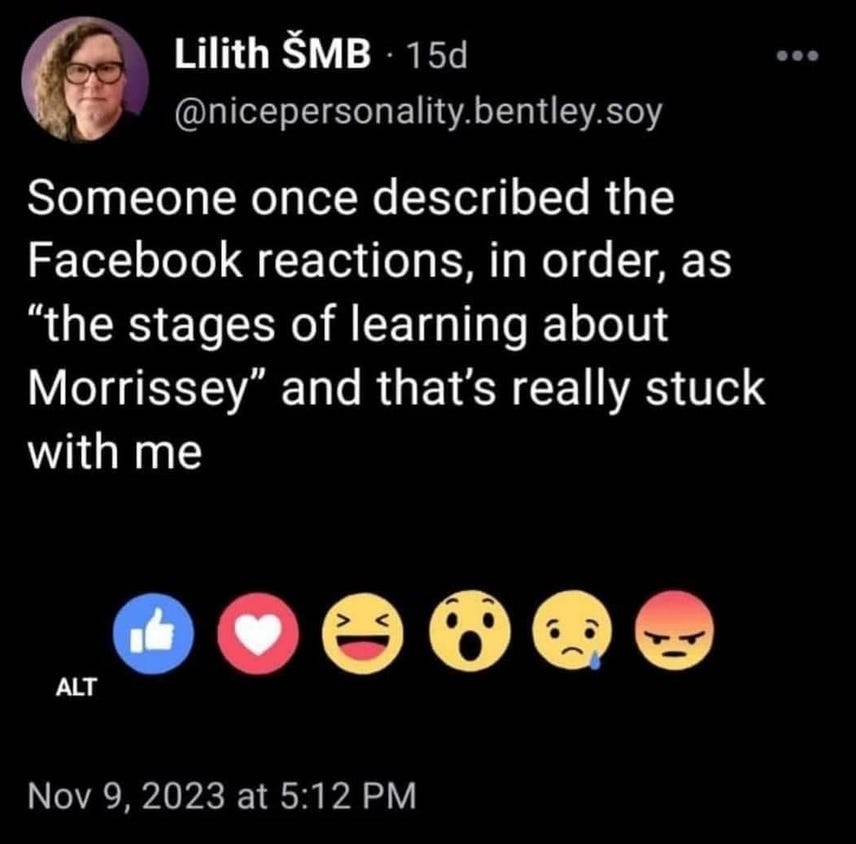
I’ve been thinking about this a lot over the past decade or so, though to be honest, it plays into a problem I’ve discussed elsewhere.
As an undergrad 20 years ago, I had a musical awakening. Let me explain.
I grew up picking and choosing from a somewhat limited selection of music as a young person. I picked from my mom’s obsessions with Enya and Otis Redding’s “Dock of the Bay.” I chose from my grandma’s Beatles tunes she would play when she drove us around the few times she collected us to stay with her. I selected from what I heard at the grocery store and the radio. The internet was not a thing for us then, the working class nothings of the 90s.
As I entered middle and high school, my choices widened, and my taste became my own. I discarded the boy bands of middle school, emerged from Hanson, and encountered the rebellious tones of Green Day and Harvey Danger’s “Flagpole Sitta” (the anthem of late middle school). My cousin, who recommended Animal Farm to me, also introduced me to the cacophonous Hole, to Billy Idol, and to a new rebellion.
In high school, obsessions with the Buffy the Vampire Slayer’s velvety goth soundtrack turned into curiosity for the “alternative” genre. Rage Against the Machine, Nirvana, and Nine Inch Nails entered my rotation, along with the introduction to Atlanta’s hallowed alternative radio station, 99X. I took what I wanted, capturing what spoke to me, gathering lyrics, melodies, and philosophies into an internal radio.
But again, there were limits. I knew what I heard on the radio and saw in music videos that the poorer sorts watched from the brief-running station, The Box. Slowly, I learned about the origins of New Order through the Marie Antoinette film, for instance. To reiterate, the internet was not as ubiquitous as now, nor was there really a digital format outside the CD that was available for the masses.
A Music Awakening with the Maudlin
College offered me another education altogether. Myspace, a platform centered around music, opened up the world to more and more variety. I also had the pleasure of expanding my personal canon through the recommendations (and burned CDs) of my friends. Finally, the post-punk and goth scenes hit me hard. The Cure, The Sisters of Mercy, Siouxsie and the Banshees . . . This only led to further adventures with Joy Division and Bauhaus. And The Smiths.
Young adulthood is a time of discovery. You truly start to find and solidify your identity. For many, this pivotal time of identity and discovery transitions to something else altogether. Many of my peers have moved on with PhDs, marriage, very different jobs, etc. Some who were interested in women (at a women’s college, mind you) ended up with men. But the traditional college experience offers a sort of experimentation, and a freedom.
During these years, I experimented with my own odd sexuality, delving a little too deeply into the online world of BDSM. Coming to terms with a bipolar diagnosis, I suffered from the euphoric highs that created the setting for some of my less-than-finer moments, and the dreadful, painful lows of the longer depression that would follow.
An introduction to The Smiths, though, helped me better understand my strange sexuality with the limited means I had available. In The Smiths, hailing from the dreary Manchester, UK, you have music that is decadently depressing yet clever and incredibly life affirming. The singer, one Stephen Patrick Morrissey (eccentrically known only by his last name) mixes coyness, literary quips, and a sense of almost cheerful melancholy in his lyrics.
This juxtaposition of the painful with the playful felt so insightful to someone who never went on a date in high school, and attended a women’s college in part to avoid that world. Morrissey, a man who proclaimed celibacy, despair, and queerness with ease, became a newfound friend to me.
Insights from The Smiths: The Human Condition Explained in Music
When I started out listening to the band’s self-titled debut (1984), Johnny Marr’s very melodic yet melancholy guitar formed the background on which Morrissey was able to paint such empathetic lyrics as:
Fifteen minutes with you,
Oh I wouldn’t say no
Oh people see no worth in you
Oh but I dofrom “Reel Around the Fountain”
Conversely, the album conveyed a Wildean playfulness, with the puckish frustration of “You’ve Got Everything Now,” in which the speaker explains why he’s never had a job with various excuses, never pinning down a logical one, and proclaims “I don’t want a lover, I just want to be seen in the back of your car.” In “This Charming Man” and “Hand in Glove,” Morrissey once more engages in this cagey and queer playfulness, more than hinting at gay themes, yet refusing to be fully defined by the label of gay.
For someone who assumed the cloak of heterosexuality for myself as default, but had no words for what I was, there was power in listening to someone who was definitely different, definitely queer, but who rejected any of these labels, rejecting sex entirely (at least publicly). Morrissey was a personal revolution on his own, unwilling to bend himself into anyone else’s boxes, and gleefully undermining any attempts to try to place him there.
This cheerful commitment to indulging one’s feelings, even if they were of a dreary sort, really defines the catalogue of The Smiths, especially in the first album. The rejection of sexual norms, the landscape painting of a desolate, gray day in a post-Industrial town—it is a music that drags you down but never drones.
Meat Is Murder: A Gentle Interpretation
A young person who felt things more strongly than others, I spent the first semester at Wesleyan working in the stables to be away from people and near animals I wanted to get to know. It was a delight to sing to and feed horses that I would never ride.
In middle school, I was hit by a very intense disgust for eating pork and beef. Growing up poor, we had limited choices as to what we ate, but at 12 or so, I began examining why I continued to eat beings that were not dissimilar from me or my aunt’s dogs. I considered how closely related we were, and I ended my affair with eating cow and pig, never returning.
Discovering The Smiths in the early 2000s, I felt a solidarity with Morrissey when he proclaimed the slaughter of a cow was “a death for no reason, and death for no reason is murder” in the eponymous song from the album Meat Is Murder (1985). The album, which came out the year I was born, ends in the aforesaid song, a difficult listen with ominous electrical slicing sounds mixed with bovine cries.
The slogan became a cry for the animal rights organization People for the Ethical Treatment of Animals (PETA), and vegetarians and vegans alike during the 1980s and 90s. The words took on a mockery, as many who indulged in carnivorous activities considered the cry to be a cry of extremists and those who were too, too sentimental.
Morrissey for years championed vegetarianism and veganism, remaining a very loud voice in the anti-meat movement (sometimes in problematic ways). In his Autobiography, published under the Penguin Classics imprint, he describes subsisting on toast and jam as a child, as he could keep down very little else. Infamous incidents of his refusal to perform if meat is involved in concessions, and his continued involvement with PETA, a controversial organization in their own right, have done much to frustrate and alienate portions of his audience. More on that later.
But for me, I imagined a person who was so sensitive that he could not imagine doing harm to a cow for cuisine. Having seen the abuse and killing of animals for sustenance as problematic for years, I thought, in some respects, that he was me in a few years: a complete vegetarian who cared.
I took up complete vegetarianism after working a few years in a grocery store. I gradually erased poultry, then seafood from my diet, unable to bear the thought of hurting another living being for the sake of my palate. I, too, had difficulty eating most foods as a kid, and at 40, I find different frustrations with eating. However, not participating in the factory farming industry (to a large amount), has helped me sleep at night.
One of my favorite pictures of me during that time is a picture where I am holding a petting zoo chicken, who fell asleep in my arms. It was a church function and I rarely felt so connected as I did with this stressed out little bird. That she fell asleep in my hands was, to me, a joy, giving me my own peace in turn.
In Morrissey I thought, at first, that I had found a companion who understood this sympathy with others, and with the world in general. Someone who would lovingly hold a chicken, and who would understand the sufferings of humanity as a whole.
The Queen Is Dead: A Morose Anti-Monarchical Rebellion
The Queen has been dead for a hot minute, as we like to say in Georgia. But in 1986, when The Queen Is Dead was released, she and Margaret Thatcher were still alive and kicking. The album starts with the searing title track, in which Morrissey very vividly depicts a fantasy of slipping into Buckingham Palace and “unaliving” the monarch.
It’s another disturbing listen, that provokes anger and indignation. Listening to it a few months ago for the first time in a few years renewed that anger in me, in light of the current political situation in the United States. The idea of assassinating a leader in such a visceral way can translate to assassinating an ideology that needed to die. As Nietzsche said, “God is dead, and we have killed him.”
Morrissey echoes this very philosophical idea of what to do after you’ve killed a god or an ideology:
The Queen is dead, boys
And it’s so lonely on a limbfrom “The Queen is Dead”
And once more, Morrissey defies any attempts to define him. His hatred for the monarchy is as outspoken as his veganism. In interviews over the years, he contended that he hated how the British monarchy wasted the taxpayers’ money, living off the largesse of the public. His hatred of the monarchy led him, in part, to his emigration to California.
And while The Queen Is Dead starts on this very vicious foot, the album combines the maudlin tunes of the self-titled debut with the activism of Meat is Murder into a more mature concept album which, even outside of itself, perfectly conveys the voice of a time and era.
Even though the title track hits like a ton of bricks, in this album, The Smiths hit their lyrical finest with “I Know It’s Over” and “There is a Light That Never Goes Out.” The former drudges on as the speaker starts with the line, “Oh mother, I can feel the soil falling over my head,” evoking an image of a grave of one’s own making. It is the song for the rejected and the lonely:
And know it’s over, still I cling
I don’t know where else I can go
Over and over and over and over
Over and overfrom “I Know It’s Over”
The song transitions into a self-recrimination, with the speaker mocking himself, his “triumphs and charms,” and concluding with, “Love is natural and real, but not for you and I, my love.” The refrain from the beginning reiterates the heartbreak in the end, the impotence that flavors this self-lamentation.
And it’s relatable as hell. The feeling of inadequacy, the malaise, that comes with failing, with not being able to measure up to an ideal, real or imagined. And the feeling of loneliness, despite wanting, yearning to reach out. I related to this and returned to this song over and over, for years. This mood of inadequacy is something I’ve never found captured as well in any other song.
The penultimate song in The Queen Is Dead probably sums up The Smiths, and people’s ideas on The Smiths, better than any other in their catalogue. “There Is a Light That Never Goes Out” presents an almost Freudian view of love: Eros and Thanatos combined. And while many would suggest that it’s absurdly depressing to concoct a song around a highway love-death, I contend that this song is not depressing, but euphoric in nature.
And if a double decker bus
Crashes into us
To die by your side
Is such a heavenly way to die
And if a ten tonne [sic] truck
Kills the both of us
To die by your side
Well, the pleasure, the privilege, is minefrom “There Is a Light That Never Goes Out”
The speaker pleas, “Take me out tonight, take me anywhere, I don’t care, I don’t care.” The idea, the hope, is for the speaker to be with the beloved. The desire is to spend time in the presence of someone one appreciates on a deeper level, when one feels as though one has no place in the world, no home, no reason.
And to have a person in one’s life, whether a friend or romantic partner, whose presence is so healing that you don’t really care what else happens, is a true source of happiness. The hyperbole in the song feels very intentional. The “Pope of Mope” seems to respond to critics’ efforts to pin down The Smiths as self-indulgently depressive. He seems to say, “I can indulge more, if you’d like. Though it doesn’t really matter what you like.”
It was this contrarian commitment to evading labels and affiliations from gay to depressed that inspired me to stick with Morrissey a little beyond the limits of reason.
The (Many) Frustrations and Disillusionments of (and from) Morrissey
And this is where it gets really frustrating. I started off with The Smiths in 2005, well after they disbanded in the late 80s, and well into Morrissey’s solo career, with his arguably last relevant album, You Are the Quarry (2004) released a year earlier. I had been so happy to encounter a person who eschewed the labels we use for sexuality, seemed to reject sex altogether, and danced with a bouquet of flowers in his pocket. William, it was really nothing.
But unfortunately, one of the key factors that drew me into listening to The Smiths and into Morrissey as an icon, also played heavily into my breakup with the solo artist.
Morrissey’s politics were, at first, difficult to pin down. In The Queen Is Dead, he very intently laid down his feelings on the British monarchy. These feelings seemed akin to those of the punk movement before him, such as the Sex Pistols’ subversive “God Save the Queen.” Surely, even if he wasn’t leftist, he had similar causes in mind.
Unfortunately, in his body of work, Morrissey decided to write such songs in his solo career as “The National Front Disco” (Your Arsenal, 1992), which many of us thought was meant to be a mockery of the ultra-right wing party in the UK. He refrains, “England for the English,” then sings that the main character, David, has gone to the “National Front Disco.”
As the song progresses, you learn that David is an immigrant who wants to assimilate, and is attending this right wing disco in order to do so. We could assume that the mockery is on the right wing group, that the song is meant to be tongue in cheek, but upon later readings/listenings, we get the idea that maybe immigrant David is the butt of this joke. And it isn’t funny anymore.
This is not the first time a disco and racism are linked in Morrissey’s work. In his time with The Smiths, Morrissey penned the song “Panic,” from which the band Panic! At the Disco’s name stems, in the compilation, Louder Than Bombs (1987). The song describes “panic on the streets of London, panic on the streets of Birmingham” and a general feeling of a lack of safety:
Burn down the disco
Hang the blessed DJ
Because the music that they constantly play
It says nothing to me about my lifefrom “Panic”
While, again, the song may seem tongue in cheek (who hasn’t had to endure music they hate?), the origins appear to be, on a closer reading, more racist in nature. The 80s not only gave birth to the post-punk and goth genres, but were also a fertile time for the origins of hip hop. And just like your racist auntie who complains, “I can’t stand that rap crap,” Morrissey, who formerly wrote for music magazines, disdains having to endure this music as well.
However, he takes the annoyance with the different music a step further, by imploring that one should “hang the DJ,” a refrain which is repeated over and over, with a chorus of children, in the song. And while we could pass off the refrain as a play on the British idea of traditional capital punishment, many of us know that there are very specific people who were specifically treated to the noose by mobs in a panic, and their backgrounds more than overlap with the backgrounds of people who would have DJed hip hop in the 80s.
As Morrissey progressed through the 90s, his worldviews began to unfold and become clearer. He wrote a song called “Bengali in Platforms,” in Viva Hate (1988), his debut as a solo artist. He ridicules, once more, the idea of an immigrant attempting to assimilate into a “national” dominant culture. In You Are the Quarry, he writes a song that bizarrely romanticizes a Hispanic gang member, adopting a rather large (and frankly puzzling) following in the Latinx community.
It becomes clear that Morrissey is difficult to work with, and that his animal rights activism precludes any for human rights. He publicly complains about being kicked from record labels, eschews his own concerts to such a degree that there is a running joke about it in the music community, and whinges for 75+ pages of his Autobiography about his feud (and legal battle) with former Smiths bandmate Mike Joyce. After a certain point, we all realize that Hell will definitely freeze over before we get a Smiths reunion.
One of Moz’s most noteworthy discourses on the nature of racism and vegetarianism includes his infamous remark that “the Chinese” are “a subspecies,” because there are parts in China where people consume dogs. China, if you don’t know, is a very large country, and the consumption of animals Westerners would consider pets is not as common there (or anywhere) as Morrissey would like you to believe. But that’s run of the mill racism for you.
And there is a litany of commentary that Morrissey has made over the years, indicating his preference for far right and unpleasantly extreme views. Ironically an immigrant himself, to the United States, the world is now treated, from time to time, to Morrissey’s politics and hatred of the non-Morrisseys of the world.
This, of course, is not to mention his fatphobia, which was clearly conveyed in his “hilarious” treatment of women of size in “Some Girls Are Bigger than Others,” a song drafted with exquisite guitar by Johnny Marr, but pooped on by Moz with lyrics such as, “I have just discovered, some girls are bigger than others.”
As a solo artist, he made sure his views on fat women were clear (if you couldn’t tell from “Some Girls” and “William It Was Really Nothing”) with “You’re the One For Me, Fatty,” the video of which shows images of an actress of size in stereotyped and unflattering display. The idea that any man enamored with “a fat girl,” is very silly, if not a little delusional. As a woman of size, this never sat well with me, and is definitely (and unfairly) minimized in Morrissey’s long list of sins.
Strangeways, Where Do We Go?: Coming to Terms with the Morrissey Paradox
And this is the Morrissey Paradox, one that the goth and alt communities have had to contend with for well over 20 years. Some of us got out of it earlier than others. But most of the goth community finds at least a certain discomfort with Morrissey, and you could say that he’s been blacklisted by many of his former black-clad followers.
But the Morrissey Paradox is not just, “Where do you go when someone who makes things you don’t like is a dick?” The Morrissey Paradox is this:
How can someone who seems to understand the human experience and empathy so well seem to lack empathy and care for others, as a person? —The Morrissey Paradox
This is the paradox of Morrissey: the person that you admired in your youth, whose words wrote your soul, painted its nakedness on a canvass so beautifully, is also frankly a professional asshole. And this is the tragedy of learning more and more about Morrissey, to the point where you end up just waiting for the next cringe thing he will say, or unfollow him completely so that you won’t have to squirm.
There are some who have said that they pretend Moz died in the early 90s. The seemingly earnest young singer of The Smiths spoke to them. The solo artist of the many opinions did not. Whatever gets you to bed at night.
Morrissey, artist and man, emphasizes a very modern problem: what do you do when someone who creates beautiful things is also a horrible person?
New Criticism and When to Cancel
I’ve spent decades figuring this out as a student, as a music listener, and as a person. When I studied literature as an undergrad, I very closely aligned myself with the New Critics, who asserted, with T. S. Eliot, that you could not (and should not) equate the work with the artist. “Authorial intent” was eschewed. I mean, it’s not like you can bring back Dante Alighieri and question what he meant in that line in the “Purgatory” part of The Divine Comedy. And, New Critics would argue, often the author could not tell you. The work transcends the author.
And frankly, this is a good baseline for reading literature or listening to music or viewing art. You shouldn’t get yourself too caught up in the creator’s biography to get something from the work. You can, in your own reading, get something out of a work for yourself, even if it’s very different from your own worldview. Like reading Dostoevsky in the 21st century and getting a better understanding of the importance of reform of the prison-industrial complex.
However, there are limits to this. You can’t read from a void. In order to understand Crime and Punishment, you should have a basic grasp of the time period, late 19th century Russia, and perhaps even a little of Dostoevsky’s biography (trust me, it’s a doozy). Otherwise, you simply aren’t going to understand much of the content in the work. It’s the reason we were encouraged to look up words we didn’t know. And now you can do so in a much, much easier way.
I am going to go there, but if you read Mein Kampf without knowing anything about Adolf Hitler, you might consider it just another incoherent manifesto, or (if you’re an asshole) you might get your cutely racist views from it. You can’t completely separate the painting from the painter (and Hitler was an infamously shitty painter).
In saying, I think it’s important to understand your personal values first and foremost, as well as their limits. For instance, Charles Dickens was also a professional asshole (oh boy was he ever). I am not supporting his lavish lifestyle by occasionally cracking open A Tale of Two Cities. He’s been dead (as a doornail, he would say). And his assholishness is not central to the literary value of his work.
With someone like Morrissey, however, or Gaiman, or Rowling, all three are living and receiving a living from those who support them. And while all three created something that mattered to me at certain times in my life, I choose to place my support elsewhere.
This does not solve the paradox of someone who is a professional asshole seeming to understand some very intense things about the human condition, etc. But we all, to some extent, will not live up to our own values, and will contradict them in more than one way over the course of our lives.
In the end, however, the empathetic thing to do, is to remove your support from someone gaining a living and profiting off something abhorrent. It is the thing that the specter of Morrissey I imagined in the songs of my youth would have invited me to do. We’re all fallible. This is human existence. But we are none of us required to condone a person who chooses racism, fascism, sexism, or any other thing we want to speak against. In the current world, money speaks louder than bombs.
Do I miss that ghost of the Pope of Mope? There is something in me that longs for that sensitive friend he portrayed, to get that happy period of my life back. To ease the loneliness that even now creeps up on me occasionally. But I do not mind throwing the soil over the head of a disgraced idol.
No posts
Comments
Nothing yet. Say the first thing.
Sign in to join the conversation.