
Economists describe the U.S. Consumer Price index or CPI as a lagging indicator because it reflects the effects of past conditions rather than predicts what comes next. Still, like a caregiver’s thermometer, it is an essential tool for measuring the economy’s temperature. Central banks and businesses use it for inflation tracking, income adjustments, and economic policymaking.
The CPI received a major overhaul in 1978 in response to the devastating global energy crises and supply shocks of the 1970s. As aggregate prices soared, policy makers needed more detail on energy commodities and services and how they impacted Americans’ living costs. Now, with nearly a half century of data on how the economy responds to energy shocks, we are better prepared for what is being called one of the greatest economic threats since the Great Depression.
In what follows, we examine how the Strait’s closure is already affecting the CPI energy index. The initial price shocks have been significant, but the greater risk is that they spread through the broader economy. If a second wave of inflation takes hold, a temporary energy spike could become a more persistent cost-of-living crisis. The central question is how far these pressures have already moved beyond energy, though future CPI reports will be needed to measure the full extent of the spread.
The country’s current inflation reading
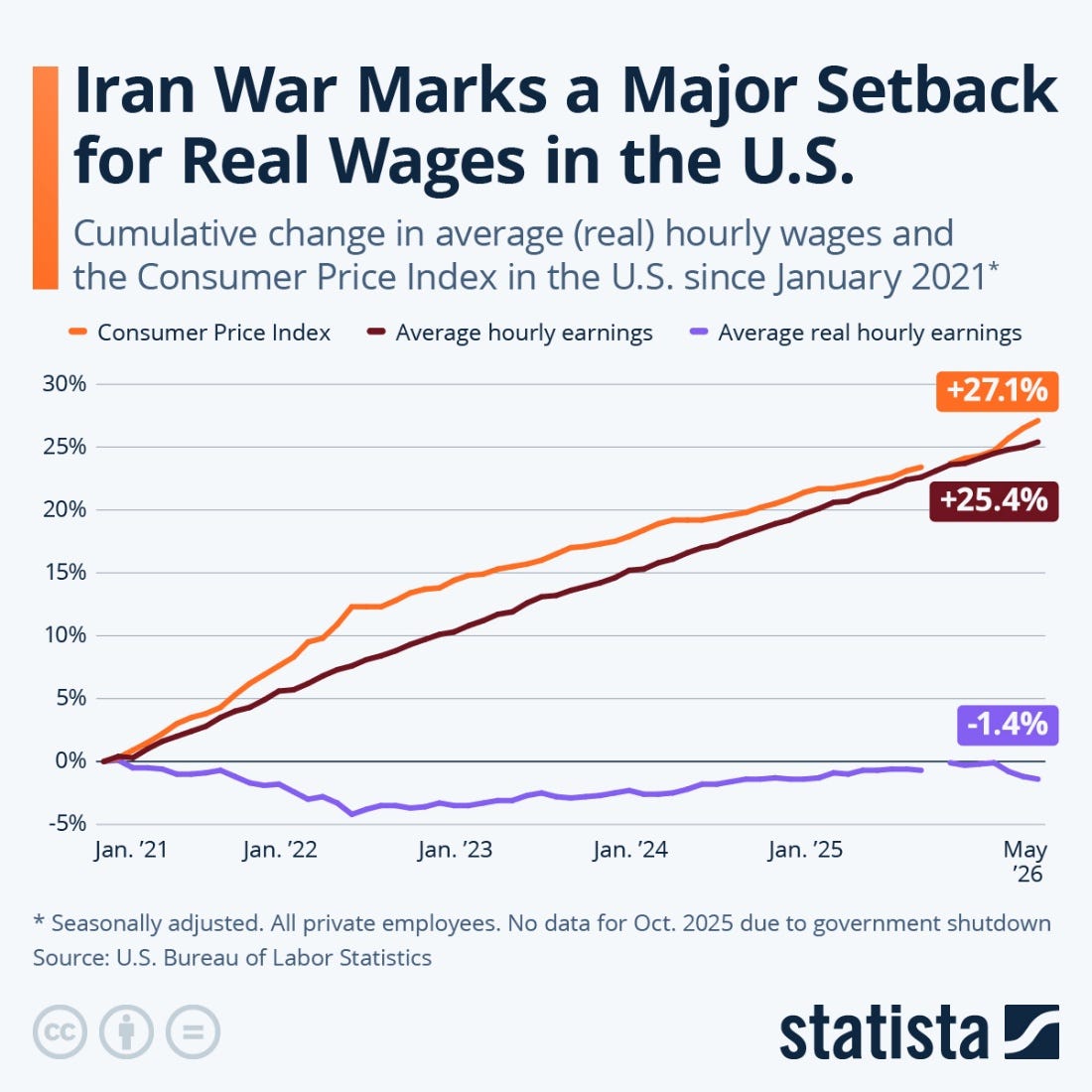
The CPI released on June 10, 2026, showed year-over-year inflation at 4.2%, the highest level in more than three years, with much of the increase attributed to energy. The figure below highlights the nature of the threat to American pocketbooks. Since COVID-19, Americans have been working to regain the purchasing power they had earlier in the decade.
Just as that goal seemed within reach, renewed inflation seems to be taking hold. Nearly half of the recent increase occurred in the past three months, suggesting that supply disruptions in the Persian Gulf are producing the effects economists had warned about. The June CPI report shows that gasoline, diesel, and heating oil had the largest immediate effect on U.S. inflation, with year-over-year prices surging 40.6%. As the figure indicates, a dollar of earnings has lost all the purchasing power gained in the last four years.
Why price declines may be less predictable than advertised
The closing of the Strait created a simultaneous and unprecedented shock to global energy, agriculture, and industrial supply chains. A successful and lasting reopening will require immediate attention to physical and diplomatic barriers. The former will require neutralizing Iranian naval mines and untangling the shipping logjam. Production must resume where possible and the multiyear effort to repair plant and equipment begun. There also will be the task of restoring physical inventories which are currently at historically low levels.
On the diplomatic front, the challenge is to ease fears of renewed fighting in the Gulf, because producers are unlikely to restore pre-war output while the region remains a tinderbox. A U.S.-Iran cease-fire could create an opportunity to strengthen regional security pacts built around collective deterrence.
Then there are the market realities that govern how quickly prices move. That price surges came so soon after the Strait closure comes as no surprise. Oil trade takes place in a highly developed global market where prices adjust quickly worldwide. Bad news in the Persian Gulf can show up overnight on the marquee at the neighborhood gas station thousands of miles away.
How rapidly prices fall in the face of good news is another matter. Retailers may have raised pump prices quickly to reflect higher replacement costs, but they are likely to lower them more slowly as costs fall, as they try to retain profitable margins on fuels bought at lower prices.
For all of these reasons, the President’s claim that prices at the gas pump will rapidly decline to pre-war levels once the hostilities cease should be treated with caution. The U.S. Energy Information Administration (EIA) indicates that energy costs could remain elevated well into 2027. Even if oil shipments through the Strait resume this summer, EIA believes that traffic will likely take several months to return to pre-conflict levels. Those with a stake in the international oil market will be watching closely for progress in easing long-standing geopolitical tensions, removing supply bottlenecks, and ensuring a sustained period of ample, uninterrupted production.
But it is not enough for crude oil and refined-product prices to fall; they must also align with physical supply and demand. Speculators in futures markets, if unfettered to market fundamentals, may place unreasonable bets in either direction. We are reminded of the term “irrational exuberance”, famously coined by the late Alan Greenspan to describe investors oblivious to real world realities. In a rising market, speculators may seriously overshoot estimates for the high. Likewise, in a falling market, they may fail to recognize the floor. The good news is that prices tend to realign with spot-market realities within weeks. Nonetheless. episodes of mispricing should be expected.
A second wave of inflation may await
More worrisome for the overall inflation rate is the threat that higher energy prices ignite a second wave of inflation, as higher fuel costs spill over into the broader economy. By raising extraction, processing, and transportation costs, energy prices make non-fuel commodities more expensive. Businesses then pass those higher costs through the supply chain, pushing up prices more broadly and adding to inflationary pressure.
Petroleum products are also key inputs into other goods. When crude oil prices rise, the cost of everyday items such as aspirin, compact discs, clothing, diapers, food packaging, and prescription drugs rise as well. In short, the Strait disruption may have affected prices across thousands of products.
Similarly, natural gas is a key input to nitrogen fertilizers, essential for maintaining global grain supplies. When the Russia-Ukraine war sharply decreased grain supplies, it boosted demand for U.S. wheat, corn, and soybeans resulting in increased inflation in food products. A similar pattern could emerge in the aftermath of the current disruption of gas and fertilizer supplies from the Gulf, driving up the prices of grains in international markets and, in turn, domestic grocery bills.
If these secondary effects spread through the global and U.S. economy, more retailers will face higher operating costs which they will be forced to pass on to their customers. If inflation persists, central banks may keep interest rates high or tighten further, increasing borrowing costs. A Hormuz closure could turn an energy shock into broader long-term inflation while at the same time stoking fears of an economic slowdown as American pocketbooks feel the pinch.
Concluding comments
The Trump Administration’s repeated claim that gas prices will quickly return to pre-war levels once hostilities end may be overly optimistic. The President’s prediction that prices will “drop like a rock” overlooks serious physical, diplomatic, and market barriers that could slow the decline. The U.S. Energy Information Administration suggests that even if all goes as planned, it will take several months for production to return to pre-war conditions
Because today’s food supply chains depend heavily on petroleum and natural gas – from production through processing and distribution – food inflation often trails energy inflation. As higher energy costs spread through the economy, the next wave of core (excluding food and energy) inflation, could prove much harder to reverse. How much of this has already occurred remains unclear, but in the months ahead, the Federal Reserve Board will be watching the CPI closely for warning signs. Until then, it may be wise to postpone buying that new gas guzzler.
____________________
Richard Richels was lead author for multiple chapters of IPCC studies in areas of mitigation, impacts and adaptation.
Henry Jacoby is William F. Pounds Professor of Management (emeritus), M.I.T.
Kristie Ebi is principal in ClimAdapt, LLC.
Gary Yohe is the receiving agent of Gary W. Yohe, LLC and Huffington Foundation Professor of Economics and Environmental Studies (emeritus), Wesleyan University.
No posts
Comments
Nothing yet. Say the first thing.
Sign in to join the conversation.