
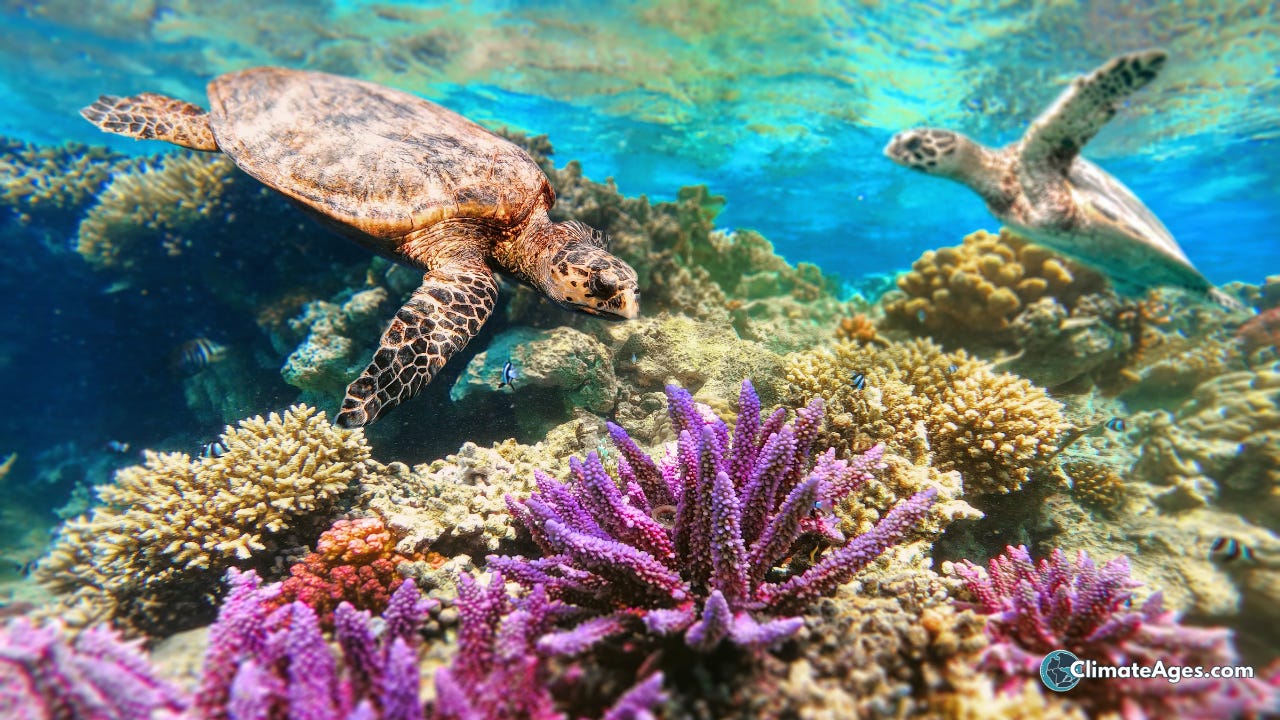
For years, when scientists talked about ecosystems that help store carbon, the same environments usually came up: mangrove forests, salt marshes, and seagrass meadows.
The logic was easy to understand. These ecosystems trap large amounts of dead plant material in muddy sediments. Because oxygen levels are low in those sediments, decomposition happens very slowly. That means the carbon inside leaves, roots, and other organic matter does not quickly return to the atmosphere as carbon dioxide. Instead, it stays buried and gradually accumulates over centuries. In some places, for over thousands of years.
Coral reefs never seemed to fit that model.
They are not muddy wetlands filled with buried plant material. They are bright, wave-exposed ecosystems built by animals that constantly grow, break apart, dissolve, and rebuild. For a long time, many scientists viewed reefs as places where carbon moved rapidly through the system rather than places where it stayed locked away for long periods.
In fact, coral reefs often seemed like an awkward fit for the idea of long-term carbon storage. Corals build reefs by producing calcium carbonate, the same material found in limestone and seashells. But this process also releases carbon dioxide into seawater. For decades, scientists debated a surprisingly basic question: are coral reefs net carbon sinks or carbon sources?
The answer turned out to be complicated.
Some reefs absorb more carbon through photosynthesis than they release through respiration and calcification. Others do the opposite. Some switch between these states depending on temperature, water chemistry, storm activity, or the health of the ecosystem itself.
This debate shaped how scientists thought about reefs for a long time. But slowly, another question started emerging underneath it:
What if we were looking at coral reefs too narrowly?
Because reefs are not just corals. They are giant living systems built by thousands of species that interact with one another constantly. Fish graze on algae, corals build structures, microorganisms recycle nutrients, sediments accumulate over time, predators reshape food webs, and even fish waste becomes part of the ecosystem’s chemistry.
Once researchers started paying attention to those interactions, reefs began looking less like static rock formations and more like dynamic carbon-processing systems.
That shift in perspective helps explain why a new study from the South China Sea is interesting. Not because it suddenly proves coral reefs are perfect climate solutions, but because it adds another piece to a growing realization that reef ecosystems may store and move far more carbon than scientists once appreciated.
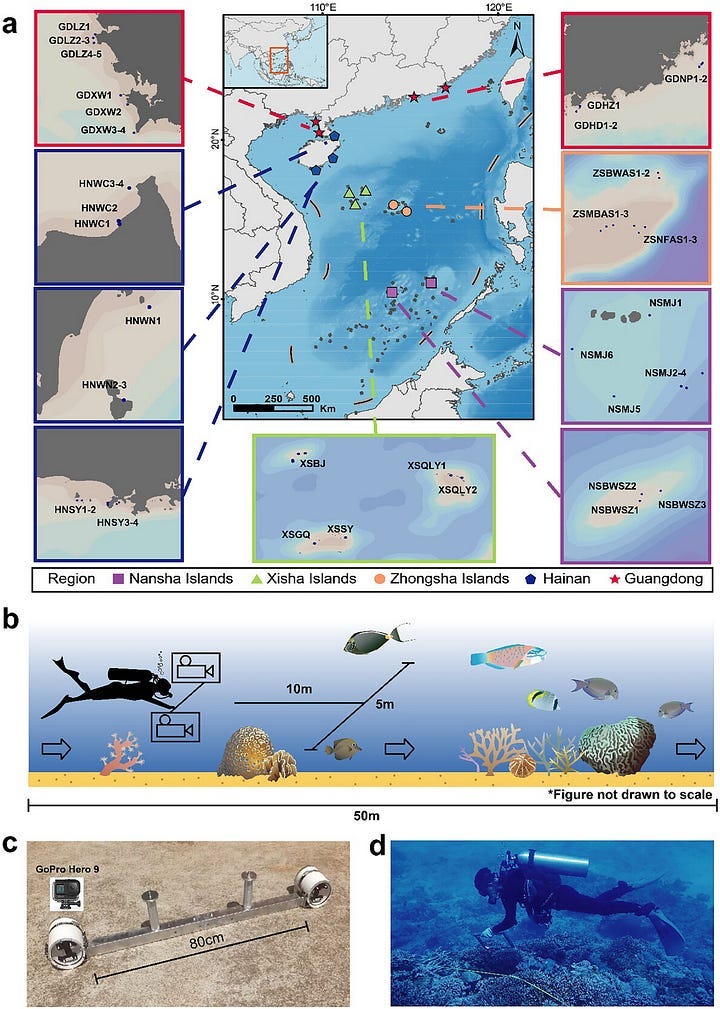
The researchers surveyed 17 coral reef systems across the South China Sea using underwater video systems, coral measurements, sediment sampling, and fish community analysis. Their goal was not simply to ask whether reefs absorb or release carbon overall. Instead, they tried to estimate where carbon is physically stored inside these ecosystems and how reef organisms help move it around.
The results point to something important.
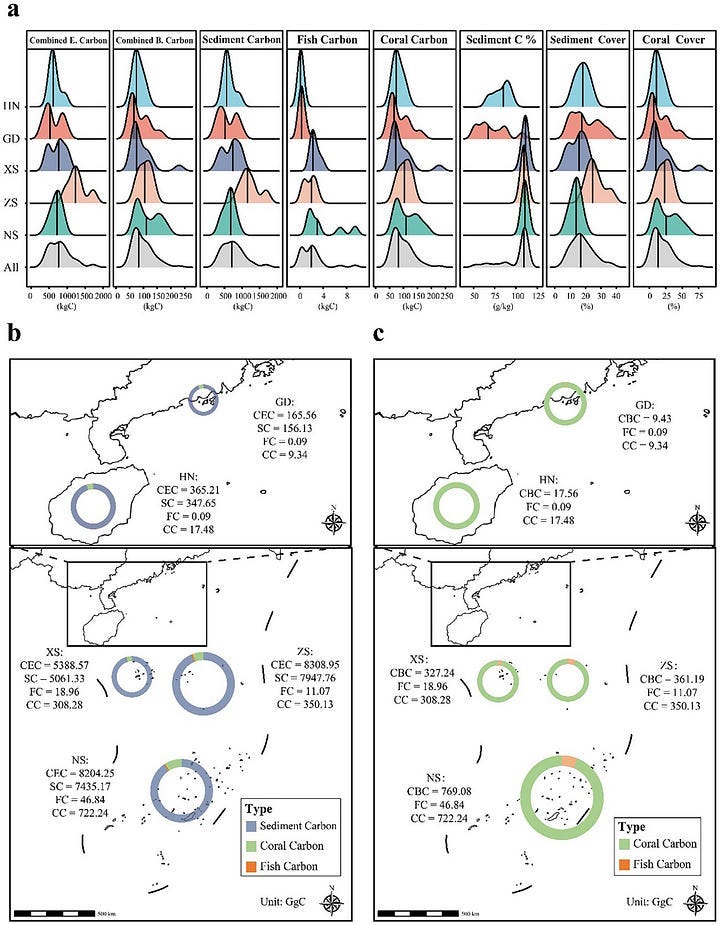
Most of the carbon in these reefs was not stored in fish or coral tissue. It was stored in sediments lying on the seafloor. More than 90 percent of the estimated carbon reservoir existed there.
That part may sound familiar because many coastal ecosystems work this way. Sediments often become long-term storage zones because material accumulates faster than it breaks down. But the more interesting part is how reef organisms help maintain that reservoir.
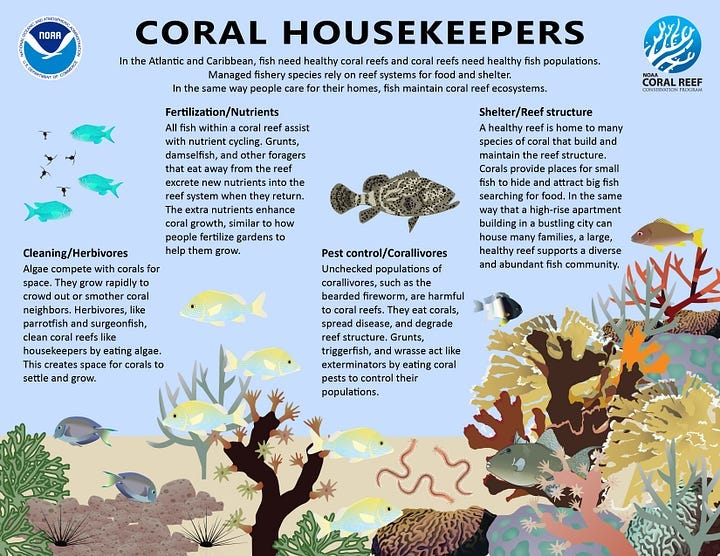
Imagine a coral reef fish scraping algae from a reef surface. That may seem unrelated to carbon storage at first glance. Yet some reef fish, especially parrotfish, constantly grind bits of coral and algae into fine carbonate sand as they feed. Over time, that material settles into reef sediments.
In other words, fish communities help transport carbon-rich material into long-term sediment storage.
The study estimated that reef fish communities move hundreds of grams of carbon per square meter into sediments each year through processes like bioerosion and excretion. That does not mean fish are “capturing carbon” in the way forests are often discussed. The process is different. But it does mean reef animals actively shape how carbon moves through the ecosystem.
This idea has been building for years in reef ecology. Ecologists already knew that fish strongly influence coral reef stability. Herbivorous fish prevent algae from overwhelming corals, predator fish help regulate food webs, and some fish species indirectly improve coral survival by keeping reef communities balanced.
What is becoming clearer now is that these ecological relationships also influence carbon storage indirectly.
Healthy reefs with diverse fish communities tend to maintain more living coral cover and more stable sediment systems. That’s because when reefs degrade, these relationships weaken, sediment production changes, coral growth slows, and ecosystem structure becomes less stable.
The new study also found that, unsurprisingly, offshore reefs farther from the Chinese mainland generally stored more carbon and supported higher fish diversity than more heavily impacted coastal reefs. Again, the pattern is not especially shocking on its own. Healthier reefs often support more biodiversity. But tying that biodiversity to measurable carbon reservoirs adds another layer to why reef conservation matters.
And importantly, this study avoids oversimplifying reefs into climate “magic bullets.”
The authors repeatedly acknowledge that reefs are dynamic systems. They can release carbon under some conditions and store it under others. Their role in the carbon cycle changes through time and varies between ecosystems.
That nuance matters.
Science communication often struggles with environmental topics because we want clean categories: Good or bad? Sink or source? Helpful or harmful? But natural systems rarely behave that neatly.
Coral reefs are not important because they single-handedly solve climate change. They are important because they support biodiversity, fisheries, coastal protection, tourism, food systems, and apparently, larger carbon reservoirs than scientists once realized.
Coral reefs may never fit neatly into the same category as mangroves or seagrass meadows. They are more dynamic, more complex, and constantly changing. But studies like this suggest that looking only at whether reefs release or absorb carbon misses a much bigger story. Reefs are living systems that move, store, recycle, and stabilize carbon in ways we are still trying to fully understand.
Climate Ages has officially become a Substack Bestseller, and it’s thanks to a community of subscribers who believe science writing should stay careful, clear, and accessible.
If you enjoy my work and want to help me keep these stories free for everyone, I’d appreciate your support at any level that feels comfortable:
💡 $1/month or $10/year – A small boost with a big impact.
🌱 $2/month or $20/year – Supporting science communication.
🔬 $3/month or $30/year – Investing in evidence-based insights.
🌍 $4/month or $40/year – Expanding science for everyone.
🚀 $5/month or $50/year – Powering independent science writing.
Every contribution helps me continue creating content that makes science accessible, engaging, and impactful.
With Love,
Silvia P-M, PhD — Climate Ages
Comments
Nothing yet. Say the first thing.
Sign in to join the conversation.