
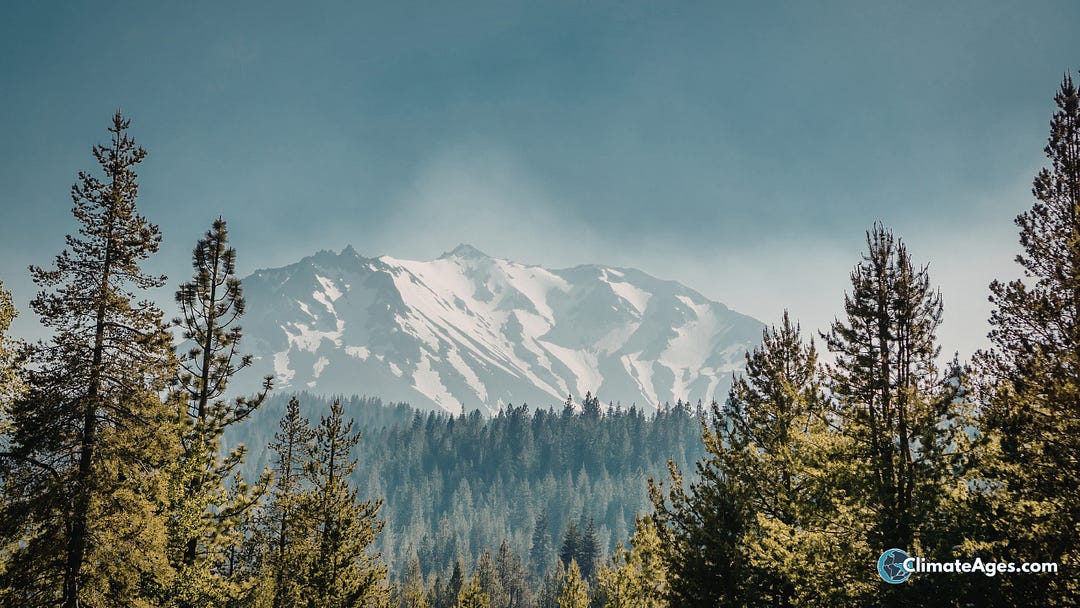
Grandpa has been coming to the same mountain cabin for almost seventy years.
The cabin sits on the side of a Rocky Mountain valley surrounded by fir trees, aspens, and a meadow that fills with wildflowers every summer. His parents bought the place in the 1950s, back when the roads were narrower and reaching the cabin took most of a day. He remembers snow lingering near the trails well into July, mornings cold enough that everyone wore jackets outside even in summer, and certain birds being so common that nobody bothered pointing them out.
Now, every time he visits, he notices small things that feel slightly off. The snow melts earlier, and the wildflowers seem to bloom farther uphill. Some birds he remembers hearing near the cabin are harder to find, while unfamiliar species appear more often at higher elevations. Even the trees seem to be creeping upward.
His grandchildren smile politely when he mentions it. Maybe he is just romanticizing the past. Maybe every generation thinks the world used to feel different.
But what if he is right?
That question sits at the center of one of the biggest scientific discussions surrounding mountain ecosystems today. Are mountains quietly reorganizing as the planet warms? And if they are, what does that actually mean for the species living there?
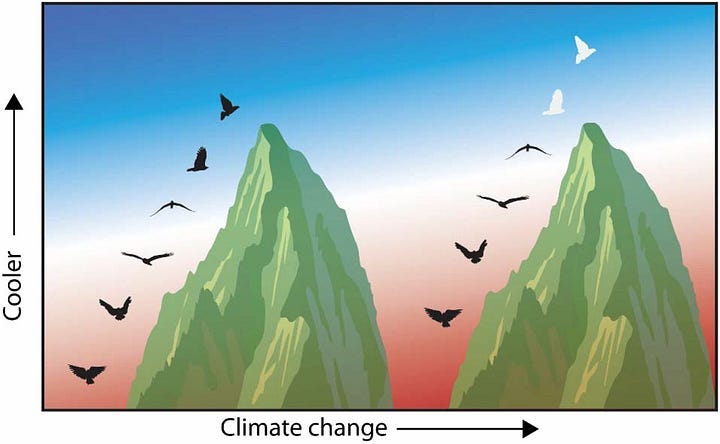
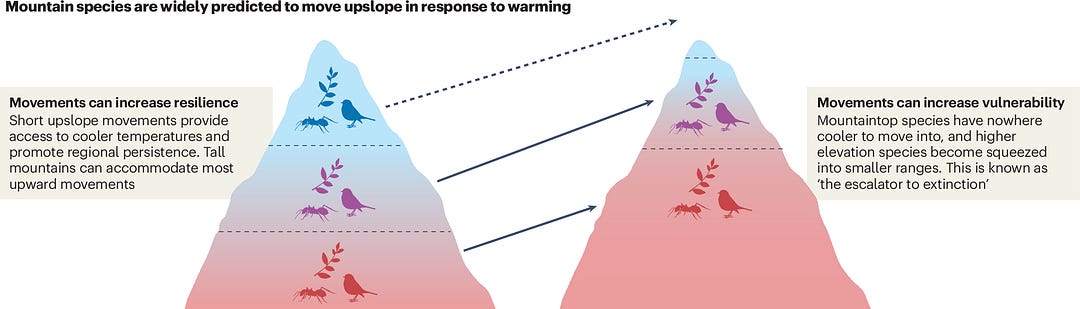
For decades, scientists have expected mountain species to move uphill as temperatures rise. The logic is simple enough to picture. Temperatures generally get colder as elevation increases, so hiking uphill is a little like traveling northward toward colder climates, except over much shorter distances on a map.
For a mountain species adapted to cooler temperatures, moving uphill can be a way of staying within its preferred environmental conditions. This idea became one of the foundations of modern climate ecology. If the planet warms, species shift their ranges to follow the climate to which they are adapted, they track the climate.
But mountains create a problem that immediately complicates this picture. What happens when species reach the top?
This concern led scientists to describe what became known as the “escalator to extinction.” Imagine populations slowly climbing uphill generation after generation as temperatures warm. Eventually, mountaintop species run out of colder places to move into.
At first glance, this sounds almost inevitable. But there has always been an important issue with treating this as a completely new problem. Mountain ecosystems have already survived enormous climate swings before.
Over the past 2.6 million years, Earth has repeatedly shifted between colder glacial periods and warmer interglacial periods. Temperatures rose and fell dramatically, glaciers advanced and retreated across continents, and entire ecosystems reorganized multiple times.
And throughout all of it, mountain ecosystems persisted.
That history matters because many species alive today are descendants of populations that already survived repeated periods of warming and cooling long before humans began recording temperatures or monitoring ecosystems. So scientists started asking a deeper question.
If mountain ecosystems already experienced major climate changes in the past, are modern extinction forecasts missing part of the story?
A recent review published in Nature Reviews Biodiversity attempts to answer that question by bringing together evidence from fossil records, pollen cores, modern ecological surveys, and long-term monitoring studies from mountain systems around the world.
One of the most fascinating parts of this story comes from fossil pollen.
Plants release massive amounts of pollen into the environment. Some of it settles into lakes, wetlands, and peat bogs, where it becomes buried in sediment year after year. Over thousands of years, those sediments build layer upon layer like a natural archive. Scientists can extract long cores from these deposits and identify the pollen preserved inside them to reconstruct past vegetation.
It sounds almost impossible at first. Tiny grains of fossil pollen helping scientists reconstruct ancient mountain ecosystems. But these records have transformed our understanding of how plants responded to past climate changes.
Again and again, the same general pattern appears.
During warm periods, mountain plants often shifted uphill. During colder periods, they expanded downslope. In some mountain systems, entire vegetation zones moved hundreds or even thousands of meters in elevation over time.
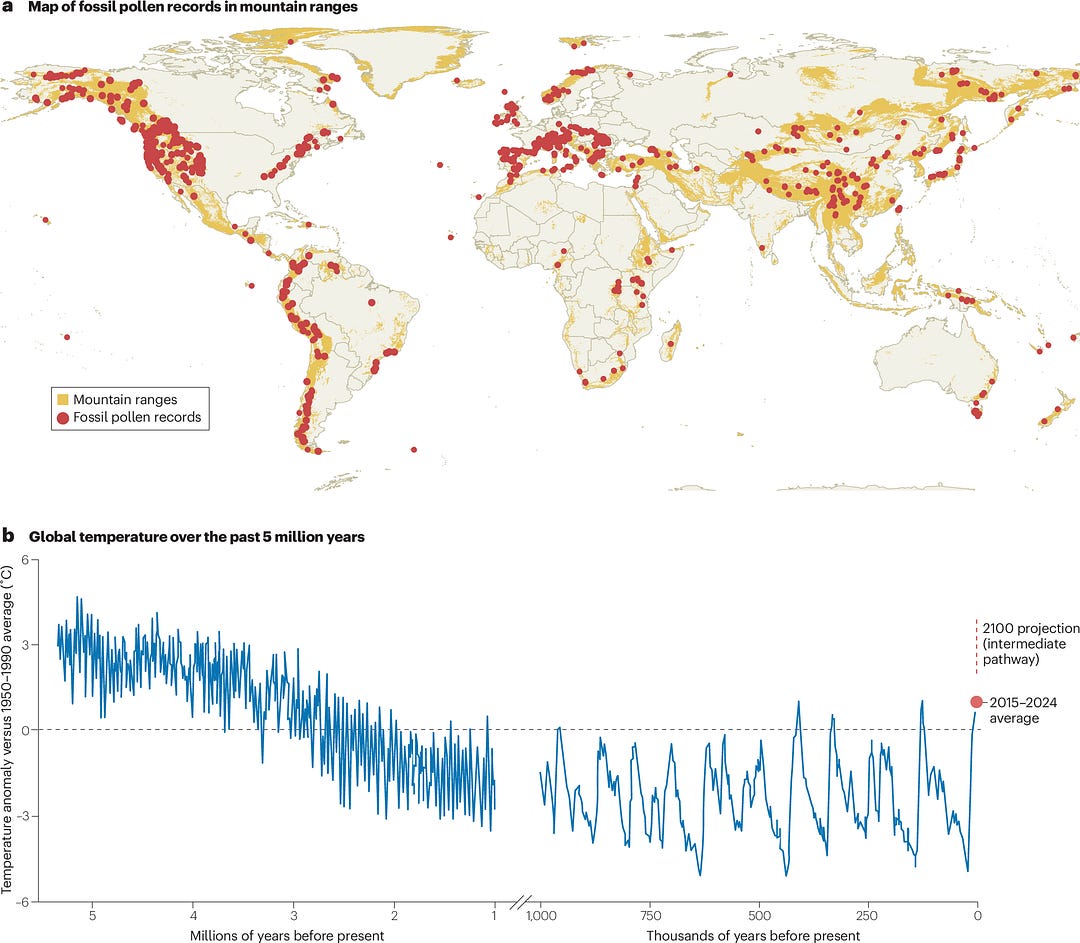
The Andes provide some of the clearest examples. Fossil records show high-elevation ecosystems repeatedly fragmenting, reconnecting, and shifting as temperatures changed through glacial cycles. Similar patterns appear in Africa, Europe, and parts of Asia.
But what surprised many scientists was what they did not find. There is relatively little evidence for widespread mountain extinctions driven purely by past warming events. Instead, ecosystems reorganized.
Some species expanded while others contracted. Communities changed composition, and species moved at different speeds. But mountains often acted less like ecological traps and more like refuges where populations could persist by shifting across short distances. And that perspective changes how scientists interpret modern ecological changes.
Today, researchers are documenting uphill movements in many mountain species. Plants, birds, insects, and mammals are all showing signs of redistribution. But the responses are much messier than early climate models predicted.
Some species are moving uphill rapidly, while others barely move at all. Some communities are even shifting downslope in response to changing moisture conditions rather than temperature alone. And perhaps most importantly, many mountain ecosystems are responding more slowly than scientists originally expected.
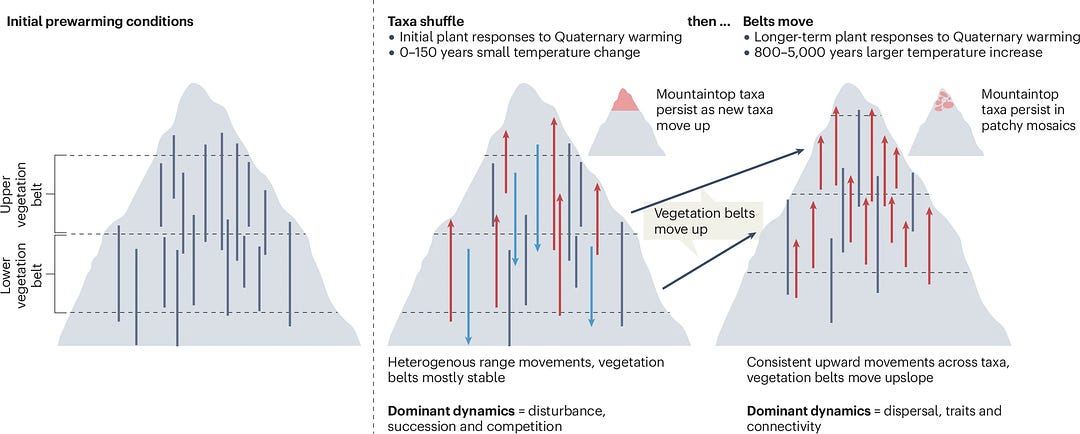
Part of the reason is that ecosystems are not simple collections of species independently reacting to temperature. A forest cannot instantly relocate uphill because the climate warms. Trees need time to establish, and seeds need opportunities for dispersal. Soil conditions, competition, water availability, and human land use matter. Even mountains themselves matter.
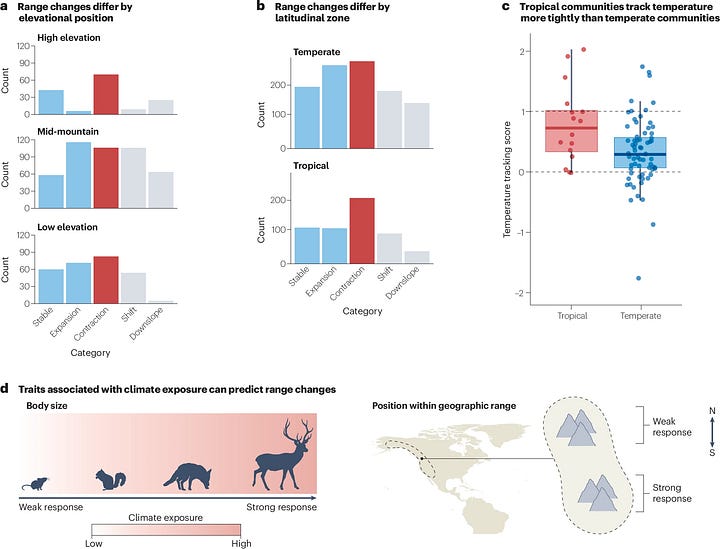
Tall mountain systems provide much more room for species to shift upward than shorter mountains do. A species living on a very tall Andean slope may still have cooler habitats available far above it. A species living on a shorter tropical mountain may reach the top much sooner.
This is one reason scientists are increasingly concerned about tropical mountain ecosystems.
The review found that tropical mountain species appear especially vulnerable to warming. Unlike temperate species, many tropical organisms evolved in environments where temperatures remain relatively stable year-round. That often means they tolerate narrower temperature ranges. In practical terms, even modest warming can create major stress.
Some of the clearest examples are already unfolding in tropical birds.
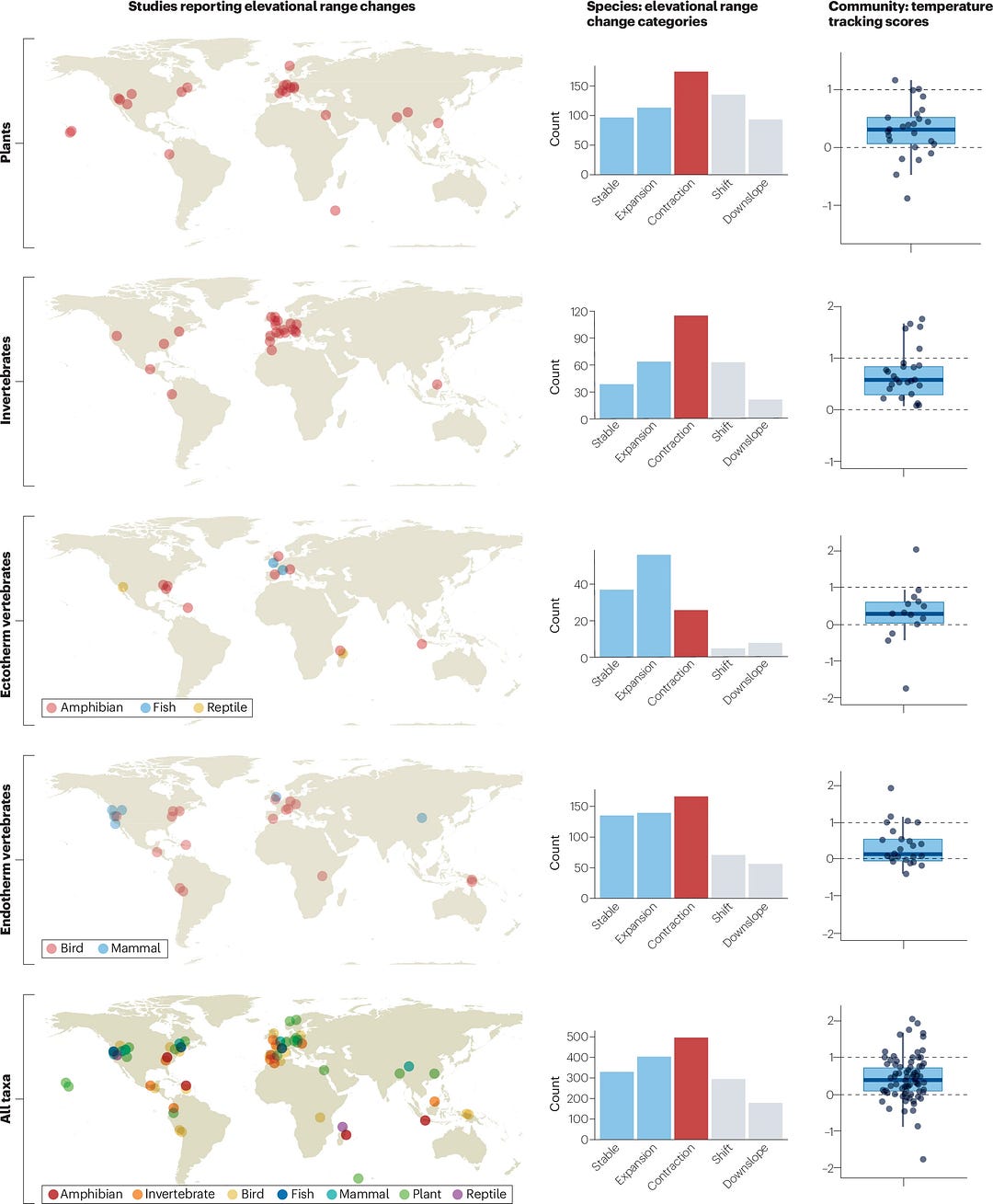
In Hawaii, warming temperatures allowed mosquitoes carrying avian malaria to expand uphill into cooler forests that once protected native birds from disease. Several bird populations have collapsed as a result. In parts of the tropical Andes and Australia, scientists are also documenting mountaintop range contractions in bird communities.
At the same time, the broader picture remains more complicated than simple narratives about inevitable collapse.
Many high-elevation plant communities in Europe are still persisting despite warming temperatures. Some mountain mammals show remarkable resilience depending on their behavior, habitat use, and access to cooler microenvironments. Fossil evidence also suggests that mountain ecosystems have historically been capable of reorganizing in response to major climatic shifts without experiencing catastrophic biodiversity loss.
That does not mean modern warming should be dismissed. The world today is very different from the one mountain species experienced during past climate swings.
Ancient species shifting uphill did not have to cross highways, fragmented forests, expanding cities, ski resorts, farmland, dams, or human-altered landscapes. Modern ecosystems face climate change layered on top of habitat loss, invasive species, disease spread, and land conversion.
And this is where the story circles back to Grandpa at the cabin. He is probably not imagining the changes, the mountain really is reorganizing itself.
But the deeper scientific insight is that mountains have always been dynamic systems. Species have been moving uphill and downhill for hundreds of thousands of years as climates shifted. The important question is not whether movement is happening. It clearly is.
The real question is whether modern environmental pressures are pushing some mountain ecosystems beyond the kinds of changes they successfully navigated in the past. That answer will not come from a single study or a single mountain range. It will come from combining ecology, paleontology, climate science, and long-term observations into one larger story about how life responds to change over time.
Sometimes the first clues arrive quietly. A snowline that no longer lingers into July, wildflowers blooming higher up the slope, or a birdsong that sounds slightly unfamiliar. Or, why not, a grandfather slowly realizing that the mountain he has known his entire life is still changing, even if most people have not noticed it yet.
Climate Ages has officially become a Substack Bestseller, and it’s thanks to a community of subscribers who believe science writing should stay careful, clear, and accessible.
If you enjoy my work and want to help me keep these stories free for everyone, I’d appreciate your support at any level that feels comfortable:
💡 $1/month or $10/year – A small boost with a big impact.
🌱 $2/month or $20/year – Supporting science communication.
🔬 $3/month or $30/year – Investing in evidence-based insights.
🌍 $4/month or $40/year – Expanding science for everyone.
🚀 $5/month or $50/year – Powering independent science writing.
Every contribution helps me continue creating content that makes science accessible, engaging, and impactful.
With Love,
Silvia P-M, PhD — Climate Ages
Comments
Nothing yet. Say the first thing.
Sign in to join the conversation.