
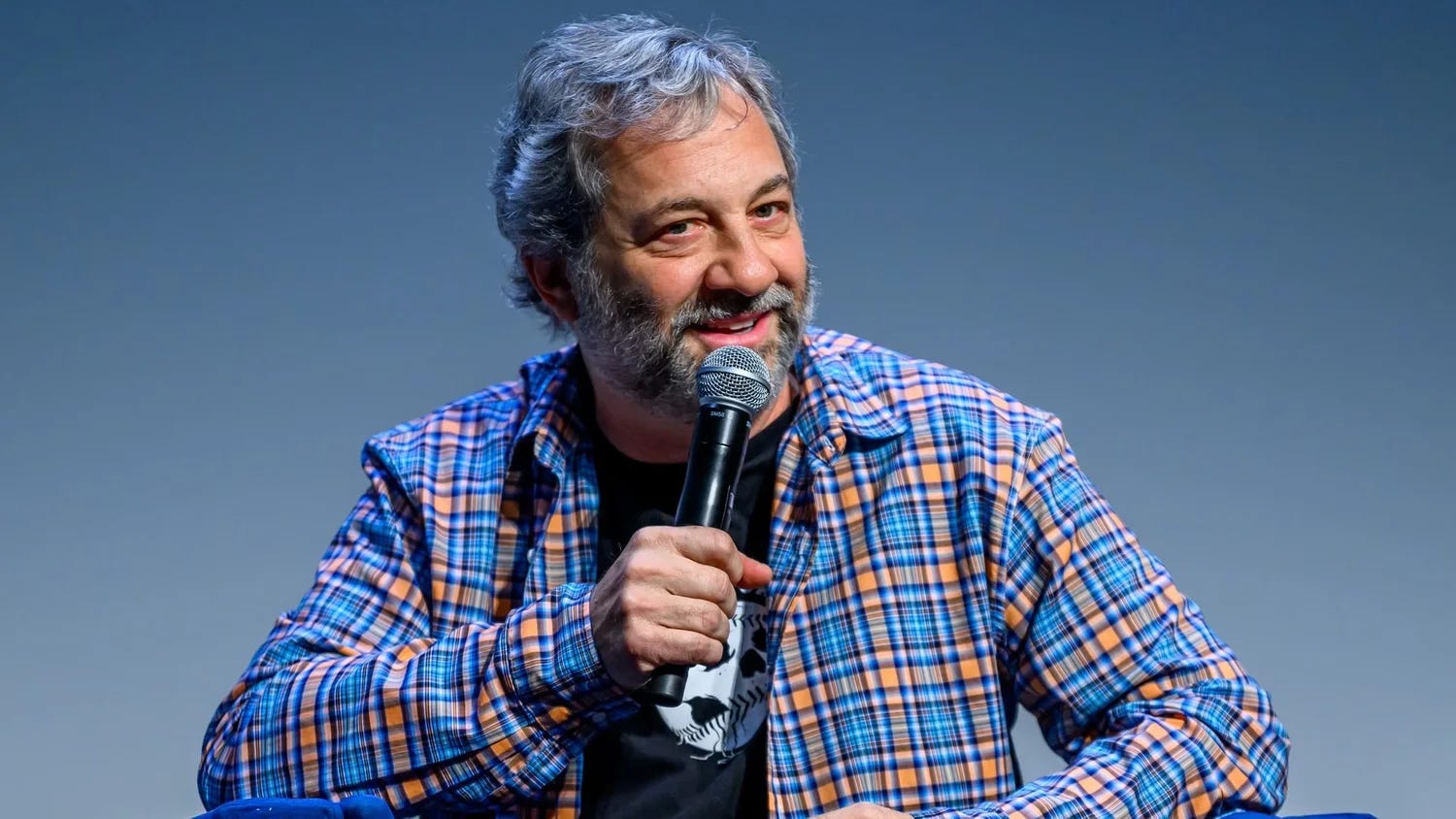
I’m something of a self-help and personal development nerd. This is not a part of my personality that I tend to advertise on first dates. Which is why I was delighted to discover, some years ago, that the very funny, very successful producer and director Judd Apatow is also deeply into self-help. (40-Year-Old Virgin, Knocked Up, This is 40, Girls, and Bridesmaids are just a few of his projects.) Here’s a guy who doesn’t take himself too seriously, who gets a lot done, and whose work many people admire, and he too has a library of yellowed, dogeared books that, if left out, a concerned friend might reasonably mistake as a cry for help.
So, back in 2022, when a publicist reached out to me and asked if I might like to interview Apatow for GQ about his upcoming movie The Bubble, I said yes—with the caveat that we get to nerd out about our mutual self-help obsession.
When I reached Apatow over Zoom, he began our interview by drawing me a card from his set of “Compassion Cards” compiled by the Buddhist nun and bestselling author Pema Chödrön (who happens to have written maybe my favorite book, When Things Fall Apart).
“Let’s pull one out right now and see what it is,” he said, picking at random from the deck and landing on Examine the nature of unborn awareness. “Now that is a complicated one.”
Because it’s never a bad time to examine the nature of unborn awareness, and because I recently dove into the topic of self-help on my podcast “excellence, actually,” I thought it’d be fun to revisit our chat. Here, Apatow talks about the lessons he’s learned from all that reading, how it relates to the great work he does, and that one time, on a plane, he heard a disembodied voice tell him to surrender. (Seriously.)
How did you come to self-help?
Apatow: I started when I met Garry Shandling. He gave me Feather on a Fan and Turning Problems Into Happiness, which had a big effect on me. It was the first time anyone ever explained that when bad things happen, and when good things happen, you rejoice, because it’s an opportunity to become aware of something you may need to work on. It’s all some sort of blessing. No one in my family ever talks about that stuff. We had no religion. We never talked about spiritual ideas. The only thing anyone ever said that was close was, “Nobody said life was fair.” Hearing that shitty things have a value was a big moment for me—and I need constant reminding of that. Use all things for the path.
“I try to imagine I’m someone else, and I give myself advice. Lately, most of it is, ‘Lighten up.’ As a comedy person, it’s weird that my biggest problem is taking things too seriously. But I think I could boil most of it down to that.”
So, how many self-help books would you estimate that you’ve read?
Read is a loose term, because it might be a chapter, it might be a page. Sometimes I’ll see what I dogeared 20 years ago, and I’ll look at it and think, “Wow, I’m still not doing that.” Other times I think, “I hope no one looks at what I dogeared, because it reveals way too much about me.”
I’ll find myself turning self-help books over so people can’t see the titles. Do you ever do that?
Sometimes, when you’re on a plane, you don’t want to just open up your book that’s called, Do I Have to Give Up Me to Be Loved by You? But generally I’m pretty open about the fact that I’m into it. It’s really helped me as a writer, because I’ve read so much about how people behave, and what their motivations are, that it’s deepened some of the characters in the movies and TV shows. That’s where I always start and what I learned from Garry: Who are they? You can’t go deep enough in creating a character, even a small character. That’s what makes the work richer, and it connects with people more.
What’s something you’ve been working on again and again, or you keep coming back to?
I’m always working on being present. And workaholism. Once, I had a therapist say I had generalized anxiety disorder. I’m always trying to figure out how to accept it in a way that might lead to it melting—or just being my companion that doesn’t bother me. But it results in a lot of overthinking and hypervigilance. I think that’s why I’m a good producer. Years in advance, I’m trying to figure out every possible thing that could go wrong, and then I try to prevent it from happening. That’s why it’s hard to get rid of. It results in success in one area of life, but then ruins the other area of life where it is not productive, and just makes you in your head and bothers other people.
That’s so often the case, right? The thing that makes you so talented in one area is a fatal flaw in another area.
Exactly. So, you want to hold onto it at the right time. My most recent attempt at mental health is I have a little folder on my phone, and I call it “Judd’s Life Coach,” but I’m Judd’s life coach. I try to imagine I’m someone else, and I give myself advice, or write down things that I think might be helpful for me. Lately, most of it is, “Lighten up.” As a comedy person, it’s weird that my biggest problem is taking things too seriously. But I think I could boil most of it down to that.
That seems like a thing that Garry struggled with, too.
Absolutely. That’s why we got along. We looked at life in similar ways and understood each other—even without words—about some of these neurotic areas. Part of it is that when you have too many ideas, and too many self-help ideas, it’s hard to listen to any of it. The thing I like about the [documentary] The Zen Diaries of Garry Shandling, is that Ram Dass says to Garry, “I am loving awareness.” And that’s it! That’s the whole philosophy. And he also points to his head, and he says, “Here’s bad.” And then he points to his heart, “You want to be here.” Sometimes I think that’s all I should think about, and really just burn all the rest of the books, and see how that goes.
I also think that some of this is a result of age. When you’re young, you feel like you have to succeed, and you have all this testosterone, and you want to take on the world. I deluded myself into thinking that anything was possible, and I had all this energy, but I think part of that energy is that you’re in constant fight-or-flight in some way. You’re just ready to brawl, to make a name for yourself, and to protect your work, and do things you’re proud of. When you get older, some of that calms down, maybe even hormonally, and you start approaching it in a less intense way.
“One of my mentors always talks about turning the bad stuff into gold. ‘Oh, this is the raw material for something that might be great.’ Nothing that’s bad is just bad.”
Is it true that you once were on a plane and heard a sort of disembodied voice say, “Surrender?”
I was on a plane to Australia. I was going to promote Funny People. I had this moment where I felt like I—“heard” is the wrong word, but we could use it here—a voice say, “Surrender!“ I took it as surrender my control, my hypervigilance, all of that. It’s a basic idea. “Let go, let God.” It’s not like it’s anything that new and complex. But I felt it. Like, “Let go of the rope.” In a way that is hard to explain. I forgot it happened until you just mentioned it.
That’s probably what’s wrong with me spiritually. It doesn’t stick. That’s why I’m excited about the idea of groundlessness, and being comfortable with uncertainty. It’s the same as surrender. Most of these ideas are the same. They’re just stated in different ways… As I get older, I realize that that learning curve doesn’t end when you’re 30 or 40. The people I know in their 60s, 70s, and 80s are still on that journey to some sort of wisdom. It never ends. I used to think, “Oh, these are coming-of-age movies.” But I think people are still coming of age at 80 and 90.
That is both reassuring—and horrifying.
I was talking to Norman Lear one day, and he was telling me about some childhood trauma that he wrote about in his book, when his father went to prison for some sort of stock fraud. He described the neurosis that it led to, and we laughed about the fact that he was still working on it. And he’s about to turn 100!
How’d that make you feel?
It made me feel good, because it’s okay. We get stamped with some sort of emotional wiring when we’re kids, and we try to work through it, and learn from it, and see if we could, as artists, turn it into creativity. For me, storytelling and comedy. Maybe it leads to something good getting created. So it is the raw materials of all of this work. Without it, I don’t think we would have much comedy.
George Saunders has this great bit where he talks about how your neurosis is the water, and you need to figure out the job that is like the water wheel that allows you to use your neurosis to create something.
David Milch is one of my mentors, and he always talks about turning the bad stuff into gold. And that’s what I like about those types of ideas, because then when bad things happen, on some level, you’re not just bummed about it, because you think, “Oh, this is the raw material for something that might be great.” Something that will make someone else happy, or help someone understand something. Nothing that’s bad is just bad.
I’m thinking now of your interview with Stephen Colbert from your book of interviews, Sick in the Head, and the way he talked about how his mom instilled that in him. “What is this in the light of eternity?” and “What punishments from God are not also gifts?”
He is able to talk about God and Jesus Christ in a more understandable way than anyone I’ve ever heard. I came to it later, and I’m always inspired by people that are able to express those ideas. There’s nothing I love more than a good, long Bono interview about religion. I always leave it thinking, “Maybe I should be religious. Bono explained that really well, and I get it now.” And for a moment, I do.
What’s the thing that’s gotten you closest to believing in God?
If you open yourself up to the idea that there’s some sort of—what’s the word they use? Universal intelligence? Is that what the word? The phrase?—then you notice certain things lining up. It may all be happenstance.
I was on a college tour with my daughter, and we sat in on a class, and Holly Hunter was a guest speaker. When we were kicking around The Big Sick, we were trying to figure out, who should play Zoe Kazan’s parents? Holly Hunter was stuck in my head. And then I tried to think about, who would she be great with? I had been thinking a lot about Ray Romano. In the movie, they are amazing together. It’s a very unlikely pair. Often I’ll listen to that voice that says, “That’s why you bumped into Holly Hunter.”
You can think of your brain as a supercomputer, or you can think, “Where did that come from? That was just random.” I don’t care what you think that piece of meat in my head does, that came from somewhere else.
I love hearing about Bob Dylan writing a billion songs over a couple of years, and he didn’t quite know where it came from. I believe that, because I’ve seen people enter that state, and there is something mystical about it.
But for me, it’s with dick jokes.
If you enjoyed this, you might also enjoy…
Life, According to George Saunders: The award-winning author offers wide-ranging advice on how to channel your ambitions, manage your anxieties, decide who to marry, be your best self, and find hope in strange times.
Seeing Between the Dominoes: Finding Space in Emotional Reactivity: How to stop reacting and start responding, find true confidence, and stay motivated.
The Tupperware Theory of Everything: Or: How to Increase Your Capacity for Stress.
Thanks for reading!
Comments
Nothing yet. Say the first thing.
Sign in to join the conversation.