
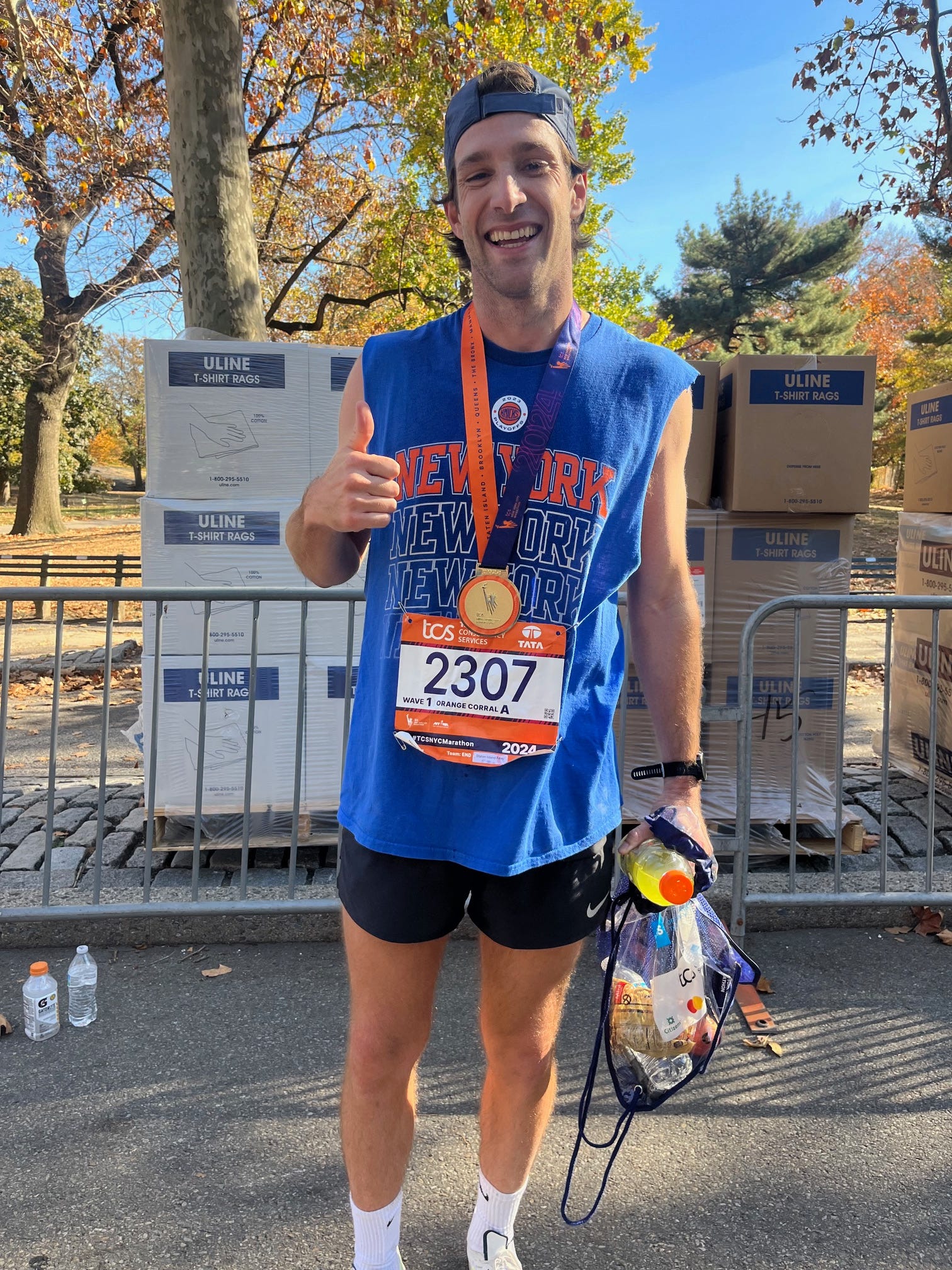
I’m running the New York City Marathon this weekend. It will be my sixth marathon, and my third time running New York. This week, on “excellence, actually,” the podcast I host with Steve Magness and Brad Stulberg, we devoted an entire episode to talking through the marathon, and how the same tools that help a runner endure 26.2 miles might help them endure life’s other challenges. I also just wrapped up an eight-week breath work and meditation workshop that I led alongside Kristina Centenari, which we largely designed to improve the mental fitness and resilience of runners training for fall marathons. Needless to say, running is top of mind for me these days (though, in recent years, it’s never been far). In the spirit of dropping seeds, here are some of my favorite lessons I’ve learned from my years of lacing up the shoes and knocking down the miles.
» I expect it to be hard so that when it gets hard — and it will — I’m not discouraged.
» In the event that metaphors help you: I like to think of each individual day of a marathon training block as a deposit I’m making into a bank account. Race day is going to try to shake me down for all I got, so the more I can fortify my savings, the more I can pay out. That means training hard (putting money in the bank) but also training smart (not spending too heavily before I have to).
» To continue with the money metaphors: I recently read the book Running Ground by Nicholas Thompson (the CEO of The Atlantic, who ran a 2:29 in his mid-40s) for a forthcoming podcast. He says he had a coach once tell him that you start a marathon with 100 pennies to spend during the race and the goal is to drop the last one right as you cross the finish lime.
» Because a marathon is a gargantuan expenditure of energy, conserving it is extremely important. One of the most nefarious types of energy leaks comes from mental stress — in particular, worrying about what I can’t control. It’s the mental equivalent of pushing as hard as I can against a wall: resistance that is maximally depleting and entirely futile. Of course, telling someone who tends to be neurotic (hello, marathoners!!!!) not to worry isn’t exactly helpful. In fact, it often triggers anxiety about having anxiety, which is… no bueno. But a subtle reframe that has helped me cut through the mental resistance is thinking of thoughts not as “good” or “bad,” but as “skillful” or “unskillful.” The barometer for whether or not a thought is skillful is simply, does it serve me right now? “What if it rains?” “How long is the port-a-potty line going to be?” “This really hurts, I don’t know if I can make it the whole way.” These are all valid thoughts, and concerns, but they’re just not useful. More importantly, they’re taking away energy that can be used on what I can actually control. Remember: I only have so many pennies, so I have to be careful where I spend ‘em.
» When I train as hard and as long as it takes to complete a solid marathon build, it’s very easy for me to forget three important things: (1) I run for fun. (2) It’s not that serious. (3) No one cares. To try to remind myself of these throughout training and especially on race day, I use the shorthand “take relative action, keep absolute perspective,” which I came across from someone wise whose name now escapes me. The point is that you take the next best step to achieve what you want, but then you couch it in this larger perspective that it really doesn’t matter much in the grand scheme of things. (You can also use, “Acknowledge the wave, stay with the ocean.” Same idea.)
» The spiritual teacher Joseph Goldstein says that the great seduction of doubt is that it masquerades as wisdom. This is especially true during a marathon. Doubt will try to convince you of many things: that it’s too hard, and you’re too slow, and there’s too much left, and you can’t do it. I try to acknowledge it, tell it that I appreciate that it’s trying to help, and let it go.
» In her book Wintering, Katherine May talks about the type of negative thoughts that often find her during “the dark insomniac hours.” They seem particularly scary in those moments, but when she wakes, and begins her day, she says her thoughts “settle like flakes in a snow globe. Everything falls back into perspective.” Running has an equivalent of middle of the night thoughts. They are incline thoughts. Whenever I am on an uphill, my doom spirals seem to get particularly scary. So I just tell myself I’m not allowed to make any decisions—particularly the decision to stop—on an uphill. I get to the top and I reevaluate.
» I’ve learned that if a marathon is long enough for the weather outside to change from sunny to breezy to overcast to rainy and back again, then it’s long enough for the weather inside me to change, too: I might move from elated to downtrodden to exhausted to energetic all throughout one race. More importantly, just like the weather outside, it might be totally out of my control. My job isn’t to control the weather (though you can influence it by taking in calories or using certain mental strategies) but to stay in it long enough to give it a shot to transform.
» Don’t underestimate the power of the chunk: It’s amazing how quickly I can psych myself out by thinking about how far 26.2 miles is. It’s also amazing how far I can keep myself moving by just taking it one quarter- or half-mile at a time.
» In meditation, when I sit down, become still, and try to focus on the sensations of my breath, my brain often runs off in a thousand different directions. When that happens, the instruction is to gently return your attention to the breath. “Begin again,” teachers will say. I like keeping that mantra in my pocket for marathons, too. Each mile (or chunk) is another opportunity to begin again. Release, reset, refocus. Begin again.
» This past Monday, I helped facilitate a panel with runners from NYC, and during the Q+A one of the attendees said, “You all seem very positive. What would you say to someone who’s very negative when they hit the wall—what advice would you give them on how to get through that?” Almost everyone agreed that, in that situation, positivity doesn’t help. What helps is being realistic. This sucks right now. Because sometimes it’s not the wall that hurts so much as the resistance to it. Once I embrace the suck, and name it as such, it takes some of the sting out of it. Then the goal becomes finding a way to get out of the story of how much it sucks, because that’s contracting. Some strategies I use to get out of my head: I’ll count each time my right foot hits the ground, up until 100, before starting over. I’ll bring a small smile to my face and let out an audible WHOOP. I’ll try to lock in on the back of the head or the foot of someone nearby who is running roughly the same pace and turn my brain off. I’ll time my breath to my steps, trying to exhale for one more step than the inhale.
» One of the runners on that panel said that he likes to do side quests during his marathon. So instead of just focusing on his performance goal, he might try to see how many high-fives he can get from the crowd during a mile, or try to spot someone in a banana costume. I love that idea. It keeps it fun, and keeps you from being too zoomed in on a singular performance goal.
» I was recently listening to a podcast with the musician Brian Eno, and he was talking about wind chimes. He made the point that whoever assembles the wind chimes has to make a choice about the length, number, design, and type of chimes included in the final construction. In so doing, the artist creates the conditions that makes sound possible — but, ultimately, it’s the wind that determines the nature of the music. That feels like such a perfect encapsulation of the marathon. The training creates the conditions for something to emerge on race day, but what that music is depends on so many factors outside of the runner’s control. My job becomes seeing just how well I can dance to whatever gets played.
» People talk a lot about the post-marathon party. It’s been helpful for me think of the marathon as the party. It’s the culmination of all the training I’ve put in. That’s not to say it doesn’t involve work, or that it’s all fun. But I find that approaching it as a celebration — not something standing between me and the celebration — has allowed me to approach it much more from a place of joy, curiosity, challenge, and adventure, rather than a place of fear or threat. You’ve spent all training cooking — now it’s time to eat.
Thank you for reading. And good luck to all the marathoners, this weekend and always! I’ll be back to drop more seeds soon.
— Clay
Comments
Nothing yet. Say the first thing.
Sign in to join the conversation.