
In 2018, someone derisively texted me (as they often did in texts or conversation) that “Your phone is smarter than you.” That was true. There were capabilities and processes inherent to it that I had neither learned nor employed and, admittedly, I still prefer listening records on my 1919 Victor Victrola - kept in condition the Victrola will still be used 300 years from now as opposed to whatever is otherwise an early 21st century system. I had no desire to learn more than the phone’s basic functions I desired of it, namely to call or to text. Simplicity was a quant throwback to growing up in the 1980s when at college there were two phone booths in the dorm, you waited in line to make a call, and then you hoped you had enough quarters. If you planned to meet someone, you pre-arranged it, and somehow by the magic of walking or driving, you managed to do it.
Artificial Intelligence has been a bit different in that it is certainly here and expanding rapidly but that it also has had an impact in my professional life as an educator, full-time until last year and part-time since. Several years ago at Thanksgiving, my cousin’s husband, a senior VP at an IT firm, told me that AI will change everything within five to ten years and that entire labor categories would be eliminated at worst and fundamentally altered at best. I erringly placed a value judgment on it, to which he good-naturedly replied: “it doesn’t matter what you think. It’s coming and there’s nothing anyone can do about it.” He, of course, was correct. The use of AI, especially in education, is here. And we have to discover what that means.
Two years ago, in my final year teaching at the Academy I had to figure out how to ensure the essays I received were not AI-generated. Yes, the concern can be there as well as any other school. Students are students and some regardless of the generation will find a way to achieve an easy end.
I had been using wargaming in my naval history class for a few years and found an added benefit to incorporate wargaming as a learning tool – it might also prevent the use of AI. While the students learned about resources, restrictions, options, decision-making, and consequences in the Tripoli War, Civil War or WW2 Pacific Theater, I had three games operating simultaneously. The students’ essays had to reflect what happened in their respective games. Consequently, no AI-generated essay could replicate that.
The process is, however, entirely different with online courses. There are platforms which can determine with a degree of confidence if a student’s essay is AI-generated and, after grading some 6,000 exams and research papers in my two decades at the Academy and practicing with more AI-generated essays based on my prompts, I have become comparatively adept at identifying the later from students…at least for now. I expect in another year or two it will become more difficult.
I’ve had open discussions with students about this technology. Some have argued that they use Grammarly or other platforms only to make their writing better and improve sentences. If that is the case, I have asked, at what point does the writing become AI’s rather than the student? I have suggested that using Strunk & White’s “The Elements of Style” and a hardcopy Thesaurus and dictionary might seem antiquated, but they improve the student’s voice in a way AI can’t, given the overreliance on something to do one’s work. Perhaps that is a lesson from Professor Goodfellow’s “Effort-Eliminating Computer”, that “real education…is how to use your brains and abilities to do things for yourself, to contribute something to society.”
I expect that argument would fall short as one who is a bit (a lot) of a Luddite. But if we accept that students will simply use AI to do something as fundamental in education as writing, at what point should schools accept that teachers be allowed to use AI platforms to grade it. Inputting a simple algorithm based on assessment metrics would be easy. Thus, AI would be grading AI. Even if students are writing their own essays, why should a school oppose a reduction in force to make teaching and grading more cost-effective and efficient? At that point is either the student or the teacher necessary? Is education itself at that point necessary?
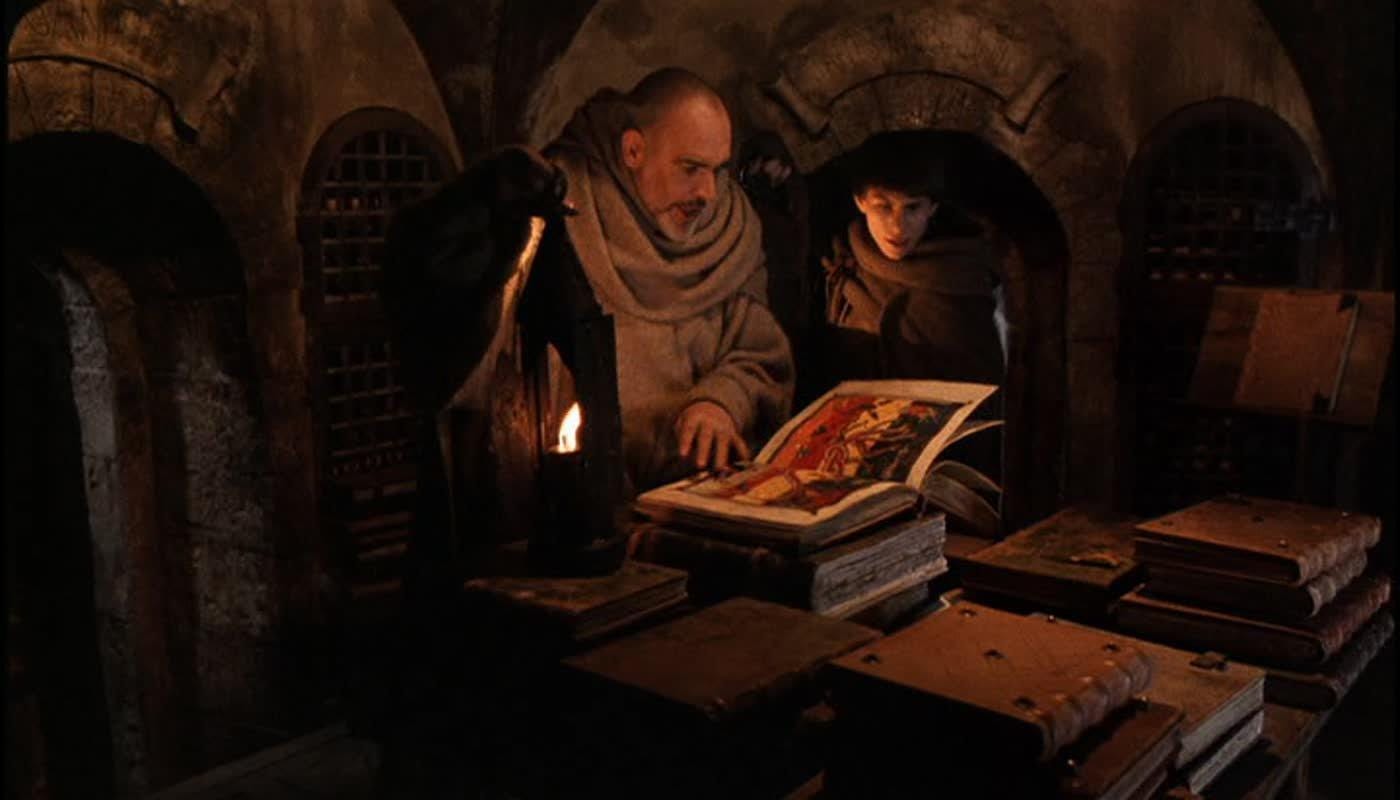
I realize the previous point may make it seem like I still advocate using a quill to write particularly as technology moves forward (I don’t, unless it’s a really nice quill). Certainly, I am using a computer to write this rather than finding a piece of vellum in a dark, candle-lit scriptorium of a 12th century Benedictine monastery (though the scriptorium would be nicer.)
But technology has its own style, and we still have to learn the basics. AI is a powerful tool and I have used it as one - not my only - component in identifying sources. Still, it is imperfect since AI is still limited. It can't, for example, find primary sources that remain in archives that are fundamental to academic research – at least until, that is, all archived documents are scanned and processed, itself a herculean and costly task.
In education, as alluded to, a likely consequence will be a cost-saving measure proposed by some realists to reduce the number of faculty required and the closure of schools, particularly rural schools. One school district in Maine that spends $55 million annually for some 2,000 students (that’s about $21,000 per student) and more than 600 faculty and staff. At some point AI will have reached a point where people and policy-makers will determine that most of those may be unnecessary. Now multiply that by some four million teachers across the United States. If AI could do the work of 90 percent of them, just as robotics will eventually replace fast food employees, that’s still more than three and a half million teachers who may need to find employment elsewhere, if they can.
At a faculty workshop recently, we discussed AI in the classroom today and in the future. These are all extremely thoughtful individuals. We heard a lecture about it. We discussed it collectively and off-line.
The education field is not ready for what is happening. Some friends and colleagues in the field deny that any fundamental change could occur, while others are understanding it to be the ones with the relevant expertise on how to handle the changes that will occur and have already incorporated it into their curriculum.
Even I recognize this change and what it means. Many fields of information and knowledge will explode exponentially and there will be benefits in medicine, and engineering, in improving physical conditions, and in other disciplines. But I also recognize the more that happens (in thinking and learning rather than in improving physical disabilities) we at risk of losing something in ourselves and the ability to think and work absent AI, as sure as it is nearly impossible to ask a young person to go 48 hours without using their phone and all the apps they employ on a daily…(hourly? minute by minute?) basis.
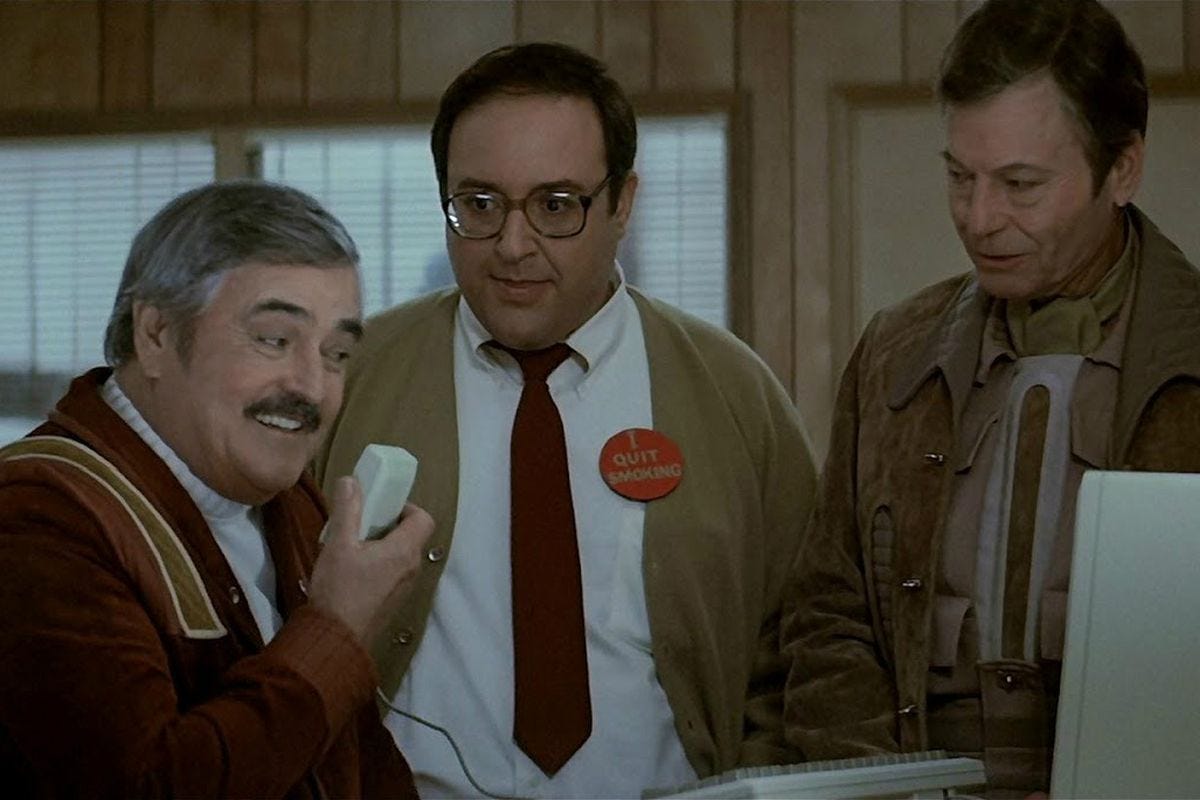
Science fiction has often addressed this issue that is both simple and complex – simple in that it will eventually be a binary system of either human or automated and complex in the problems that it will ultimately give rise to. There is always an easy quote from science fiction on this issue. In Star Trek TOS, for example, Captain Kirk is faced with the M-5 unit which does all the work of his crew. Foreseeing what this means, he tells its creator, "There are certain things men must do to remain men. Your computer would take that away." In this case, I prefer a callback to a less technologically dependent era about what distinguishes us as humans. Thanks to one of my theology professors, Fr. Benedict, who four decades ago imprinted upon us in his Christian Social Ethics course Pope John Paul II’s 1981 papal encyclical Laborem Exercens, in which he writes in the opening:
THROUGH WORK man must earn his daily bread and contribute to the continual advance of science and technology and, above all, to elevating unceasingly the cultural and moral level of the society within which he lives in community with those who belong to the same family. And work means any activity by man, whether manual or intellectual, whatever its nature or circumstances; it means any human activity that can and must be recognized as work, in the midst of all the many activities of which man is capable and to which he is predisposed by his very nature, by virtue of humanity itself. Man is made to be in the visible universe an image and likeness of God himself, and he is placed in it in order to subdue the earth. From the beginning therefore he is called to work. Work is one of the characteristics that distinguish man from the rest of creatures, whose activity for sustaining their lives cannot be called work. Only man is capable of work, and only man works, at the same time by work occupying his existence on earth. Thus work bears a particular mark of man and of humanity, the mark of a person operating within a community of persons. And this mark decides its interior characteristics; in a sense it constitutes its very nature.
What might that look like in the 21st century? It is with a sense of irony that I asked AI to produce a possible papal encyclical on the subject:
Intelligentia artificialis educationis
Encyclical Letter on Human Work, Education, and the Advent of Artificial Intelligence
Issued by the Supreme Pontiff
Beloved Brothers and Sisters in Christ,
With the unfolding of human history, new circumstances arise demanding renewed reflection in the light of the Gospel. In Laborem Exercens the mystery of human work was considered as central to the dignity of the human person. Today, I turn in particular to the sacred field of education, where the task of forming minds and hearts is now confronted by the advent of artificial intelligence. If in past ages the Church warned against the reduction of labor to mere mechanism, so now we must guard against the reduction of learning to the mere transmission of data.
Every act of teaching, every effort of study, is more than the exchange of information: it is a communion of persons. The teacher communicates not only knowledge but wisdom, not only facts but values; the student receives not only answers but formation of the soul. Here lies the dignity of educational work. Artificial intelligence may assist by extending access to knowledge, guiding research, and easing administrative burdens, but it can never replace the witness of a teacher’s presence, the warmth of encouragement, or the moral guidance which prepares the young for life in truth and love.
It is fitting to affirm that AI, when rightly harnessed, can open treasures of learning once confined to the few: children in remote regions may access instruction; the disabled may find new ways of participation; and teachers may be freed to dedicate more time to personalized accompaniment. Yet a grave danger emerges when education is entrusted wholly to digital systems, as if human beings were passive recipients of knowledge rather than active seekers of wisdom. In such a view, the formative relationship between teacher and student is eclipsed, and the growth of virtue and moral judgment is abandoned.
Therefore, we call upon families, educators, and all responsible for the common good to ensure that artificial intelligence is ordered to serve authentic human formation. Curricula and structures shaped by these tools must serve the integral growth of the person, uniting intellectual, ethical, and spiritual dimensions. We exhort policymakers and institutions to establish safeguards so that no child is deprived of human mentoring, no teacher is displaced without just recognition, and no community is left behind as progress advances. AI should remain a servant of the teacher, never her successor.
Finally, I remind all that true education is more than preparation for employment or mastery of technique: it is a participation in the divine call to wisdom. Let the use of artificial intelligence, then, be judged by this higher measure—does it foster communion, discernment, and truth? Let us work together to ensure that the marvels of technology strengthen, rather than fragment, the bonds of learning in family, school, parish, and university. May Christ, the true Teacher, bless every effort to place education at the service of human dignity and eternal destiny.
No posts
Comments
Nothing yet. Say the first thing.
Sign in to join the conversation.