
Last week when news broke about a fire aboard USS New Orleans (LPD-18) and how long the fire lasted, many of us watching were wondering if another ship, like Bonhomme Richard despite the most heroic efforts of her crew, would be lost. At best, as the damage is assessed, it will likely be out of commission for some time. Both USS John S. McCain and USS Fitzgerald, for example, were both unavailable due to significant repairs for about three years following their accidents and each costing hundreds of millions of dollars to repair. We can hope that it will be repaired quickly. More importantly, we ought to commend the sailors and anyone associated with the firefighting and damage control efforts.
The question then became - can we afford any permanent or temporary operational loss of a ship given the environment of the western Pacific and the potential for conflict with China? The fire aboard USS New Orleans is a reminder that the danger of potential or actual sudden loss has always been part of naval service.
Mariners for thousands of years have understood the realities of operating a ship at sea, whether it’s a modern warship or merchant ship, or those that sailed before the era of nuclear power, before the age of steam. Some ships simply wear out, the burden of years or decades of pounding of waves that cause metal fatigue (go to an old shipyard like Philly and take a look at some where you can see the hull framing through the metal plates.) Some get scrapped. Some are loss during military conflicts. Other times they vanish in storms, run aground, explode, or burn. The U.S. Navy has known this truth from its earliest years.
Take the 1820s and 1830s, for instance. In that time of peace the Navy lost ships not to battle, but to nature and accident.
The schooner Alligator was built to fight pirates in the Caribbean after the United States acquired Florida from Spain in 1819. She earned her reputation in 1822 by taking on pirate vessels during the spring and summer, but by November the same year, while escorting a convoy of merchant shipping, she ran aground. Efforts to save her failed. Rather than let pirates salvage the wreck, her own crew set the ship ablaze.
One year later, the Navy lost another veteran: Enterprise. On July 9, 1823, she grounded on Little Curaçao Island in the West Indies and broke apart. No lives were lost, but the ship’s decades-long career ended in splinters on a reef.
USS Franklin, a ship-of-the-line, nearly went onto the rocks rounding Cape Horn in 1823, and in another storm during 1824 she again came within two hundred yards of destruction. Seven hundred lives depended on Commodore Charles Stewart’s decisions in minutes. The Navy avoided disaster, but only by a narrow margin. Had she gone down, that represented approximately ten percent of all navy personnel at the time.
Disaster struck in sequence during Andrew Jackson’s first year in office.
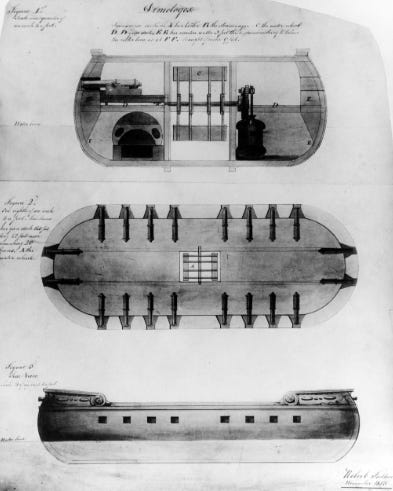
In June 1829 the Navy lost its most novel experimental vessel. Demologos - later renamed Fulton - was built by Robert Fulton in 1815 as the world’s first steam warship. She never saw combat, but she symbolized the Navy’s first step toward steam power. By 1829 she lay at the Brooklyn Navy Yard as a receiving ship, already rotten and leaking, but still fully manned. In June an accidental explosion obliterated her. Roughly thirty officers and sailors were killed, and another twenty-nine were wounded. Commodore Isaac Chauncey had only just left an inspection when it happened. He blamed a lantern in the magazine passageway. It was a simple accident, but one that erased the Navy’s only steam warship.
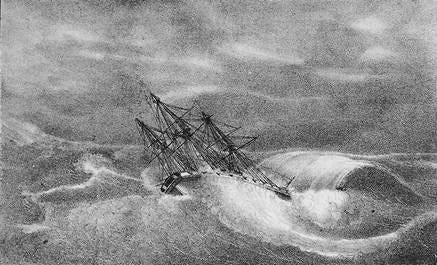
The celebrated sloop Hornet, famous for her War of 1812 victory over HMS Peacock, had spent much of the 1820s suppressing piracy. That August she received orders to evacuate the American consul at Tampico, Mexico, where Santa Anna’s forces were engaged in fighting. Writing to his friend Lieutenant Samuel DuPont in January 1829, Lieutenant Daniel Mackay aboard Hornet expressed deep reservations about his commanding officer as weak and an
imbecile to a degree of which you can form no conception – the premier […] is totally incompetent and disqualified in every point of view.
Later that year, Hornet anchored offshore of Tampico Mexico:
Hornet was part of the West Indies Squadron patrolling the waters and deterring actions of pirates and was to receive new orders on 11 August 1829. Hornet’s wardroom was aware of the situation, believing the Mexican Army was exceedingly anxious for a melee. Spanish forces and Mexican insurgents under General Santa Anna were engaged in military operations near Tampico by late summer. [In September,] Norris’ orders were to evacuate the American Consul, his family and other Americans. The ship anchored offshore when an unexpected gale rose up. Soon the gale had grown into one of the most powerful hurricanes in years. Norris had recalled all small boats ferrying people and got underway to escape it but was too late.
The storm consumed the ship. She vanished with all hands. Not a single survivor was ever reported.
Samuel DuPont’s own recognition and acceptance of his friend Lieutenant Daniel Mackay’s death aboard Hornet was sufficient to be entered in his private journal:
I have been somewhat prepared while in Mahon to hear the confirmation of a most melancholy piece of intelligence – the loss of the Sloop of War Hornet. By the papers received here, the most sanguine must abandon all hope…I have experience inward and deep sorrow for one in particular who has gone down with that decorated Ship.
In the same month as the Hornet’s loss, another sloop - Ontario - nearly joined it. DuPont, who was one of the young officers aboard, recounted in a letter that en route to the Mediterranean, she was caught in a violent gale on the 8th. Eyewitnesses later admitted they expected her to founder. Had she gone down, the U.S. Navy would have lost three of its thirty-eight commissioned warships in just three months.
The pattern didn’t stop there during Andrew Jackson’s first term. In 1831, Sylph was a small schooner, light and fast, designed for coastal patrol and dispatch duty. She sailed into the Caribbean and simply never returned. No wreckage was found, no survivors ever located.
The Porpoise, a schooner like Sylph, served in anti-piracy patrols and coastal operations. In 1833 she was wrecked in the West Indies of the Island of Sacrificios, near Veracruz, Mexico.
For the crew aboard, it has always been the same reality - living with the knowledge that one accident or one turn in the weather, can erase the ship beneath your feet. It’s why training is a necessity, to give the crew a fighting chance about what it may encounter at sea.
No posts
Comments
Nothing yet. Say the first thing.
Sign in to join the conversation.