
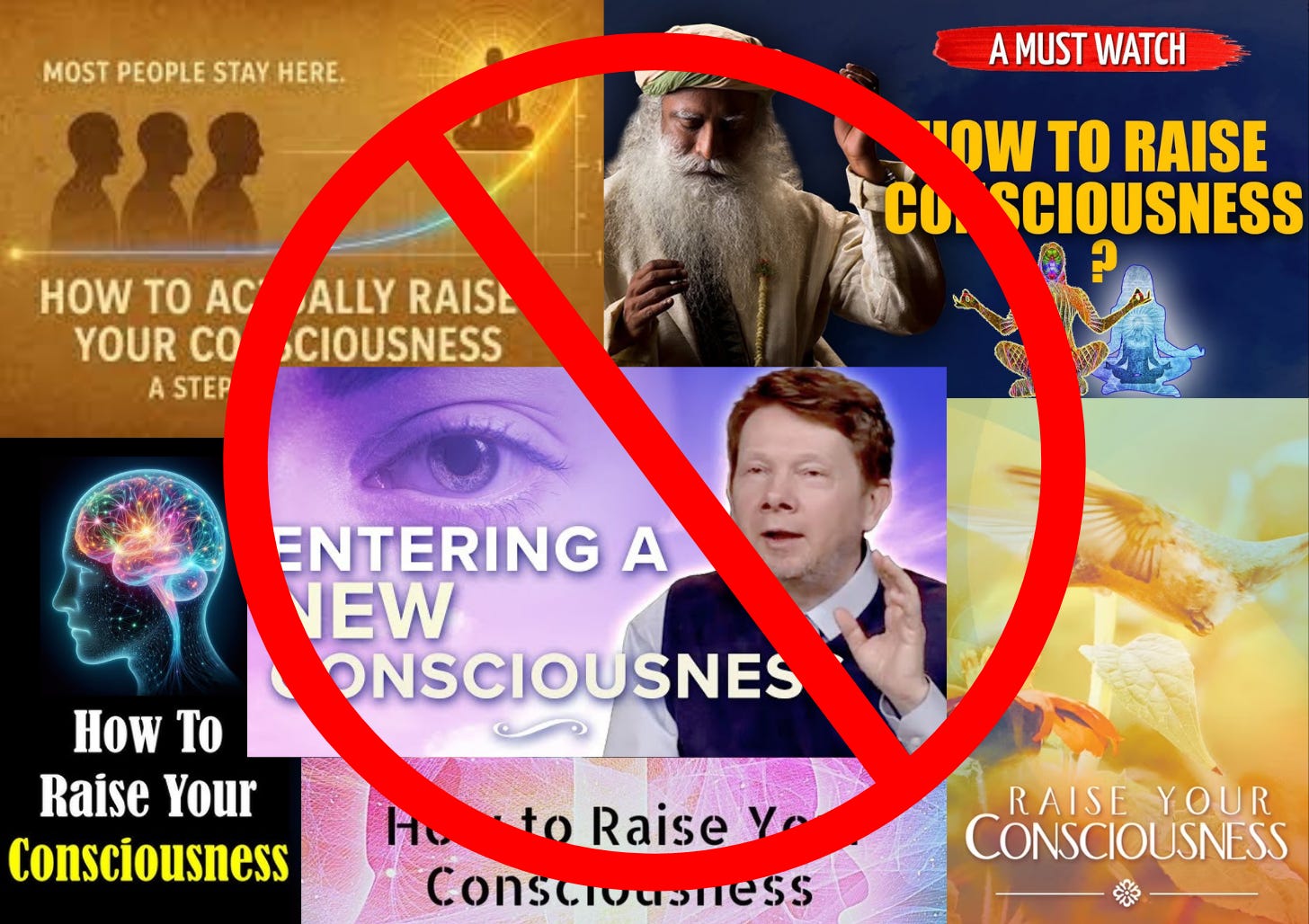
“Raise your consciousness.”
The expression appears in self-help literature, new age communities and wellness podcasts, typically accompanied by the assumption that consciousness is something quantitative. it is treated as a resource that can be accumulated, a frequency that can be elevated or some sort of software that can be upgraded.
This wrong assumption deserves intense scrutiny, because it rests on a foundational misunderstanding of what Consciousness actually is.
The Definitional Problem
The confusion begins with definition. In mainstream scientific discourse, consciousness is frequently treated as an emergent biproduct of neurological activity. In popular spiritual circles, it is often imagined as some sort of energetic hierarchy one ascends through experience, practice, or altered states.
Despite their apparent differences, both frameworks share a common premise: that consciousness is something dynamic, something subject to change.
Consciousness, understood as pure awareness or Mind-awareness as I often call it, is not thought, which is cognitive motion arising from that awareness. Nor is it sensation, which is an electrical body-awareness generated by the nervous system’s electrical activity of other electrically conditioned phenomena in one’s environment. It is also not memory, which constitutes the stored records of prior sensory experiences. And most importantly, it is not brain activity, which is itself electrical motion and therefore belongs to the domain of Effect rather than Cause.
The Still Center
Nature offers a useful mechanical analogy. Consider the eye of a hurricane or the center of a tornado. The most powerful storms exhibit, at their core, a region of stillness. Paradoxically, the greater the storm’s intensity, the more absolute the centering calm becomes. The surrounding motion orbits the stillness. Power is expressed not despite the still center but through proximity to it, and the closer the surrounding forces approach that center, the more energy the storm is able to express.
Consciousness functions in the same way. It is not the storm of thought and sensation; it is the still center around which thought and sensation organize. And like the eye of a hurricane, it does not move.
What changes, then, is not consciousness itself but the quality and intensity of the thoughts and expressions that extend from it.
To use a precise formulation: one does not raise Consciousness. One increases the Thought-potential organized around a static and unchanging Consciousness.
This distinction carries significant implications for how we understand the spiritual world. If Consciousness is already complete and unchanging, the goal cannot be to acquire more of it. The goal becomes, instead, to unify thought and action with what Consciousness is aware of—the God (Mind) qualities of Truth, Intelligence, Beauty, Love, Balance, Love and Knowledge.
Consciousness Defined:
Consciousness is Mind-awareness of Idea—the Mind-quality of awareness of its own Mind-qualities. Consciousness is Cause. Thought, emotion, memories and brain activity are Effect.
This reorientation and way of thinking shifts spiritual development from abstract metaphysics to a discipline of being one can actually pursue. The relevant questions are not “How much more conscious am I becoming?” but rather: Do my thoughts increasingly reflect Truth, Love, and Beauty? Does my character increasingly express those qualities? Does my work increasingly embody loving service?
These are practical, verifiable measures and have nothing to do with the possession of “higher” consciousness. The notion that one individual can have fundamentally superior consciousness than another is, on this account, not merely imprecise but conceptually false. Consciousness is universal, and as the universal cornerstone of awareness, is not privately owned. What differs between individuals is not a difference in Consciousness but a difference in thought potential and expressive capacity.
The ramifications go much deeper than this such as the question what happens when you go to sleep. Most psychologists and neuroscientists would say that you are unconscious. In fact, there is no such condition as unconsciousness. The Mind is the ETERNAL YOU, and always IS because it is unchanging. When one sleeps the electrical potential running through the brain decreases to the point where the senses cannot synchronize with an ever present Consciousness. You have merely stopped body sensing, but the Mind still IS. When you take a local anesthetic to numb a tooth for an operation by lowering its electrical nerve potential you do not say that your tooth is unconscious. So why say that your body is unconscious instead of just saying that its electrical potential has been lowered while it recharges in sleep?
The Misunderstood Role of Meditation
This framework also clarifies the function of contemplative practice. Meditation is commonly misunderstood as a technique for manufacturing elevated states. It has been marketed to spiritual circles as a way of chemically or psychically enhancing Consciousness. But if Consciousness is already universally present, unchanging and eternal, meditation cannot create what already is.
What meditation can do is progressively quiet the turbulence of sensory and cognitive activity so that one can be aware of one’s centering consciousness.
The awareness of being aware, not the awareness of sensed phenomena. The mystic traditions have largely understood this and the great contemplatives such as Lao Tzu did not achieve some augmented consciousness. They became progressively less distracted from the clouded thoughts that were cloaking their already existent being, which we call consciousness.
The inversion this suggests is significant.
Spiritual development, properly understood, is not the process of becoming something greater by adding to one’s self. The SELF is already eternal, it can’t be added to or subtracted from.
A more correct term would be spiritual unfolding, which is the process of removing the obstructions to let the already present Mind-Qualities emerge naturally.
Friends, please consider reading my articles on the Substack app, it helps tremendously.

Available for iOS and Android
Liking, commenting and sharing is a free way to help spread this message.
Upgrading to a paid subscription allows me to continue my work.
All paid subscribers receive a complimentary copy of my eBook The Art of Persuasion: 20 Rhetorical Tools for Writers (a $9 value) and private access to all my YouTube videos before they go public.
Michael Post, Creator of Beyond the Cosmic Veil
Comments
Nothing yet. Say the first thing.
Sign in to join the conversation.