

If you’ve never attended a Calico Cat Club candidate conversation before, you may not know that the audience gets to ask questions. You don’t have to submit them ahead of time, and you don’t have to hope someone else asks the question you’ve been wondering about. If you have a question, you can ask it.
On Thursday, August 27, from 6:30pm to 8:30pm at 290 MacLeay Road in Sequim, the Calico Cat Club will host a candidate conversation between incumbent Clallam County Commissioner Mike French and challenger Jake Seegers.
If you’re planning to attend, come with questions.
I’ve spent the last few weeks reading Mr. French’s issue papers and following the sources behind them. That turned into three articles:
I’ve pulled together some questions that came out of that research, but I’m not suggesting these are the questions anyone should ask. They’re starting points. If one of these issues is interesting, then read the original source material through the links provided above. All my articles link back to Mr. French’s issue papers. Follow the links, look at the numbers and the issues, and think for yourself.
People may agree with me, or they may disagree with me. People may find something I missed, and that’s great. The point is to do some homework and come up with questions of your own.
In Untying the Knot, I took a closer look at the substance-use section of Mr. French’s Public Safety, Substance Use, and Homelessness issue paper.
One thing that caught my attention was his statement that the decline in opioid deaths following the 2023 peak was “likely due to” expanded treatment options and Operation Shielding Hope.
It’s good opioid deaths have declined. That’s not really the controversial part. What I wondered was how to know that particular programs caused the decline.
That could make for a good question:
What data supports the conclusion that the decrease in opioid deaths was caused by the programs you identified, and what other factors were considered?
The paper also discusses the Opioid Settlement Fund and the county’s efforts to establish goals for how the money should be spent.
Another reasonable question would be:
How much of the Opioid Settlement Fund has been spent, where has the money gone, and what measurable results are being used to determine whether that spending is working?
And because Mr. French is an incumbent who has been in office for four years:
What specific results should voters look at to determine whether the county’s current approach to substance use is working?
A good follow-up would be:
What would tell you that the current approach isn’t working and needs to change?
Those questions don’t require taking a position on treatment, enforcement or anything else. They simply ask how to measure whether what is being done is producing the wanted results.
My second article, The French Connection (Or Lack Thereof), looked at Mr. French’s Economic Development issue paper.
The paper identifies several problems: housing, infrastructure, zoning, permitting, utilities and attracting businesses.
I don’t think many people would argue with the idea that those things affect economic development. The question is what he actually intends to do about them.
Mr. French proposes identifying industrial land and being open to rezoning, UGA swaps or UGA expansion. He also discusses economic development planning for areas such as Clallam Bay/Sekiu and Carlsborg.
That leads to questions like:
Which areas do you believe should be considered for rezoning, UGA swaps or UGA expansion, and what changes would you pursue?
Or:
What specific permitting problem do you believe needs to be fixed, and what would you change to fix it?
And here’s one I’m sure many would like to hear an incumbent answer:
Which of the solutions you now propose could have been pursued during your first term, and why weren’t they?
That’s a fair question about what has been done, what hasn’t been done and what would be different in a second term.
Then there’s Recompete, which got its own article because there was a lot to unpack.
The program has a goal of creating 900 living-wage jobs over five years. I hope it succeeds. I think most people would like to see 900 good jobs created in the region. But when it comes to whether the program is meeting that goal, people need to know exactly what is being counted.
The first-year reporting in my article included 208 participants, 21 people placed into jobs after training and 38 new jobs created through Recompete investments. Those are three different measurements, and none is the same thing as 900 permanent private-sector jobs.
So:
What exactly qualifies as one of the 900 jobs?
How many permanent private-sector jobs have actually been created so far?
How will you distinguish between jobs created because of Recompete and jobs that would have existed without the program?
And:
What specific measurements should taxpayers look at five years from now to determine whether Recompete was successful?
There’s another question I keep coming back to:
What remains when the grant money is gone?
Recompete is a five-year federal investment. Eventually the money stops. So I think it’s fair to ask:
What is the plan to ensure that the jobs, businesses and economic activity created through Recompete continue after the federal funding ends?
That’s an important question for any program funded with temporary money. If the goal is lasting economic development, Mr. French should be able to explain what will still be here after the grant ends so the people know what to expect.
There’s one question I’m sure many people would like to hear Mr. French answer that doesn’t require knowing anything about Recompete, opioid settlement funds or UGAs:
Looking back at the priorities you’ve identified in your issue papers, what do you believe has not worked as well as you expected during your first term, and what would you do differently in a second term?
Four years is enough time to learn some things.
Not everything works the way it’s intended or expected. Programs don’t always produce the results elected officials hoped for. Circumstances change. Sometimes it’s finding out that the original plan wasn’t the right plan.
I’m curious what an incumbent has learned from those experiences.
And Jake Seegers shouldn’t get a free pass, either. Ask him what he would change, what he thinks the county is doing well, what his priorities would cost and how he would measure whether his proposals worked.
Both candidates are asking for the votes of constituents. Both should be prepared to answer questions.
The questions above came from my review of Mr. French’s issue papers and the sources behind them. They’re starting points, not a script.
If one of these issues is interesting, read the source material. I’ve linked the sources in my three articles at the beginning of this article. Follow the links in the articles. Read the issue papers. Look at the numbers.
You may find something I missed. You may disagree with my conclusions. You may come up with a better question. That’s exactly what I hope you’ll do.
The point isn’t to have everyone show up at the August 27th candidate conversation asking the same questions. It’s to have people show up prepared to ask questions that matter to them.
And remember, there’s no need to wait until August 27th to ask the candidates a question. Mr. French can be reached at electmikefrench@gmail.com. Jake Seegers can be reached at vote@jakeseegers.com.
If you have a question about one of Mr. French’s issue papers, ask. If you want to know where a number came from, ask. If you want to know why something wasn’t done during his first term but is now being proposed, ask.
And if the answer doesn’t answer the question, send an email and ask a follow-up. That’s what a conversation is for.

A Note About AI:
Yes, AI helped with this article. But let’s be clear: AI did not write this unsupervised. I supplied the research, the source material, the questions, the opinions, the corrections, and — apparently — the necessary amount of yelling.
AI helped me organize and polish the final piece after I spent a considerable amount of time whipping AI into shape. So, in the interest of full disclosure: this article was written with AI assistance, after AI assistance was thoroughly assisted.

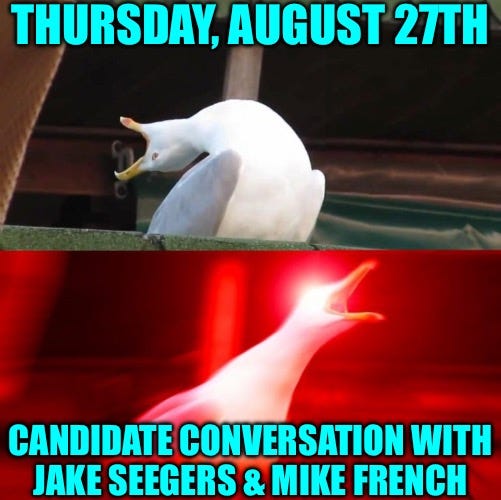
Thursday, August 27th, a candidate conversation with Jake Seegers & Mike French, candidates for Clallam County Commissioner District 3, at the Sequim Grange; hosted by the Calico Cat Club. The event is free and open to all. Information available online here and in the Google Event Invite.

Help get the petition to 600 signatures! You can sign the petition without displaying your name; the signature still counts, but if you want your name not to be seen by others, uncheck the box about displaying your name before clicking the submit button. Thanks to Terri D. for starting the petition!
4PA: A Clean & Safe Community for All
Monday Meetings Google Event Invite
New issues published at 6am every Monday and Thursday.
Senator Mike Chapman: (360) 786-7646, email form
Representative Adam Bernbaum: (360) 786-7916, email form
Representative Steve Tharinger: (360) 786-7904, email form
Mark Ozias: Mark.Ozias@clallamcountywa.gov
Randy Johnson: Randy.Johnson@clallamcountywa.gov
Mike French: Mike.French@clallamcountywa.gov
Loni Gores, Clerk: Loni.Gores@clallamcountywa.gov
Find all other Clallam County officials, offices, and employees in the staff directory.

No posts
Comments
Nothing yet. Say the first thing.
Sign in to join the conversation.