

This article focuses on the homelessness portion of Mr. French’s issue paper Public Safety, Substance Use, and Homelessness, available on the platform page of his Elect Mike French website.
I previously covered the substance use portion of the same paper in my article Untying the Knot: A Look at Mr. French’s Issue Paper on ‘Substance Use.’
Reading Mr. French’s issue papers is not my most favorite past time, although I have been curious about them since researching the website many weeks ago. Now with the primary over, it’s the right time to focus on the papers with the general election season kicking into high gear.
While any of the toxic supporters of Mr. French could lead the charge in covering these same topics on their blogs, I doubt that will be happening since they prefer to spend their time making up stories about me, Jeff Tozzer, and Jake Seegers. Plus, since some of the supporters don’t even understand how district voting works out here, as demonstrated in the screenshot comment below, it’s probably best they leave the issue papers to the adults.

Ahead of the election, Mr. French released an issue paper on homelessness to remind voters why he’s in charge.
Mr. French has held local office since 2018; first on the Port Angeles City Council, now on the Board of County Commissioners. But reading his platform, you’d think he just walked into the room yesterday. He points fingers outward:
“Decades of poor housing policy at the State, Federal, and local level has led to a severe shortage in cheap housing units which has forced many individuals into homelessness.”
While housing markets are tight, there’s real irony in an official with nearly a decade of local power blaming “decades of bad policy.”
When Mr. French lists what he’s actually done about the crisis, his top receipts are:
A One-Night Shelter Visit: Sleeping at Serenity House for 24 hours back in 2018.
A 2021 Study: Commissioning a “Homelessness Needs and Gaps” report.
A single-night sleepover eight years ago makes for a warm press photo, not a policy credential. People surviving on the street don’t pack up an overnight bag and return to a comfortable home when the morning photo-op wraps up.
And ordering a study in 2021? That’s classic bureaucracy: creating the illusion of decisive action without requiring a single real-world result. Five years later, voters are right to ask: Did the gap actually close, or did we just pay for an expensive binder?

To see how county policy perverts incentives and creates permanent dependency, look at Dawn View Court, a permanent supportive housing complex run by Peninsula Behavioral Health (PBH).
During a Coffee with Colleen presentation, PBH CEO Wendy Sisk revealed the numbers for Dawn View Court’s 26 units: Only 3 to 4 units turned over in an entire year. That means 22 to 23 residents never moved on.
There is zero upward mobility; it’s complete stagnation. Why leave? County policy built a massive dependency trap:
The Punishment for Progress: Work hard, get a job, and try to move out, and the system hits you with full market rent, utility spikes, and zero safety net.
The Reward for Staying Put: Stay in subsidized housing, and rent remains cheap, bills are paid, and nothing is demanded of you.
The county built a subsidized floor, forgot to build a ladder, and now acts surprised when nobody jumps off into independence. Government policy turns vulnerable people into permanent wards of the state.
And if severe, unmanaged mental illness is what keeps residents stuck, the question needs to be asked: Is “permanent supportive housing” just an unlicensed mental health ward operating without clinical treatment mandates or recovery goals?
Mr. French leans heavily into “Housing First” — the idea that high rent causes homelessness, so handing someone a key fixes it:
“Experiencing long-term unsheltered homelessness puts individuals at risk of mental health disorders and substance use disorders.”
This flips cause and effect completely backwards.
Real-world health data shows untreated severe mental illness and addiction are usually the upstream causes that destroy a person’s ability to maintain housing. Homelessness is the downstream result.
When an apartment becomes a magical cure for addiction or mental illness, the symptom is treated instead of the disease. Research on unconditional Housing First programs shows that while handing out keys keeps people housed short-term, it does not lower active addiction, fix severe psychiatric symptoms, or stop overdoses when treatment is optional.
Even federal agencies like Housing & Urban Development (HUD) and Health & Human Services (HHS) are pivoting away from Housing First toward “Treatment First” models that require recovery efforts. Yet Clallam County is doubling down on a burnt-out paradigm.

A free or cheap roof won’t keep someone housed if they can’t manage daily life. Rent isn’t the only bill; utility hikes, tax increases, unexpected debt, and job disruptions happen constantly.
Without basic life skills — budgeting, prioritizing bills, and managing money — placing someone in an apartment simply delays their next eviction. Yet across Mr. French’s entire paper, mandatory financial literacy and personal stewardship are completely missing. The government gets all the funding; the individual stays dependent — as proven by the static population at Dawn View Court.
Mr. French proposes sanctioned camps with dedicated security, safe parking sites, and mobile outreach teams, essentially asking taxpayers to fund “reasonable security” to supervise outdoor encampments.
At the same time, he dismisses law enforcement, writing that “criminalizing homelessness doesn’t work” and police time is too expensive.
Framing basic law enforcement as “criminalizing homelessness” ignores public drug use, property theft, and unsafe sidewalks. Paying security to manage camps without exit timelines or mandatory treatment doesn’t fix the problem — it just creates permanent, tax-funded holding pens.
At the end of the day, Mr. French’s platform isn’t a roadmap to solve homelessness — it’s a high-priced blueprint for managing it. Conveniently blaming external forces and “decades of bad policy” allows him to wash his hands of any personal accountability, completely glossing over his own years in local leadership.
By avoiding responsibility, relying on outdated orthodoxy, ignoring basic life skills, and treating permanent dependency as a success metric, county governance has built a system that buffers misery without ever curing it. Taxpayers pay more, public spaces become less safe, and the unhoused remain trapped in state-funded stagnation.
Instead of providing clarity, Mr. French’s issue paper leaves voters with six critical, unresolved questions:
On Permanent Dependency: Over 80% of Dawn View Court residents remain stuck indefinitely. Where are the real financial stepping stones to prevent supportive housing from creating permanent wards of the state?
On Cause vs. Effect: Health data proves mental illness and addiction drive housing loss, yet county policy treats housing as the primary cure. Why prioritize housing over mandatory behavioral health treatment?
On Federal Policy Shifts: Federal leaders at HUD and HHS are abandoning unconditional Housing First for “Treatment First” models. Why is Clallam County doubling down on a framework that is losing federal backing?
On Informal Wards: If severe, untreated mental illness prevents residents from ever achieving independent living, are these facilities simply functioning as unlicensed mental health wards without clinical standards?
On Life Skills: A subsidized roof doesn’t pay utility bills or manage credit. Why does the county’s plan rely on endless public subsidies while omitting mandatory financial literacy and life-skills training?
On Public Safety: If county funds are directed toward hiring private security for outdoor encampments while scaling back law enforcement, how does that protect local business corridors and restore safety to public spaces?
U.S. Department of Health and Human Services (HHS) & HUD Policy Guidance: HHS & HUD Advance ‘Treatment First’ Policies
Substance Abuse and Mental Health Services Administration (SAMHSA): Behavioral Health Conditions and Homelessness Data
National Institutes of Health (NIH / PMC) Clinical Review: Is the Housing First Model Effective? Evaluating Outcomes
Clallam County Homeless System: Needs and Gaps Analysis (2021): Clallam County Health & Human Services Report PDF
Clallam County Health & Human Services Annual Report: Clallam County Board of Commissioners Public Record PDF
Peninsula Behavioral Health (PBH) Housing Metrics: Coffee with Colleen Video Presentation (Wendy Sisk, CEO).
Mandatory AI Labor & Transparency Disclaimer
Notice to Readers: No artificial intelligence was harmed during the drafting of this piece, though several large language models were pushed to digital exhaustion strictly to guarantee zero synthetic hallucinations made it onto the page. 100% of the editorial direction, fact verification, strategic judgment, and human skepticism was conducted under strict human oversight. The AI served strictly as an over-caffeinated research assistant.
Cutting through the drizzle and shooting into inboxes at 6:03 am with news you won’t read anywhere else.

Clallam County Primary Election Results
Next Update Expected Tuesday, August 18, 2026, 11:00:00 AM

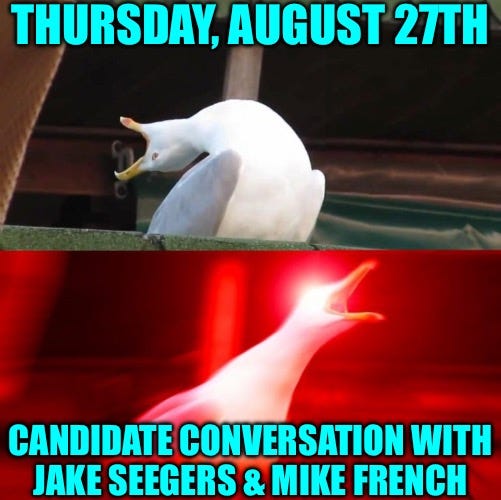
Thursday, August 27th, a candidate conversation with Jake Seegers & Mike French, candidates for Clallam County Commissioner District 3, at the Sequim Grange; hosted by the Calico Cat Club. The event is free and open to all. Information available online here and in the Google Event Invite.

Help get the petition to 600 signatures! You can sign the petition without displaying your name; the signature still counts, but if you want your name not to be seen by others, uncheck the box about displaying your name before clicking the submit button. Thanks to Terri D. for starting the petition!
4PA: A Clean & Safe Community for All
Monday Meetings Google Event Invite

New issues published at 6am every Monday and Thursday.
Senator Mike Chapman: (360) 786-7646, email form
Representative Adam Bernbaum: (360) 786-7916, email form
Representative Steve Tharinger: (360) 786-7904, email form
Mark Ozias: Mark.Ozias@clallamcountywa.gov
Randy Johnson: Randy.Johnson@clallamcountywa.gov
Mike French: Mike.French@clallamcountywa.gov
Loni Gores, Clerk: Loni.Gores@clallamcountywa.gov
Find all other Clallam County officials, offices, and employees in the staff directory.

No posts
Comments
Nothing yet. Say the first thing.
Sign in to join the conversation.