
Friends,
This week, we’ll learn the lessons from two popular universal childcare programs and explore why states that haven’t raised the minimum wage are failing working Americans. But first, let’s talk about why Chris Turner, the CEO of the corporation that owns national fast-food chains like Taco Bell and KFC, went on CNBC to justify his company’s sale of the global Pizza Hut chain of restaurants to a private equity firm.
The sale of all non-China Pizza Huts to Long Range Capital for roughly $1.5 billion, Turner said, “positions Pizza Hut for even greater growth going forward.”
We’ve all come to expect CEOs to make wildly improbable statements in the media, but even after years of empty promises, it’s hard not to roll your eyes at Turner’s statement.
That’s because we’ve all seen how the private equity playbook works, again and again. First, these firms buy profitable-but-declining brands like Red Lobster and Bed Bath & Beyond, paying huge price tags financed with debt. Then they transfer that massive debt to the company that they purchased, basically poisoning the balance sheets for years to come and instantly transforming a steadily profitable venture into a money-losing deadweight.
Next, they start cutting costs by laying off workers, closing locations, and slashing the goods and services that customers have come to expect. While that death spiral plays out, they airlift all incoming funds out of the company and its workers, sucking the company dry of profits.
And finally, after the PE firms have sucked the profit from the bones of the company and left vacant storefronts and laid-off workers nationwide, they sell the corpse for scraps and move on to their next victim. It’s a system that enriches nobody except a handful of wealthy executives at the private equity firms, while thousands of workers are left with less than nothing. (If you’d like some more information about the mechanics of private equity, Senator Elizabeth Warren has been leading the charge and has published several great explainers.)
If Long Range Capital follows this PE playbook and Pizza Huts nationwide eventually close, the media will invariably refer to Pizza Hut as a “flagging brand” that was doomed to failure after years of decline. But to be clear, Pizza Hut is still remarkably popular.
As CNBC reported when the sale was announced, as of six months ago, “Pizza Hut had nearly 20,000 locations across 108 countries and territories and reported $12.8 billion in annual system sales, according to regulatory filings from Yum.” The company still earned hundreds of millions of dollars in profit every year.
So while Pizza Hut enjoys nowhere near the ubiquity and popularity that it did in the 1980s and 1990s, it still brings in a steady stream of income that could have been applied to refreshing and reinvigorating the chain for the 21st century. After all, that’s how we were taught in Econ 101 how capitalism is supposed to work.
Under private equity, though, businesses aren’t profit-making pipelines to be invested in and cultivated. Instead, they’re resources to be strip-mined, exploited, and discarded. And while big national chains like Toys “R” Us and Red Lobster are the most public victims of private equity, the reality is that private equity firms are now entering local economies around the country and snapping up small businesses.
For the American Prospect, Robert Kuttner explains that private equity firms are establishing mini-monopolies in communities around the country in what’s called the rollup business model by consolidating mom-and-pop businesses under one big firm and winning “market dominance and thus pricing power.”
Kuttner explains that for about ten years, “private equity rollups have targeted a wide range of smaller businesses, including nursing homes, medical specialties, funeral parlors, trailer parks, ski slopes, veterinary practices, as well as such home services as HVAC, plumbing, electrical contractors, roofing, and pest control.”
“Typically, the PE partners put little of their own cash into a deal, but borrow most of the money, and then pile the debt onto the books of the operating company,” Kuttner writes. “Following the acquisition, the new PE owner may run the company for a while and reap supernormal profits, or may extract so much money from the operating business that it will be driven into bankruptcy.”
Again, that money-extraction process results in fewer employees, worse service, and higher prices. If you’ve needed to hire a plumber or electrician in the past decade or so, you might have encountered some of the side effects of this rollup practice, including a frustrating inability to actually get a human being on the phone to discuss pricing or service availability.
The process happens so gradually and on such a small scale, Kuttner explains, that these firms tend to avoid antimonopoly laws. But as their reach exceeds their grasp, these small private equity companies are finally attracting negative attention. One company tried to corner the market on anesthesiologists in Texas, for instance, which prompted the FTC to act against the monopoly.
And Kuttner writes that another rollup firm has quietly bought a number of fire truck manufacturers, which led the International Association of Fire Fighters to warn that ““The average price of a new fire engine has roughly doubled since 2020, and wait times that once ran about 18 months now stretch up to four and a half years,” resulting in small local fire departments limping along by keeping “aging, sometimes unsafe, apparatus in service far longer than they should.”
As we pointed out on the Pitchfork Economics podcast, over the last decade, private equity firms have insinuated themselves into pretty much every aspect of American life, stripping value from working Americans and handing it off to a few wealthy elites. If the American middle class is to survive, the practice of extractive capitalism needs to end. Kuttner points out that “Sen. Elizabeth Warren’s Stop Wall Street Looting Act would essentially do that, by taking away PE’s special tax breaks, requiring essentially the same disclosures as publicly traded companies, prohibiting extractions of special dividends at the expense of the operating company, and constraining other forms of predatory behavior.”
We need more of our elected leaders to frame private equity as anticapitalist behavior. Private equity removes competition and economic growth from the equation, replacing them with a rigged game that benefits only the super-rich. That’s not capitalism—it’s oligarchy, and it is un-American to its core.
In this week’s episode of the Pitchfork Economics podcast, economist Kathryn Anne Edwards explains her vision of what a national universal childcare system might look like.
“It would probably be one of the largest investments the federal government has made in communities across the U.S.,” Edwards says.
That’s a worthy goal. States and cities around the U.S. are already starting to think about what their local versions of universal childcare might look like. One day, perhaps those local childcare programs might inspire a national program. But in order for that to happen, the state and local programs have to be successful—meaning, they have to deliver what they promise, and they have to be popular with voters.
For the Roosevelt Institute, Josh Wallack looks at New York City’s universal childcare program, which was attacked by any number of national and local trickle-downers throughout its dozen years in existence, but which remained universally popular and is now on track to become a statewide policy.
“New York City Mayor Bill de Blasio’s signature policy initiative—universal, free childcare for three- and four-year-olds—was largely regarded as a success and proved popular during his administration,” Wallack writes. “From the launch of the program in 2014 to the end of his second term in 2021, over 500,000 three- and four-year-olds participated.”
The policy was successful, Wallack writes, because it was universal, free, and easy to access—that is, the childcare was physically accessible to every neighborhood in the city, and it didn’t require reams of paperwork to sign up.
Things changed when a new mayor, Eric Adams, came into office. “The Adams administration publicly backed off the promise of a universal program for three-year-olds, saying that it was unaffordable,” Wallack explains. “The Adams administration quickly and publicly cut close to $300 million from the budget, reducing resources for both services and program support. Subsequent years saw even further cuts.”
Wallack explains that the Adams administration created “a kind of negative policy feedback loop” that threatened to pull the plug on the popular program. “As families were forced to seek out other care if they could afford it or care for their children themselves, demand for the service decreased, which the administration used to justify further cuts,” he writes.
This is a common trickle-downer tactic: Make the investments harder to access, defund them, and create enough ill will around them in the public space that they become controversial. People then take sides on the issue—typically, though not always, along partisan lines—and the fight over cuts and funding eventually weakens it to the point of uselessness.
So what was different about universal childcare in New York City? Wallack says, “a group of committed activists, providers, families, and former staff from the program, including the author, came together in 2022 to try to reverse this trend.”
This team worked to “ensure that the childcare issue remained front and center in public discussion even during the cycle of disinvestment and declining support,” Wallack writes, eventually “leading to a historic announcement from the current administration that the city and state would build universal childcare statewide.”
Not to belittle the hard work of those people who fought for childcare even as the Adams administration tried to kneecap it, but it also helped that the policy was designed for success. Wallack cites a checklist from political scientist Alexander Hertel-Fernandez that determines whether a policy can create a positive feedback loop with voters:
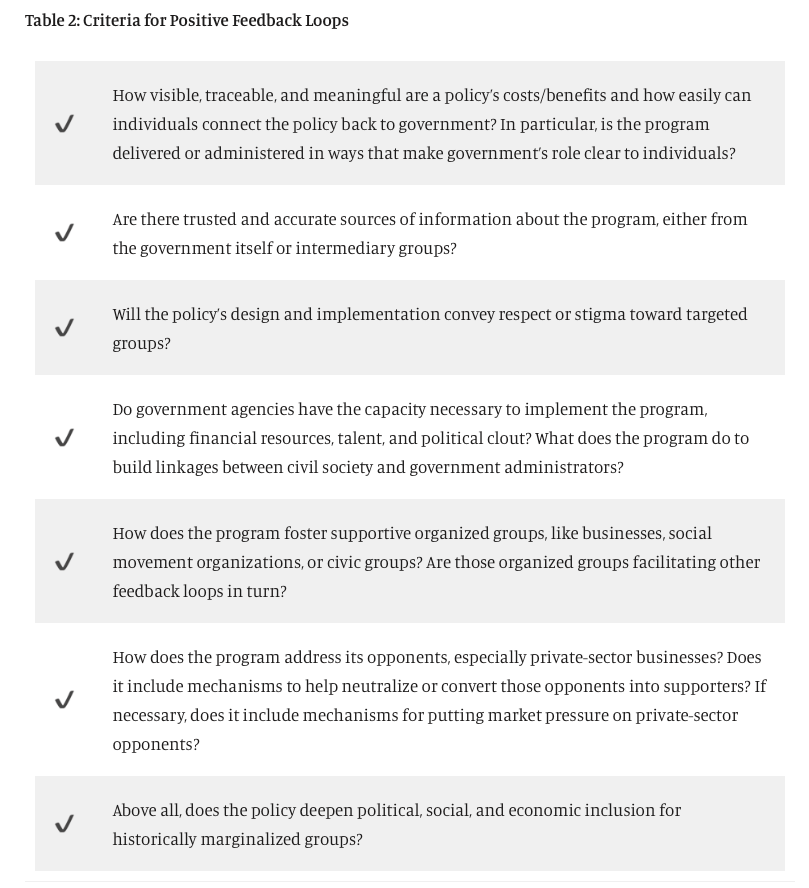
“Pre-K for All met most, if not all, the criteria on the checklist,” Wallack concludes. He draws three main lessons from the case study: “childcare is a strong candidate for a leading priority for any local, state, or national administration,” he writes. “Few other topics create the opportunity to demonstrate that government can deliver something that makes such a dramatic material difference in people’s lives in ways they can see and feel quickly.”
Second, Wallack explains, the policy needs to be universal, free, and easy to access. And lastly, “It will always be important to fund and support organizations that are building the public support and issue advocacy coalitions needed to win and maintain policy victories.”
That last piece, the buy-ins from advocates, activists, and partner organizations, is the factor that most politicians forget they need when passing big policies that benefit working people. And in many cases, that support can make the difference between a popular policy that falls apart when it’s signed into law and a treasured government program that generates a positive feedback loop of enthusiasm, investments in the American people, and economic growth.
As current New York City mayor Zohran Mamdani and New York State Governor Kathy Hochul prepare to expand NYC’s universal childcare program to statewide status, the leaders will undoubtedly be looking to New Mexico for guidance. Last September, New Mexico became the first state in the country to enact its own universal childcare program for kids from birth through the age of 13.
Now, in New Mexico, “Participating families can choose from a wide range of options, including center-based care, home-based providers, before- and after-school care, and faith-based centers,” writes Karen Fischer for educational news site The Hechinger Report. “On average, the universal program is expected to save participating families $12,000 a year.”
As the state becomes the first in the union to build such a program, it’s now struggling to answer questions that could serve to shape New York and other states in the very near future. First and foremost, Fischer writes, the state is trying to figure out how much childcare workers should be paid.
As a result, New Mexico’s leadership “has had to decide questions such as how to weigh experience against education in child care wages, how to financially incentivize centers to adopt rigorous measures of quality and a whole host of issues that have typically been left to the market.”
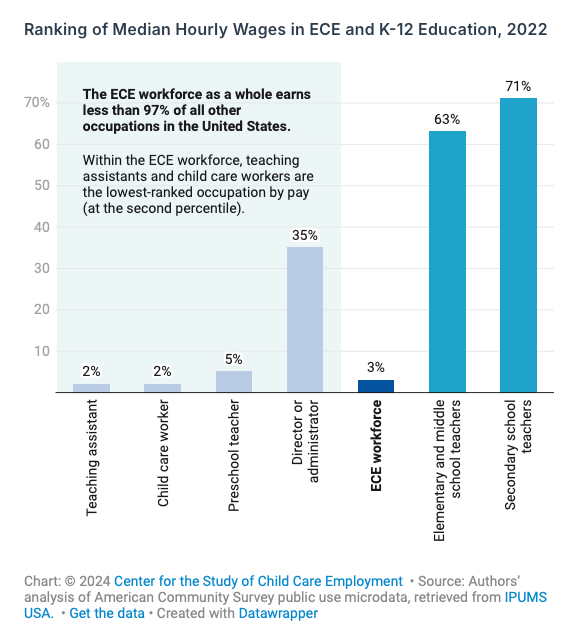
To be clear, the unregulated free market has done a terrible job of managing the costs and wages of childcare. Even though the average annual cost of childcare in the United States has skyrocketed to $13,128 per child, early childhood education (ECE) professionals are among the lowest-paid jobs in the entire United States—below 97% of all other jobs.
“New Mexico has currently set aside $60 million for increased wages for the state’s child care workforce,” Fischer writes. “A working group is now refining a ‘wage scale and career lattice framework’ intended to support experience, education, and quality.
Right now, New Mexico is encouraging employers to pay higher wages in order to unlock higher reimbursements per child. Fischer writes:
Mirna Polendo, the director of Imagination Station, a Christian preschool in the mountain resort town of Ruidoso, made some changes to her program when the state moved to a universal system. New Mexico pays enhanced rates to centers that are open at least 10 hours a day and that pay increased wages to teachers. Polendo extended her hours from 7:30 a.m. to 5:30 p.m. and bumped employee wages to $17 an hour to qualify for more state reimbursement.
In return, Polendo receives $1,400 per month from the state to care for an 18-month-old infant, $1,075 for a toddler and $890 for kids ages 3 to 5. Across the board, the state reimburses more for care than private tuition ever did.
When taken into consideration alongside Wallack’s observations of New York City’s universal childcare program, Fischer’s story indicates that childcare might just be the next major issue for middle-out leaders. It’s a policy that benefits a huge number of American workers, it eliminates one of the fastest-rising price pressures of the last decade, and it helps reestablish the wages of a criminally underpaid segment of the workforce. And of course, those higher wages will have the added benefit of growing the local economy for everyone as childcare workers spend their bigger paychecks in the community.
Those leaders who do decide to take up the mantle of universal childcare need to keep in mind the lessons from New York: It’s not enough to pass a popular policy—you also need buy-in from people who will fight to protect your policies from entering the trickle-down death spiral, when you’re no longer in office to defend them. Now that we’ve seen that universal childcare is possible in America, I expect to see a lot of exciting innovation in the political and policy design of this issue in the months and years ahead.
As the price of beef continues to skyrocket, South Dakota representative Dusty Johnson went on Newsmax to justify the prices by saying it’s “still an incredible value. We’re not used to paying $8 or $9 for a pound of ground beef, but you compare the nutrition in a pound of beef to a $9 bag of chips, and I would tell you beef still packs a powerful punch.”
The Center for American Progress published an extensive report documenting how the Trump administration’s budget cuts could potentially result in disaster for Americans on two major fronts: First, by cutting the National Weather Service budget, the administration is making us less prepared for potential weather disasters. Second, by slashing the Federal Emergency Management Agency budget, they’re reducing government’s ability to respond to those disasters once they’ve passed.
“1 in 10 U.S. workers (15.5 million) finds her primary job in a ‘nonstandard’—i.e., subcontracted, temporary, on-call, on-demand, or freelance—work arrangement,” reports the National Employment Law Project. Those workers are much more likely to suffer losses of wages and benefits than workers in more traditional employment situations.
For the Center for American Progress, Rosa Barrientos-Ferrer writes that the Deferred Action for Childhood Arrivals program, despite being under attack from the Trump administration’s continued campaign of forced deportations, is one of the most important tools to help America overcome a nursing shortage.
Bloomberg Law reports that dozens of former federal employees who lost their jobs due to the so-called Department of Government Efficiency cuts that brought about the biggest federal workforce layoffs in living memory are now running for Congress around the country. This could inspire a necessary civic conversation about the importance of federal employment and funding, and how it relates to local economies. For a lighter look at the issue, the Daily Show recently profiled several DOGE-d candidates from around the country:
Civic Ventures founder Nick Hanauer appeared on the Hot Girl Finance podcast to talk about his history as the first non-family investor in Amazon.com and his eventual realization that growing economic inequality could eventually lead to global chaos. It’s a great overview of Nick’s deep roots in the business world and his evolution as an economic thinker:
As I mentioned at the beginning of this email, in this week’s Pitchfork Economics podcast, Nick and Paul talk with Kathryn Anne Edwards, the host of the excellent Optimist Economy podcast, to talk through her thoughtful three-part series for Bloomberg exploring AI-inspired job losses and potential policy responses that can help workers—and therefore the economy—survive the adoption of artificial intelligence.
Unfortunately, this week, primary voters in Oklahoma rejected a measure to raise the state minimum wage to $15 an hour by 2029.
“More than 350,000 Oklahoma workers will not receive raises that would have totaled to over $783 million as a result of Question 832 failing,” writes Claire Bernard at Bloomberg Law. “Oklahomans last received a minimum wage increase when the federal floor was raised in 2009.”
Putting on my political operative hat for a moment, I’d say the measure failed in large part because it was moved by executive order from the November 2024 elections to the June 2026 GOP primary ballot, thanks to meddling from the conservative governor and business and farm lobbying groups. The enduring popularity of a higher minimum wage with independents and the broader voting base suggests that the measure likely would have passed had it been on the ballot in the high-stakes 2024 general election.
So, thanks to the dirty pool that defied the will of voters who supported the initiative in 2024, Oklahoma will still be one of the 20 US states whose minimum wage sits at the federal minimum of $7.25 an hour.
In a fantastic newsletter, economist Arin Dube recently looked at the differences between the economies of the 30 states that have raised the minimum wage above $7.25 since 2013 and the 20 states that still have a $7.25 minimum wage.
Dube finds that there is now a huge and growing gap between workers in the states that raised the wage and workers in the 20 states that haven’t. “In the 30 ‘raise states,’ the average floor climbed from $7.60 in 2010 to $14.44 by 2025,” Dube writes.
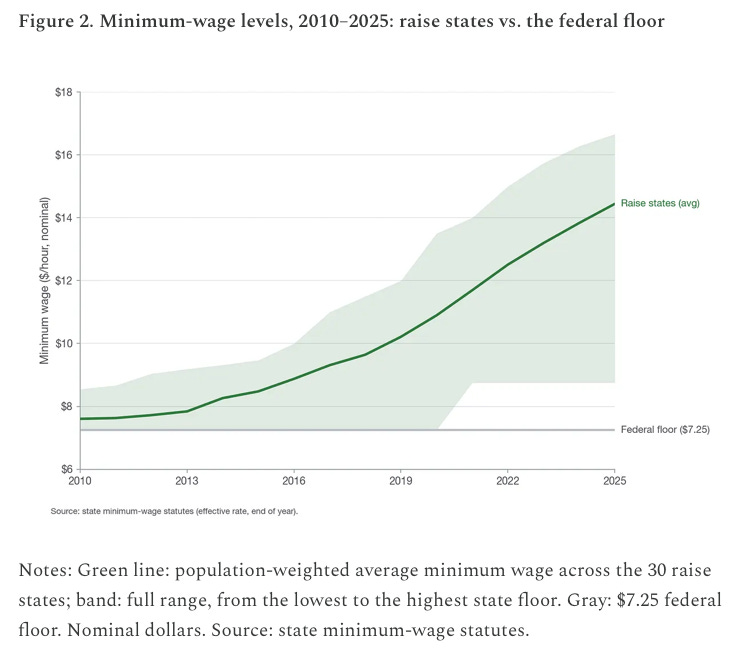
“The light green band shows the spread between the lowest and the highest of these floors by year, ranging from $8.75 in West Virginia to $16.66 in Washington in 2025,” Dube continues. “For the 20 ‘federal-floor’ states, in contrast, the nominal minimum wage remained stagnant at $7.25 throughout the whole period.”
One of the big arguments made by trickle-down opponents to Oklahoma’s minimum wage was that only a small portion of workers were still actually only receiving $7.25 per hour—most employers had to pay more than that to attract workers. This meant, the trickle-downers argued, that the free market was raising wages for everyone.
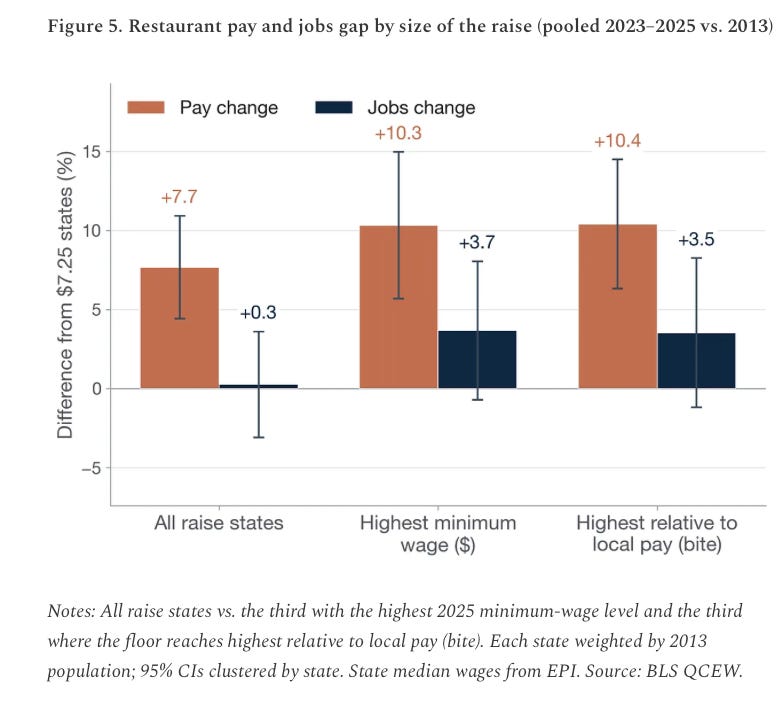
Dube crunched the numbers for restaurant workers in the 30 states that raised the wage against workers in the 20 states that didn’t, and he found that overall wages have stayed virtually flat in states with a $7.25 minimum wage. He found that “the average wage grew by around 7.7% ( ±3.3%) more in the raise states since 2013.” In other words, raising the minimum wage actually increased the wages of other workers in the same field who earned more than the minimum wage.
Dube also found that the higher the minimum-wage increases, the more jobs were created compared to states with $7.25 minimum wages.
Most Americans understand how this could be the case: When you pay restaurant workers enough money that they can afford to eat in restaurants, that’s good news for everyone. Restaurants have to hire more workers to meet the increased consumer demand, and those workers have more money to spend in the economy.
It’s a message that is easy to understand intuitively, and that’s why raising the minimum wage is universally popular—and it’s also why trickle-downers and the politicians who do their bidding have to resort to changing the rules to subvert the will of the people. That kind of interference can only go on for so long before people respond by voting in candidates who fight for them rather than against their will.
Be kind. Stay strong.
Zach
Comments
Nothing yet. Say the first thing.
Sign in to join the conversation.