
Friends,
We have a lot of ground to cover this week, including a new inflation report, some startling consumer and worker data, and the looming Social Security “crisis” that is actually pretty easy to fix.
But first, we have to address an op-ed in the New York Times that tries to reframe the debate about affordability and inequality by answering a simple question: How big is the American middle class?
To give you an idea of what the piece concludes, we have to recognize that the authors of this editorial are Stephen J. Rose and Scott Winship, two economists who work at the libertarian-leaning American Enterprise Institute. Their piece immediately attacks the proposition that inequality and affordability are hollowing out the middle class, and tries to debunk the commonly accepted idea “that many families can no longer achieve the American middle-class dream the way their parents once did.”
This editorial, if left uncontested, will serve as a handy link that trickle-downers can throw into thousands of editorials opposing raising the minimum wage, improving outcomes for working Americans, and combating inequality. The New York Times’s credibility will allow those arguments to gloss over the realities of the economy for the vast majority of Americans. It’s a foot in the door that allows a smooth-talker the space and time to make economic arguments that would otherwise never fly in polite company. So it’s important that we take the time to recognize this argument for what it is and debunk it fully.
Here’s the nut of AEI’s argument from the Times editorial:
In 1979, 36 percent of families were in the middle class. At first, it looks ominous that by 2024, a smaller number — 31 percent — could claim that status. But it’s worrisome only if you overlook that over the same period, the upper middle class grew to 31 percent of families from 10 percent. Meanwhile, the number of Americans falling short of the middle class — once more than half — dropped to 35 percent of all families.
The traditional middle class shrank because so many families became better off over time, not because more people fell short.
The first thing we have to address is AEI’s definition of the term “middle class.” AEI measures the 1976 inflation-adjusted “middle-class” against the 2025 poverty line: In other words, they measure 1976 incomes, given a modest bump for inflation, against modern standards of living. The Pew report on inequality, by contrast, has for decades measured family wealth and class against that year’s median income—and Pew’s findings line up much more cleanly with the typical American’s assessment that the rich have gotten richer while everyone else has lost ground.
Pew noted in 2022 that the “widening of the income gap and the shrinking of the middle class has led to a steady decrease in the share of U.S. aggregate income held by middle-class households.” So for example, “In 1970, adults in middle-income households accounted for 62% of aggregate income, a share that fell to 42% in 2020.”
In short, AEI selected the broadest definition of the middle class and muddled the numbers to support their worldview. Winship and Rose also do not explain in the Times the way they measure inclusion in the upper, middle, and lower classes. For that, you have to read their full report at AEI. There, they state their thesis right up at the top of the report: “using a definition of the middle class that keeps the entry and exit points constant in terms of purchasing power tells an unappreciated story.”
This is very important—and, again, it’s never mentioned in the Times piece. Rose and Winship are comparing two American families from two different time periods—one family from today and one from 1976. And to measure their economic health, they ask: “Does the 2026 family have more purchasing power than it did in 1976?”
When you just measure those two families together using economic tools that purposefully undercount inflation, it is strictly true that modern families across the economic spectrum have more purchasing power. But Winship and Rose didn’t compare the worlds of 1976 and 2026. Just because a family can purchase more items from AEI’s carefully selected list of goods for less money now than their economic peers did a half-century ago doesn’t mean that families have more aggregated wealth or opportunities than they used to.
As the Washington Post pointed out in 2024, families today spend about a third less on groceries than families 50 years ago, and about half as much on clothing. However, they’re also paying nearly a third more on housing and nearly double on health insurance. Using this EPI cost-of-living calculator for my home of Seattle, we can see that the average family of four spends $30,052 per year on housing, $14,613 annually on groceries, and $15,150 per year on health insurance. You don’t need a degree in accounting to understand that the modern family’s savings on groceries compared to the 1976 family are dwarfed by the tens of thousands of dollars in additional housing and healthcare expenses that the modern family has to pay.
We could pick AEI’s argument apart for the entirety of this email, but suffice it to say that you can’t just compare a 1976 family directly against a 2026 family without accounting for all the complex economic changes that have occurred in between. Wealth is accrued differently, people spend money differently and on different goods and services, and goods are manufactured, distributed, and purchased differently.
A few weeks ago, I wrote about the fact that we most often use the words “working Americans” in The Pitch to describe the broad majority of the population because the old terms of lower, middle, and upper classes have become so scrambled and uneven that they no longer make any sense. This editorial and report from AEI is a desperate attempt to dust off those old class descriptors and make them fashionable again.
Why does AEI want to revive these old-fashioned class distinctions? Because as we learned during the trickle-down era, it’s much easier to pit Americans against each other when they have a distinct “other” that they can punish. From the 1980s through the beginning of the 21st century, most Americans believed they were in the middle class, even if their wealth fell above or below the true definition of middle-class living. That made it easier for presidents Reagan and Clinton to villainize the poorest Americans as takers and to use those bad feelings to rationalize cuts to the social safety net.
What AEI doesn’t seem to recognize is that Americans have given up on those distinctions. In current economic polling, most people now see the economy as divided between two groups: The vast majority of Americans who work for a living, and the tiny group of wealthy folks who don’t earn their wealth through salaries but rather through financial wizardry, hoarding, and manipulations of the system that suck tens of trillions of dollars’ worth of wealth from the paychecks of everyone else.
Last Friday, the economics world reported on the release of a jobs report that they hailed as good news for American workers. “The labor market is finding its footing,” NPR’s Scott Horsley wrote.
“Restaurants and bars added 48,000 jobs last month in anticipation of strong summer demand,” he continued, “while the overall hospitality industry added 70,000 jobs. Construction companies and local governments were also hiring. Healthcare, which has been a steady source of employment gains, added another 35,000 jobs.”
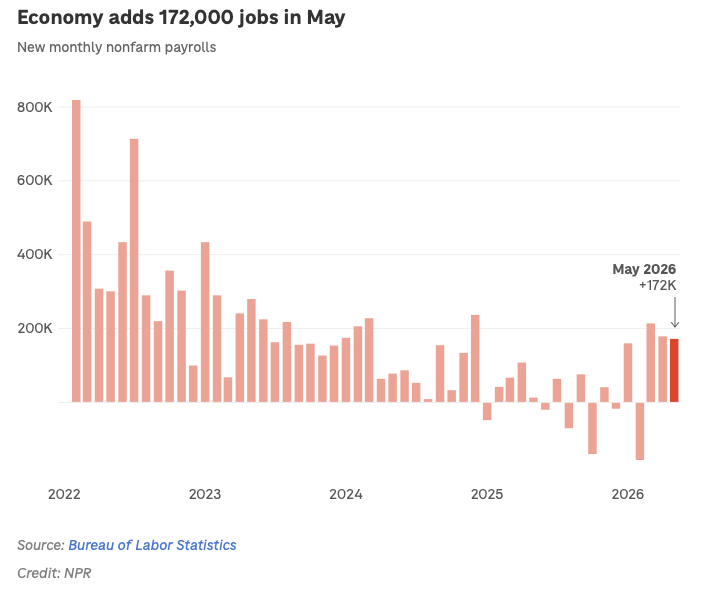
There was plenty of good news in the report, to be sure: Some 83,000 Americans either started new jobs or started or relaunched their job searches, which demonstrates some optimism that has been missing over the last year or so in the labor market.
The fact remains that the job market is not exactly roaring. Layoffs are still not broadly rising, it’s true, but the construction industry and manufacturing are still way behind in terms of job creation. And when you look at the paychecks of American workers—the truest indicator of the nation’s economic health—things are much shakier.
To explain what’s happening to those paychecks, we need to look at another report—specifically, the monthly inflation numbers, which were released on Wednesday.
“U.S. consumer prices rose 0.5 percent in May and were up 4.2 percent from a year earlier,” New York Times reporter Ben Casselman wrote yesterday. He added that so-called “core” prices, meaning inflation “excluding food and energy, were up 0.2 percent month-over-month and 2.9 percent year-over-year.”
“In inflation-adjusted terms, workers have now seen *zero* wage gains since Trump returned to office,” Casselman writes. He explains, “the surge in prices over the past few months has wiped out all of the real wage gains made in the first year of Trump’s second term.”
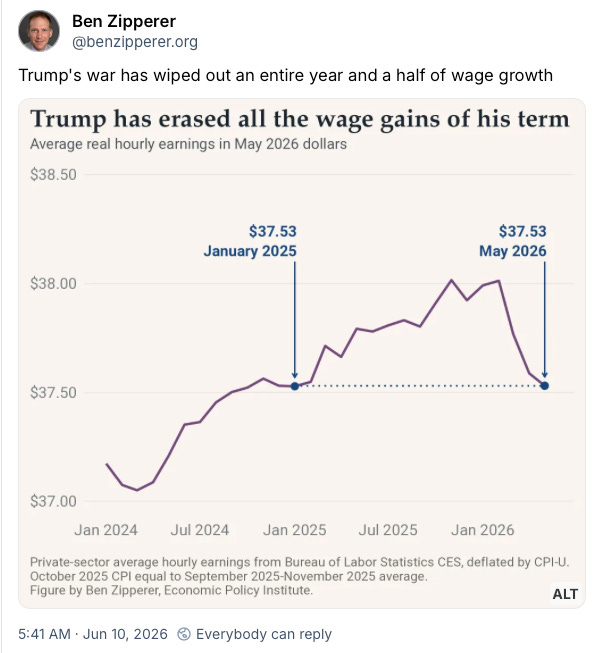
Paychecks tell us where the economy is most likely to go next. When your paycheck grows, you’re going to spend that money in the local economy. And when everyone’s paychecks are growing, that increased consumer demand creates jobs.
Now, paychecks are shrinking compared to the rising prices caused by the closure of the Strait of Hormuz and the forced migration campaigns of the Trump administration, among other pressures. Economist Aaron Sojourner reports that if this trend of rising prices and flatlining or declining wages continues for the year, an hour of your work will actually buy 5.4% less than it did last year:
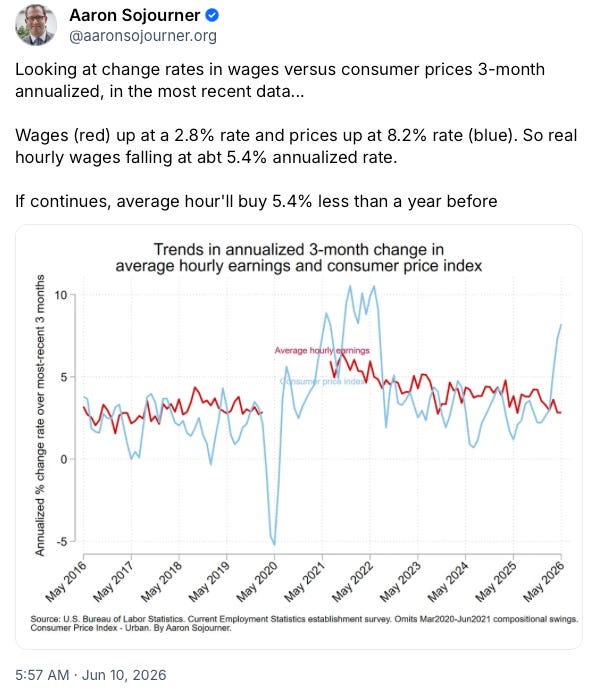
When Americans see prices rising faster than their wages, they pull back on spending, and that results in less job creation. In the next section, we’ll dig into some of the most distressing signs that American consumers might be approaching a breaking point.
“American consumers have kept the economy afloat for years, even as inflation, high borrowing costs and rising grocery bills squeezed household budgets,” reports Jing Pan at MoneyWise, adding that “some of the country’s biggest corporate leaders are now warning that shoppers may finally be hitting a breaking point.”
Steve Cahillane, the CEO of the Kraft Heinz corporation, recently delivered a somber assessment of the American economy. He warned that American consumers are “literally running out of money at the end of the month. We’re seeing negative cash flows in the lower-income brackets where they’re dipping into savings.”
Cahillane isn’t the only CEO who’s worried about the spending habits of working Americans. The CEO of McDonald’s recently talked about the “heightened anxiety” that the company saw in its customer spending habits. (I can’t in good conscience quote the CEO of McDonald’s talking about economic anxiety without pointing out the fact that his company is the poster child for extractive low-wage practices, and he could do his part to improve the economy for everyone by paying a living wage to his workers.)
Most of these CEOs report that the war in Iran, with its attendant closure of the Strait of Hormuz and skyrocketing gas prices, were the real breaking point for their customers. That’s when Whirlpool CEO Marc Bitzer reported that his company started to see “amplified consumer concerns about the cost of living.”
“According to the Bureau of Labor Statistics, food prices in the U.S. have increased 33.3% since the beginning of 2020, while housing costs are up 32.5%,” Pan writes. “Energy prices, meanwhile, have surged 48% over that period.”
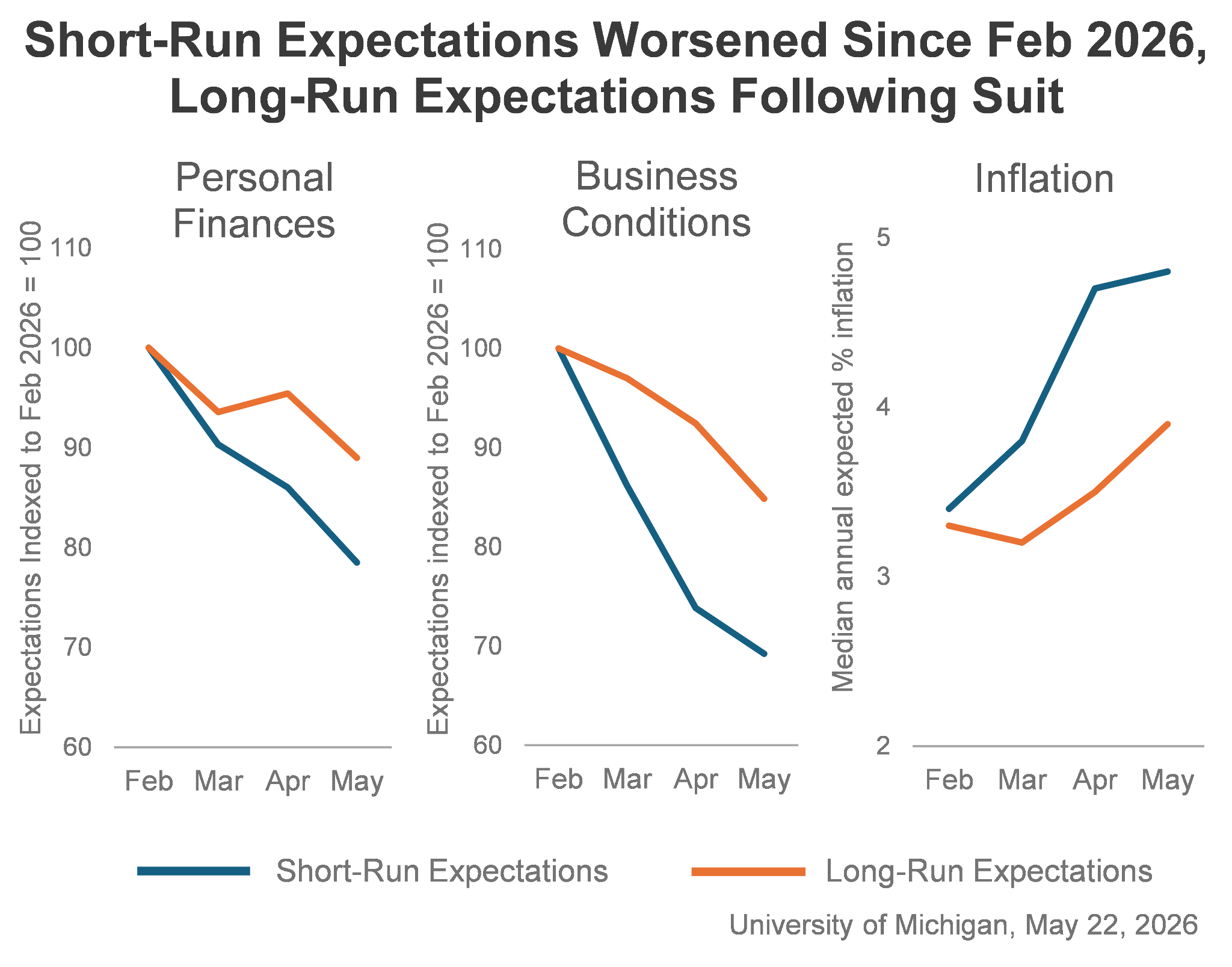
With all that in mind, is it any wonder that the gold-standard University of Michigan consumer sentiment study shows a dramatic decline in optimism from American consumers about the future of business conditions and personal finances over both the long term and the short term, or that consumers expect inflation to continue to climb in the near and far future?
For the Guardian, Heather Timmons points out that it’s not just the high prices that are driving consumer sentiment down. “Many consumers feel they are constantly fighting against an onslaught of overcharges, customer service hassles, shoddy products and billing mistakes that always seem to go in the company’s favor,” she writes.
This might just sound like entitled griping, but Timmons points out that these failures of customer service are actually symptoms of systemic decline: “That toxic cycle is now being sped up by a Trump administration that is defanging government watchdogs, consumer rights advocates say.”
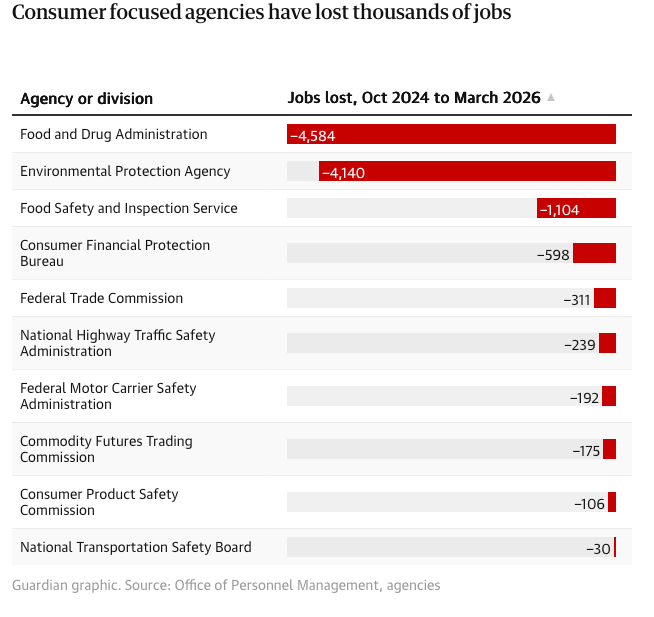
It’s not just the fact that the Trump administration has fired the watchdogs: Decades of deregulation have transformed the consumer experience into something genuinely ugly and exploitative.
“Federal laws and agencies that consumers depended on to protect them have been substantially weakened in recent years,” Timmons writes. “Supreme Court rulings over the past decade have weakened consumer protection agencies, backed forced arbitration and made it harder for consumers to get restitution.”
So everything is more expensive, the consumer experience is littered with grift and buffered with few protections, and paychecks have flatlined. American workers have plenty of reason to pull back on their spending—and they’re probably not going to be happy about President Trump’s comments in the Oval Office yesterday when asked if he was concerned about the latest inflation report.
”No, I love it. The numbers were great,” Trump said. “I love the inflation.”
Axios reports on the many proposals that billionaires are offering in the face of growing unrest as AI threatens to make income inequality even worse. These policies range from cutting taxes of working people to universal basic income, but the one thing they all have in common is that they would not interfere with the capabilities of the wealthiest few to hoard even more wealth. Oh, and also, none of the proposals include taxing the wealthy even a penny more than they already pay.
For the American Prospect, Robert Kuttner reports that American primary care physicians are “leaving the medical profession in droves because their conditions of practice have become intolerable. These doctors are being pressured to see more patients in shorter appointments despite ever more complex cases and treatment options, even as they are required to spend more time at computer terminals entering patient data. One recent paper in the Journal of General Internal Medicine calculates that primary care doctors, to meet all of their clinical and clerical obligations, would literally need to work 26.7 hours a day,” he writes. Many of these pressures are caused by corporate consolidation in the medical field and in health insurance.
“In an era of poisonous politics, Democrats, Republicans, and independents have found common cause over the value of tax breaks worth billions to Big Tech companies worth trillions,” reports Kuttner at the American Prospect. “What residents see in exchange are higher electricity and water rates, a paltry number of new permanent jobs, and a host of unsavory environmental impacts, from the desecration of green spaces, erasures of wildlife habitats, and air and noise pollution. The public outcry has had a serious impact: Across America, at least 25 different data center projects were canceled last year, and half of all data centers expected to open in 2026 will be delayed or simply canceled, according to reporting from Bloomberg.”
Senator Bernie Sanders proposed an interesting policy to address AI’s growing income inequality in the New York Times. It’s called the American A.I. Sovereign Wealth Fund Act, and it “would give the public a direct ownership stake in the largest A.I. companies in our country” by creating a “sovereign wealth fund through a one-time 50 percent tax — not on the profits of OpenAI, Anthropic, xAI and other companies, but paid with something far more valuable than that: the stock.”
Will Fischer at the Center on Budget and Policy Priorities reports that to address our high housing costs, leaders will need to expand renter assistance programs: “Housing vouchers and other rental assistance close the gap between the cost of housing and what households can afford. Rental assistance has proven highly effective at enabling people with very low incomes to afford stable housing. But only 1 in 4 low-income households who need rental assistance receive it due to inadequate funding, and there are long waiting lists for assistance. Policymakers should expand rental assistance toward the goal of guaranteeing it for everyone in need.”
We talk a lot in this newsletter and in our other channels about the fact that worker protections have been weakened by over four decades of trickle-down economics. In this week’s episode of Pitchfork Economics, Goldy and Nick talk with economists Lawrence Mishel and Josh Bivens about the specific decisions and policies that shrank worker paychecks and stripped workers of the hard-fought protections that were in place for much of the 20th century.
Elsewhere, Goldy made a fantastic video explaining how Senator Ted Cruz is trying to falsely disguise a tax cut for the super-rich as housing relief for working Americans. This is worth it for Goldy’s clear and passionate explanation of some wonky manipulations of the tax code alone, but there are also some striking visuals illustrating the point that I suspect you’ll enjoy:
Civic Ventures founder Nick Hanauer was interviewed on the very popular Diary of a CEO podcast this week, and it’s a wide-ranging, substantive economic debate about the role of government in the relationship between consumers, workers, corporations, and small business. Below is a small taste, and you can also watch or listen to the whole episode here.
And for the New Republic, Monica Potts interviewed Nick about the concepts behind Market Humanism and why an economic paradigm shift isn’t just likely to happen—it’s an absolute necessity. For what it’s worth, I love the headline on this interview: “What If Everything We Know About the Economy Is Dead Wrong?”
“The financial forecast for Social Security worsened this year, according to the annual financial report released on Tuesday by the program’s trustees,” reported the New York Times on Tuesday. “If Congress does not develop a plan to shore up the program, it will need to cut benefits for millions of Americans in just a little more than six years.”
The 68-million-plus beneficiaries of Social Security could see a drastic cut of 22 percent to their benefits by the end of 2032, according to the report. “But that situation would come to fruition only if lawmakers didn’t act to strengthen the program before then, through some combination of higher taxes or reduced checks,” the Times notes.
To be clear, this isn’t just a problem for the tens of millions of Americans who will receive Social Security benefits in 2032. It ultimately will harm the whole economy. “Social Security benefit spending supported more than 12 million jobs in 2023,” Meredith Mackenzie De Silva writes at the Roosevelt Institute. “And the checks keep coming even when the job market worsens, helping local economies get through hard times.”
Also for the Roosevelt Institute, Stephen Nuñez puts the report in context: “This does not mean that Social Security is failing. It means the economy is failing to support Social Security.”
For one thing, this is a known problem. “The Social Security Administration has known for at least 15 years that the trust fund reserve would reach this point sometime between 2033 and 2035,” Nuñez writes.
And contrary to popular belief, Social Security isn’t in trouble because of the large population of Baby Boomers reaching retirement age. It’s because Congress amended the rules through which Social Security is funded in 1983, and Nuñez explains that those amendments didn’t take into account “rising income inequality and the depth and slow speed of recovery from the Great Recession.”
The Great Recession piece is fairly obvious: Thanks to trickle-down policies that favored the wealthy and corporations, American workers saw 10 years after the Recession in which job growth and wage gains were stagnant. So a whole generation of workers simply didn’t make the predictable investments into Social Security that otherwise would have happened without that lost decade.
And then, “Rising income inequality starved the fund of expected revenue (and the opportunity to build reserves) because the vast majority of earnings gains went to workers with earnings that exceeded the FICA tax cap, which did not grow fast enough to capture them,” Nuñez explains.
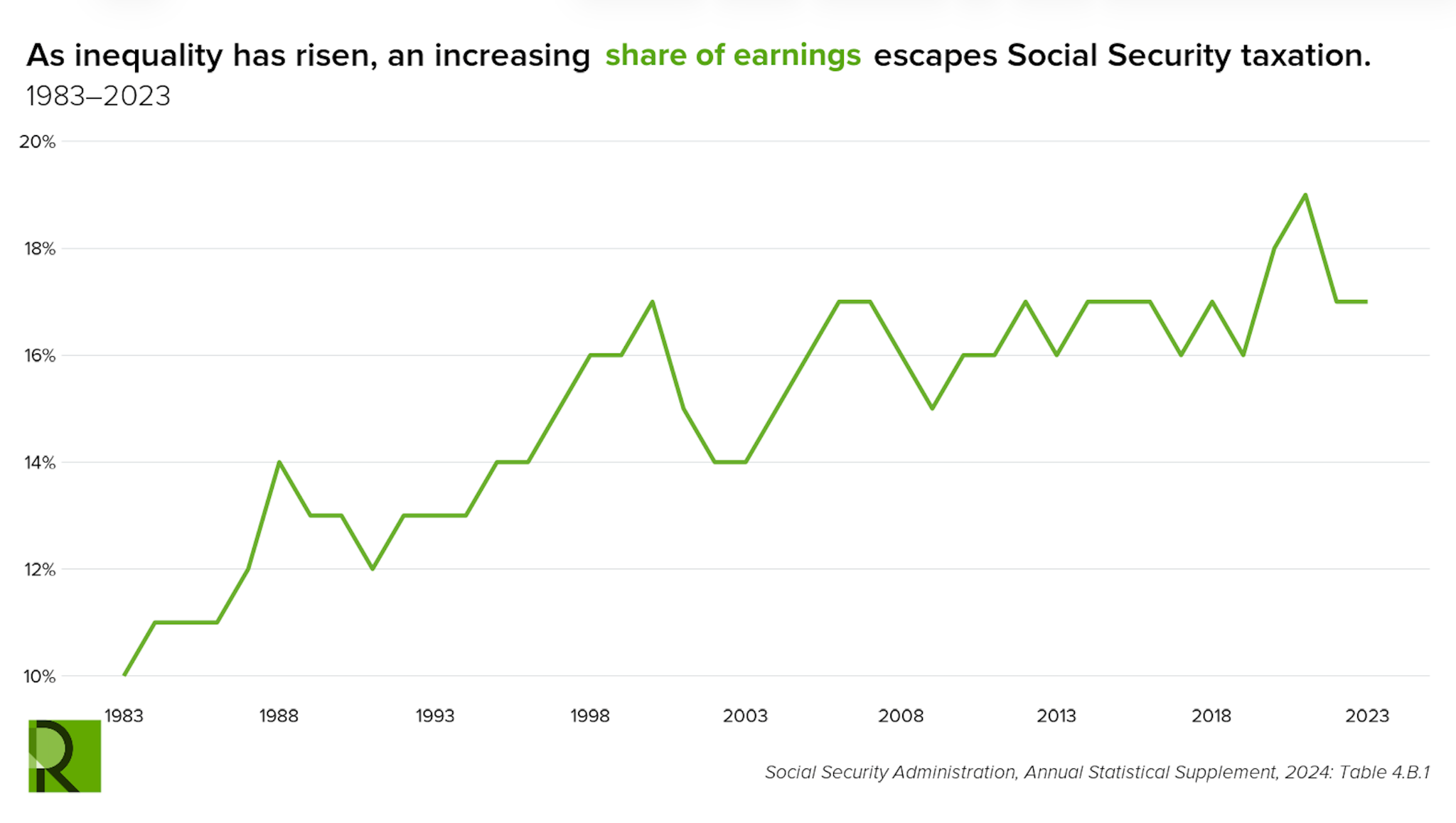
The great news is that we already know how to solve this problem. In fact, Congress has been sitting on a bill called the SSI Restoration Act since 2013. If passed into law, that policy would address the problems with Social Security that have lingered since 1983.
“The bill would reform SSI’s outdated asset limits, streamline benefit calculations, remove the SSI ‘marriage penalty,’ and increase the maximum benefit,” Nuñez writes with Jack Landry at Roosevelt. “The proposed reforms could both improve the material conditions of SSI recipient households and reduce the complexity and expense of administering the program.”
It’s the limits on Social Security taxes that are currently causing the biggest problem. Earlier this year, Civic Ventures founder Nick Hanauer identified the problem and proposed a simple solution. “The problem with Social Security isn’t that the benefits are too generous. It’s that the tax base has collapsed as inequality has shifted more and more national income above the cap,” Nick said. “If you make $60,000 a year, you pay Social Security tax on every dollar you earn, but If you earn $60 million a year, you stop paying after the cap of $168,000.”
That’s a lot of money that should be going into Social Security that isn’t being paid. Nick’s big idea is a very simple one, and it includes a big benefit for working Americans. “Let’s cut the Social Security payroll tax in half from 12.4% to 6.2%,” Nick said. “And then, this is key, apply the same 6.2% to all income with no cap. Wages, capital gains, dividends—everyone pays the same rate. No loopholes, no cliffs, no exemptions.
The beauty of Nick’s idea is that it would give “95% of Americans a 6% raise overnight. A real raise— not a tax credit, not a rebate. A permanent increase in take-home pay. For a median household, that’s between $3 and $6,000 a year, every year, forever.” And it would also ensure that “Social Security is fixed permanently—not patched, not kicked down the road.”
Social Security is one of the most popular policies in America. Working people inherently understand that it’s their money, and they trust it to be there for them when they retire. This week’s new report about the threat to Social Security may not have offered much new information, but it did offer an opportunity to litigate the issue in full view of the American public.
If middle-out candidates offer a simple and straightforward solution to the Social Security “crisis” that calls on wealthy people to pay their fair share into the system, it would force trickle-downers to go on the record explaining why the wealthy shouldn’t be expected to pay the same rate that their workers do. And in the current political climate, telling the American people to put up with less so that the wealthy can have more is not likely to be very persuasive at the ballot box.
Be kind. Stay strong.
Zach
Comments
Nothing yet. Say the first thing.
Sign in to join the conversation.