
Friends,
This week, we’re going to take a look at what the American people want to do about prediction markets, why prices won’t necessarily go back down if the Strait of Hormuz reopens to shipping traffic, and how care work became so underpaid in comparison to other careers. But first I want to talk about a step in the right direction on housing.
Since the 2024 elections, Congress has rightfully caught a lot of flak from voters of both parties for its inaction on a host of issues. The legislative branch of the federal government has failed to act on lowering prices, raising the hourly minimum wage from its shameful current rate of $7.25, or curbing the Trump administration’s harmful slate of tariffs and the war in Iran that caused the closure of the Strait of Hormuz.
So in the spirit of fairness, I want to point out that this week, Congress finally passed a bill that would lower housing costs for many working Americans, and it did so with sweeping bipartisan support, clearing the House with a vote of 358 for and 32 against, and the Senate by a vote of 85 to 5. These are numbers that we never see in our hyperpartisan times.
This is the first major housing bill from Congress in more than three decades.
“The 21st Century ROAD to Housing Act includes grant funding and pilot programs to build new homes. It would also ease some regulations and empower local governments to expedite reviews to build housing,” reports Sahil Kapur at NBC News, adding that “a key section titled ‘Homes Are For People, Not Corporations’ would limit any ‘large institutional investor’ from buying single-family homes.”
That last detail has garnered some of the biggest headlines in the wake of the bill’s passage through Congress. Kapur explains that it would “bar institutional investors that own over 350 single-family homes from buying more.”
“The measure would also have the federal government create model zoning plans, which local officials could then adopt as their own,” Tony Romm writes at the New York Times. “And lawmakers looked to retool billions of dollars in federal grants sent to states and localities, primarily aiming to reward communities that construct new residences.”
“The sum of those provisions could encourage more development as new construction is lagging,” Romm continues. “Housing starts in May fell 15 percent from the previous month, according to federal data, which is seasonally adjusted. That was a nearly 9 percent decrease from the previous year.”
As I write these words on Wednesday, news just broke that, even though the White House supported the bill’s advancement through Congress, President Trump canceled the signing ceremony for the bill hours before it was supposed to happen. Now he is demanding that Congress pass an unpopular bill that would limit the voting rights of Americans around the country before he signs the housing bill into law. Like so many of President Trump’s decisions in the past year, he’s holding the economic survival of working Americans hostage in an awkward attempt to pass unpopular policies that would only serve the president himself.
If Trump doesn’t sign the bill into law, it will go into effect in ten days. If he vetoes it, Congress does have a veto-proof majority and can pass it into law anyway. Or there is a slight possibility that Trump could enact a so-called “pocket veto,” which would kill the law if Congress goes into recess before the bill naturally passes into law in ten days.
But regardless of what happens to this housing bill, one thing seems pretty clear to me: By passing this bill with such popular acclamation, Congress has all but ensured that the housing conversation will remain at the top of mind in Washington, D.C. for the near future. Because on its own, this bill isn’t a solution to America’s ongoing housing affordability crisis. It is nowhere near big enough to address the size of the problem. In many parts of the country, buying a house now swallows up nearly three times the share of worker incomes than it did in 1980:
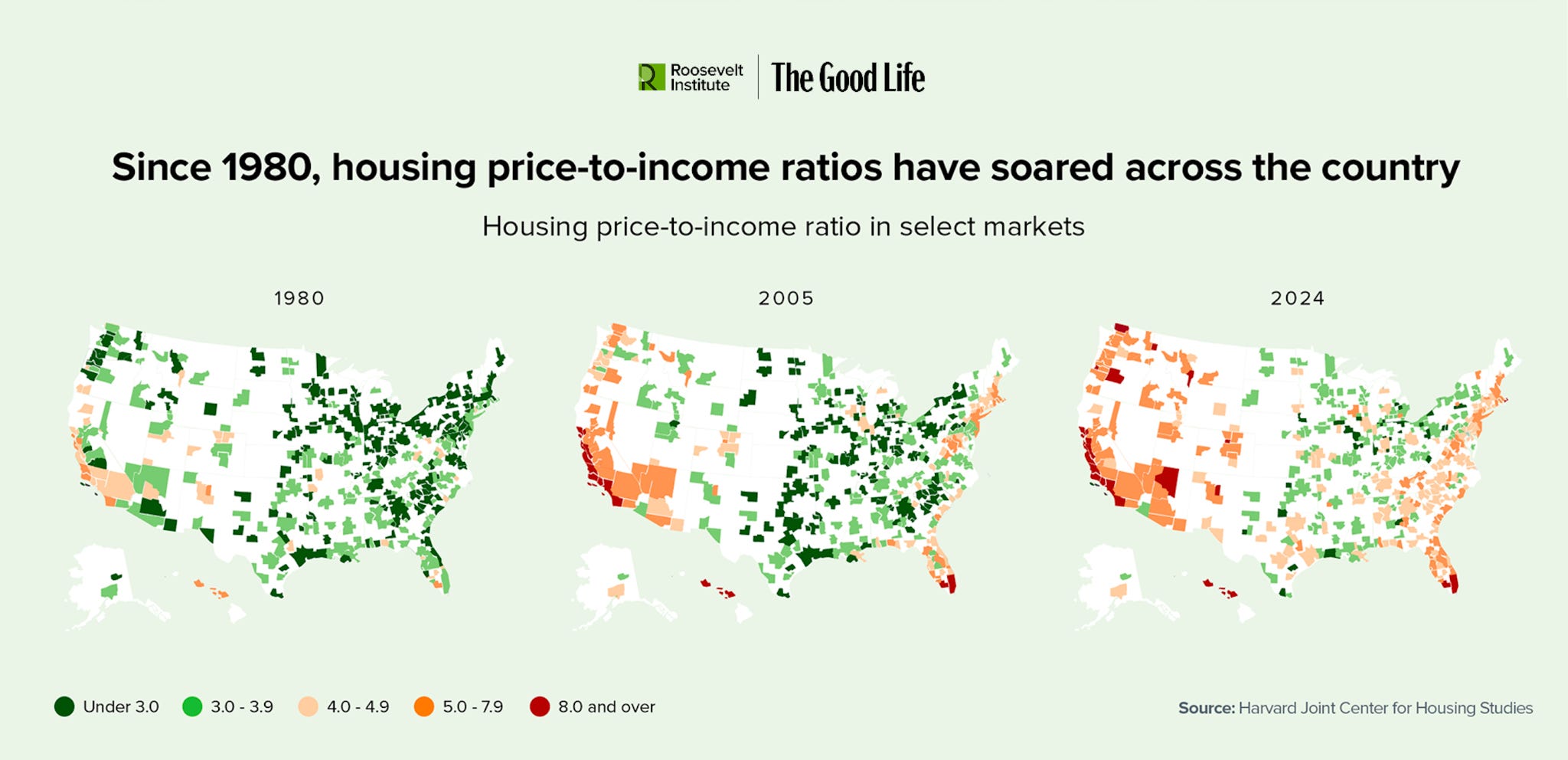
The nation needs millions more units of housing of all types in order to bring prices down and make buying and renting housing more attainable for everyone. Instead, if it does eventually become law, the bill should be viewed as the starting point for a conversation about how to truly address the outsized scale of the problem.
So with that in mind, let’s look at a few potential policy solutions to the housing affordability crisis that middle-out politicians should run on, whether the housing bill passes through Congress or not.
The Roosevelt Institute’s Good Life Agenda calls for a national construction financing fund to support the construction of housing, even if the Federal Reserve makes loans and mortgages more expensive by raising interest rates. It would also require those housing subsidies to be tied to increased labor standards that ensure construction workers can afford to live in the houses they help build.
The Center for American Progress has proposed “investing in new financing models and supercharging innovation to build more affordable homes at a lower cost; and protecting consumers and lowering other housing expenses by reducing junk fees and preventing collusive pricing,” which would lower housing costs for American families by an estimated $1,000 per year.
The Congressional Progressive Caucus has already written bills that would offer $20,000 investments for first-time homebuyers and call for “$1 trillion to create and preserve affordable and accessible housing, support public housing, expand homeownership opportunities, and expand rental assistance.”
And last but certainly not least, my coworker at Civic Ventures, David “Goldy” Goldstein, wrote an excellent piece for Democracy Journal envisioning a “public option” for housing. You should read the whole thing, but here’s the thesis: “What America needs is a massive investment in building a public option for rental housing, affordably priced and perpetually owned outside the rent-seeking impulses of the private market,” Goldy writes. “By issuing bonds against the revenue generated by future rents, local housing authorities can build millions of units of affordable middle-income housing at no cost to taxpayers.” The best part: “if they patiently wait for inflation to erode the value of the money borrowed, this publicly owned housing will grow even more affordable over time.”
Housing affordability is not a small problem. When mortgage payments and rent consume more than a third of a family’s budget, they have less money to spend on everything else—and that means the money which used to circulate through the economy is instead sucked up into the profit margins of big banks and corporate landlords.
Now that we’re talking about the need for investments in housing construction and support for renters who are at risk of being priced out of their homes in any given month, it’s clear that we need to devise even bigger and faster policies to make housing affordable for working Americans again.
If Congress can find near-unanimous support for a small bill to address housing affordability, that means constituents could probably press a clear majority of their Congresspeople to come up with solutions that meet the size of the problem—or they can vote for candidates who understand what needs to be done in November.
Just this morning, the Bureau of Economic Analysis issued its monthly inflation report, and the data show that the higher prices Americans are paying aren’t just due to the war in Iran—though for the New York Times, Ben Casselman notes that the invasion of Iran absolutely “made the whole U.S. inflation problem worse.”
“The Federal Reserve’s preferred inflation measure, the Personal Consumption Expenditures price index, rose 0.4 percent in May,” Casselman notes. “Prices were up 4.1 percent from a year earlier, the fastest annual inflation in more than three years.”
Casselman explains that the core inflation measurement, “which excludes volatile food and energy prices, rose 0.3 percent in May and was up 3.4 percent from a year earlier — a sign that the pickup in inflation isn’t limited to the categories directly affected by the war.”
Later on in this week’s issue, we’ll talk about why we can’t expect high gas prices to suddenly return to pre-war levels, even if the Strait of Hormuz opens. And of course we’ll have more to say about this morning’s inflation report in next week’s issue.
As the popularity of prediction markets continues to grow, Americans are seeing the downside of an unregulated industry that allows anyone to bet money on virtually any outcome on their phone in seconds. We’ve already seen what appear to be clear cases of insider trading, with government employees allegedly profiting from knowledge that nobody in the general public could possibly have.
About half of all U.S. states have responded to the rise of prediction markets by trying to formulate a regulatory response. Kentucky, for instance, claims that the markets should be governed by the state’s Horse Racing and Gambling Corporation’s right to license gambling within state lines. And Illinois is taxing bets placed on apps like Kalshi.
But Americans have made it clear that they don’t want a patchwork of state-by-state regulations, taxes, and rules for prediction markets. For Semafor, Eleanor Mueller shares a new poll showing that voters “in both parties prefer federal oversight of prediction markets to state oversight.”
“That breaks down to 48% of Republicans who favor federal oversight versus 27% who prefer state oversight,” Mueller reports, “while 45% of Democrats favor federal oversight and 35% prefer state oversight.”
When nearly half of all Republicans prefer federal oversight of an industry, you know things are getting serious. Americans can see the obvious capacity of unregulated prediction markets to become hotbeds of corruption and cultivators of gambling addiction, and they think it would be better to have one clear standard for the entire industry, as opposed to 50 different rulebooks depending on your geographic location.
And a new poll from Politico shows that a majority of respondents don’t believe that prediction markets should be allowed to let users bet on the results of political events, “like what President Donald Trump will say, who he will pardon, and the outcome of the 2028 presidential election.”
Political wagering seems especially ripe for corruption, which is why the Senate rushed to ban prediction-market trading for senators and their staff. The House hasn’t responded as quickly, though a ban on certain political-themed prediction markets did just recently move forward.
The American people outright hate the idea of their elected officials getting rich off of insider information that they receive on the job. A 2023 poll found that overwhelming supermajorities of respondents in both parties—87% of Republicans, 88% of Democrats, and 81% of independents—favor banning members of Congress from trading the stocks of individual companies for just that reason.
But when you watch this video of Georgia Senator Jon Ossoff calling for an immediate vote to ban stock trading and crypto purchasing for members of the Senate, you can see why the overwhelmingly popular policy hasn’t passed: Within seconds, Wyoming Senator Cynthia Lummis objected to Ossoff’s proposal “because there are alternatives” to an outright ban. It’s a classic ripped straight from the trickle-down playbook: Paralyze forward motion on good policy by gumming up the works, adding to the public’s overall sentiment that government is corrupt and unable to get anything done.
Lummis isn’t running for re-election, but Ossoff should continue to talk about this incredibly popular policy and force its opponents to go on the record. The American people can tell when someone is trying to sell them a load of BS.
For industry blog Grocery Dive, Catherine Douglas Moran highlights four numbers that show the strain on American consumers when it comes to food prices. She points out that the total food and drink purchases in America fell by just shy of one percent in the last week of May. In fact, total sales of food and drink in the U.S. fell for every single week in May. “Perishables sales last month dropped 0.8% year-over-year, with seafood taking the hardest hit and refrigerated dairy posting the only sales increase in the category,” she writes.
You don’t often see such a consistent drop in food sales over multiple weeks in a row, for the obvious reason that everyone needs food to survive. The biggest factor for this decline is that still-rising grocery prices, which increased by 2.7% in May, have finally hit the ceiling of what consumers are able to spend. Another number in Douglas Moran’s report backs that up: One survey found that nearly a third of all consumers—29%—reported using a buy-now-pay-later service to purchase groceries.
Another reason food sales are dropping: Fewer Americans are on the food assistance program known as SNAP, formerly known as food stamps. She notes that after the Trump administration cut support programs in order to fund their tax cuts for corporations and the rich, “SNAP participation fell by more than 3.5 million people” in less than a year. “Tightening food assistance eligibility has led to worries that more people could face food insecurity and turn to food banks,” Douglas Moran writes.
The worst part of all this is that those food prices are likely to continue rising. “The possible end of the Iran war will not cure the drought that has stunted the wheat crop,” writes David J. Lynch at the Washington Post. “It won’t secure soybean export orders caught in the U.S.-China trade war. And it will do nothing to promote competition in agriculture.”
“President Donald Trump’s February decision to join Israel in attacking Iran aggravated the farm economy’s struggles,” Lynch writes. “Soybean growers, who were already suffering from the president’s tariffs, are expected to lose money in 2026 for the fourth straight year.”
As a result, “Rural voters backed Trump’s economic policies by a 45 percent to 43 percent margin early last year but now disapprove of them 61 percent to 31 percent,” with about half of all agricultural workers saying that the economy is not headed in the right direction.
Lynch notes that “soybean prices are down by roughly one-third from their 2022 levels. The combination of higher input costs and lower sales prices leave many soybean farmers needing to borrow money.” But the problem is that even money is more expensive these days: “For loans in excess of $100,000, farmers face interest rates of nearly 7 percent, more than twice the figure from four years ago.”
If the Strait of Hormuz does reopen to cargo traffic, a large percentage of the world’s fertilizer supply will finally make its way to farms around the world. If the economy was the perfect system of supply and demand that trickle-downers would have us believe, that would mean fertilizer prices would drop, bringing grocery prices down with them.
But Lynch talks to one farmer who “worries that the small number of fertilizer suppliers will use their market power to keep prices high.” He’s seen that happen again and again due to “the agribusiness consolidation of recent years.”
Many of the high prices we’ve seen over the last two years have been the direct result of President Trump’s choices—primarily his campaign of tariffs and the war in Iran. But the farmer who Lynch interviewed is correct to assess that those prices will not naturally come back down thanks to the good hearts of the CEOs of big fertilizer corporations. The only way to bring prices down is to encourage competition—and that means breaking up the stranglehold that a handful of companies have on the market.
Similarly, Niraj Chokshi explains for the New York Times why airline ticket prices might not come back down if and when gasoline prices finally start to fall. “Even when fuel does become cheaper, airlines may not reduce fares for a long time because they want to recover the money they spent and have figured out that travelers are willing to pay more for tickets anyway,” Chokshi writes. Ticket prices have risen by 28% for domestic flights and 18% for international destinations since the war in Iran began.
Chokshi talks to an aviation business expert who suggests that “while many carriers in the United States, Europe and elsewhere will resist lowering fares, they could be forced to do so to remain competitive.” That’s an almost laughable thought, given how noncompetitive the airline industry has become.
Just this year, Congressman Jamie Raskin explained the problem with the industry during a Congressional investigation: “In 2000, the four largest carriers controlled roughly 60 percent of domestic traffic. Today they control about 80 percent,” Raskin said.
“One merger after another has consolidated the market power of the four major airlines: American, Delta, Southwest, and United,” he continued. “The result: higher prices, lower wages, and growing profits.”
So even if oil and fertilizer traffic begins freely flowing across the world, Americans don’t expect prices to come down. Is it any wonder why a record-low number of Americans report that they believe in the American Dream?
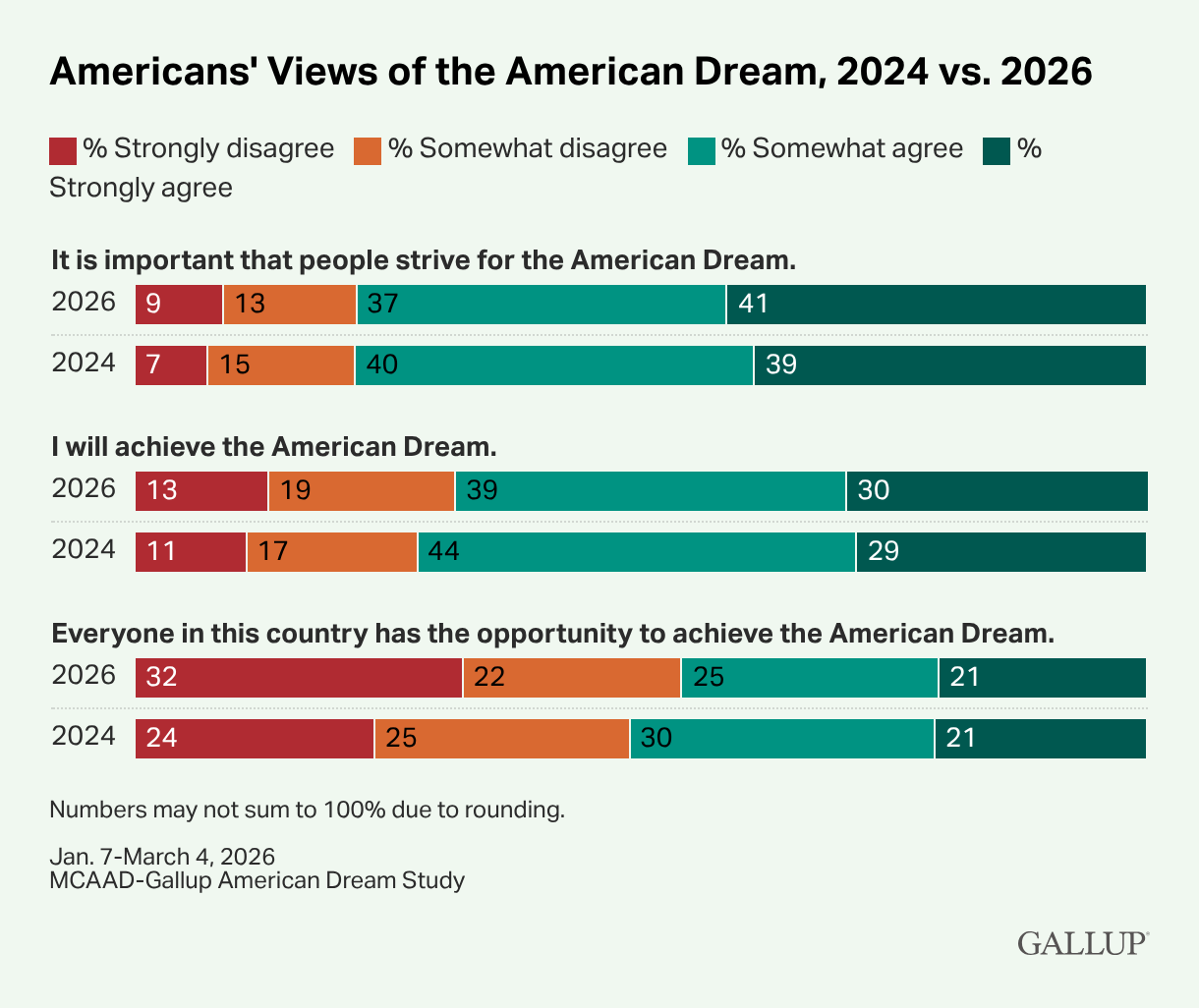
“Sixty-eight percent of respondents in a new Gallup poll” said they believed in the American Dream in terms of achieving economic success, reports Danielle Paquette at the Washington Post. That marks “a four-percentage-point drop from the last survey on the topic in 2024.”
This kind of self-reporting poll often skews too high because respondents don’t often want to admit that they’re experiencing economic anxiety or difficulties making ends meet. Tellingly, only 46 percent of the same respondents believed that every American “had the opportunity to attain the same success,” crossing below the halfway mark from two years ago.
Bad things happen when majorities of the public believe that the system has stopped working. The American Dream is a shorthand for the economic well-being of the country and its prospects for the future. The optimism behind the American Dream has been the secret weapon of America’s economy for our lifetimes—it’s encouraged countless business owners and workers to take bold swings and make big plans for the future. Rekindling that optimism and encouraging Americans to bet big on each other’s success will be the most important task for whoever becomes the next steward of the American economy.
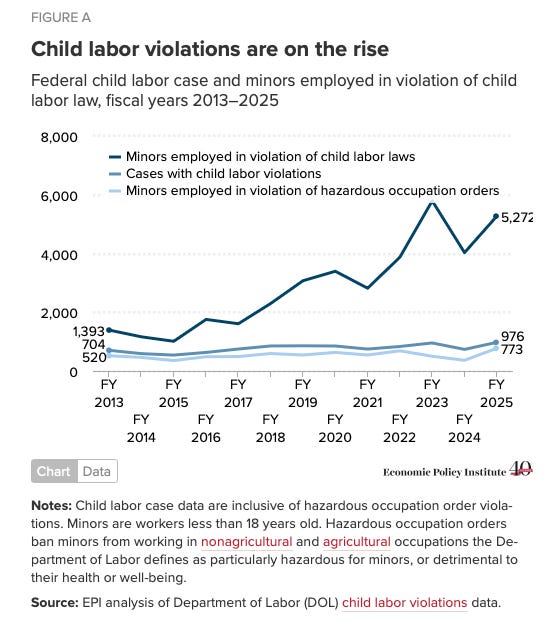
The Economic Policy Institute just issued a heartbreaking report showing that state lawmakers around the country continue to weaken child labor protections this year, while only four states worked to strengthen their child labor protections. Meanwhile, child labor violations are skyrocketing:
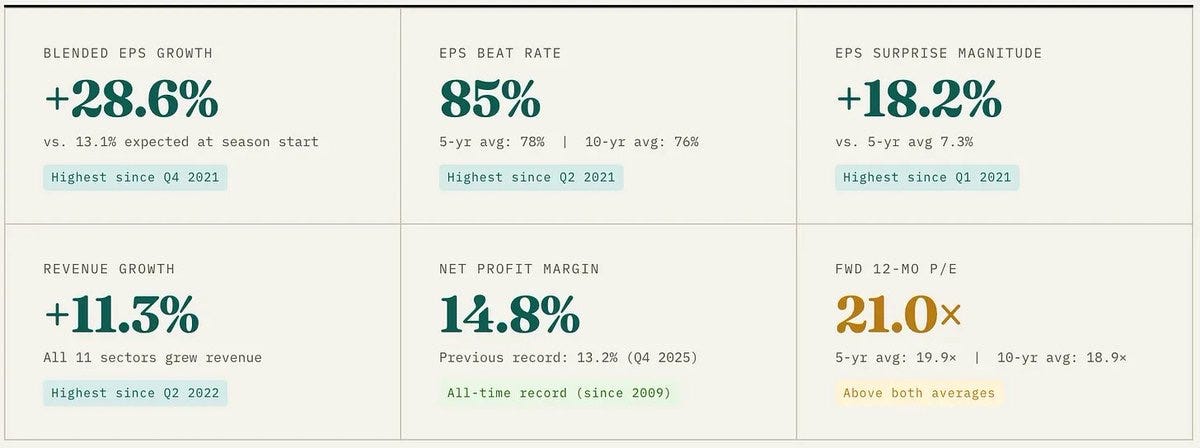
New York Times economics reporter Talmon Joseph Smith reports that corporate earnings were “insane” in the first quarter of the year, including a 14.8% net profit margin. This indicates that corporations are on track to continue their trend of hoarding record profits while the wages of workers barely budge.
This morning, Senate Democrats released the text of a bill that would “raise the federal minimum wage to $25 per hour in five years, drawing a contrast with Republicans at a time when many workers say they’re struggling to make ends meet,” reports Dave Jamieson. “The legislation is identical to a bill House Democrats put forward earlier this year, and shows a growing faction of the party is coalescing around $25 as their goal for a wage floor.” This is breaking news, and we’ll obviously have more to say about it next week.
Massachusetts Senator Ed Markey put forth two solid pieces of legislation that would protect worker rights in the 21st century: The No Robot Bosses Act would “put safeguards on the use of automated decision systems, which can include AI, to make work related decisions. Additionally, Senator Markey, along with Senator Schatz and Senator Cory Booker (D-N.J.), today introduced the Stop Spying Bosses Act to address the growing use of surveillance technology in the workplace.”
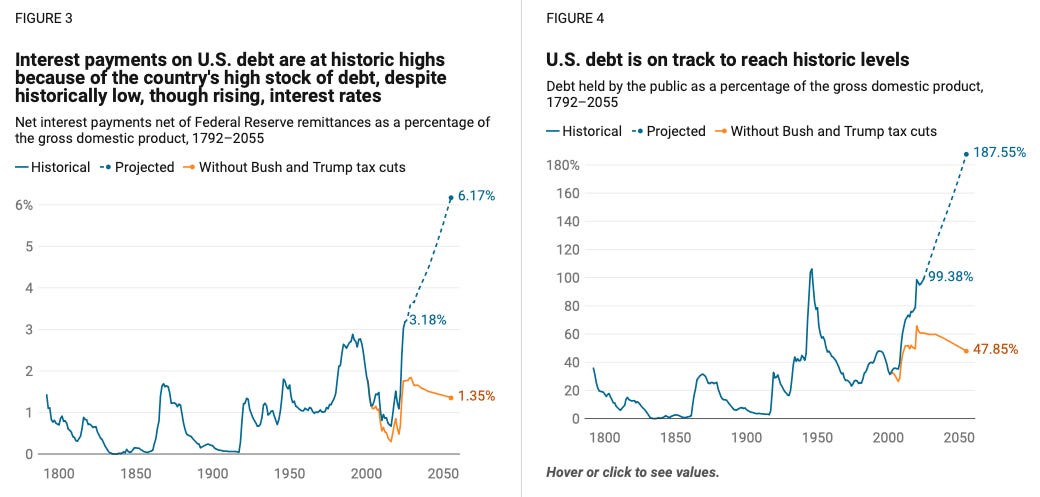
The Center for American Progress put out a report on the national debt that included several graphs showing how much the Bush and Trump tax cuts for the rich contributed to the debt. Without those tax cuts—depicted in the graphs below by an orange line—our debt would be on track to hit about half its current levels:
On his YouTube channel, Civic Ventures founder Nick Hanauer checks in on his prescient 2014 predictions that runaway income inequality would cause massive societal upheaval. He also explains three simple lies that rich people tell you in order to get you to support policies that increase inequality:
And on the Pitchfork Economics podcast, as part of our summer series exploring the myths that power trickle-down economics, we’re revisiting a conversation Paul and Nick had with former Labor Secretary Robert Reich about why regulations don’t kill growth.
The Roosevelt Institute published a new report this week about what it calls “the care cascade.” It’s based on the idea that workers in the care economy—which is to say, nurses, daycare workers, and other workers in hospitals, nursing homes, schools and childcare facilities—are continually at the bottom of a cascade effect that strips their careers of wages and benefits.
“The US relies on a DIY model of care that pushes responsibility downstream,” Jessica Calarco writes at Roosevelt. “Rather than treating care as a collective obligation, the system expects families to purchase or provide whatever care they need and absorb the costs when they can’t.”
In other words, because America has no affordable childcare program or a universal healthcare program, that means Americans are largely on the hook for childcare, intensive elder care, and care for disabled family members. But because working Americans have lost more than $80 trillion in wealth from their paychecks to the top 1 percent over the past 50 years, their yearly median household income is about half of where it would have been had paychecks grown at the rate they did during the postwar decades of the 20th century.
Because everyone earns less than they used to, they have less money to spend on care economy services. So either care workers earn less, or American workers have to leave the labor market to care for their family members rather than hire help.
We have to acknowledge that class plays a role in this problem, too. Men still earn more than women in the workplace on average, and white workers earn far more than equivalent Black or Hispanic workers. It’s no coincidence that care work is a field that is not favored by white men. In fact, “One in five careworkers nationally are immigrants, and 97.6 percent of them are women,” Calarco writes.
That’s why “ care in the US has reached a crisis point,” Calarco explains. “Americans need care, but most cannot find or afford the quality care they need to live with dignity.”
She continues, “At the same time, care workers are underpaid relative to other industries, leading to shortages and high rates of turnover, as all but the most vulnerable workers flee for better-paying work.”
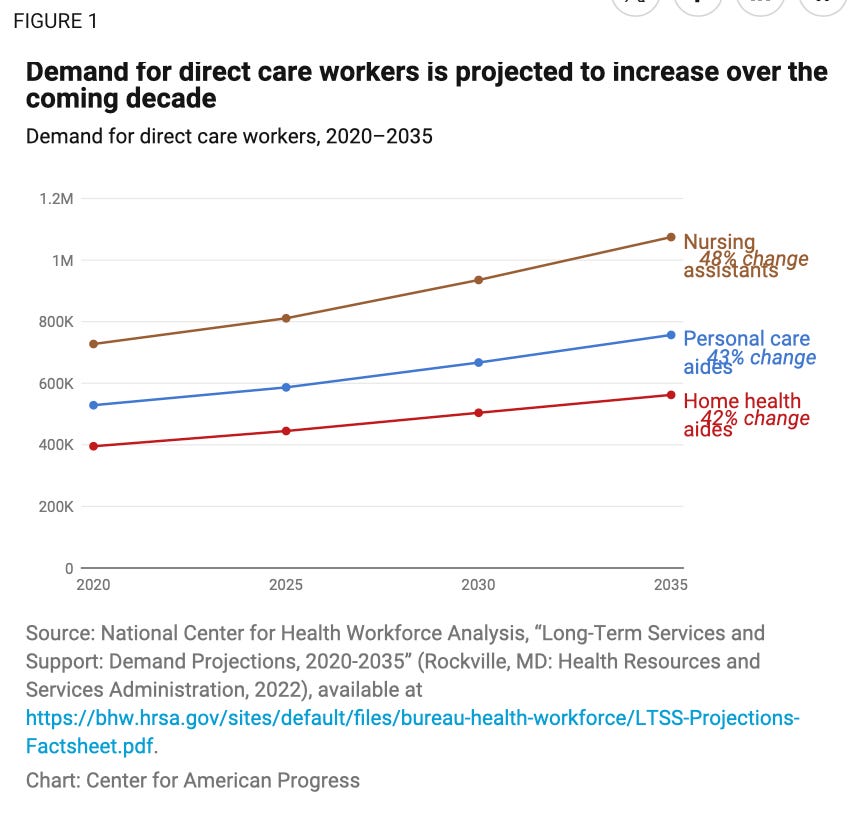
So even though the demand for care work continues to climb…
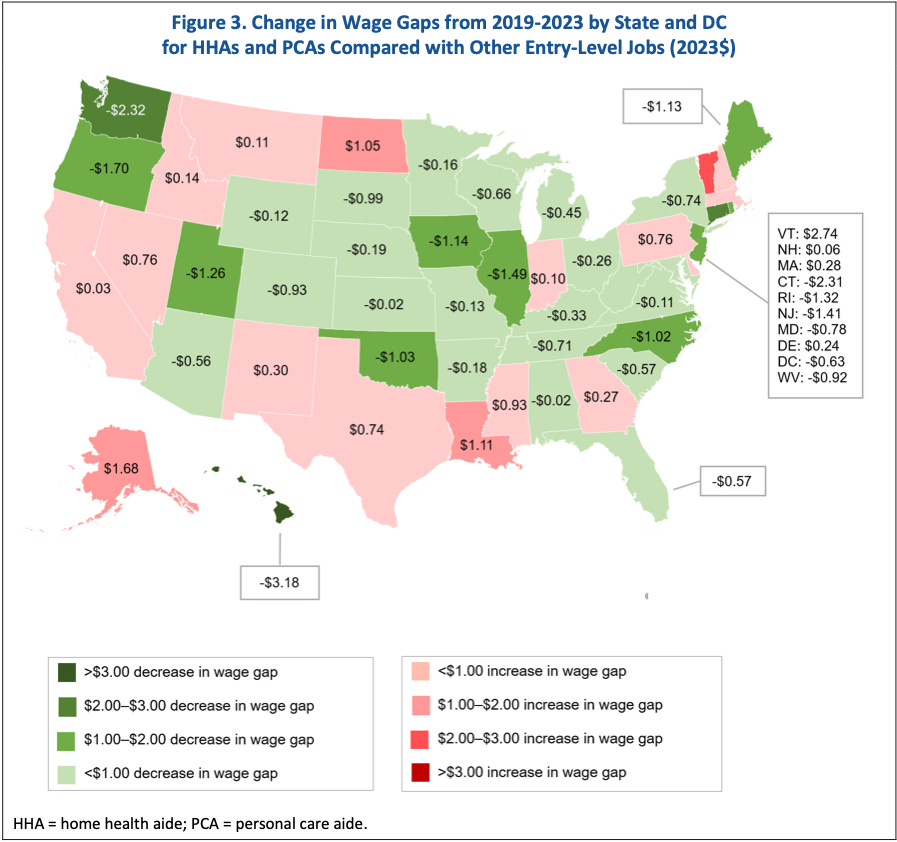
…care work pay continues to fall below the pay rate of other entry-level occupations.
For Capital and Main, Mark Kreidler points out that those numbers are even worse for public school teachers: “ According to the most recent data from the Economic Policy Institute, the gap between average public school teacher pay and that of comparable college graduates working in other professions hit a record 27% in 2024,” Kreidler notes. By contrast, “In 1996, the furthest year back before an interruption in data gathering, that gap sat at only 6%.”
Of course, this is another refutation of the trickle-down idea that the free market pays every worker exactly what they are worth. The law of supply and demand that we all learned in our Econ 101 classes should mean that the pressing demand for care workers will drive up wages, but that’s not what happens in real life. In fact, the opposite is true in red and blue states around the nation.
But those shrinking paychecks do have real-world results. Workers are finding jobs in other fields. “Worker shortages in caregiving professions—like K-12 teaching, nursing, social work, and mental healthcare—are likely to become increasingly prevalent as earnings in these fields stagnate,” Calarco writes, “and as policymakers push more of the costs of higher education onto students and their families.”
It should be clear to everyone that the unfettered free market is not going to solve this problem. In other words, it’s a problem that only government can solve. Many European nations have done just that, through universal healthcare and childcare programs. Just last week, we looked at two universal childcare programs that seem to be succeeding in New Mexico and New York City, and how they can serve as models for other states and cities to follow. We also touched on the fact that those policies must increase the pay for care workers.
Many of the sluggish jobs reports we’ve seen in the past year would have been even bleaker had America’s aging population not increased the need for care workers in the health sector. Healthcare jobs have been the one bright spot in one of a handful of the most tumultuous years for the American job market in our lifetime. But many of those care jobs are extractive, low-wage care work.
This is another reminder that it’s not just our duty to measure the quantity of jobs created in the economy every month—we need to make sure those jobs are high quality, too. If the people who care for our most vulnerable neighbors don’t make enough money to participate in the economy, the resulting inequality will have bad results for all of us.
Be kind. Stay strong.
Zach
Comments
Nothing yet. Say the first thing.
Sign in to join the conversation.