
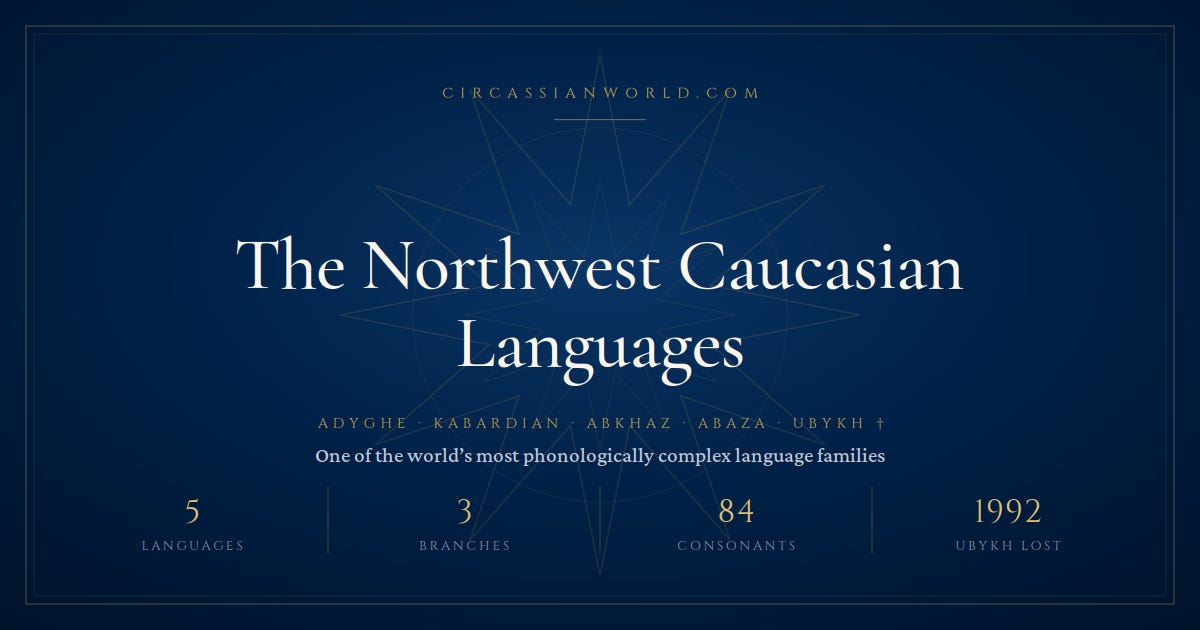
New The Northwest Caucasian Languages reference page
In October 1992, in a village near Istanbul, an 88-year-old man named Tevfik Esenç died. He had spent much of his later life sitting with linguists, most famously Georges Dumézil, who worked with him across four decades and credited him as co-author on publication after publication, an almost unheard-of courtesy toward a field consultant in that era. Esenç understood exactly what he was doing. He was the last person on earth who spoke Ubykh, and he was making sure that something survived him.
Ubykh had around eighty-four consonants. No language ever documented without click sounds has had more. Against them stood three vowels.
That ratio, an enormous consonant system balanced on almost no vowels, is the signature of the whole family to which Ubykh belonged, and which nobody outside a small circle of specialists tends to have heard of. The Northwest Caucasian languages are Adyghe and Kabardian, the two Circassian standards; Abkhaz and Abaza, their northern and southern cousins; and Ubykh, which stood between them and is gone. Together they form one of the primary language families of the world, indigenous to the north-western Caucasus and the eastern Black Sea coast, with no demonstrated relationship to any other family on Earth.
They are also, by some measures, among the most structurally extraordinary languages ever described. Abkhaz distinguishes words using two vowel phonemes. Kabardian verbs have thirteen prefix positions, so a single word can carry what English needs a full sentence to say. All five are ergative, meaning they cut the relationship between subject and object along a line that speakers of European languages find genuinely difficult to see at first.
We have published a new reference page on all of this, and it is the fullest English-language treatment of the family we know of anywhere online.
It covers the phonology in detail, ejectives, labialization, the vertical vowel system, and why the consonants swallowed the vowels historically rather than the other way round. It covers each language separately: speaker numbers, dialects, official status, sample vocabulary. It traces the writing systems through the Soviet alphabet churn, when Abkhaz alone went from Uslar’s Cyrillic to Marr’s seventy-six-sign Latin experiment to a Georgian-based script imposed in 1938 and back to Cyrillic only after Stalin’s death. And it includes a linguistic map of the Western Caucasus as it stood between 1774 and 1780, before the exile — on which every dialect discussed in the text appears as a named territory, Guma and Sadz and Ahchypsy among them, in the places their speakers still held.
Which brings us to the part that is not a linguistic story.
Every question about the future of these languages runs back through 1864. The mass expulsion of the Circassian, Abkhaz–Abaza and Ubykh populations to the Ottoman Empire did not merely displace people; it severed the village-scale transmission on which these languages had always depended. Communities that had spoken them for centuries were resettled among strangers, with no schools, no press, and no standard orthography. Two or three generations was usually enough. Ubykh took slightly longer and ended completely.
UNESCO now classifies Adyghe, Kabardian and Abkhaz as vulnerable, and Abaza as definitely endangered, meaning children are no longer learning it at home.
Esenç is said to have described his language as a bird that had flown away: you can describe it, but you cannot bring it back. Whether he put it in exactly those words is uncertain; the line circulates as a paraphrase. What is certain is that four of these languages have not flown away yet.
No posts
Comments
Nothing yet. Say the first thing.
Sign in to join the conversation.