
Deep-rooted tribal, and in later periods feudal, fragmentation ruled out any prospect of the Circassians conducting common affairs as a single people. As a result, they never developed a unified system of record-keeping, and consequently no indigenous Adyghe script emerged. During the spread of Islam, Circassians used Arabic to read religious texts, but fluency in that language belonged almost exclusively to men of clerical standing: mullahs and teachers at Islamic schools. The vast majority of the people, commoners and nobility alike, knew Arabic script, if at all, only well enough to recite the Qur’an, without grasping the meaning of most of the words. Not until the nineteenth century did enlightened Circassians such as Umar Bersey, together with members of the Russian intelligentsia drawn to Caucasian culture, attempt to devise a proper Adyghe alphabet; even then, efforts to bring the new script into everyday use came to nothing.
Nonetheless, across centuries, even millennia, the Circassians preserved a wealth of historical events and the biographies of notable figures within their collective memory. Until well into the twentieth century, it remained customary among the Circassians that any event significant enough to lodge itself in the popular consciousness would be marked by the composition of a song. Song carried enormous weight in Circassian life, as indeed it did elsewhere. Unable to read or write, and lacking radio, television or theatre, ordinary people entertained themselves by performing songs passed from mouth to mouth. Songs were sung without fail at every celebration, in any gathered company, and during the monotony of village labour. Alongside songs recounting past events, there existed ritual songs rooted in ancient pagan practice, among them ‘healing’ songs meant to persuade the spirit of some illness to leave its victim in peace. One such healing song, known as ‘The Song of Smallpox’, was performed outside the house of a smallpox sufferer. The principal composers and custodians of these songs, who fixed significant events for posterity much as the mass media do today, were itinerant singers known as gybzau, who performed so-called lament-songs about the various tragedies and misfortunes that had befallen the people, and dzheguako, professional organisers of popular festivities. The importance of folk song as the chief source of information about the past was reflected in how such professional singers were treated: those who composed and preserved songs never went hungry. Whatever door they knocked on, they were offered the best place in the house, and travelling singers were received with equal respect by commoners and feudal nobility alike. Naturally, in the course of being retold across generations, the historical reality depicted in these songs became distorted: the virtues of admirable heroes were exaggerated beyond measure, as were the failings of villains. Even so, the folk songs that survived into the Soviet era, when professional scholars began studying Circassian culture and history in earnest, made it possible to investigate the distant past of the people, the particulars of their way of life, relations within individual Circassian tribes, relations between tribes, and relations with other peoples.
A song recounting particular events paid close attention to the people involved in them, their biography and their personal qualities. Often an entire song would be devoted to the biography of a single figure, with the events in which he was involved unfolding incidentally within it. The central figure of a song might be not only a hero but equally a villain. Ethnographers have recorded whole songs devoted to traitors who aided enemies against their own people. Such songs, naturally, do nothing to honour their subjects or hold them up as models; on the contrary, they condemn them, underscoring the baseness of their conduct by noting that they had been raised by their own people before betraying them. These songs of censure abound in insulting epithets directed at those who left behind an unflattering memory, and just as positive heroes were endowed with extraordinary beauty, strength and courage, negative characters were often described as ugly, physically deformed, or contemptibly cowardly. Here one can trace an attentiveness to physical perfection and beauty of the human form that was characteristic of the old Caucasus, much as it was of the ancient Greeks, apparently a legacy of some still older culture that once spread across the broad expanse surrounding the Mediterranean and Black Seas. In earlier times, public opinion carried immense weight for every Circassian. No one wished to appear as a villain in a folk song, bringing shame upon himself and his lineage, for songs travelled fast across vast distances. It was largely through folk songs that the names of certain individuals who collaborated with the Russian military administration during the Caucasian War of 1818 to 1864 found their way into modern histories of Circassia. In other words, the stain that a song’s composer cast upon someone’s lineage might remain indelible for centuries afterwards.
The theme of social-class struggle features prominently in Circassian folk song. The shift from the traditional tribal order and military democracy towards feudal relations most likely began among the Circassians in the late mediaeval period. Military leaders and the warriors of their personal retinues accumulated ever greater quantities of war booty. This growing wealth made it possible to bind impoverished kinsmen into debt bondage, turning them into serfs of the tribal nobility. Because serfs and captives taken in war worked the estates of the nobility, the nobles had more time to perfect their military skills, essential to fulfilling their principal function of defending the tribe from external enemies. Gradually, the common people, occupied chiefly with agricultural labour, ceded ever more authority to their nobility. Noble tribal leaders, known as pshi and referred to in the Russian literature as princes, granted land and weapons to their permanent retainers, the uorks, referred to in the Russian literature as nobles. Among the uorks themselves, several ranks emerged in turn: some nobles answered directly to the princes, but relied in their service on a lesser class of minor nobles, among whom the land received from the prince was further distributed. In this way a typical feudal hierarchy took shape. Wealth, together with the people’s need for military protectors, encouraged the noble stratum to distance itself from the mass of the population. The feudal nobility developed its own system of governance and its own way of life.
Conflict between nobility and commoners was, of course, unavoidable. The frequent wars that swept across Caucasian lands throughout the mediaeval period and into the nineteenth century claimed many lives among the Circassian feudal class, yet at the same time reinforced its influence. It was the feudal cavalry that formed the principal striking force of the Circassian army, so working people were obliged to maintain their princes and nobles in order to guard against devastating enemy raids. The nobility, meanwhile, continued to enrich itself through the seizure of war booty and captives. Wealthy feudal lords sought to strengthen their position by exerting economic pressure on the common people. In particular, they would billet themselves at length upon village households, ruining their hosts, who were obliged by ancient custom to maintain the lord and his servants at their own expense. Lords also abused the custom of perfecting their military skill by rustling livestock from commoners (custom held that a thief, even a prince, if caught in the act, had to return everything he had taken, but village herdsmen found it difficult to catch feudal rustlers, who were, after all, professionals at their trade). Common people ruined by such practices were then forced to borrow provisions and fodder from the very nobles who had impoverished them, and if they could not repay in time, they became serfs of the nobility. This process, by which the feudal-tribal nobility rose and the common people were subjugated, continued among most Circassian tribes until the mid-nineteenth century and ceased only with the incorporation of the North Caucasus into the Russian Empire, when real power passed into the hands of tsarist officials.
The rise of the feudal stratum was, naturally, a gradual process, and by no means every prince or noble was unprincipled or grasping. Even so, uprisings among the common people periodically broke out against especially harsh lords, all the more so because the common people had not yet entirely lost their military significance: in major wars, every free Circassian man capable of bearing arms took the field. These episodes, too, were inevitably commemorated in song, preserved from generation to generation across the centuries. It is chiefly through such songs that the names of Circassian popular leaders who resisted feudal despotism, and who rallied the common people through their own authority to resist attempts by the nobility to exceed the bounds set by unwritten custom, have come down to modern historians and ethnologists, along with information about wars waged by tribes that had not undergone a sharp division into nobility and commoners (the majority of the Circassian tribes inhabiting the mountains of the Western Caucasus and the Black Sea coast fell into this category) against the feudal lords of neighbouring tribes. Among the songs recounting the latter is the song of the battle in the Oshneu gorge, composed by the Abadzekh highlanders. It tells of an attempt by Kabardian princes in the sixteenth and seventeenth centuries to subject the Abadzekhs, who lived under tribal democracy, to their rule. What is notable about the song is that it is sung, as it were, from the perspective of the Kabardians themselves, surrounded by Abadzekhs in a narrow gorge and lamenting their desperate position and the harshness of the mountain terrain: ‘Their [the Abadzekhs’] sun beats down cruelly, their gadflies bite like dogs, their swords leave no bones behind.’
Perhaps the most celebrated of the Circassian fighters against feudal oppression is Aydemirkan, the hero of Kabardian song, literally ‘the ward of Aydemir’. More songs survive about him than about any other hero. They describe not only his exploits but also his birth: the strikingly romantic episode of his abduction as an infant by an eagle, his upbringing by a shepherd named Aydemir, and his eventual return to his family home. His true parents are often said to be princes of the Mudarov line, yet, having been raised by a commoner, the hero retains a lifelong love and loyalty towards the common people. Aydemirkan is credited with extraordinary strength: the very earth is said to tremble as he rides his wondrous horse, Zhamansharyk. His principal adversary is the wicked Prince Beslan the Corpulent, clad in armour that no weapon can pierce. Aydemirkan repeatedly rescues poor commoners from Beslan the Corpulent’s injustices. At the same time, Aydemirkan is friends with another prince, Kambolet (Kanbulat). Beslan the Corpulent strikes a bargain with Kambolet, who deceives Aydemirkan into leaving the village without his horse or weapons. There, Beslan’s men fall upon him and kill him in an unequal fight. As a reward, the treacherous Prince Kambolet receives an impenetrable coat of armour from Beslan the Corpulent, but it does not save him from retribution: Kambolet is killed and beheaded. The figure of Kambolet carries an unmistakable message: the aristocracy always shares common interests, and a commoner can never trust a nobleman. In songs and legends, Aydemirkan is often called a Nart, a member of the people who, in the legends of various Caucasian nations, inhabited the Caucasus in the most remote antiquity (the tales of the Narts apparently reflect events of the pre-feudal, including late-primitive, era in the Caucasus). This is, of course, an anachronism: the songs and tales of the Nart epic rarely mention any division of the nation into nobility and commoners, and most of the heroes in the songs about Aydemirkan, including Aydemirkan himself, bear names of clearly Turkic origin, which only began to penetrate Circassian society in the mediaeval period. It is possible that the legend of Aydemirkan fused the biographies of different people who lived at different times: during the era of sharp social-class division in Kabarda, bards and singers may have begun retelling the story of some ancient hero, perhaps one who had fought against an external enemy, but who, viewed through the lens of new events, was transformed in song into a fighter against an internal one.
In Kabarda, the division of the population into aristocracy and working people was, by comparison with other Circassian regions of the Caucasus, especially pronounced. Yet, as already noted, it existed among other Circassian subgroups inhabiting the lowland territories of the North-West Caucasus as well, and to a lesser extent even among the Circassian highlanders. The conflict between feudal lords and the labouring population took particularly acute forms in the nineteenth century among the Bzhedugs, who inhabited the steppe and forest-steppe districts along the left bank of the lower Kuban. This was encouraged by the Bzhedugs’ close contact with the Russians, who had established themselves on the right bank of the Kuban at the end of the eighteenth century, where the Kuban Fortified Line was built. At Russian trading posts, the Bzhedugs conducted brisk trade, supplying the Russian market with millet grain, dairy produce, wool, Caucasian clothing suited to local conditions, and ornaments. Some particularly enterprising villagers grew wealthy through trade with the Russians and began to encroach on the influence of their feudal lords, who traditionally regarded trade, apart from the sale of war booty, as unworthy of an aristocrat. On the other hand, autocratic, landowner-dominated Russia invariably sided with the feudal lords whenever conflict arose with the common people. The newly wealthy villagers of Bzhedugia, who had turned into a young farming class but had not yet lost close ties with the milieu from which they had risen, repeatedly took the lead in anti-feudal popular uprisings. The Bzhedug princes, for their part, called on Russian troops for help in their wars against the commoners. A number of folk songs recorded by ethnographers have preserved the memory of these events.
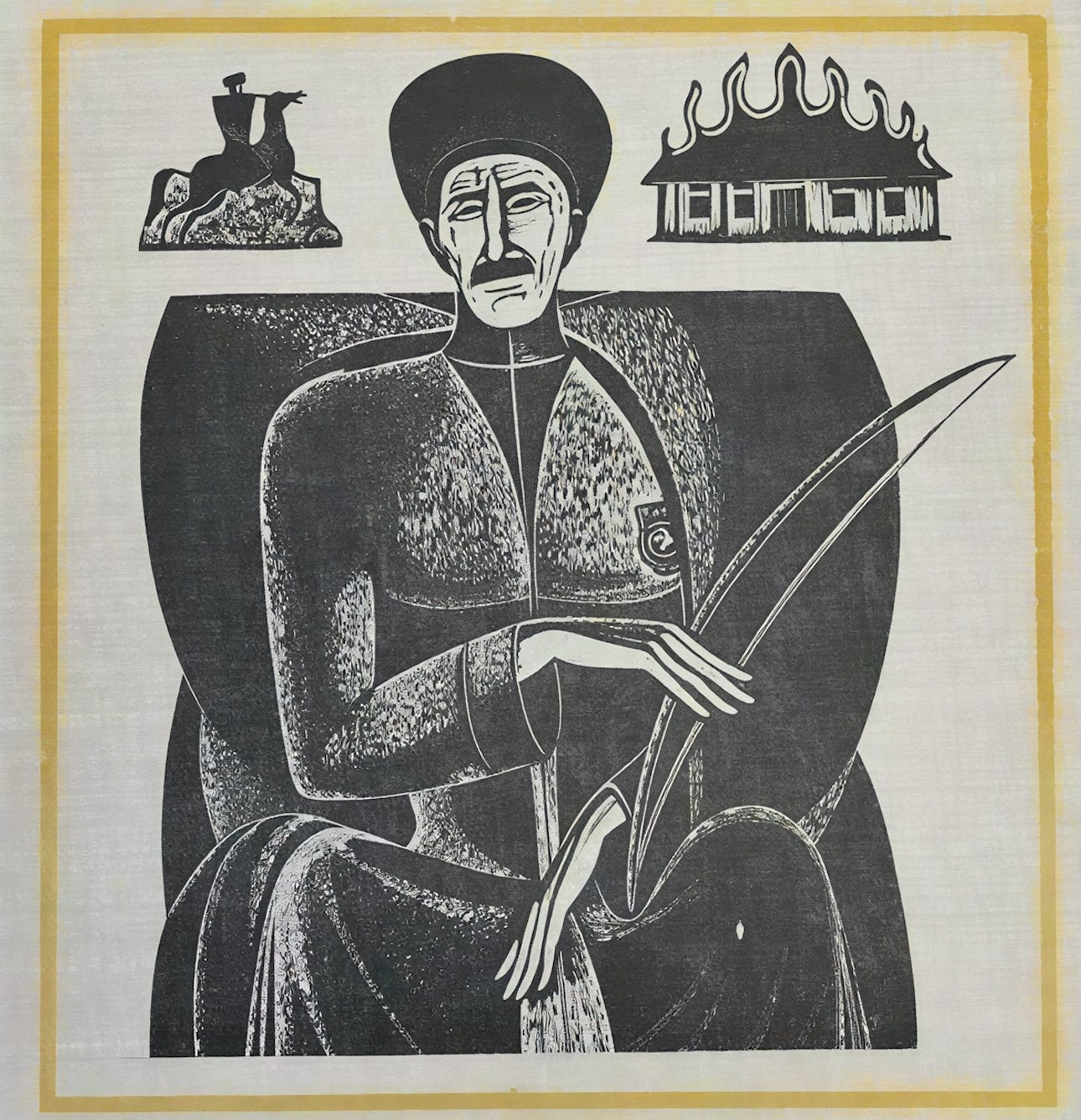
Among them is the well-known song of the Battle of Bziuk, which tells of an engagement between a Bzhedug force led by its princes and the militia of the neighbouring highland Shapsug tribe, fought on the river Bziuk on 10 June 1796. Among the Shapsugs, as among most Circassian highlanders, there were no princes as such, but a distinct noble stratum had nonetheless formed and had come to dominate most political affairs. At the end of the eighteenth century, resentful of their nobility’s growing dominance and its flagrant violations of Circassian custom, the Shapsugs rose against their aristocracy. The Shapsug nobles turned to the Bzhedug princes for assistance. At the Battle of Bziuk, the Bzhedug force, reinforced by Cossack cavalry and Russian artillery summoned by the princes, managed to inflict a defeat on the Shapsug popular militia, though this had no bearing on the wider course of the conflict, and the Shapsug aristocracy was ultimately forced to relinquish the privileges that had curtailed the rights of the common people. The song of the Battle of Bziuk was composed by the Bzhedugs and, accordingly, glorifies the courage, heroism and martial skill of the princes. Before long, however, a crisis broke out between feudal lords and commoners among the Bzhedugs themselves, and songs began to circulate in Bzhedugia that praised the leaders of popular uprisings and condemned the nobility for oppressing the common people. One such is the song of Urusbiy Mafoko, who dealt firmly and decisively with princes and nobles who tried to raise themselves too far above ordinary people. Then followed the song of the resolute Bzhedug uprising against their feudal lords in 1856, when the people, led by the prosperous tfokotls (free commoners) Kimcheriy Khanakhoko and Khusen Depchen, went so far as to demand the abolition of estate distinctions altogether and equal treatment for the entire population. Initially successful, the uprising was suppressed by Russian troops under the commander of the Kuban Line, Colonel Borzik. Afterwards, the Bzhedug princes, fearing a repeat of such popular unrest, voluntarily swore allegiance to the Russian Emperor Alexander II. The folk song known as ‘Pshy-uork Zau’ (’The War against Princes and Nobles’) tells of the cowardice and faint-heartedness of the deposed Bzhedug princes.
The Circassian highlanders, among whom social stratification never reached the extremes found among the lowland Circassians, nonetheless composed songs of their own about heroes who managed to curb overly proud nobles. The Shapsug bards, for instance, immortalised the name of the popular champion Kochas Khatkh, a hunter who stood for justice and checked any attempt by aristocrats to overstep the bounds of unwritten custom. Kochas Khatkh feuded with Dauepsh Khan, prince of the Khatukay tribe, who once tracked him down while he was alone and attacked him with his retinue. Khatkh was killed, but not before he had struck a mortal blow against the prince himself.
First published in Russian on history-tema.com. Translated into English by CircassianWorld.
No posts
Comments
Nothing yet. Say the first thing.
Sign in to join the conversation.