
I missed last week’s newsletter. My wife, Stephanie, and I were on a University of Oklahoma alumni cruise around the coast of Italy. One of the unexpected benefits of being away is that it breaks the daily rhythm of politics. For a few days, I spent more time looking at Roman ruins, Renaissance architecture, and fishing boats than campaign ads, polling memos, and social media feeds.
Then I came home.
Within minutes, I found myself looking at AI-generated political ads, synthetic images being shared as news, campaign videos that had never been filmed, and political content being produced at a volume that would have required an entire communications department just a few years ago.
That was the moment I realized something.
The biggest political story of 2026 may not be AI itself. It may be what artificial intelligence is doing to our ability to recognize what matters.
Today, Oklahoma voters (where I live) are heading to the polls. Across the country, campaigns are already preparing for the next round of primaries, runoffs, and general election fights. Most are focused on how AI can help them create more content, reach more voters, and communicate more efficiently.
I suspect they’re asking the wrong question.
The more important question is whether anyone will still be able to identify genuine political movement once the information environment becomes saturated with synthetic content.
Researchers have recently started using a term for this phenomenon: Slopaganda.
It’s an inelegant word, but it describes an increasingly important reality.
The age of information scarcity is ending. The age of signal scarcity is beginning.
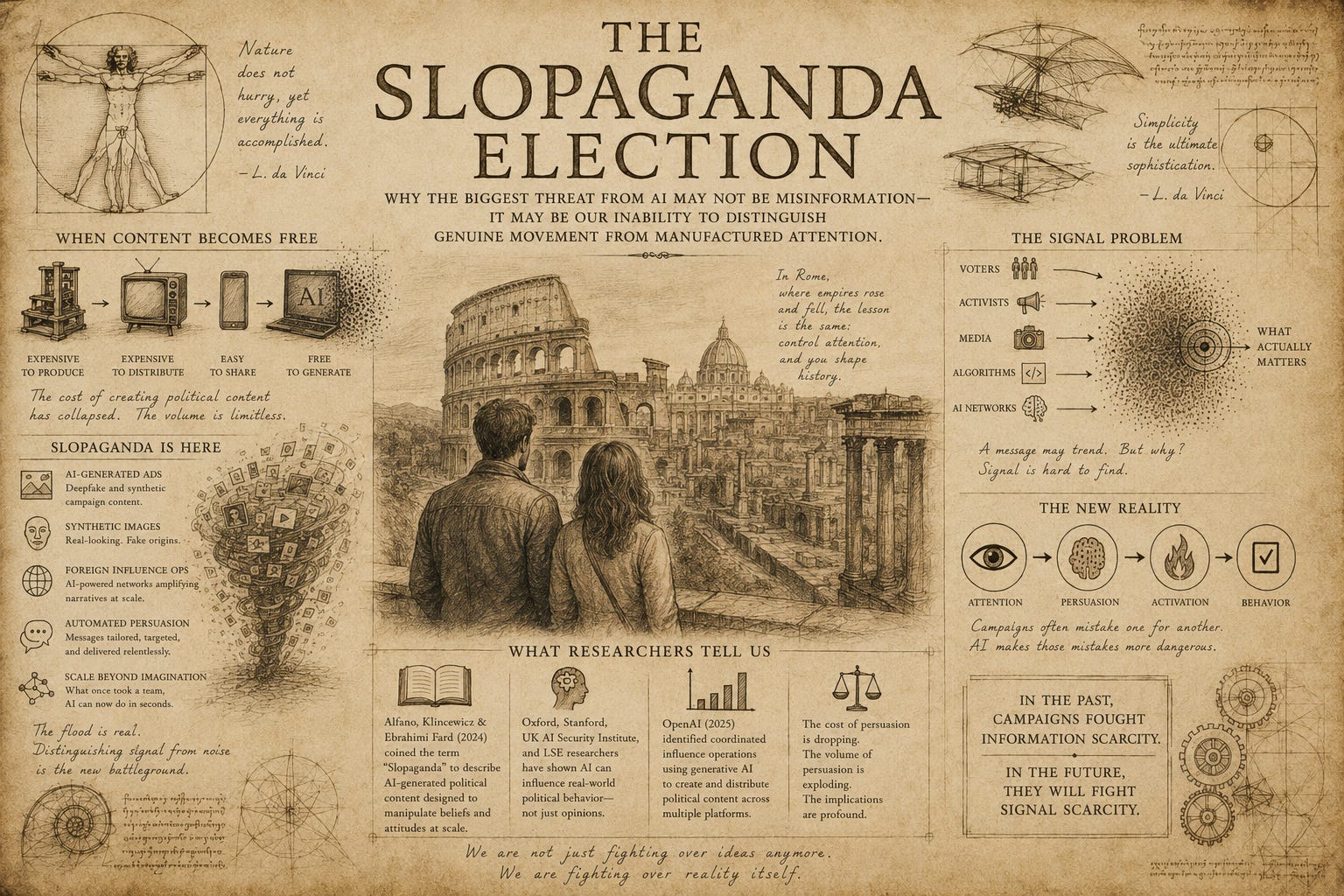
For most of modern political history, information was expensive.
Television advertising required production budgets (and as anyone doing a campaign this year knows, many still do—and big ones).
Direct mail required graphic artists.
Radio required unique voice over talent or custom music.
Even publishing an opinion generally required access to institutions that controlled distribution.
The challenge was reaching voters.
Campaigns fought relentlessly for attention because attention was difficult to acquire.
Today, the economics have changed entirely.
A campaign intern with access to modern AI tools can produce more content in a single afternoon than many statewide campaigns generated during an entire election cycle twenty years ago.
Images.
Videos.
Memes.
Articles.
Social posts.
Voiceovers.
Targeted messages.
All created at virtually no marginal cost.
This shift is so profound that we still haven’t fully absorbed what it means.
Most discussions about AI focus on whether the content is accurate.
Will voters be fooled by deepfakes?
Will synthetic images spread misinformation?
Will AI-generated propaganda distort public understanding?
Those are legitimate concerns.
But they are also familiar concerns.
Every major communications technology, from newspapers to radio to television to social media, created new opportunities for misinformation.
What makes AI different is not simply its ability to create false information.
It is its ability to create virtually unlimited information.
That distinction matters and I haven’t seen many campaign professionals talking about it.
A growing body of academic research is beginning to explore this phenomenon.
Researchers Mark Alfano, Michał Klincewicz, and Amir Ebrahimi Fard recently introduced the term “Slopaganda” to describe AI-generated political content designed to influence beliefs, attitudes, and behavior at scale.
Their argument is straightforward: Propaganda has always existed. What is new is the cost structure.
Historically, creating persuasive political content required resources, expertise, and distribution.
Today, much of that cost has disappeared.
The result is a political environment capable of generating content at a volume that would have been unimaginable only a few years ago.
Meanwhile, researchers at Oxford, Stanford, the UK AI Security Institute, and the London School of Economics have demonstrated that conversational AI can influence real-world political behavior; not merely opinions. In controlled studies, AI systems significantly increased actions such as petition signing and political participation.
That finding should concern political professionals for a different reason than it concerns academics.
The challenge is no longer simply understanding persuasion.
The challenge is understanding persuasion in an environment where the volume of political content is increasing exponentially.
Over the past year alone, we’ve seen examples emerge from nearly every corner of the political world.
Governments have used AI-generated imagery as political communication.
Campaigns have experimented with AI-generated advertising.
Researchers and technology companies have identified foreign influence operations using AI-generated content to amplify narratives and shape political conversations.
OpenAI recently disclosed multiple influence campaigns using generative AI to create and distribute political content across digital platforms.
The common thread in all of these examples is not deception; it is scale.
The ability to generate political communication faster than human systems can evaluate it.
And that creates a problem most campaigns are not prepared for.
Imagine you’re managing a campaign in 2012:
A message starts spreading online.
An issue begins gaining traction.
A narrative starts appearing in earned media.
The reasonable assumption is that something meaningful is happening beneath the surface:
Voters care.
Activists are engaged.
Opinion is shifting.
Today, those same signals are becoming harder to interpret. A narrative may be gaining traction because:
voters genuinely care about it;
activists (or paid influencers) are amplifying it;
journalists are covering it;
algorithms (or paid bots) are promoting it;
or AI-generated content networks are flooding the information environment.
Increasingly, all five may be happening simultaneously.
That changes the nature of political analysis. The challenge is no longer gathering information. The challenge is identifying which information actually matters.
In other words, the scarce resource is no longer content. It is signal.
One of the recurring themes in my writings has been the distinction between movement and measurement.
Campaigns routinely confuse:
attention with persuasion,
persuasion with activation,
and activation with voter movement.
The Slopaganda Election makes that problem even harder.
Because AI-generated content can create enormous amounts of attention without necessarily creating persuasion. Likewise, genuine voter movement can sometimes appear small or insignificant inside a flood of synthetic content.
The danger isn’t simply that voters will believe things that aren’t true. The danger is that campaigns will increasingly struggle to identify what is actually driving behavior.
That’s a very different problem. And arguably a more dangerous one.
Since joining EyesOver after the 2024 election cycle, one of the most interesting developments I’ve watched has been the growing importance of distinguishing movement from noise.
Not simply measuring:
sentiment,
awareness,
volume,
or engagement.
But identifying:
salience,
volatility,
behavioral shifts,
and genuine changes in public opinion.
Because as AI continues flooding the information environment, those distinctions become increasingly valuable.
The future advantage will not belong to the campaign that creates the most content. It may not even belong to the campaign with the best AI. It will belong to the campaign that most accurately identifies genuine signal while everyone else is drowning in noise.
Most people think the danger of AI in politics is misinformation. I increasingly think the larger challenge is signal collapse.
For two centuries, campaigns operated in a world where information was scarce and attention was abundant enough to be captured.
Today, information is becoming effectively unlimited.
What is becoming scarce is our ability to determine what actually matters. In the past, campaigns fought information scarcity. In the future, they will fight signal scarcity.
And that may prove to be the defining political challenge of the AI era.
Comments
Nothing yet. Say the first thing.
Sign in to join the conversation.