
For decades, campaigns have been built around averages.
The average Republican.
The average suburban woman.
The average independent voter.
The average Hispanic voter.
The average evangelical.
The average swing voter.
Entire campaign strategies, media plans, mail programs, polling plans, digital targeting, and messaging operations have been built around the assumption that these groups exist and can be understood through broad demographic categories.
There’s a big problem with that: The average voter doesn’t exist.
Or at least not in the way most campaigns think.
And as artificial intelligence, predictive analytics, and behavioral modeling (combined into a powerful tool) continue to reshape politics, campaigns that still rely primarily on demographic averages are finding themselves at a growing disadvantage.
Because the future belongs to campaigns that understand behavioral clusters, not demographic categories.
One of the most valuable lessons I learned about voter behavior came from a statewide research project several years ago.
At the time, conventional wisdom suggested suburban women were being driven primarily by the same issues dominating national political coverage.
Healthcare.
Education.
Taxes.
Partisan politics.
Those issues mattered. But when we dug deeper into the data (and first learned this in a focus group in The Woodlands), another issue kept appearing among a particular segment of suburban voters: Red-light traffic cameras.
To many political observers, that would have sounded ridiculous. How could traffic cameras possibly matter in a major statewide election? But the data suggested something deeper was happening. These voters weren’t reacting to the cameras themselves. They were reacting to what the cameras represented:
Government overreach.
Fairness.
Local accountability.
The feeling that citizens were being treated as revenue sources rather than constituents. The issue carried far more emotional intensity than most observers realized. More importantly, it revealed something larger: voters who looked identical demographically often behaved completely differently politically.
Two suburban women of the same age, income, education level, and party registration could have dramatically different political motivations.
The average voter model could not explain that (but the data could).
The issue eventually gained enough traction that Texas outlawed red-light traffic cameras statewide in 2019.
But the larger lesson wasn’t about traffic cameras; it was about discovery.
The data identified a meaningful behavioral signal long before most political observers considered it politically important.
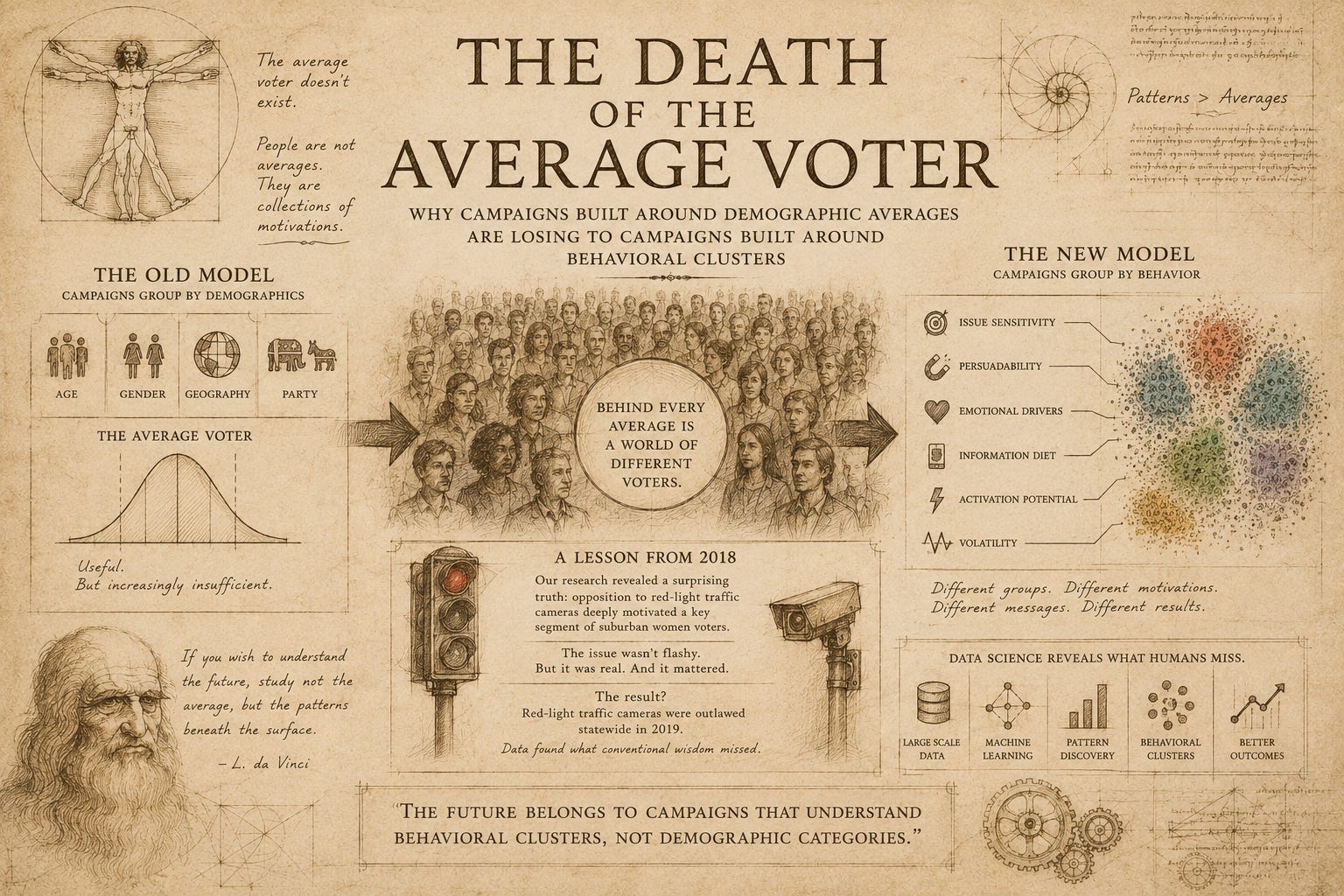
Traditional political analysis groups voters into broad buckets.
Age.
Race.
Gender.
Geography.
Party registration.
Those variables still matter, but increasingly they are insufficient. Because people are not simply collections of demographic traits.
They are collections of motivations:
Some voters are motivated by economic anxiety.
Others by cultural identity.
Others by institutional trust.
Others by personal freedom.
Others by fairness.
Others by status.
Others by belonging.
Two voters who look identical on paper can respond to entirely different messages. And two voters who appear completely different demographically may respond to exactly the same message.
That reality is becoming impossible to ignore.
When I first entered politics (I won’t list the year), segmentation was relatively simple: Republican versus Democrat; urban versus rural; male versus female.
Today, the most sophisticated campaigns increasingly think differently.
They focus on:
turnout probability
issue sensitivity
persuasion likelihood
coalition alignment
emotional activation
behavioral volatility
The question is no longer: Who is this voter?
The question is: What kind of voter is this?
That distinction is subtle, but it changes everything.
One of the most important developments in modern politics is the ability to identify patterns that are nearly impossible to detect intuitively.
Using large-scale data systems, machine learning models, and behavioral datasets, analysts can now identify relationships that would have been invisible a decade ago.
Increasingly, we are building entirely new voter indexes designed to measure things that traditional demographics struggle to capture:
persuadability
issue salience
sentiment volatility
narrative alignment
activation potential
These measures often tell us more about future behavior than age, gender, or party registration ever could.
That doesn’t mean demographics are dead, but it means they are no longer enough.
This is especially important in the current midterm environment.
Most campaigns will continue targeting demographic categories.
Suburban women.
Independent voters.
Young voters.
College-educated voters.
But the campaigns that gain an advantage will increasingly identify the behavioral clusters hidden inside those categories.
Because not all suburban women think alike.
Not all independents behave alike.
Not all Republicans respond to the same messages.
The campaigns that recognize those differences first will possess an enormous strategic advantage.
Artificial intelligence is accelerating this shift. AI doesn’t think in demographic averages.
It identifies patterns.
Correlations.
Clusters.
Relationships.
In many ways, AI is forcing campaigns to abandon one of the oldest assumptions in politics: The idea that voters can be understood primarily through broad demographic labels.
Instead, campaigns are increasingly moving toward a world where understanding behavior matters more than understanding demographics.
That is a profound change.
And it may ultimately prove more important than any individual technological breakthrough.
For most of modern political history, campaigns asked: Who is this voter?
Increasingly, the better question is: What kind of voter is this?
Because the average voter is disappearing.
And campaigns that recognize that first will possess one of the most powerful advantages in politics.
Comments
Nothing yet. Say the first thing.
Sign in to join the conversation.