
Night has fallen soft and cool over the olive grove.
The day has been long—full of healing, teaching, listening, walking—and yet the moment Yeshua invites a few close followers to linger with him beneath the trees, you feel as though something sacred is about to unfold.
The moonlight filters gently through the leaves, casting patterns across the ground. A few clay lamps flicker next to the baskets of bread left from supper.
Yeshua sits beside an old olive tree and gestures for those near him to sit.
You join them, your heart as open as the night sky above you.
There is a stillness here.
A sense that the veil between worlds is thinned.
Yeshua’s eyes soften as he looks at each face around him.
It is as though he sees something deeper than your features — as though he sees the divine spark within each person, glowing.
Then, in a voice both intimate and luminous, he speaks:
“I am in the Father…
and you are in me…
and I am in you.”
The words fall into the night like droplets of oil—rich, fragrant, absorbing into the soul.
You are not hearing metaphor.
You are hearing revelation.
The Invitation Into Communion
In the world many of us inhabit today, the word “God” often carries the weight of distance—an authority far above, far beyond, far removed.
But in Yeshua’s world, in Yeshua’s language, in Yeshua’s being, God is the breath within the breath.
The Source of All That Is.
The pulse beneath creation.
The animating presence in every living thing.
When Yeshua speaks of the Father, he is not invoking a distant deity; he is describing the Divine Presence woven into the fabric of existence.
And when he says:
“I am in the Father,”
he is revealing his own consciousness
his unbroken awareness of their union.
Then he turns and says:
“…and you are in me, and I in you.”
This is not hierarchy.
This is reciprocity.
This is the mystical heart of the Way.
He is not describing himself as separate from humanity.
He is describing himself as the window through which humanity can rediscover its own divine connection.
Abide in Me — The Aramaic Meaning
Later, he continues:
“Abide in me, and I in you…
for apart from me you can do nothing.”
In English, this has often been heard as a claim of exclusivity or dependence.
But in Aramaic, “abide” (qeva) carries a different meaning:
to remain in alignment
to stay connected to the Source
to remain rooted in Love
to dwell in the divine flow
And “apart from me” (la bleddi, bar minni) does not mean apart from his human self.
It means apart from the awareness that he is living within— the inner center where the Divine Presence moves freely.
He is not saying:
“You are powerless without me.”
He is saying:
“Outside of this awareness of and connection to this union, you cannot bear the fruit your soul longs for.”
This is not dependence.
This is resonance.
He is describing a consciousness—
a way of seeing, breathing, being.
Next, as we conclude Chapter Six what Yeshua wanted most for his followers — and for each of us.
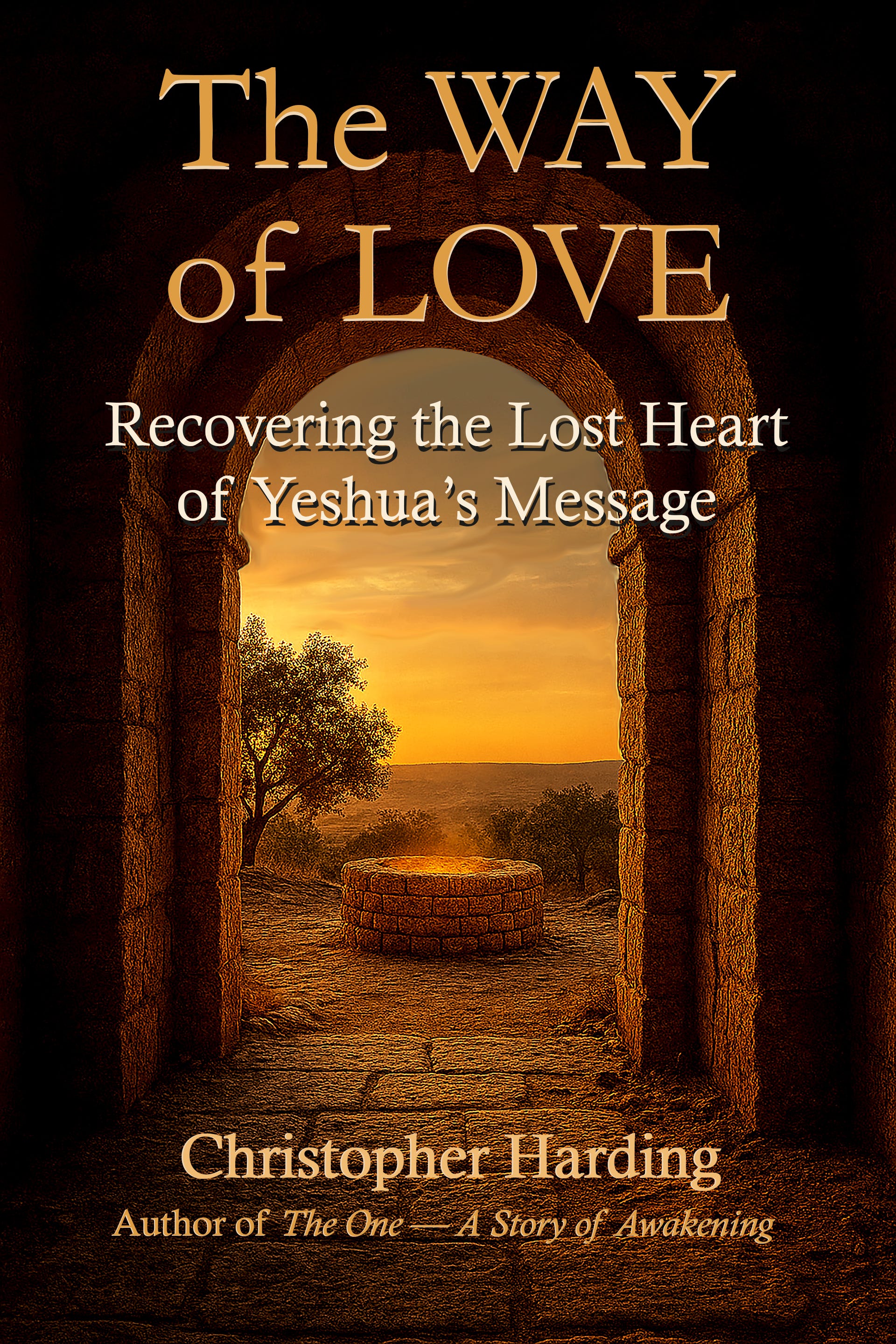
In the days and weeks that follow, I’ll continue to post sections from the new book as I craft them, or as they craft me. Your thoughts and comments, as always, will be greatly appreciated.
~ Christopher Harding
No posts
Comments
Nothing yet. Say the first thing.
Sign in to join the conversation.