
The day is nearly spent when Yeshua leads his small band of followers toward the edges of the village. The sun spreads gold across the hills, turning every blade of grass to fire. The air is warm and carries the scent of bread cooling in nearby homes.
People walk with him—not because they have to, not because they fear missing something, but because his presence feels like water after a long drought. You walk with them, slipping into step just behind a mother carrying her child, and a man with worn hands who introduces himself simply as Eliab.
No one here is important by worldly standards.
But every person is treated as if their life is of infinite worth.
Yeshua stops and turns toward the group as they settle beside a set of large, flat stones. Someone begins to unwrap fish and bread. Someone else pours water into clay cups.
Children weave between the adults laughing. No one shushes them. Old women lean on their walking sticks, smiling at the noise.
It feels like family—
not one built by birthright,
but woven by love.
You realize you are witnessing the beginning of a movement that is not about doctrine or ritual, but about a new way of being human together.
What It Felt Like to Belong
People often ask today what it must have been like to follow Yeshua.
What kind of community was this?
How did these wandering villagers become the seed of something that would outlast empires?
The answer, more than anything, is belonging.
Belonging without needing to prove yourself.
Belonging without being pure enough.
Belonging without having the right reputation.
Belonging without hiding your wounds or your doubts.
Around Yeshua, people felt seen.
Known.
Called by name.
He looked at each person as if he already saw their soul’s original beauty — and by seeing it, he helped them remember it.
This is why the tax collector Zacchaeus climbed down from the sycamore tree.
This is why fishermen left their nets.
This is why women, marginalized by the culture of the day, became his closest disciples.
He saw in them something they had forgotten.
He saw who they could become—who they truly were.
Compassion as the Center of the Community
As night settles fully around the stones, Yeshua notices a man standing alone, hesitant to approach the fire. His clothes are torn. His posture is defensive, as though he expects mockery.
Yeshua walks straight to him.
“Brother,” he says, “will you join us?”
The man’s eyes widen. “Me…? I’m not…”
But Yeshua interrupts him—not rudely, but with warmth:
“You are welcome. Come.”
The man sits. Bread is placed in his hand.
No one asks him what he has done, where he comes from, or why he stands alone.
He is simply received.
This is compassion— raḥmān in Aramaic—
a word that means not pity,
but to be the womb for someone,
to create a safe space where new life, new hope, new identity can be born.
This was the ethic of the early community.
Not rules.
Not rituals.
Not hierarchy.
But compassion.
A willingness to see each person as a bearer of divine image, even when their life had forgotten it.
A Story Yeshua Told: The Woman at the Well
One afternoon, traveling through Samaria, Yeshua stops to rest by a well. His disciples have gone into town for food. A woman approaches—alone, at midday, when no one draws water. Her reputation precedes her.
In their world, Jews did not speak with Samaritans.
Men do not speak with strange women.
The righteous do not speak with the morally suspect.
But Yeshua asks her for a drink.
She freezes.
“You… a Jew… asking me?”
His smile is disarming.
“If you knew the gift of God,” he tells her, “you would ask me, and I would give you living water.”
Not judgment.
Not condemnation.
Living water.
He speaks to her wounds without shaming her.
He names her thirst without humiliating her.
He sees her history without defining her by it.
When she runs back into town crying, “Come see a man who told me everything I ever did,” she is not confessing fear.
She is confessing relief—gratitude.
For the first time in her life, she has been fully known and fully loved.
This is what salvation looked like.
This is what belonging felt like.
Becoming: How the Way Transformed People
Yeshua’s followers did not merely believe him;
they were transformed by him.
A fisherman who once cursed loudly becomes gentle.
A woman ashamed of her past becomes a fountain of wisdom.
A man who had hoarded wealth becomes generous.
A woman once tormented becomes peaceful.
A zealot longing for violence becomes a healer of conflict.
Transformation was not sudden perfection.
It was awakening — the slow, steady infusion of Love into every corner of the human spirit.
The early followers called this:
Metanoia (a Greek word used in the Septuagint or early version of the New Testament that later evolved into a more complicated concept often associated with modern notions of repentance).
It’s original meaning was:
not guilt,
not self-loathing,
not sorrow,
but a change of heart-mind;
a new way of perceiving life,
a new way of being.
The Aramaic word likely used by Yeshua would have been , ܬܘܒ (tuv / tob) which meant:
returning to alignment with God — the Source.
returning to the covenant promise of restoration
returning to one’s true path
On this path, people learned to forgive.
To listen.
To serve.
To walk in humility.
To carry one another’s burdens.
To see the divine in the ordinary and in one another.
They were not trying to be holy.
They were becoming whole.
The Path of the Heart
As the stars emerge overhead, Yeshua stands and looks out at the faces illuminated by firelight.
He speaks:
“Let the one who has ears… hear.”
The hush that follows is familiar, sacred.
“You are the light of the world,” he says,
“a city on a hill cannot be hidden.”
He does not say I am the light of the world, though he is.
He says you are.
He does not call them sinners in need of appeasement.
He calls them light in need of uncovering.
“Let your light shine,” he says,
“so others may see and give glory to the Father.”
It is as if he is reaching into each heart and pulling forth something luminous,
something long buried,
something holy.
This is what it means to belong.
This is what it means to become.
Next, we will enter Chapter Six and explore the meaning of Oneness as experienced by Yeshua — and the invitation he extended to his followers — and to each of us.
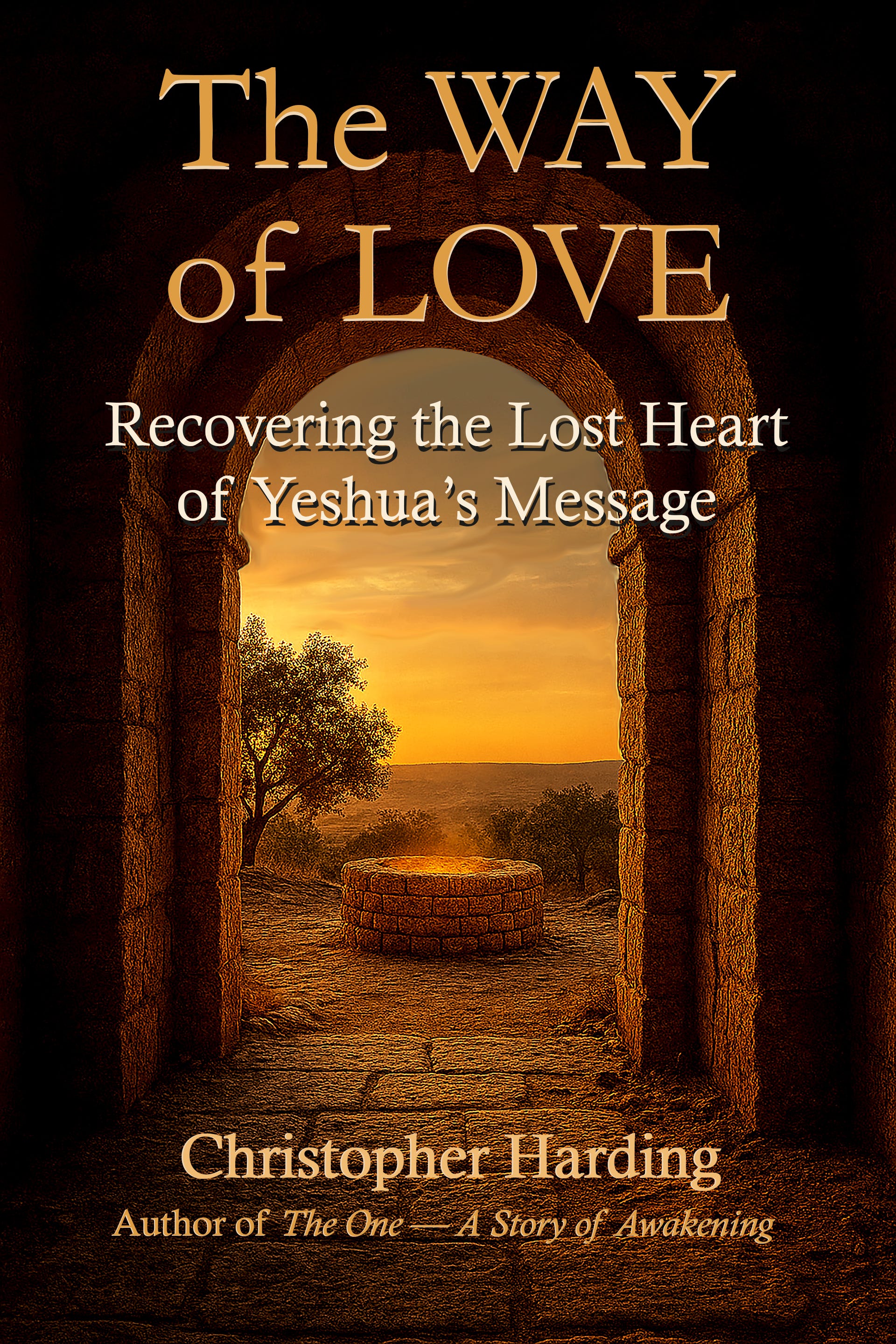
In the days and weeks that follow, I’ll continue to post sections from the new book as I craft them, or as they craft me. Your thoughts and comments, as always, will be greatly appreciated.
~ Christopher Harding
No posts
Comments
Nothing yet. Say the first thing.
Sign in to join the conversation.