
For anyone who has studied with a teacher, whether in martial arts, painting, or on a spiritual path, those who seem to glean the most from such relationships are those who—while learning about boundaries—are willing to dive in fully.
So when Yeshua said, “Follow Me” — What He Was Really Saying?
If we explore the culture of his time, when Yeshua called someone to follow him, he was not inviting them into a religion or a moral code.
He was inviting them into transformation.
“Follow me” meant:
Walk the path I walk.
Learn to see as I see.
Let Love become your center.
Allow God’s presence to awaken in you.
Let your life become spacious enough for the Divine to shine through.
It was not obedience he sought.
It was awakening.
(And awakening, it seems, naturally bears, as Paul the apostle once called them, Fruits of the Spirit.)
He did not ask them to worship him from afar.
He asked them to join him in the consciousness of the Father.
To follow him was not to stand behind him,
but to walk beside him
in the same flow of Love.
Not a Substitute, But a Revealer
In the centuries after Yeshua’s life, theology would shift dramatically.
He would be framed primarily as a substitute—
the one who suffers in humanity’s place,
the one who stands between humanity and divine wrath.
But this is not how he spoke of himself.
In Yeshua’s own words, he is not:
the barrier between God and humanity,
but the bridge revealing their union,
a conduit through which people can be reunited with their Creator.
He does not say:
“Only I can do these things.”
He says something far more astonishing:
“The works that I do, you will do also;
and greater works than these will you do.”
Only someone who sees humanity as sharing his nature—as connected to and drawing from the same Source—could say such a thing.
He is not the exception.
He is the example.
The first of many brothers and sisters of the Spirit,
not the last.
What He Came To Restore
Yeshua came to restore:
1. Sight
—not just physical, but spiritual
(the ability to see God in all things, including oneself).
2. Identity
—not as sinners deserving wrath,
but as children of the Living God.
3. Alignment
—to harmonize the human heart with the divine rhythm.
4. Communion
—the awareness that “I am in the Father, and you are in me, and I am in you.”
5. Love
—the ground of being, the center of all things, the essence from which we come.
He came to show humanity its own reflection in the face of God. And to show the face of God in humanity.
A Night Around the Fire
Later that evening, long after the crowd has dispersed, a small group sits around a fire with Yeshua. The flames cast shifting shadows on their faces.
A disciple asks, “Rabbi… how can we do what you do?”
Yeshua smiles—not a proud smile, but a knowing one.
“Remain in my love,” he says softly. “Everything flows from that.”
Another disciple, confused, presses, “But how do we remain in your love?”
“By living from the same Source,” he replies.
“The One who sends me… sends you. The One who fills me… fills you. As the Father has loved me, so I have loved you.
Remain in that love.”
They sit in silence as his words sink in.
The fire crackles. A cool breeze moves through the grass.
Slowly, you begin to understand:
He is not asking them to climb upward toward God.
He is asking them to awaken to the God who is already
waiting with arms wide open.
This is the heart of his path
This is the Way.
Next, we will enter Chapter Five and explore the path of transformation Yeshua invited those who followed him to walk—and what it felt like to belong to such a community.
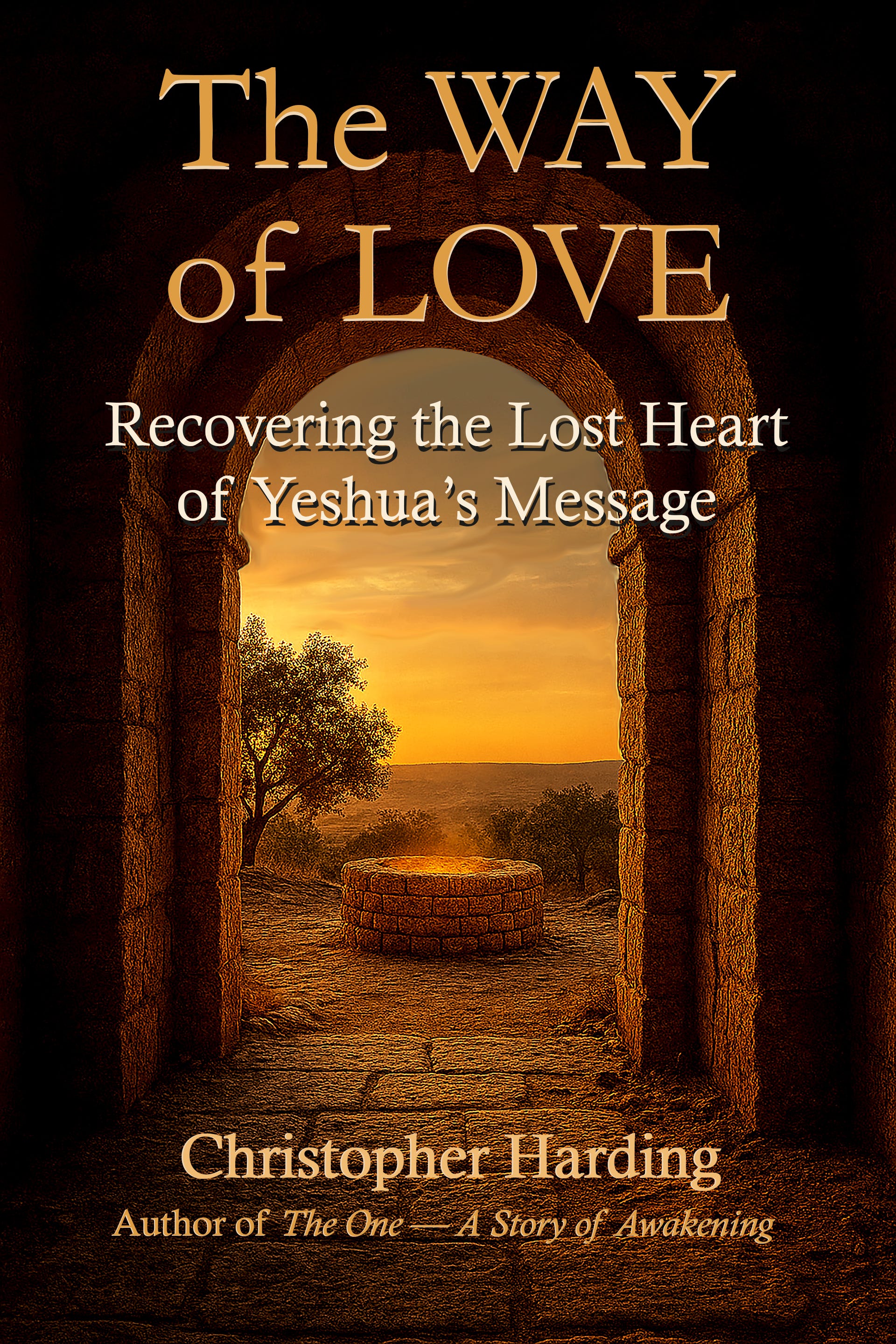
In the days and weeks that follow, I’ll continue to post sections from the new book as I craft them, or as they craft me. Your thoughts and comments, as always, will be greatly appreciated.
~ Christopher Harding
No posts
Comments
Nothing yet. Say the first thing.
Sign in to join the conversation.