
The wind has picked up over the ridge by the time you reach the gathering. People have formed a wide half-circle around Yeshua, who stands at the center, speaking with an intensity that is gentle yet unmistakably powerful.
Children play at the edges, drawing shapes in the dirt with sticks. A few older women sit together, their hands resting on baskets of bread and herbs. Farmers, fishermen, widows, laborers—a community woven from those the world often overlooks.
Yeshua looks tired, but radiant—like someone carrying a light too large to be contained by a single body.
A young man steps forward. You’ve noticed him before: restless, eager, full of questions that seem to burn inside him.
“Teacher,” he asks, “are you the one we’ve been waiting for?
The one who will save us?”
The crowd quiets.
Some expect Yeshua to declare himself the Messiah who will overthrow Rome. Others expect him to reject the title completely. But instead, he looks at the young man with a compassion so profound it almost hurts to witness.
“The kingdom of God is near,” he says softly.
“Nearer than you think.”
Then, placing a hand over his own chest, he adds:
“It is here… and it is here.”
He touches the young man’s heart.
A murmur passes through the crowd.
No prophet had ever said this.
No teacher had ever dared to speak this way.
He is not merely pointing to God.
He is revealing what God looks like in human form—
unveiling a truth many had forgotten:
Heaven is not far.
Heaven is within.
And the one standing before them is the window through which they can see this.
Yeshua as the Revealer of the Real
In the Aramaic-speaking world of Yeshua, a messiah —in the spiritual sense—was understood less as a deliverer from God’s anger and more as a deliverer from oppression; one who leads his people back into alignment—one who restores the image of God within humanity, one who reveals the true path.
Yeshua did not come to create a religion.
He came to do something far more profound.
He came to reveal Reality.
Not to satisfy the wrath of God,
but to awaken people to the Love of God.
Not to stand between God and humanity,
but to reveal that God had never been distant in the first place.
He functioned like a mirror, showing people who they truly were beneath the layers of fear, shame, and misalignment.
To encounter him was to encounter the truth about yourself.
The Aramaic Meaning of “Messiah”
In Aramaic, “Messiah” (M’shikha) means:
The Anointed One
The One Immersed in the Divine Presence
The One Who Reveals the Path
The One in Whom God’s Flow Is Fully Awake
This term carried mystical implications.
The Messiah was not only seen as a future political liberator. He was the embodiment of what the human soul was meant to become.
A glimpse of the what may be possible for all.
When people looked at Yeshua:
some saw a teacher
some saw a healer
some saw a prophet
some saw a threat
But the early followers of the Way saw something else entirely:
They saw the destiny of humanity made visible.
Not because Yeshua was separate from humanity,
but because he was its fullness.
The awakened human.
The aligned human.
The human in whom the Source flowed without obstruction.
In the next post: We will continue with Chapter Four and explore what Yeshua meant when he said, Come Follow Me.
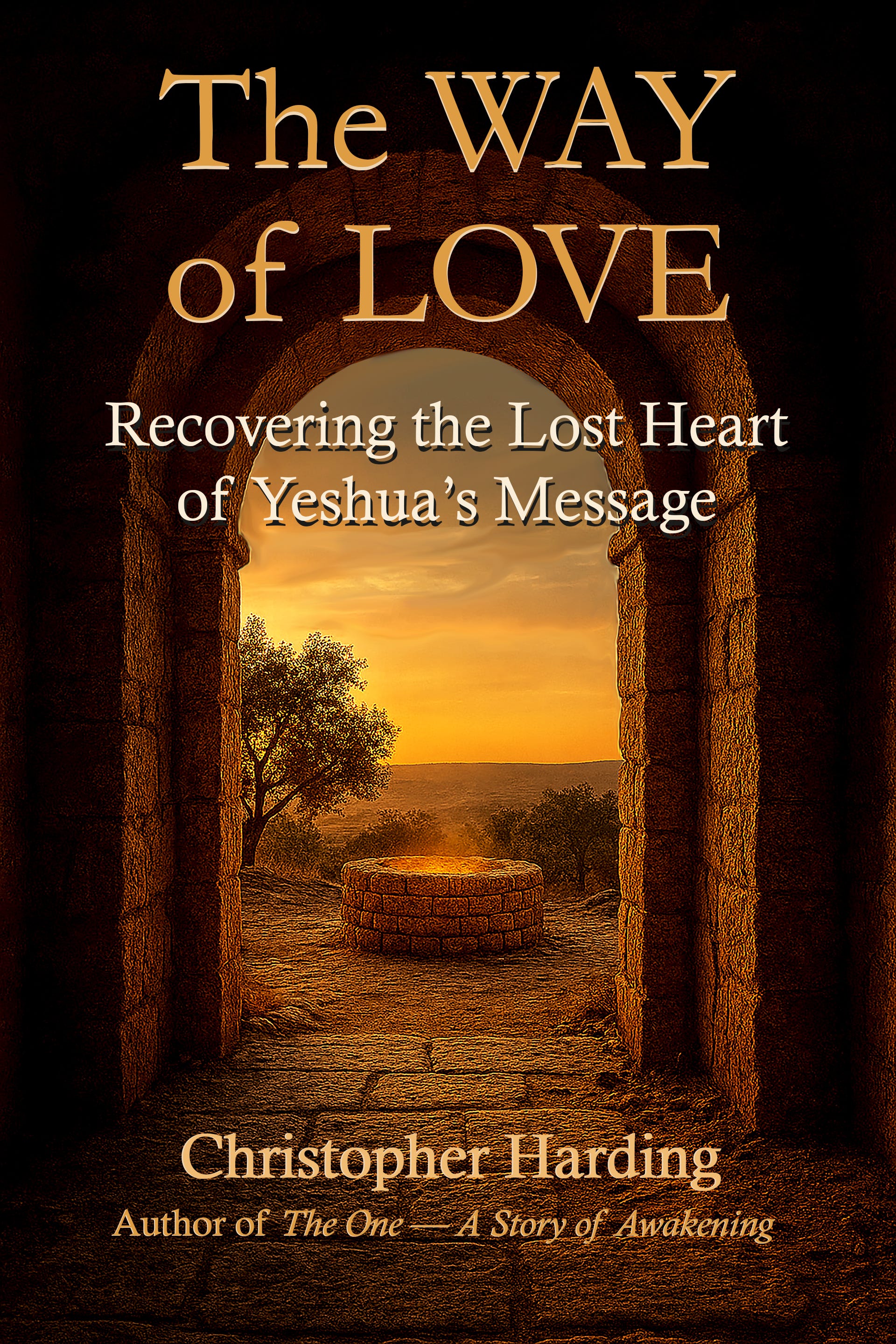
In the days and weeks that follow, I’ll continue to post sections from the new book as I craft them, or as they craft me. Your thoughts and comments, as always, will be greatly appreciated.
~ Christopher Harding
No posts
Comments
Nothing yet. Say the first thing.
Sign in to join the conversation.