
You know you should talk to customers before you build. It’s the best way to make sure you don’t invest a bunch of money and effort into building something that nobody wants.
The trouble is you don’t have customers for this thing, because it doesn’t exist yet. So who do you interview?
Let’s explore two situations that you might find yourself in, along with next steps for how to spot the innovation opportunity.
You have a real business and real customers. You just don’t have a product in this space yet.
I’ll use a bank as an example. It already sells a suite of products to its business customers: deposit accounts, loans, credit card acceptance. Now the team is considering adding an invoicing product, something it has never offered. There are no customers to interview about the bank’s invoicing tool, because there is no invoicing tool.
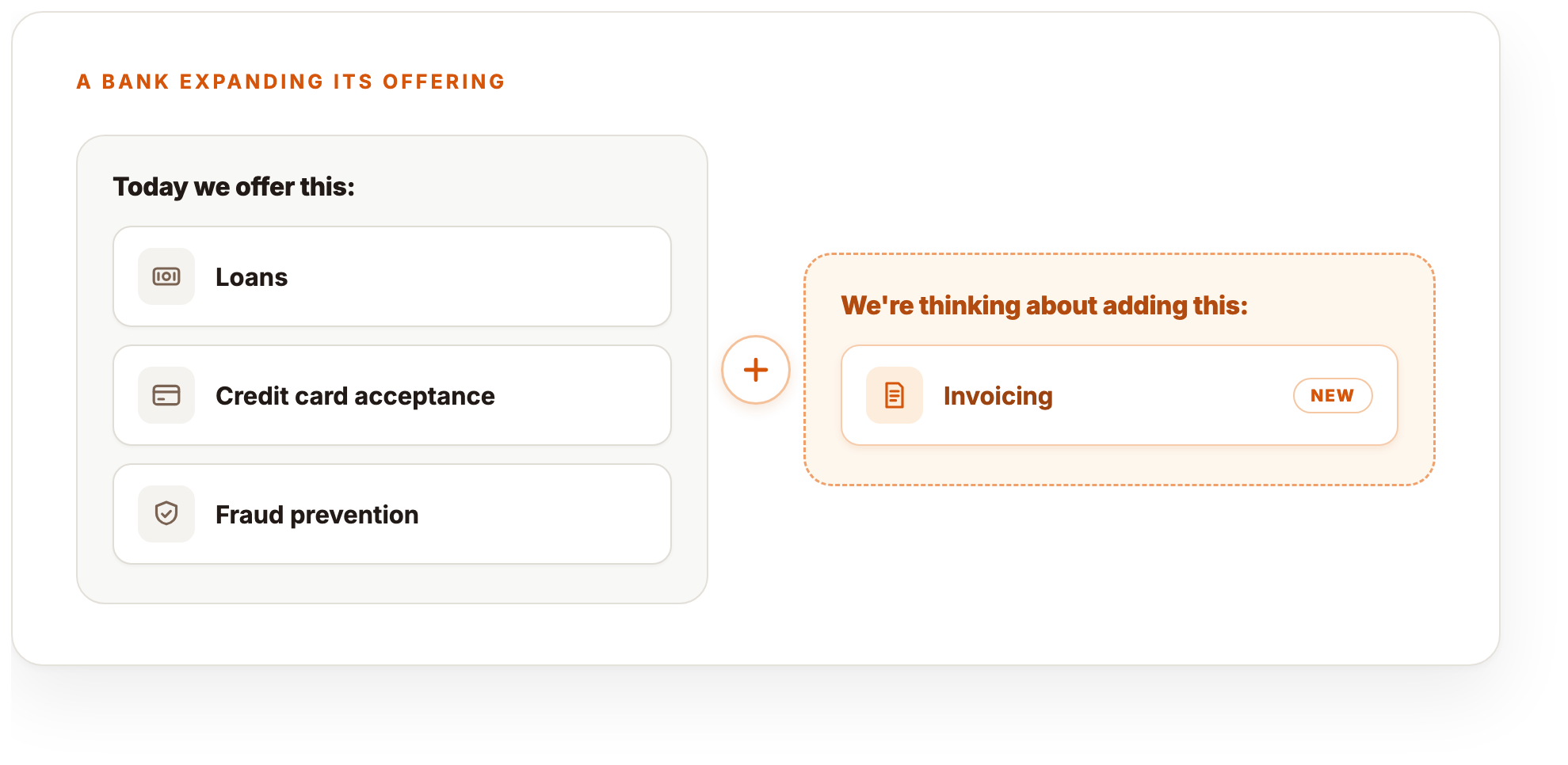
But the bank’s customers are invoicing somehow right now. Many of them recently adopted a competing invoicing solution. If you’re on this team, you interview those customers about that purchase:
How did they decide they needed something new?
How do they define value in an invoicing tool?
What does the one they picked do well, and where does it fall short?
Once you understand how they define value and where today’s options leave them wanting, you can see exactly where the bank is uniquely positioned to help, sitting on the customer’s money and payments already, and bring something genuinely better to market instead of a me-too copy.
You have an idea for something new, and you have no customers yet. This is where a lot of startup founders freeze.
Say your idea is a completely new way for businesses to invoice their customers and get paid.
Nobody can tell you the real story of what caused them to shop and eventually buy your product, because nobody has bought your product yet.
So you go find people who have the struggle you believe you are solving, and who recently switched to some new invoicing solution. Then you study that switch:
What were they struggling with that finally pushed them to go looking?
How did they define the progress they wanted, meaning what did they expect the new tool to do for them, and what did they imagine life would feel like once they had it?
And then the part that matters most for you:
Where are the gaps?
Did the solution they chose actually deliver on that promise, or did it fall short?
Because the space between the progress they wanted and the progress they got is exactly where your new idea gets to live.
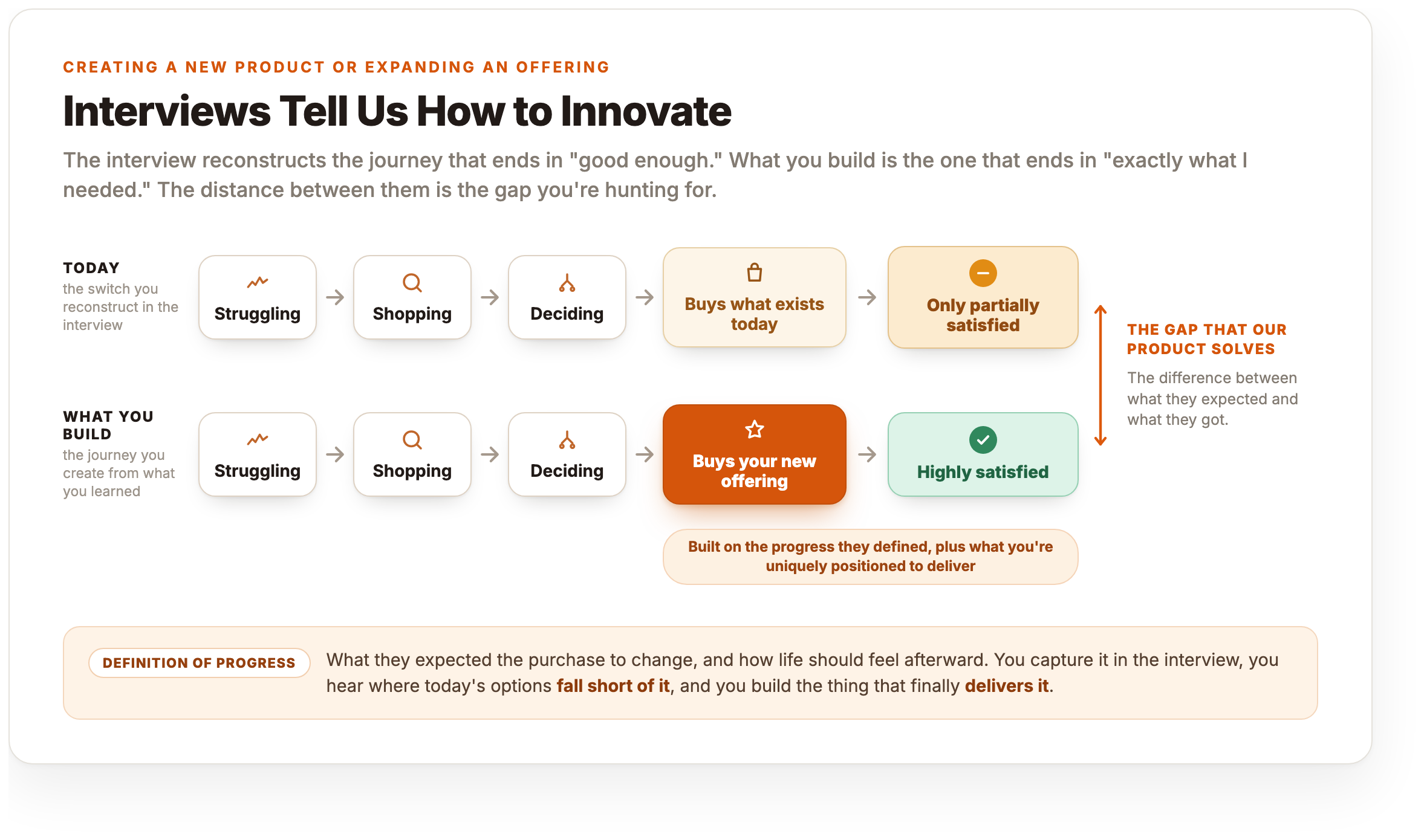
Whether you’re expanding a product offering or inventing a category, the move is identical. You never need your own customers to begin. You need people who recently made the closest real purchase to the one you are imagining. Your product may be new, but the progress is not. Someone is already reaching for it, and paying to try to achieve it.
Three things make the difference between a recruit that teaches you something and one that wastes everyone’s time.
The most valuable person to talk to is someone who bought the closest existing substitute for what you are building.
For the invoicing examples, that is a competing invoicing tool, because almost everything about the decision rhymes with yours: the same struggle, the same payer, the same fears. A homemade spreadsheet workaround is further out and teaches you less (unless you’re focusing your solution on business owners who are graduating from that spreadsheet to their first real solution). A general “how do you run your finances” chat is further still. Start as close to your product as you can, and only widen the net when you have to.
This is where most first-time interviewers give the whole thing away. They get someone on the call, describe what they are building, and ask what the person thinks. That conversation is worthless. People are generous, they will tell you it sounds great, and you will learn nothing.
Do the opposite.
Do not mention your product. Ask them to walk you through the switch they already made: the moment the old way stopped being good enough, what set them shopping, what they hoped would change, who else got pulled in, what almost stopped them, and how they feel about it now that they are living with it.
Your job is to take those findings and innovate with them. Replay the story. How would the ending be different if they had the product you’re thinking about building?
In both situations, the gold is the distance between the progress they wanted and the progress they actually got. In the expansion case, that gap tells you where the incumbents are weak and where your unique position lets you win. In the startup case, that gap is the whole reason your product deserves to exist.
Listen for the quiet disappointment, the workarounds they still run, the thing they assumed would be solved and was not. That is your build list, in the customer’s own words.
Do this a handful of times and you walk away holding what no amount of brainstorming could give you: how real buyers define value, which forces pushed them to act, the shape of the timeline from first thought to signed contract, and the specific promise that the current options fail to keep.
You learn all of it before you have built a thing, which is the entire point. Your product is new. The struggle it solves almost never is. Go find the people who already tried to solve it, and let their purchases teach you how to build yours.
There are great tools that you can use to find people to interview, like Respondent.io and UserInterviews.com. Getting the screener correct so that you interview people who actually switched, who had control or influence over the budget, and were the actual decision-makers is critical. Use the recruiting breakdowns that I do in each one of the interviews that I share in the Customer Interviews section of this site to figure out how to correctly set up your recruit.
No posts
Comments
Nothing yet. Say the first thing.
Sign in to join the conversation.