
A huge thank you to all the recent subscribers. I can’t do this without you, and I appreciate your interest. Please reach out to me if there’s something you want to explore in depth and I’ll try to cover it or point you somewhere I already have. Genuine thanks and appreciation to you and welcome!
It’s been a busy week here at Orion Growth - especially in the world of Pathway Communities. We’ve updated the North Carolina model of the StableLiving Index™ to align with the state’s Councils of Government (NCARCOG), continued stress-testing the capital ecosystem behind the Pathway Development Theory, and are closing the bridge round for Hudson Commons, our first brick-and-mortar community in Western North Carolina.
It’s a tough grind to the finish line as we push toward some ambitious ‘mid-year’ goals. The world is moving fast, and the economics that shape housing, development, and community stability are evolving right alongside it. As the tech advances and the economy transitions, one question seems to follow me everywhere I go:
“Why doesn’t my project pencil?”
Developers ask it. Investors ask it. Municipal leaders ask it. The answer is rarely as simple as construction costs, interest rates, or land prices.
In this article, I want to introduce the concept of Value-Created Modeling and the financing structure behind the Pathway Development Theory. This isn’t an academic exercise. It’s the framework we are actively using to bring Post-Hurricane Helene projects in Western North Carolina from concept to reality, and the lens through which we evaluate whether a community can create lasting value for residents, investors, and the places they call home.
Onward and upward, but always forward.
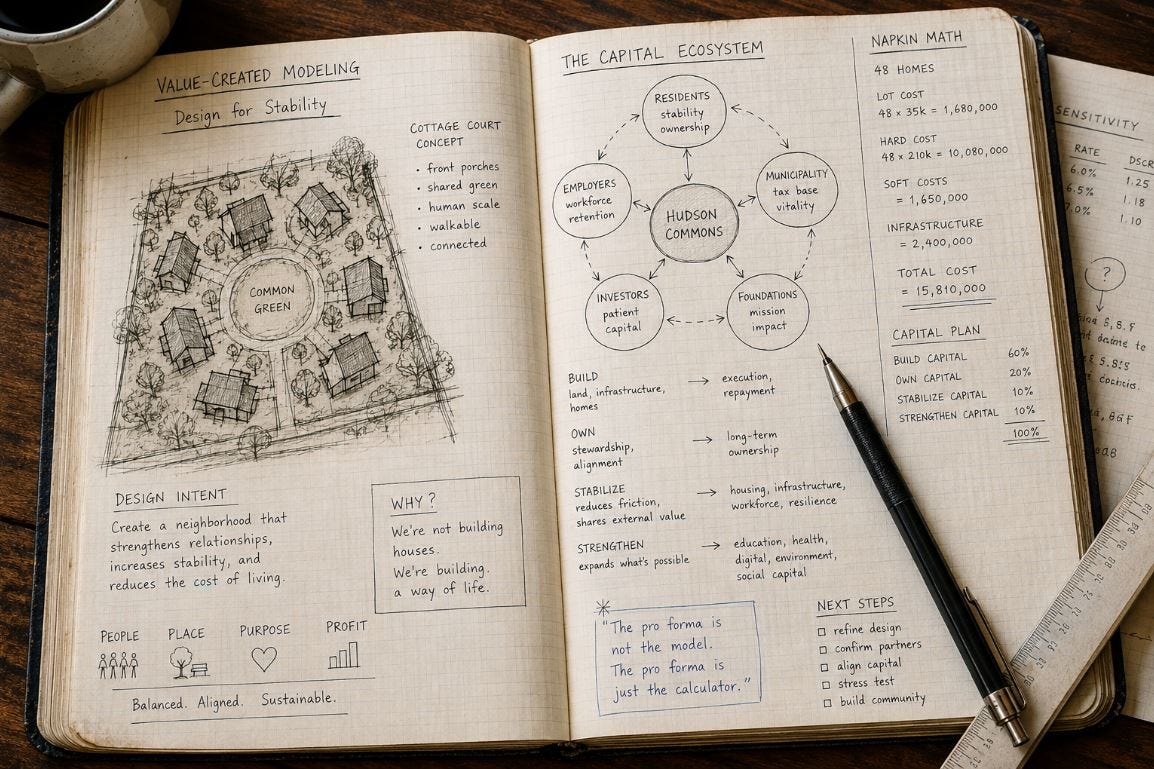
If a traditional development asks, “How much money can we make from this project?” a value-created model asks “What value is being created, for whom, and how should that value be reflected in the capital ecosystem?”
Let’s start with design - because all awesome things start with design.
Design is not decoration. Design is intention. Before we finance anything, before we build anything, and before we ask a household to call a place home, we have to decide what the project is designed to do. Is it designed to maximize yield, maximize exit value, stabilize household costs, create ownership, or strengthen the community around it? Those are not the same project. They may sit on the same piece of land, use the same contractor, and show up in the same spreadsheet, but they are not designed to create the same value.
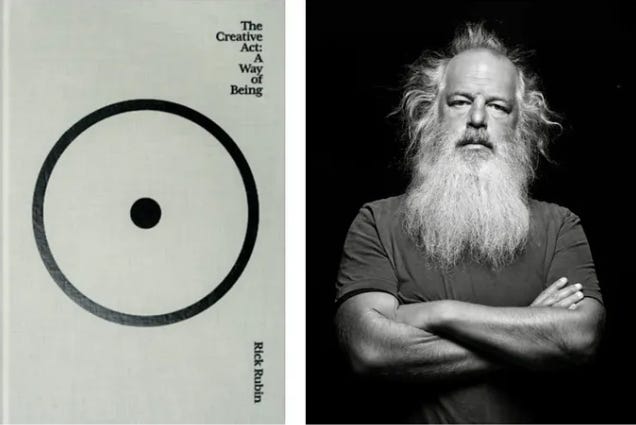
In his book, The Creative Act, Rick Rubin suggests that the creator’s role is not to force an outcome but to recognize what is trying to emerge and help bring it into existence. I think development works much the same way. Every project begins with a set of assumptions about what success looks like. Those assumptions shape the design, the financing, the partnerships, and ultimately the outcomes. The homes, roads, sidewalks, and buildings are simply the physical manifestation of an underlying idea.
The pro forma is not the model. The pro forma is just the calculator. Before we start calculating, we have to decide what we are creating and why it matters. Only then can we begin to understand what value is being created, who benefits from it, and how that value should be reflected throughout the capital ecosystem.
Developers think they’re financing buildings. In reality, they’re financing way of life. With the Pathway Communities model, the way of life we’re financing is stability.
That’s the heart of value-created modeling.
Of course, stability is not the only possible outcome. Every development finances a way of life, whether the developer realizes it or not.
A luxury high-rise may be financing convenience and status. A suburban subdivision may be financing privacy and space. A student housing project may be financing proximity and flexibility. A vacation rental community may be financing experiences and recreation.
None of those outcomes are inherently right or wrong. They are simply different expressions of value. The challenge is that most development models never explicitly define the value they are trying to create. Instead, they default to whatever outcome is most easily measured by the spreadsheet.
Value-created modeling begins by asking a different question. Before we ask how much money a project can generate, we ask what type of life the project is designed to support. The answer to that question influences everything that follows, from design and financing to ownership and long-term stewardship.
Buckminster Fuller spent much of his life studying how structures behave under load. One of his observations was that strength does not come from making a single component infinitely stronger. Strength comes from distributing load efficiently throughout the system.
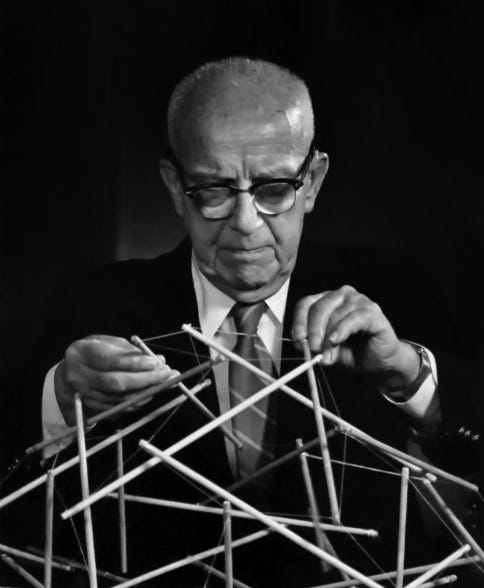
I believe development works much the same way.
Traditional real estate finance is often described as a capital stack. Debt sits on top of equity. Additional layers are added until the project is fully funded. As construction costs rise, interest rates increase, and community expectations expand, those layers become heavier. More load is concentrated on fewer participants.
Eventually something gives.
The project no longer pencils.
Not because value isn’t being created, but because the wrong capital is being asked to carry the wrong load.
Margaret Wheatley offers another way to understand this. In A Simpler Way, she reminds us that healthy systems are not built through control alone. They emerge through relationships, shared purpose, and the ability of each participant to contribute to the whole.
That matters because a community is not just a financial structure. It is a living system. If the bank, the developer, the municipality, the resident, the employer, and the foundation are all pursuing different outcomes, the project may be funded, but it is not aligned.
Value-created modeling asks a different question. Instead of asking how much debt and equity are required, we ask what value is being created, who benefits from that value, and how the capital should be aligned to carry the load.
That shift moves us from a capital stack to a capital ecosystem.
If a capital stack is a hierarchy of funding sources, a capital ecosystem is a collection of aligned participants. Each contributes a different form of capital, carries a different form of load, and benefits from a different form of value creation.
Capital should be organized by function rather than source. The source of capital may change from project to project, but the functions remain consistent: build, own, stabilize, and strengthen.
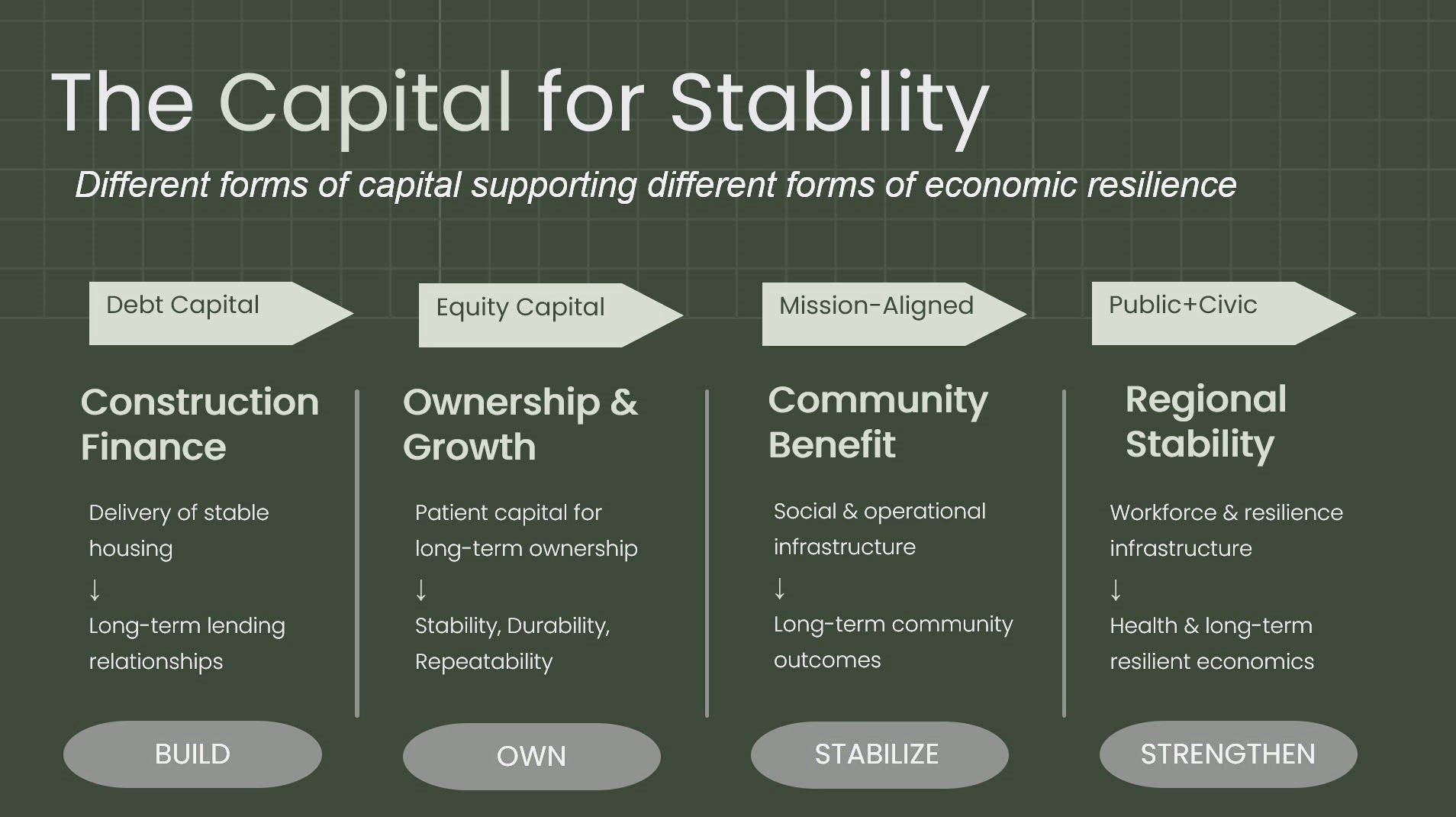
Together, these four forms of capital create the conditions necessary for long-term stability.
Build capital transforms an idea into a physical asset. It is primarily concerned with execution, risk management, and repayment. Build capital finances the roads, utilities, infrastructure, and homes that bring a vision into the physical world.
Own capital creates stewardship. It aligns long-term interests with long-term outcomes and provides the patience required to weather inevitable cycles. Ownership capital ensures that those creating value have a stake in preserving and growing it over time.
Stabilize capital reduces friction and volatility. It recognizes that certain outcomes create value beyond the boundaries of a project and that beneficiaries should participate accordingly. Stable housing, reliable infrastructure, workforce retention, and economic resilience all create value that extends far beyond a property’s lot lines.
Strengthen capital expands what is possible. It supports outcomes that traditional markets often struggle to measure but communities deeply benefit from. Education, health, resilience, environmental stewardship, digital access, financial literacy, and social cohesion frequently fall into this category.
Viewed individually, each form of capital serves a different purpose. Viewed together, they create a more durable system. When capital is aligned with the value being created, load is distributed more appropriately, participants become better aligned, and projects that once struggled to pencil begin to make sense.
Theory is useful. Application is what matters.
Hudson Commons is our first opportunity to put Value-Created Modeling into practice. Located in Hudson, North Carolina, the project is designed around a simple objective: create long-term stability through ownership.
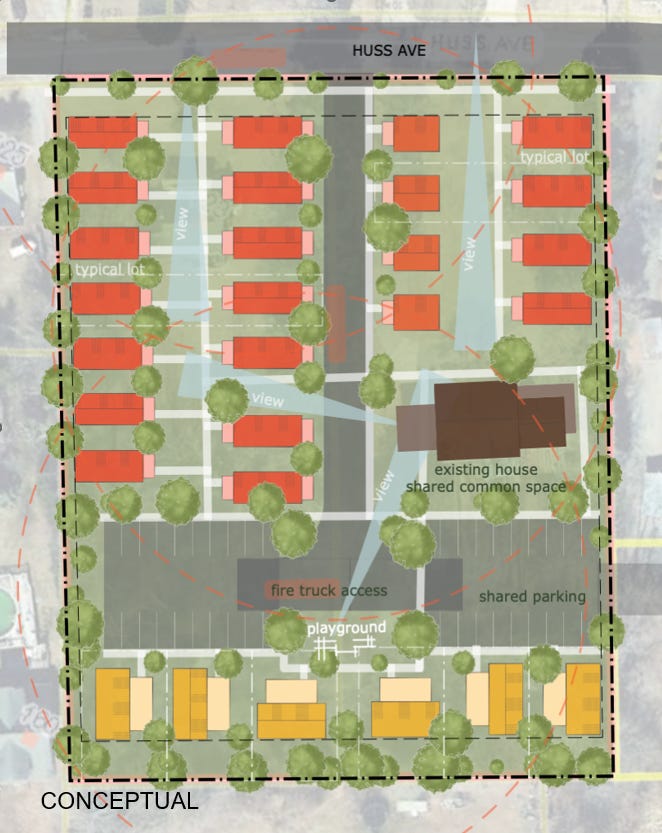
That objective matters because the value being created determines how capital should be organized. If the goal is simply to maximize returns, one capital ecosystem emerges. If the goal is to maximize stability, a different ecosystem emerges.
This is where the four forms of capital become real.
Build capital helps us acquire the land, develop the infrastructure, and construct the homes. Own capital aligns investors, partners, and future residents around long-term stewardship. Stabilize capital recognizes the value created for employers, municipalities, and the broader community. Strengthen capital supports the outcomes that extend beyond housing itself, including digital equity, financial literacy, resilience, and community well-being.
Viewed through a traditional lens, Hudson Commons is a housing development. Viewed through the lens of Value-Created Modeling, it is an attempt to align capital with the value being created and the people who benefit from it.
That distinction may seem subtle, but it changes everything.
It changes how we design. It changes how we finance. It changes who we invite into the conversation. It changes what we measure. It changes what we call success.
Rick Rubin helps me remember that every project begins with an intention. Buckminster Fuller helps me remember that no structure survives when the load is carried in the wrong place. Margaret Wheatley helps me remember that communities are living systems, and living systems depend on relationships. We are literally building structures for humans - we have to place them at the core of our ‘why.’
That is the work in front of us.
Hudson Commons is not the finish line. It is the first proof point. From there, our goal is to bring this model to two more communities in Western North Carolina: one in Watauga or Ashe County, and one in Black Mountain. Three communities. Three applications. One theory tested in the real world. After that, the sky is the limit. We’re grateful for our national partners who are allowing us the margin to think intentionally and locally and solve the challenges in front of us before ‘scaling’ to the rest of the country.
Value-Created Modeling is not about making a spreadsheet prettier. It is about making the value visible. It asks what we are creating, who benefits from it, and how the capital ecosystem should be aligned to carry the load.
That is how projects begin to pencil.
Not because we squeezed one more dollar out of the pro forma, but because we finally aligned the model with the outcome.
Compasses, not maps.
#StableLiving™ #SLIx™ #TinyGiants #TheyIsUs
Also - if you’re not listening to Moonshots podcast, you’re missing out on a free backstage pass into how we’re thinking about what we’re building from the technical perspective. There is a digital trust layer behind this thinking that requires alignment of incentives and chain-of-custody documentation to get us across the finish line. Ask me more.
No posts
Comments
Nothing yet. Say the first thing.
Sign in to join the conversation.