
I’m not a huge sports fan - but I love, love, love the camaraderie and celebration big wins produce. I also love teams, leadership, and accomplishment.
This week didn’t disappoint here in North Carolina.
The University of North Carolina Tarheels baseball team advanced to the Men’s College World Series - and the Carolina Hurricanes won the Stanley Cup.
Winning feels good, and it should.
Success marks the culmination of persistence, teamwork, desire, motivation, dedication, strategy, practice….and maybe even a little luck.
It reminds me of the time my son’s baseball team won the state title and earned their way into the national bracket in Clearwater, Florida.
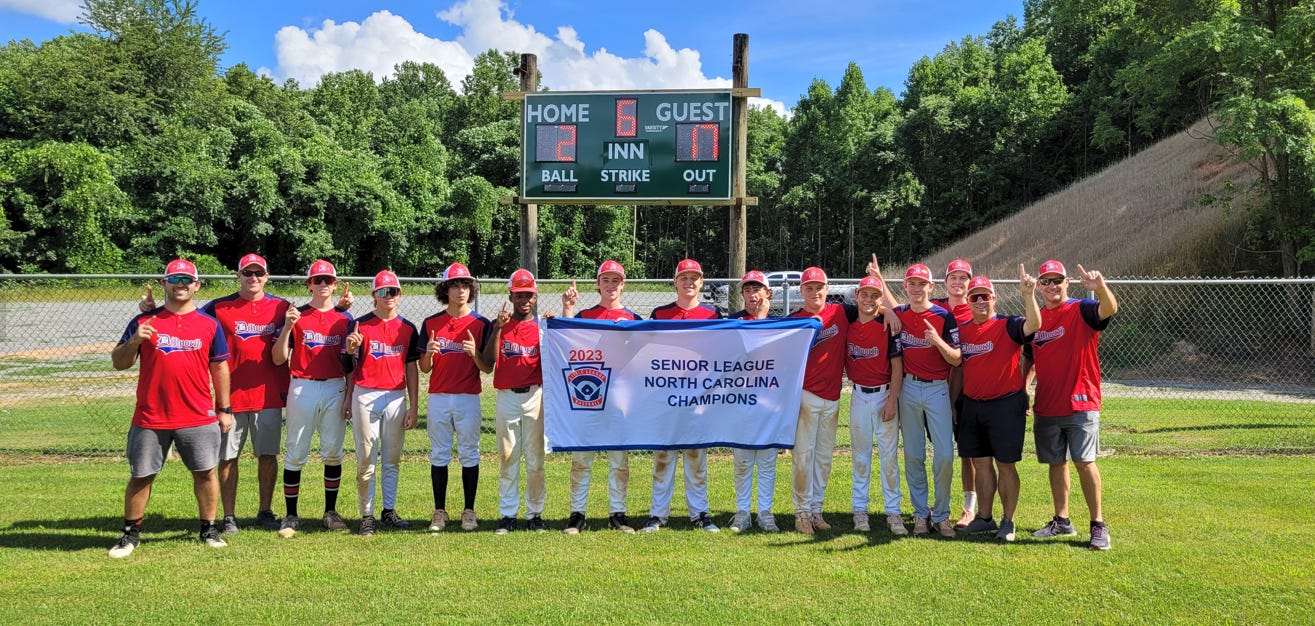
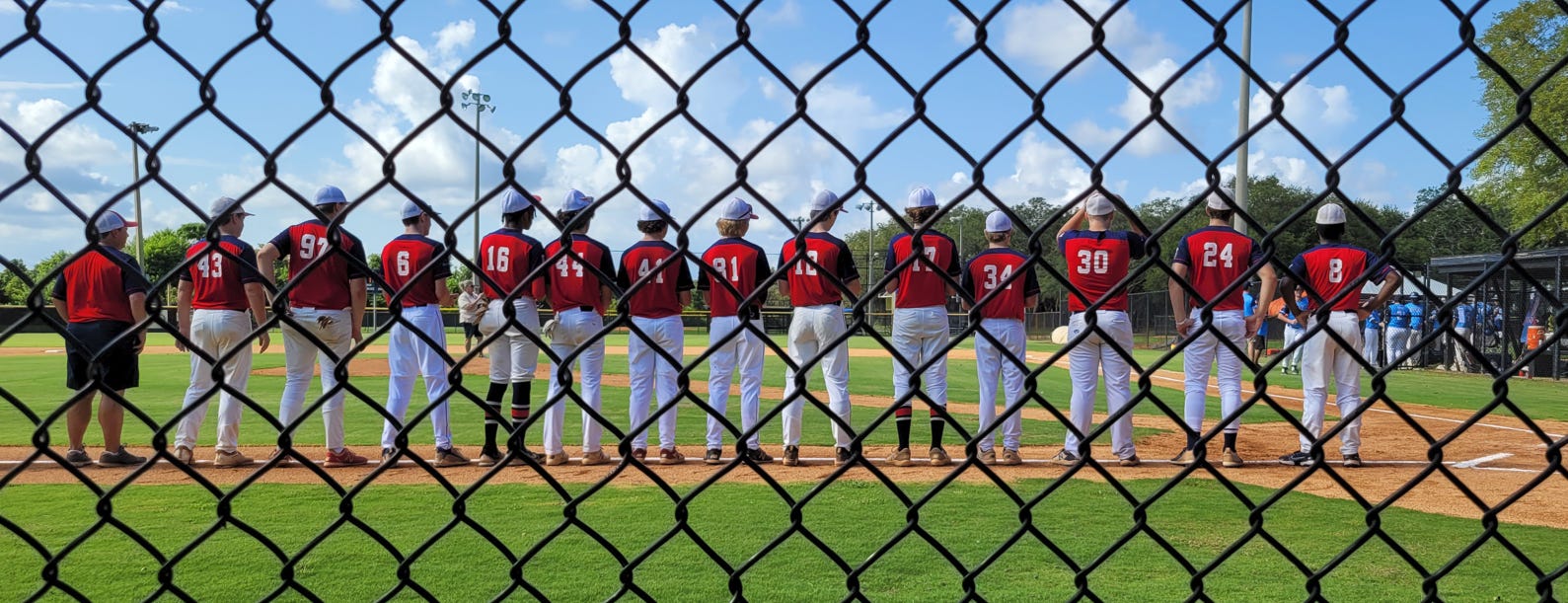
This was a different level of success. His team had come together in a way most don’t. There was no disputing their commitment to the game - especially in the late July heat across the Southeast. Those kids are friends for life. The memories will never be erased.
I’m going to get to my newsletter in a minute - but I wanted to point something out that has me really bothered.
It sucks to lose. But it sucks even worse to watch someone else win like a loser.
That’s what happened in NY with Knicks fans last week. I grew up with that team - well, not THAT team. Bernard King, Patrick Ewing, Bill Cartwright, Gerald Wilkins, John Starks - Madison Square Garden, St. Johns, Big East Basketball. Even in college - the Knicks did their preseason training in Charleston, a town I loved living in for 10 years.
But I was also taught how to handle our successes and failures. We were taught to win with humility and recognize that when you’re on top, everyone else wants to knock you off the peak.
Coaches know this. Players know this. Owners know this.
You have to learn to win and lose - just like you have to learn to dribble and shoot.
With this Knicks win - some fans exclaimed, “It’s euphoria!”
There was a shooting and four slashings or stabbings amid fights in the city, the police reported. Five school buses were destroyed – including by lighting them on fire. The vehicles were slated to transport fans from the city to MetLife Stadium in New Jersey for World Cup games, a police spokesperson stated. People also badly damaged five police cars, including by smashing them with baseball bats.
Police arrested 63 people connected to the game. Ten police officers suffered injuries, including ones who were punched in the face and struck with a glass bottle.
That’s not celebration, it’s ideocracy.
The euphoria, like the win, is ephemeral.
The ticker-tape celebration is on Thursday this week. Let’s hope it can remain a celebration without it turning into a melee.
Go Canes. It feels good to have Stanley back in NC.

The A-B-C’s of UB’s: Universal Basic Word Salad
Want to go down a rabbit hole? Follow the path to Universal Basic Income and see how many exit ramps you stumble across: UBHealthcare, UBFood, UBEducation, UBCompute, UBEnergy, UBWater, UBMobility, and about a dozen or so more.
Because I’m always trying to frame this around the Pathway Communities model, I’m going to share how I tried to simplify the UB’s into a cleaner framework.
Body Basics - Housing, food, water, healthcare, safety.
Household Basics - Energy, mobility, child/eldercare, banking, legal access.
Modern Life - Connectivity, compute, AI access, digital ID, data rights.
Community Basics - Education, civics, social ecosystem, local trust, resilience.
Future Needs - Ownership, time, purpose, upward mobility.
For the record, I list #5 not as a FAR future, but very near-term future - as in intended results or the fruit of our labor behind building these communities. I just want to make sure I highlight that here. This is not some far-off future. It is a highly intentional and intended result or yield.
The old social contract was built around income. The new one is being built around access.
The Apple ecosystem is a good example of this. They’re not selling us phones anymore. They’re selling us access to a managed life system - identity, storage, devices, payments, communication…etc. A simpler way to think of it is as a system built around access that gives people the ability to participate without having to own, build, or manage the whole infrastructure themselves. As a builder and tinkerer, this isn’t exactly appealing to me. That’s why my text messages come in a different color. Not sorry, btw.
Other examples include Amazon Prime - another great example. A bundle of delivery, shopping, streaming, reading, and software. Costco - food, fuel, prescriptions, household goods, travel, business supplies - all through a membership model. Coworking - access to workplace infrastructure without owning or leasing long-term liabilities.
Even the local public library system and the community college system fall into this category of access. The pattern is important because the systems all require and provide similar attributes - membership, identity, tools, trust, support, and a way to participate.
Body Basics
Body Basics are the things a person needs before they can think clearly about much else: housing, food, water, healthcare, and safety. This is the physical foundation of stability. If the home is unstable, the food is unreliable, the water is unsafe, healthcare is reactive, or the environment feels unsafe, then life becomes a constant series of short-term calculations. It is hard to plan for the future when the present is always negotiating with crisis. For Pathway Communities, this is why housing sits at the center, but not by itself. A stable home should reduce exposure to volatility. It should lower the true cost of living. It should protect health, support daily routines, and create enough breathing room for a household to move from survival mode into planning mode.
Household Basics
Household Basics are the systems that make a home actually work over time: energy, mobility, child and eldercare, banking, and legal access. These are the quiet systems that determine whether a household can function without constantly falling behind. Can you afford to heat and cool the home? Can you get to work, school, the grocery store, and the doctor? Can someone care for a child or aging parent without collapsing the household budget? Can you access fair financial tools, understand contracts, build credit, protect yourself legally, and avoid predatory systems? This is where affordability is often misunderstood. The housing payment is only one line item. A home can look attainable on paper and still create instability if the systems around it are too expensive, too fragile, or too difficult to navigate.
Modern Life
Modern Life includes connectivity, compute, AI access, digital identity, and data rights. This category did not exist in the same way a generation ago, but it now determines who can fully participate in school, work, healthcare, banking, government services, and the broader economy. Reliable internet is no longer a luxury. A working device is no longer optional. Digital identity is becoming the front door to essential services. Compute and AI access are quickly becoming the next layer of economic opportunity. This is why I prefer language like Digital Access & Readiness over what I used to call Digital Equity. The goal is not to win a terminology fight. The goal is to make sure residents have access to the tools of modern life, and the knowledge to use them safely and productively.
Community Basics
Community Basics are education, civics, social ecosystem, local trust, and resilience. These are harder to measure than housing costs or utility bills, but they may be just as important. People do not stabilize in isolation. They stabilize inside networks of trust, information, relationships, and shared problem-solving. A community with weak social fabric becomes more fragile during every shock, whether that shock is a storm, a job loss, a health event, or an economic downturn. A community with strong local trust can coordinate, respond, recover, and adapt. This is where Pathway Communities is different from a traditional housing development. The goal is not just to put houses next to each other. The goal is to create a local environment where residents can learn, connect, participate, prepare, and support one another.
Future Needs
Future Needs include ownership, time, purpose, and upward mobility. Again, I do not mean some far-off future. I mean the intended yield of the system. If Body Basics, Household Basics, Modern Life, and Community Basics are working together, then the result should be more ownership, more time, more purpose, and more mobility. This is why ownership matters so much in the Pathway model. Access without ownership can become dependency. Ownership without support can become fragility. The point is to create a system where residents are not just consuming services, but building stability, capability, agency, and wealth over time. The outcome is not simply that someone got a house. The outcome is that they gained a pathway.
Parting Thoughts
The old question was, “How much income does someone need to survive?” That question still matters, but I don’t think it is enough anymore. The better question may be, “What systems does someone need access to in order to live a stable life?” Income helps people buy access, but when the essential systems are broken, expensive, or unavailable, income alone does not solve the problem. It just gives people a slightly better chance of competing inside unstable systems. This is why we built the StableLiving Index™. It’s a starting point. A consensus among the confusion. It’s a score we can all agree on before we get started with the heavy lifting.
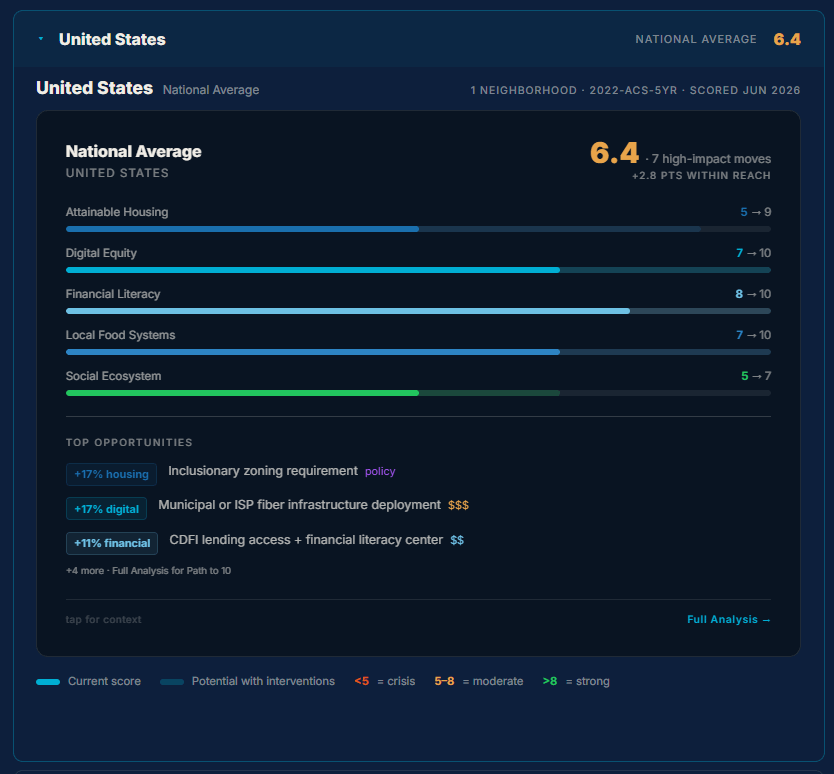
To be clear, none of this is a call to socialism. It’s a call to better designed access to better designed systems.
Socialism implies public ownership or centralized control of production. That’s not what I see here at all. I’m talking about access architecture: the way communities, markets, institutions, and households can organize essential systems so people are not forced to rebuild the basics from scratch every time life gets expensive, fragile, or disrupted. It’s a jumping off point - a direction or heading for the compass.
The old social contract was built around income. The new one is being built around access.
That is why the UB conversation is bigger than Universal Basic Income. It is really a conversation about the basic infrastructure of modern life. Housing. Food. Water. Energy. Healthcare. Connectivity. Compute. Learning. Trust. Ownership. Time. Purpose. These are not separate debates. They are connected conditions - and they need to be collected, quantified, qualified, measured, and improved - just like every dollar in a balance sheet.
And that is the real opportunity for us right now. Not to build another housing product. Not to add another acronym to the word salad. But to build a place-based access system around the stable household. A model where the basics are not treated as disconnected services, but as the operating conditions for a better life.
A home. A future. A pathway. #StableLiving™
No posts
Comments
Nothing yet. Say the first thing.
Sign in to join the conversation.