
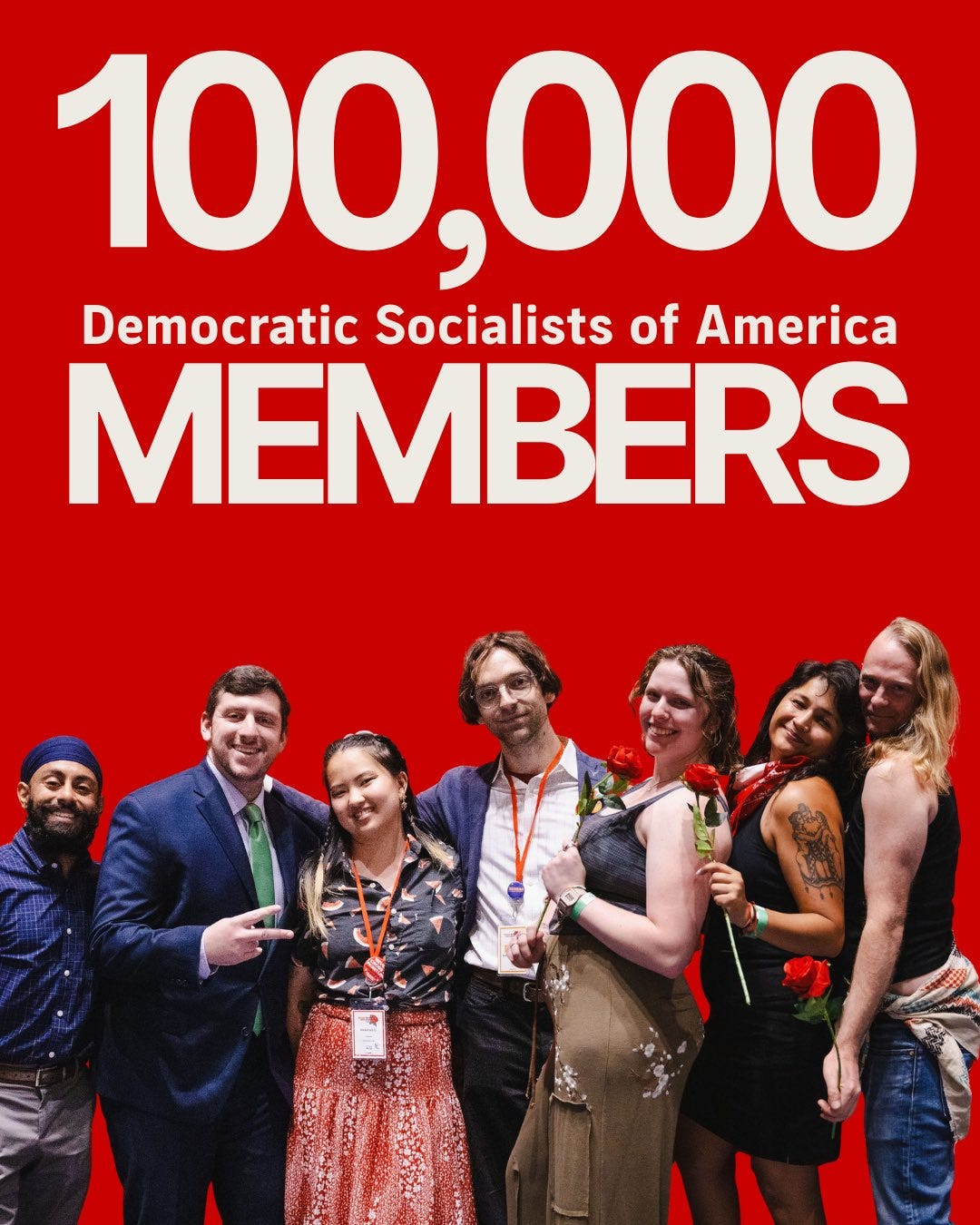
Last week Democratic Socialists of America hit 100,000 members. When I first joined DSA at the end of 2015, we were having our first membership boom with Bernie 2016. We were a mere 6,000 members nationally.
What’s even wilder to a longtime member (11 years, baby) and former senior staffer such as me is that this number is a harder count than in past years. If you counted it by previous year standards (with a longer expiration of membership) that number would be more like 120,000-130,000.
Large chapters and most of all electoral political campaigns–alongside mass shifts in politics as a backlash to Trumpian authoritarianism–have been fueling a long sustained boom after a recent decline.
And it’s not just DSA, it’s also seen at my day job at Showing Up for Racial Justice. Mass calls there were considered large if they had 500, now we expect 3,000 and routinely have many more than that on organizer trainings against ICE. Calls to actions create scores of events. Turnout for phone banks to support anti-ICE movement champions like Analilia Mejia create huge upset victories.
But Just How Big?
Every growing political organization eventually confronts a serious question: just how large could we realistically become? Not how big we wish we were, and not how big we feel on a good day, but how large a dues-paying, member-led socialist organization could plausibly exist given the current political terrain of the United States.
Crossing 100,000 members places DSA in a qualitatively different strategic category than it occupied even five years ago at its last high water mark. DSA is now the (second) largest socialist organization in U.S. history, just 13,000 short of our ancestor, the Socialist Party of America.
That fact alone requires a shift in how we think about scale, structure, and ambition. The central question is no longer whether socialism has any real mass base in the United States. The question is what portion of that constituency can realistically be organized into a mass organization for the longhaul.
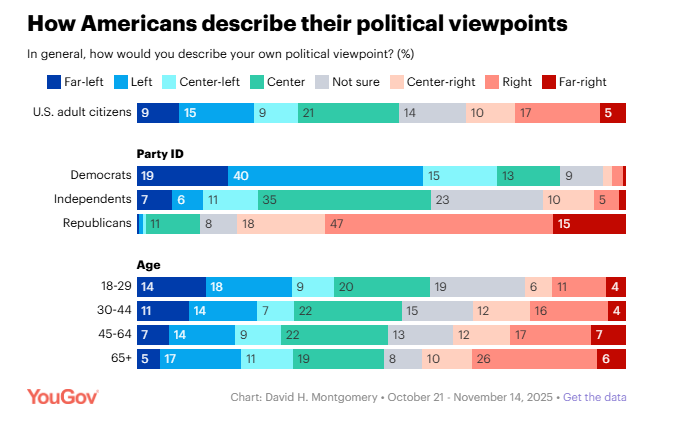
A remarkable, recent YouGov poll suggests that roughly one-third of Americans place themselves left of the political center. And in that breakout: 9% identify as far-left, 15% as left, and another 9% as center-left. Even if we exclude the center-left and focus only on those who describe themselves as left or far-left, that is roughly a quarter of U.S. adults if the poll dynamics scale out. With an adult population of roughly 250 million in the US, that equals almost 60 million people who already understand themselves as to the left of establishment liberalism.
The Socialist Label Universe
Within this broader left-of-center population is a smaller but still pretty dang substantial group of people who explicitly identify as democratic socialists. Gallup finds that roughly 40% of Americans view socialism favorably, and around two-thirds of Democrats do in a 2025 Gallup poll. Pew surveys similarly show large shares of Democratic and Democratic-leaning voters expressing positive views toward leaders who identify as democratic socialist. Labels are fuzzy sure but it does signal availability.
A conservative and useful working estimate is that 10–20% of U.S. adults fall into a broad “social democrat-identifying or left populist-identifying” universe. That equals roughly 25–50 million people nationally that feel some resonance with what we called “big idea organizing” in the Bernie 2020 campaign. This feels high to me but I remind myself that Bernie got 13.2 million votes total way back in 2016 so let’s say ballpark-ish given growth over time.
This is the possible outer boundary of DSA’s long-term potential mass base barring some major political ruptures.
Why Membership Is Always a Fraction
No political organization converts its entire receptive universe into members. Historically, even very successful mass parties and movements convert only a small share of sympathizers into dues-paying, active participants. A reasonable historical range is 1–5% of the broader ideological base, and anything above that is generally considered exceptional by academics.
Applied to our 25–50 million person universe, this yields a long-term membership ceiling in the hundreds of thousands. One percent implies 250,000 members, two percent implies 500,000, and five percent implies 1.25 million. These numbers should be read as horizons, not forecasts. They describe scale, not inevitability.
DSA today has just over 100,000 members. That places it at about 0.2–0.4% of its plausible long-term universe (again barring major change). In other words, DSA is nowhere near exhausting the pool of potential recruits. The limiting factor is not public opinion.
The limiting factors are internal: absorption, retention, onboarding, chapter health, leadership development, political education, and political coherence. These are difficult problems, but they are solvable ones. They are also very different problems than “most people just plain don’t want socialism.”
Two-Year Membership Scenarios
Looking toward early 2028, three broad scenarios are plausible. A pessimistic scenario, marked by churn and weak retention–like what happened to us from 2022-2024–would place membership around 70,000–90,000. A middle scenario, with steady recruitment and modest retention improvements, would place membership around 110,000–160,000. A better scenario, requiring good political conditions and real internal improvements, could get us up to 170,000–250,000. (And I hope I look back on this 10 years and laugh at how much I lowballed it.)
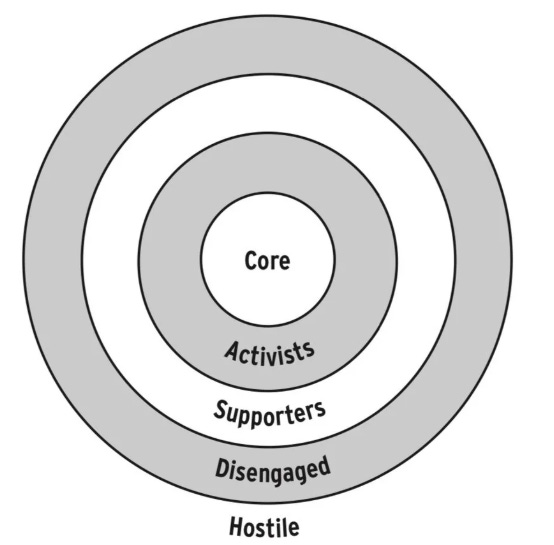
As any attendee of the Mass Org trainings we liked to do on DSA staff, membership is only an inner circle of a much larger ecosystem. Most mass organizations have an engaged orbit several times larger than their formal membership. A common rule of thumb in movement-building is 5-20 supporters for every dues-paying member. This includes email subscribers, event attendees, and occasional campaign volunteers.
At 100,000 members, that implies roughly 500,000 to 2 million people already interacting with DSA in some way. At 150,000 members, that becomes 750,000 to 3 million. At 200,000 members, 1 to 4 million. At these rates DSA is not only building an organization; it is helping constitute a mass socialist public.
Not All “Democratic Socialists” Are the Same
The large mass of people who say they are “democratic socialist” are not ideologically uniform. Most are best described as social democratic. They support universal healthcare, strong labor rights, major climate investment, and higher taxes on the rich. They often like Bernie Sanders and figures such as Zohran Mamdani.
Within this mass is a smaller layer value-aligned with a more radical democratic socialist tradition. (I would like to think its a synthesis of Ralph Miliband, Nicos Poulantzas, and André Gorz politics combined with Bernie-style mass electoral politics but that’s a personal conceit, it’s a layer not that articulated or rarified). This layer is open to structural transformation and a vague long-term transition beyond capitalism, but through democratic and pluralist (coupled with street protest and disruptive social movement) means. Realistically, this group is a much smaller subgroup, let’s say 10% of the social democratic-identifying universe, or roughly 2.5 million people nationally.
Smaller still is the layer that identifies with explicitly revolutionary socialist or anarchist politics. Historically and cross-nationally, this tendency usually represents a small minority of the left. Often it falls in the range of 1-3 percent of the broader left ecosystem (according to Eric Hobsbawm’s brilliant How to Change the World, Reflections on Marx and Marxism). In U.S. terms, that likely means hundreds of thousands to perhaps a couple million people.
This layer is politically important (I would like to think having spent another 20 years in groups there). It has often played outsized roles in moments of upheaval. But it is not, and has never been in this country, a mass base on its own.
The Misalignment Pit
The greatest strategic danger is not that DSA becomes too opportunistic (perhaps the opposite danger for our electeds). The greater danger is misalignment between national and middle leadership culture and the organization’s actual mass base. If national leadership, or a highly active minority of chapters, drifts toward an ultraleft posture or say a highly disciplinary internal culture, DSA risks moving outside the zone of its real membership ceiling.
This would not happen because millions of people suddenly became too left-liberal. It would happen because tens of millions of potential members experience the org as alien, brittle, or uninterested in their political language. Organizations rarely collapse only from repression. They also collapse by narrowing their own on-ramps.
DSA’s plausible membership ceiling is likely in the hundreds of thousands, and under favorable long-term conditions, possibly much higher. Reaching even a fraction of that requires prioritizing broad and accessible political language, deep but pluralist ideological culture, and organizational forms built for scale.
The task is not to chase the furthest-left edge. The task is to anchor a broad democratic socialist center of gravity. One capable of holding millions in its orbit, and growing without tearing itself apart.
No posts
Comments
Nothing yet. Say the first thing.
Sign in to join the conversation.