
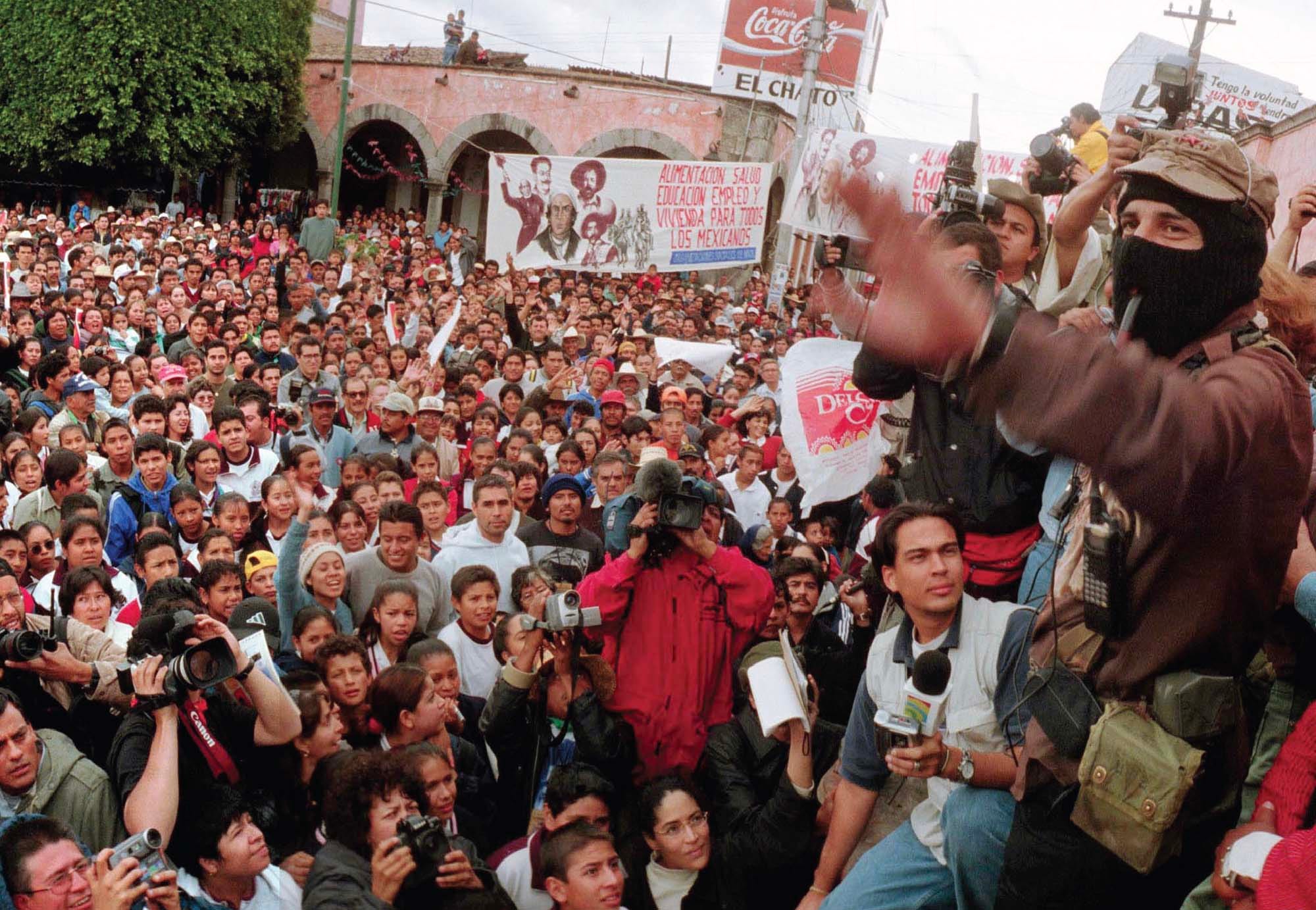
“In keeping with Zapatista tradition of anti-climax, the worst place to see a demonstration in the Zócalo is from the platform.”
Subcomandante Marcos, The Punchcard and the Hourglass
A thought stream occasioned by today, the 32nd anniversary of the (second) Zapatista uprising and recent debates about reformism. In early January of 1994, semi-dodgy newspaper credentials in hand I crossed the border in Laredo and hopped a bus bound ultimately to Chiapas. Mexico was in a huge uproar over a spunky and then mysterious uprising by a force of masked indigenous fighters styling themselves after the agrarian radical tradition of Zapatismo. There was still fighting in the towns when I arrived. I never managed to get much further than Army roadblocks outside of Ocosingo but I wrote it about it extensively at the time from a dirt cheap hostel in San Cristobal talking to whoever I could.
It made a huge political impression on me and it pulls me in again 30 years later. What I found incredibly compelling about the EZLN and the solidarity movement that sprung up to defend it was the paradox of an armed rebellion that recognized that the time for the frontal assault on the modern states of late capitalism, the kind of grand insurrection that smashes the entire state apparatus, had truly past many decades ago. But one could still mightily content for a liberated society in the here and now regardless.
It also bluntly rejected the increasingly fantasy notions of politico-military Leninist organization and vanguardism. Subcomandante Marcos put it so much better at the time: “The moment social forces come into play, it becomes clear that the vanguard is not such a vanguard and that those it represents do not recognize themselves in it. The EZLN, in renouncing any claim to be a vanguard, is recognizing its real horizon. To believe that we can speak on behalf of those beyond ourselves is political masturbation. In some cases it is not even that, because there is no pleasure in this onanism...”
Which all of course leads us to a different dilemma: if we can’t make revolution and we also can’t gradually coast into socialism, what does the Left do? It’s a dilemma and crooked path that the best of the mass politics Left has grappled with now for decades.
Poulantzas and the Democratic Problem
Nicos Poulantzas’s contribution to socialist strategy was to insist that socialism could not be achieved either through parliamentary gradualism alone or through a romanticized rupture with the state. Capitalist states are not neutral actors, but neither are they monoliths. They are condensations of social power, structured by class struggle, and therefore transformable only through prolonged fights across multiple terrains.
For Poulantzas, the democratic road to socialism required two simultaneous movements: the deepening of representative democracy and the expansion of popular, participatory, and self-governing forms. The task was not to abolish democracy in the name of socialism, but to multiply democratic fronts and recompose state power itself.
Two historical moments illuminate this tension particularly well: the Portuguese Revolution of 1974–75 and the Zapatista uprising and aftermath. They represent distinct paths toward democratic expansion, one largely inside the state, the other largely outside it.
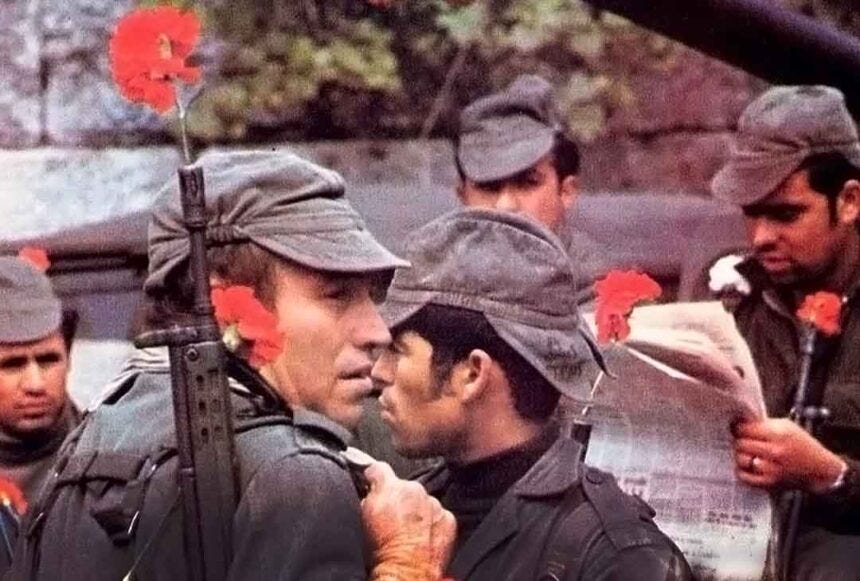
Portugal 1974–75: Democracy Erupts Inside the State
The Carnation Revolution toppled a decades-long fascist dictatorship and unleashed one of the most intense periods of radically democratic working class experimentation in postwar Europe. What followed was not simply a transition to liberal democracy, but a moment when the very meaning of democracy was contested.
Workers occupied factories, farmers collectivized land, tenants formed neighborhood commissions, and rank-and-file soldiers and junior officers organized councils that challenged traditional military hierarchy. Banks were nationalized without compensation. Alongside these extra-parliamentary forms, Portugal also held competitive elections and convened a constituent assembly to draft a new democratic constitution.
This dual power dynamic is exactly what Poulantzas meant by a democratic rupture. Popular forces did not bypass representative institutions, nor did they confine themselves to them. Instead, they attempted to reshape the state from within while simultaneously creating alternative democratic organs rooted in workplaces, neighborhoods, and barracks.
The Zapatistas: Democracy In and Beyond the State
The Zapatista uprising in 1994 began as an armed rebellion but quickly evolved into something far more durable and innovative. Rather than seizing the Mexican state or forming a conventional party, the EZLN pivoted toward constructing autonomous democratic institutions rooted in Indigenous communities.
Through autonomous municipalities, assemblies, rotating leadership, and collective decision-making, the Zapatistas developed a lived practice of democracy that rejected both authoritarian socialism and liberal electoralism. Their governing principle, “to lead by obeying,” inverted conventional political authority and foregrounded accountability from below.
Rather than directly transforming state institutions, the Zapatistas carved out spaces where capitalist social relations and the direct control of the state were partially suspended, replaced by collective governance and social reproduction organized on non-capitalist terms.
This strategy avoided some of the vulnerabilities seen in Portugal, but it also faced limits. Autonomous zones remained territorially constrained and structurally exposed to military pressure, economic isolation, and political marginalization. The Zapatistas demonstrated how an anti-capitalist politics could be practiced locally, but also how difficult it is to generalize such practices without engaging broader state power.
Two Paths, One Democratic Problem
Portugal and Chiapas are often treated as opposites: one a co-opted revolution within a European state, the other a successful but localized rebellion at the margins of a postcolonial one. But we can see them as complementary experiments along the same strategic horizon.
Portugal illustrates the dangers of reducing socialism to electoral victory without sufficiently embedding popular power for the longhaul. The Zapatistas illustrate the dangers of abandoning contesting the state entirely, leaving autonomous democracy vulnerable to containment.
Both cases show that democracy is not a fixed institutional form but a contested social relation. Councils, assemblies, cooperatives, and autonomous municipalities are not merely supplements to electoral politics. They are sites where class power is reorganized and where new political subjectivities are forged.
Lessons for the Left Today
The democratic road to socialism is neither a straight march through parliaments nor a permanent retreat into autonomous zones. It is a process of more: more democracy in all its forms and in all spheres of our lives.
Portugal reminds us that mass democratic openings are possible even within capitalist states, but they must be defended and deepened. The Zapatistas remind us that democracy can be built from below, even under hostile conditions, but it cannot remain isolated from participating directly in the body politic forever.
Taken together, these experiences reinforce our central guiding star: socialism must be democratic and majoritarian in form and content, or it will fail. The task is not to choose between the state and autonomy, but to build a politics capable of transforming both.
No posts
Comments
Nothing yet. Say the first thing.
Sign in to join the conversation.