
Token Engineering (TE) encompasses numerous disciplines, all united by the central concept of Resource Allocation.

What is Resource Allocation made up of?
Blockchain networks, for example, are equipped with cryptoeconomic mechanisms that allow the decentralized network to simultaneously maintain a universal state layer, support peer-to-peer settlement, and incentivize collective action. This is often referred to as Token Engineering.
I am currently studying Foundations of Cryptoeconomic Systems written by @Shermin Voshmgir, Vienna University of Economics @Michael Zargham, Vienna University of Economics & BlockScience.
Designing a token intercrosses many disciplines and considerations. To design and analyze these economic systems, we need:
(i) A complex systems approach,
(ii) Interdisciplinary research, and
(iii) A combination of economic and engineering methods
You may need to read a thread by SherminVO This is because we have to think about Technical Implementation, Economic Design, Legal and Regulatory Compliance, User Experience (UX) Design, Security Considerations, Market Strategy, Governance Structure, etc.
In all these, determining a cryptoeconomic system is very complex. various disciplines include Industrial and Systems Engineering, AI, Optimization and Control Theory, Computer Science and Cryptography, Economics, and Game Theory, Psychology and Decisions Science, Political Science, Institutional Economics and Governance, Philosophy, Law and Ethics, as well as Operations Research and Management Science.
These are lots of disciplines. But the good thing is that there is a central concept that binds them all together. This concept is Resource Allocation.
This involves allocating tokens, computing power, and other resources to ensure the network's efficiency, security, and sustainability.
Allocation decisions being made include resources which are:
(i) Physical, such as hardware and electricity;
(ii) Financial, such as tokens or fiat money; and
(iii) Social such as attention (see my content on Attention Economy), e.g. governance participation, code contributions, or evangelism.
The key aspects include token distribution, governance, economic incentives, security and maintenance, development funds, user adoption & community building, etc.
When creating and managing cryptoeconomic systems with regard to the allocation of resources, we consider these questions:

The Bitcoin networks use mining rewards as a resource allocation mechanism for miners who engage through PoW.
Ethereum 2.0 uses staking rewards as incentives to participating validators in the PoS Consensus mechanism.
And recently defi protocols utilize liquidity mining for token distribution in the realization of resource allocation.
But very importantly, this interdisciplinary nature of token systems has led to a cooperative perspective and the development of a theory of human behavior based on the iterative Prisoner's Dilemma.
For example, the idea that the coordination of a cryptoeconomic system is derived purely from the self-interest of individual actors is a conjecture which, while useful as a narrative, is unlikely to be factual.
The iterated Prisoner's Dilemma approximates complex social phenomena, and continued study has provided additional insights into concepts such as indirect reciprocity and meta-incentives. These concepts are relevant to our study of token economies (TE).
Take for example two prisoners, A and B, suspected of a robbery, are isolated and urged to confess. Each aims to minimize his prison sentence without knowing the other's decision.
They know the outcomes:
(1) Both confessing results in five years each;
(2) Neither confessing results in one year each (for carrying concealed weapons); and
(3) One confessing while the other remains silent results in the confessor going free and the silent one getting 20 years. There would be lots of self-interest expression here.
As the paper says, "the coordination of a cryptoeconomic system is based on an acceptable theory of human behavior” not just the self-interest of actors. This is exemplified by the Miner’s Dilemma which implied that the observed mining pools would break down under pure selfishness. What's this dilemma?
In a cooperative mining pool, miners agree to share the rewards based on their contributed computational power. However, miners face a temptation to act selfishly to maximize their individual profits. This selfish behavior can take several forms:
1. Withholding Blocks (Block Withholding Attack
2. Selfish Mining
For mining pools to remain stable and effective, mechanisms that incentivize honest behavior and discourage selfish actions are crucial.
This is just an approximation of a whole complex system and this is why coordination in the cryptoeconomic system is needed to make sure all things work well and keep the protocol going. This coordination is facilitated by correct/exact resource allocation.
See emergence below, an interscale phenomenon that closes the feedback loop of the macro, meso, and micro level activities.
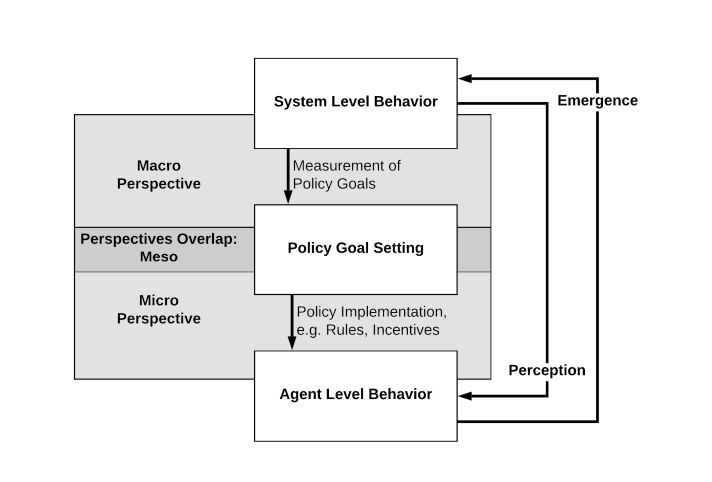
We can leverage network science and apply it to cryptoeconomic systems to gain insights into the dynamics of these systems and design robust, efficient, and secure blockchain networks. And of course, gain reasonable on where resource allocation matters most.
Network science uses graph theory and understanding of dynamic systems to study/design complex system networks. Networks are collections of interconnected entities. These can be people, computers, bots, fin. system
By defining a network mathematically, it is described as a graph G which is composed of two main components Vertices V, and Edges E. An edge indicates a relationship or interaction between vertex i and j.
Vertices (V): Represent individual agents or entities (e.g., miners, nodes, users in a blockchain).
Edges (E): Represent interactions or relationships between these agents (e.g., transactions, communication links).
A cryptoeconomic system like a blockchain network is a multigraph because it has different types of vertices and edges which include labeling maps for the vertices and edges.
(i) Nodes representing computer software in the peer-to-peer computation and communication network,
(ii) Accounts are addresses in the financial network,
(iii) Entities are identities of people and organizations in an off-chain socioeconomic network
(i) The computation and communication network comprised of nodes that leverage a peer-to-peer protocol to validate transactions by mining new blocks,
(ii) The financial network comprised of Bitcoin addresses, which may sign transactions and transfer funds, and
(iii) The off-chain socioeconomic network representing people and organizations that control the tokens in the financial network and operate those nodes in the computation and communication network
This is all network science does, helping you analyze network users and preferences and potentially giving you an idea of which direction to go in terms of resource allocation.
Token represented as state systems make it provable and durable, most of which are complex and require multi-scale perspectives to steer it.
These multi-scale perspectives include three levels of analysis:
(i) Micro-foundational, relating to agent-level behaviors in terms of algorithmic game theory in computer science and mechanism design in the economics literature
(ii) Meso-institutional, relating to policy setting and governance based upon macro-observables and requiring micro-foundations.
(iii) Macro-observerable, relating to the measurement and analysis the system-level metrics.
Purpose-driven tokens
Data-driven economies
Incomplete contracts
Ethics of decision algorithms
Computational social science
Cyberphysical systems engineering
Go to Token Engineering Site and register Courtesy of Akrtws dive deep into the pool.
Comments
Nothing yet. Say the first thing.
Sign in to join the conversation.