
Rockefeller’s Standard Oil was one of the earliest large-scale rollup strategies. In the 1860s, as the oil industry grew rapidly on the back of kerosene for lighting replacing whale oil, Rockefeller built one of the most efficient oil refinery operations in Cleveland. He then used those operational advantages to roll up the industry in the 1870s, going from a small market share to controlling 90% of U.S. refining within a decade.
Even though this was 150 years ago, we see patterns of successful rollups: decentralization, clear improvability of acquired companies, structured knowledge sharing, and encouraged employee stock ownership. I deep dive into these at the end.
Rockefeller’s early life was unstable: his father was often absent, the family moved frequently, and money was tight. Rockefeller reacted by becoming disciplined and inward-looking. He was deeply Christian, avoided drinking, smoking, and gambling, and held strong views about personal conduct.
At 16, he became a bookkeeper at a produce-trading firm. At 18, he left to start his own partnership with the Clark brothers, who brought more capital and connections. He entered the oil business at 22 by investing in Samuel Andrews’s refinery—an early, experimental venture in a new industry. As kerosene demand grew faster than the other products he traded, Rockefeller shifted more of his time and capital into oil.
He eventually broke with the Clarks. He disliked their habits and considered them unreliable, and the partnership had become strained. Rockefeller engineered the buyout calmly: he let tensions rise until the Clarks demanded that he purchase their shares.
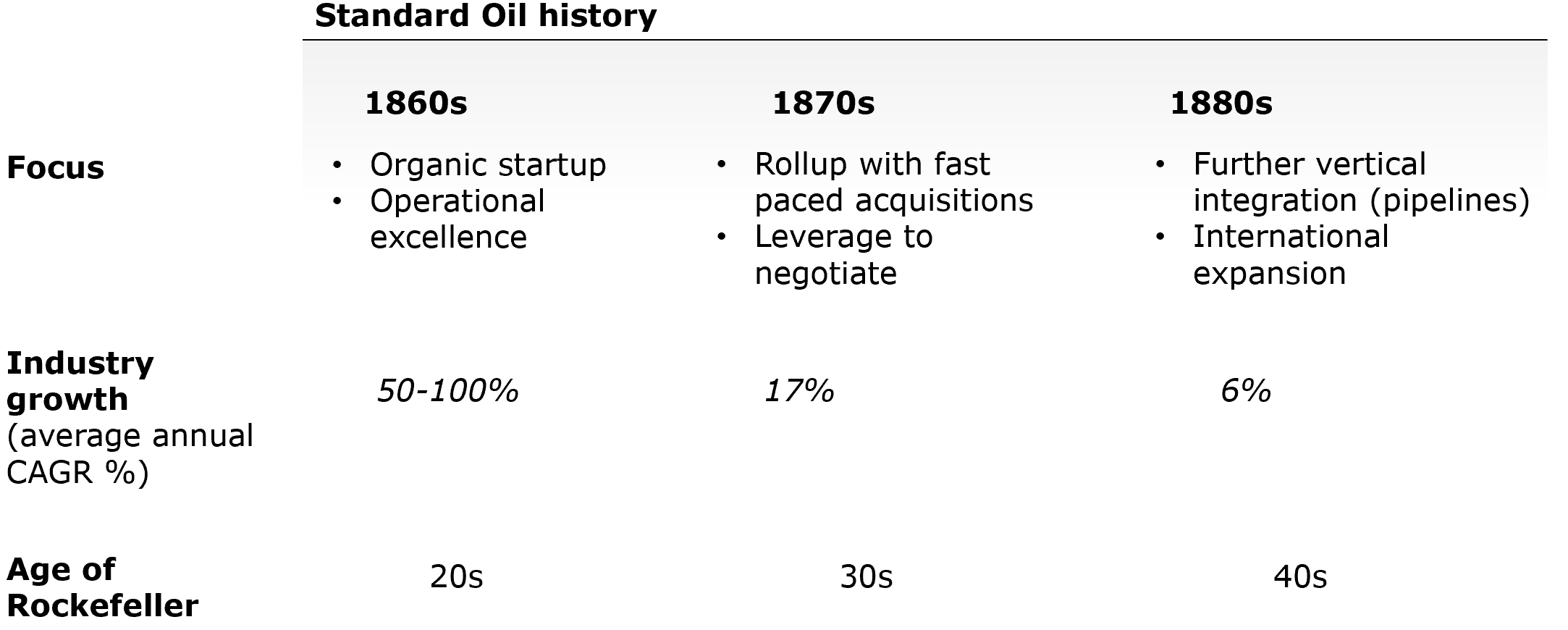
Through the 1860s the industry was growing and Cleveland had around 50 refiners, with even more in Pittsburgh, so the industry was fragmented and full of small upstarts - it was cheap to get started and in the periods of high prices it was profitable. Rockefeller stood out because he ran a far more efficient operation, being able to produce and transport so cheaply that he could sell below the production costs of competitors and still have a good margin.
This is how he did it:
Process Obsessed.
“Devoid of superior airs, he was often seen at Kingsbury Run at 6:30 A.M., going into the cooper shop to roll out barrels, stack hoops, or cart out shavings”
“he would wake up during the night and wake up his brother to tell him an idea for the business so that he would not forget”
Three examples:
Fires were a common source of risk and operational inefficiencies at early refineries. Rockefeller would obsess over this and had very strict codes and processes, if someone was caught smoking anywhere near the premises they were fired instantly. “We kept ourselves like the firemen, with their horses and hose carts always ready for immediate action.”
In barrel production, the Cleveland producers had staves cut in the forest and transported wet. Transporting them dry reduced weight and therefore cost, so Rockefeller installed a drying facility in the woods when insourcing production. They also optimized barrel design.
He had cans of kerosene tested and realized they could hold with one drop less solder on each seam. “That one drop of solder… saved $2,500 the first year… and has amounted since to many hundreds of thousands of dollars.”
By-product monetization.
Most early refiners treated anything that wasn’t kerosene as trash.
For example, when residue of sulfuric acid remained after refining, Rockefeller drew up plans to convert it into fertilizer—the first of many worthwhile and extremely profitable attempts to create by-products from waste materials. Standard Oil ended up producing many by-products of oil refining, while competitors did not.
Gasoline was literally run into rivers; tar and heavy fractions were dumped.
At Standard, gasoline and lighter fractions were used to power refinery machinery and then sold into emerging markets (lubricants, fuel, solvents).
He pushed his organization to use less material (iron in hoops, solder on cans) and to recover even trivial scraps like tin and solder from factory sweepings. Some of those products you’d recognize today: Vaseline (now owned by Unilever) or UTLX (now owned by Berkshire).
Insourcing. Instead of relying on outside suppliers and tradesmen, he internalized critical pieces. When there was a chronic barrel shortage, he built his own cooperage at the refinery
Innovation. They were at the forefront of adopting innovation—from the latest chemistry, to being among the first to use or manufacture specialized carriage containers instead of mounting barrels onto railroad flatbeds, to becoming the leading builders of oil pipelines decades later.
Transport rates
Transport costs were the most important lever of all (and what Rockefeller spent most of his career optimizing), both from the drillers to the refineries and from the refineries to market. He had three things working for him to improve the rates he got:
Cleveland gave Rockefeller the optionality to use both railroads and boats in the canals to New York during the summer, giving him negotiating power.
He built loading docks so barrels could be loaded onto trains faster.
Finally, and most importantly, increased scale gave Rockefeller growing negotiating leverage. Not only was it cheaper to make one stop at Rockefeller’s refinery than three stops at the next three largest ones, but Rockefeller was also becoming an increasing percentage of overall railroad business.
Standard could move crude to Cleveland and refined oil to New York for around $1.65 per barrel, versus the posted tariff of $2.40. That ~$0.75 spread was massive in a commodity business.
Most importantly, Rockefeller surrounded himself with great talent: initially a strong chemist (Sam Andrews who was the equivalent of a CTO), and Henry Flagger, who joined 5 years in and was the COO equivalent.
In 1870, Rockefeller is starting to plan for an acquisition strategy in order to have more control of kerosene prices, and for the first time incorporates a C-corp equivalent to be able to issue shares to pay for acquisitions, it was a private trust called Standard Oil, and it is the basis for how holding companies are organized.
By the early 1870s, the refining industry was trapped in a cycle of booms and collapses. Low barriers to entry and high short-term profits attracted new refiners every time prices rose. Supply repeatedly overshot demand, kerosene prices crashed, and many plants operated at a loss. It was estimated that close to 90% of refineries were in the red during the late 1860s. The volatility hurt Rockefeller—who remained profitable but saw margins pressured—and it also hurt the railroads, which preferred stable, predictable traffic from a smaller set of customers.
During this period, a Cleveland competitor approached Rockefeller offering to sell out for ten cents on the dollar. This reinforced a conclusion he was already reaching: the industry was producing too much capacity, and in order for refining to be a structurally good business he had to consolidate it to control the number of barrels of production.
To pursue this, Rockefeller and Henry Flagler formed an alliance with two Cleveland refiners friendly to Standard, as well as several Pittsburgh refiners who would later join the group. Together they approached the three major railroads—Pennsylvania, New York Central, and Erie—with an offer: guaranteed traffic in exchange for lower freight rates. The railroads agreed, and the arrangement went a step further. Alliance members received a rebate not only on their own shipments but also on shipments by non-alliance refiners. Every barrel shipped by an independent refiner effectively made the alliance members more profitable.
Armed with these preferential rates, Rockefeller moved quickly in Cleveland. He told local refiners that, under the new freight structure, competing would be untenable. They could either sell—at a low but fair price—for cash or, preferably, Standard Oil stock, or face being driven out of business. The message was direct, and the financial logic was hard to argue with.
The alliance itself lasted only a few months before public pressure forced the railroads to dismantle it. But in that short window Rockefeller used the leverage it gave him to acquire 22 of the 26 major refiners in Cleveland. Many sellers later regretted their decision, but by then the transactions were done.
Rockefeller himself noted he was influenced by earlier aggregation strategies: Western Union’s consolidation of small telegraph lines and Vanderbilt’s consolidation of railroad routes. Standard Oil was applying similar logic to refining—using cost advantages, transport leverage, and share-based deals to bring a fragmented industry under coordinated control.
1873 was a setup year. Another price collapse hit the oil industry, and Rockefeller responded by stopping dividends, conserving cash, and waiting for weaker national competitors to struggle. His Cleveland base was now secure; the next step was to extend the consolidation outward.
In 1874 he moved into Pittsburgh and Philadelphia. His approach was straightforward. He met with the leading refiners in each city, showed them Standard Oil’s books, and demonstrated that Standard could produce kerosene so cheaply that it could sell at or below their cost and still earn a profit. Once they saw the margin gap, most accepted that continued competition made little sense.
These owners typically took Standard Oil stock rather than cash and joined the enlarged organization as regional leaders. Their mandate was to consolidate the smaller refiners in their areas—repeating the pattern that had worked in Cleveland.
In 1875 he acquired key refiners in New York, adding operators who would become central to Standard’s broader system. From 1875 to 1878, Rockefeller used the same method across the Northeast: approach the major refiner in each region, show the economic advantage Standard held, offer stock and a leadership role, and rely on them to integrate the local market.
By 1878, with most major refining centers under some form of Standard influence, Rockefeller began expanding vertically as well—moving into the infrastructure that connected production, refining, and distribution.
By the 1880s, Standard Oil was no longer rolling up refiners at the same pace; it already controlled around 90% of the U.S. refining market, and the remaining independents were too small to matter. The focus shifted to vertical integration.
Standard began building pipelines to lower transportation costs and reduce dependence on the railroads. It also invested in specialized tank cars, which it then leased to the railroads—cutting transport costs further and giving Standard more control over how oil moved. The cumulative effect was that any company transporting oil was likely to touch Standard Oil infrastructure at some point.
At the same time, Standard expanded internationally. It built tanker fleets and foreign marketing networks, turning kerosene into a global product used to light homes across Europe, Asia, and Latin America. By 1900, Standard Oil was worth roughly $33 billion in today’s dollars—and in a much smaller economy, it was one of the most powerful enterprises in the world.
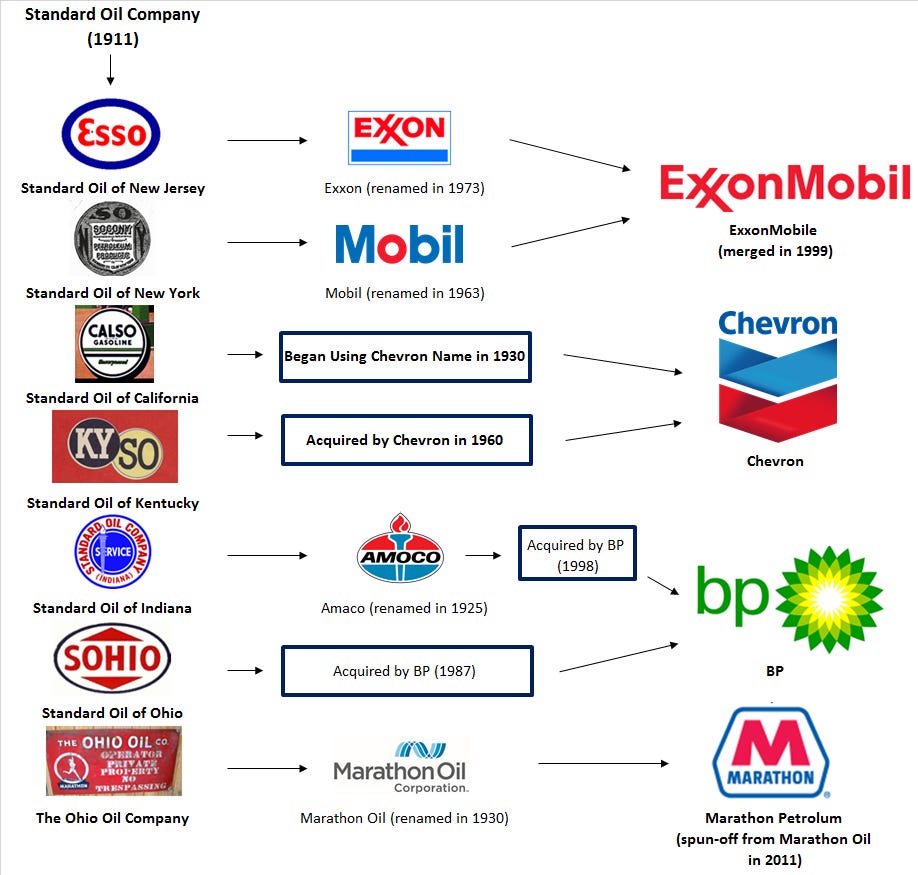
This level of industry control eventually triggered federal investigations in the 1890s and early 1900s into the Standard Oil Trust. These inquiries led to the formation of modern antitrust laws, and in 1911 Standard Oil was broken up into independent companies, many of which still exist today.
But by then Rockefeller had structured his position, and was one of the richest people in modern history. If measured as a % of GDP, his wealth would be to par with that of Elon Musk, around $400Bn.
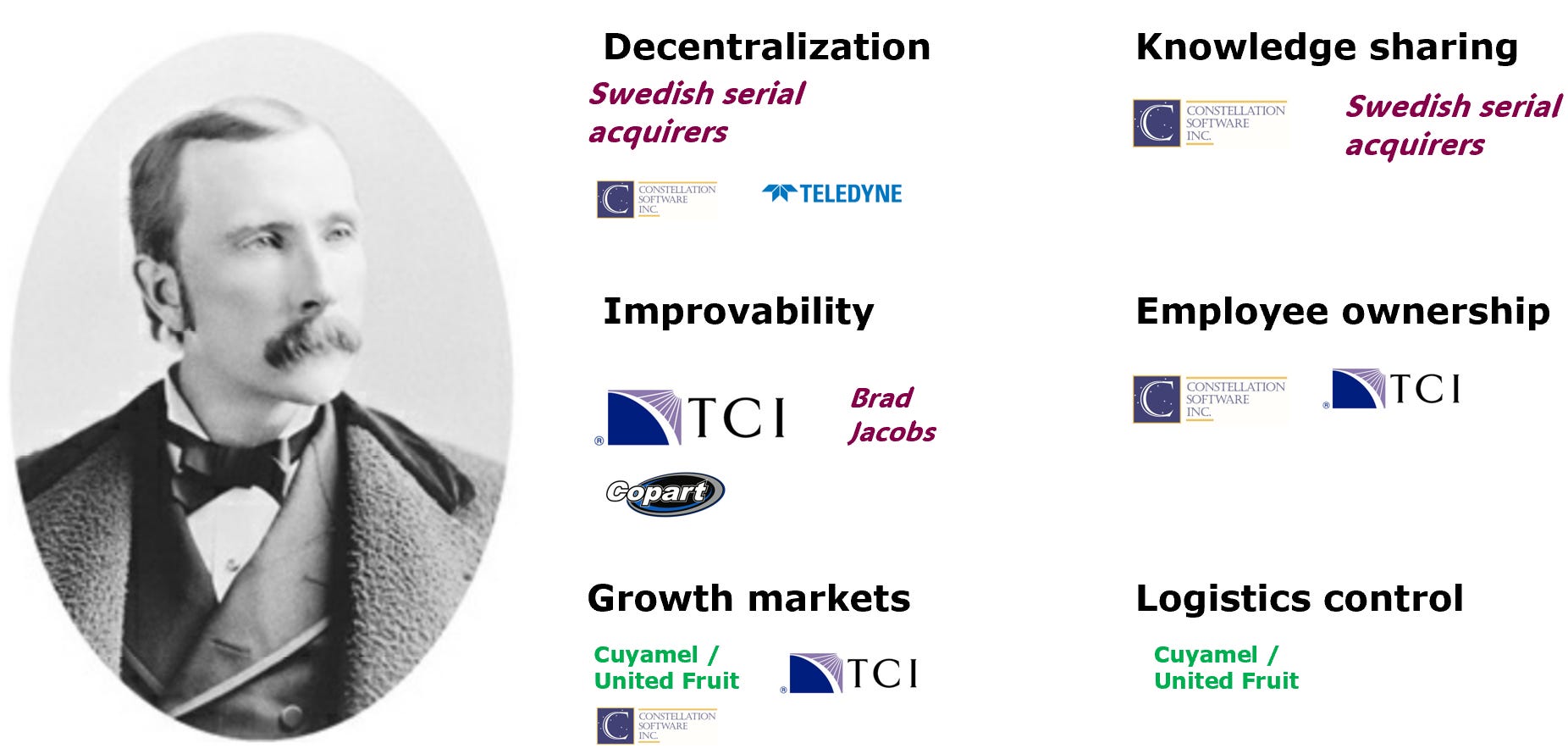
I have studied several companies that used ‘serial acquisitions’ to produce excellent shareholder returns. There are patterns that repeatedly emerge: decentralization, significant improvability of acquired businesses, knowledge sharing processes, employee ownership, and being in markets with growth tailwinds. Not all successful serial acquirers / rollups show all patterns, but most of them have a high % of these elements. I was surprised about the extent to which a Rockefeller in the 1800s may have agreed with Mark Leonard from Constellation Software or Willis Johnson from Copart.
Standard Oil functioned as a holding company that allowed a high degree of local autonomy. Rockefeller kept acquired companies operating under their own names, which also helped maintain secrecy and reduce public attention. Standard did not always own subsidiaries outright; in many cases it held controlling stakes while promising former owners meaningful independence in running their operations.
Rockefeller’s typical pattern was to acquire the leading refiner in a region and then give that local leader the mandate to buy the smaller plants around them—sometimes allowing them to pay what seemed like very high prices for the smallest operators, simply to control the amount of output in the region.
He delegated heavily. Rockefeller was regarded as a caring but demanding manager: he tested employees early, and once they proved competent he trusted them with significant responsibility. Delegation freed him to think about larger strategic questions, and he encouraged his subordinates to do the same with their teams.
Although operations were decentralized, Standard created strong mechanisms for sharing best practices across the organization, the “expert committees”. These were chosen experts, who had daily sessions and study of the problems, new as well as old, constantly arising. The benefit of their research, their study, was available for each of the different portfolio companies.
“Below the executive committee came a battery of specialized committees dedicated to transportation, pipelines, domestic trade, export trade, manufacturing, purchasing, and so on. These committees standardized the quality of subsidiaries engaged in similar work, enabling managers to swap insights and align their operations”
These committees produced several effects:
Standardization of quality across plants doing similar work
Fast diffusion of practical improvements, from yield techniques to safety procedures
Internal rivalry, since performance figures were shared and companies competed for records and recognition. “The committees encouraged rivalry among local units by circulating performance figures and encouraging them to compete for records and prizes”
The system allowed Standard to maintain local autonomy while ensuring that every subsidiary benefited from the best available methods. It also gave Rockefeller levers to coordinate output—especially for kerosene production, which had been the original driver for industry consolidation.
This pattern is seen in successful rollups today, such as Constellation Software, which has KPIs for how a Saas business should operate (e.g. pricing, % of services, % of revenue spent in developers, etc)
One of Standard’s core advantages was that nearly every acquisition improved immediately upon joining the group. Several factors contributed:
Better transport rebates due to Standard’s scale and freight leverage
Access to by-product monetization, which many independents had never attempted
Cheaper inputs from Standard’s insourced barrels, plumbing, and tank cars
The option to close subscale plants and consolidate output into more efficient refineries
This pattern—day-one uplift driven by structural advantages—is characteristic of many successful rollups. In modern analogues: Copart gains more buyers and improved yard processes, TCI (cable) secured better programming rates, ESW Capital (and Bending Spoons) centralize Saas operations in lower-cost locations.
In the early days Rockefeller preferred to pay sellers in Standard Oil stock both to preserve cash internally but to also align those that would stay with the interests of the company.
Inside the company, he encouraged key employees to buy shares, sometimes helping them finance the purchases. As Standard compounded, these employees became wealthy, which reinforced long-term retention and alignment. Director-level turnover was low.
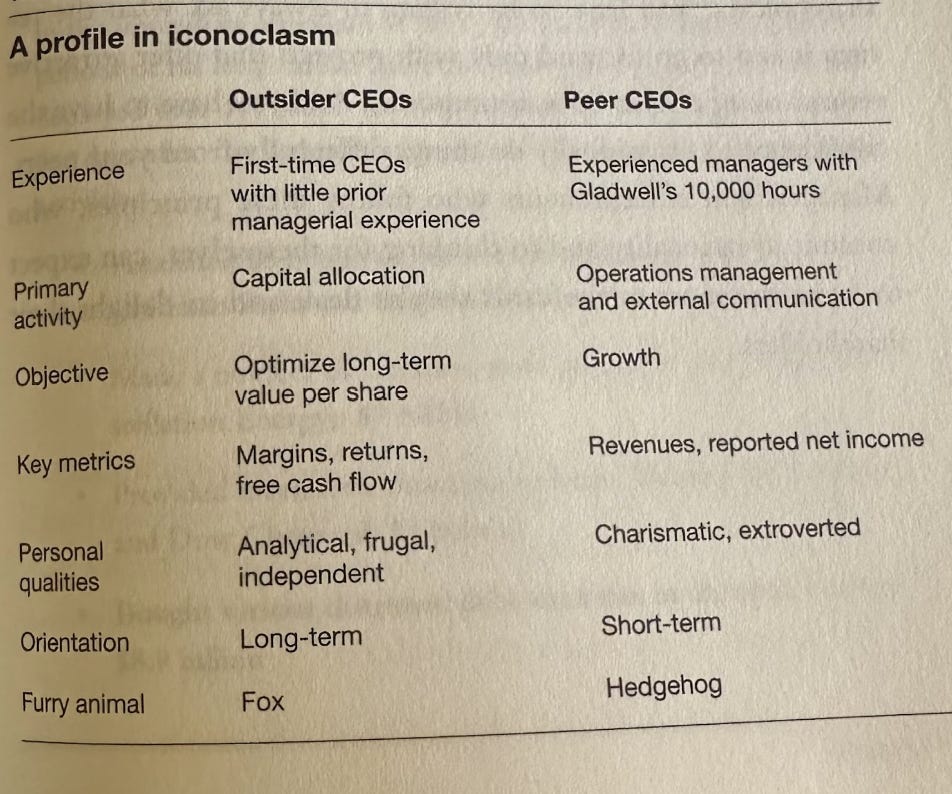
Will Thorndike conducted a study on some of the companies with the highest long term equity returns relative to peers. In studying the CEOs that produced those returns, Will distilled a set of 7 characteristics that are common to these CEOs (‘the outsiders’). Rockefeller had not read Will’s book, but exemplifies quite closely many of the characteristics of outsider CEOs:
Personal qualities: Analytical (with his numbers focus), frugal by personality (both in Cleveland and in New York he lived significantly below his means), and independent thinking. Not extroverted, on the contrary, he was private and inward.
Primary activity: After his 20s, Rockefeller started to delegate more to focus on strategy and capital allocation (e.g. controlling transport). However he still dipped into operations (which is a counter argument to his fit in the Outsiders framework).
Key metrics and objectives: Focused on margins - that was the reason he did the rollup in the first place, to stabilize a volatile industry, not because of aspirations of top-line growth. Good evidence of this is that Rockefeller would immediately shut down many of the refining plants he bought in the 1870s.
Long term orientation: an example is how he planned a decade of acquisitions to be able to stabilize the supply of oil and kerosene from its unruly state in the 1860s. Many of his competitors were short term focused, over-extending their production capacity during “drilling booms” and losing money during crisis.
Rockefeller is more of a “fox” (open minded, draws from many experiences) vs “hedgehog” (one big idea): he is able to play with the railroads and then become the biggest pipeline producer, he goes into non-kerosene products, and in the period of steel he became one of the major controllers of iron ore. From a more philosophical standpoint, he was very religious man and able to take the lessons from the church, but also marry them with the lessons from the business world, without coming into conflict.
One point in which he fits less is that he was not an outsider to the business, he had been in materials trading for almost 10 years before he goes full time into Oil. And as mentioned earlier, while he does turn into a capital allocator, he is an operator in the earliest part.
Overall Rockefeller would closely match outsiders like the ones described in Will Thorndike’s book, The Outsiders.
If your curiosity wants to take you further, I recommend downloading PDFs of Rockefellers late biography (Titan) and his autobiography (Random Reminiscences of Man and Events), uploading them to ChatGPT or your AI co-thinker of choice, and letting your curiosity roam free. I did read most of the books, but they are heavy.
No posts
Comments
Nothing yet. Say the first thing.
Sign in to join the conversation.