
Vitec started in Sweeden at the same time as Constellation Software, but today is 1/35th of the size. Vitec was in the right place, at the right time, and did the right things, producing a 300x return for shareholders since 1999. Vitecs only mistake was not dreaming even bigger - it raised less and focused less agressively on scaling up acquisitions than Constellation.
The company recently wrote a book about their story. The title, “Driven by Curiosity”, hit close to home - I am myself chasing my Curiosity. So this weekend I read the book, and put together a 1)history of Vitec, 2) a comparison with Constellation, and 3) some notes I had on the Vitec stock. I admire Vitec, and own it, even if I have constructive reflexions.
If you are another curios mind that wants to debate about Vitec or the other publicly traded software serial acquirers, dont hesitate to reach out.

Vitec started as a software company for property managers to track energy usage in the 1980s. They expanded organically into other products for property managers: Financial decision support for property managers, and software for short-term forecasting of energy producers (aimed at energy plants). At the beginning these products were bundled with hardware, and a lot of the revenue was from the initial license sales (in the 90s and early 2000s there was no SaaS!).
Vitec was doing $0.7M/year of sales by 1995, after the first decade. They hit a high market share of their niche, and looked to expand, so they raised money for international expansion. They tried to expand to Germany and failed, so redirected the capital towards acquisitions in order to meet investor growth expectations. These acquisitions worked so well they realized they could continue to grow via acquisitions. They hit $4M in sales by 2002, having acquired 3 companies.
Until 2013 Vitec continued acquiring 1 company per year on average, with focus on real estate and media. In 2013 it was 40M in revenue and took the decision to acquire software being more agnostic about the end market (what Constellation had been doing for over a decade), so they started looking at software in healthcare, in banking, in insurance, church software, and many other niches.
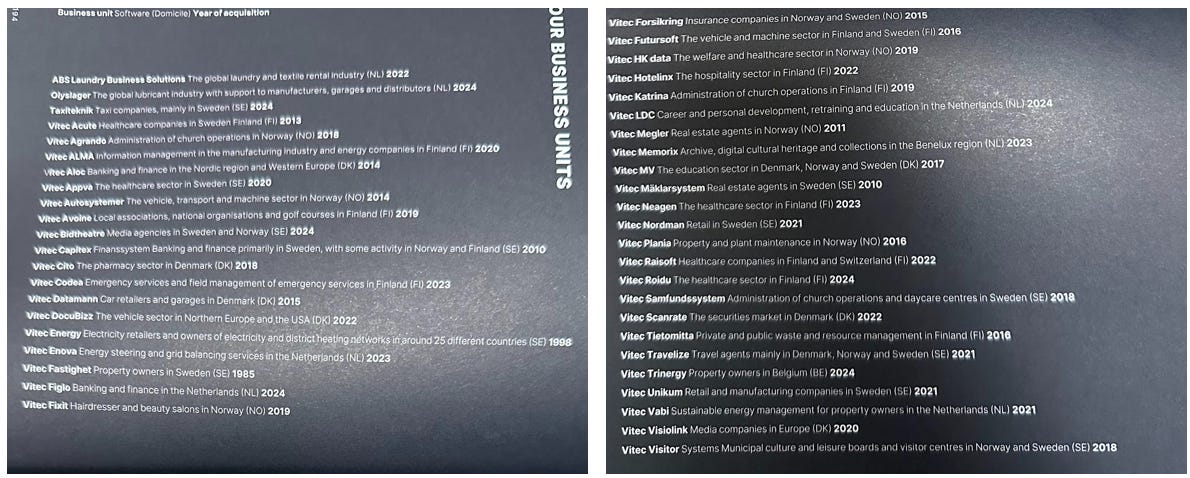
From 2013 onward, Vitec increased its acquisition pace to ~4–5 companies per year, and now Vitec has acquired 60 companies in a variety of niches, with Property Management and Healthcare being the largest. Redeye research reports Vitec has >99% annual client retention. Below we highlight a list of most acquisitions
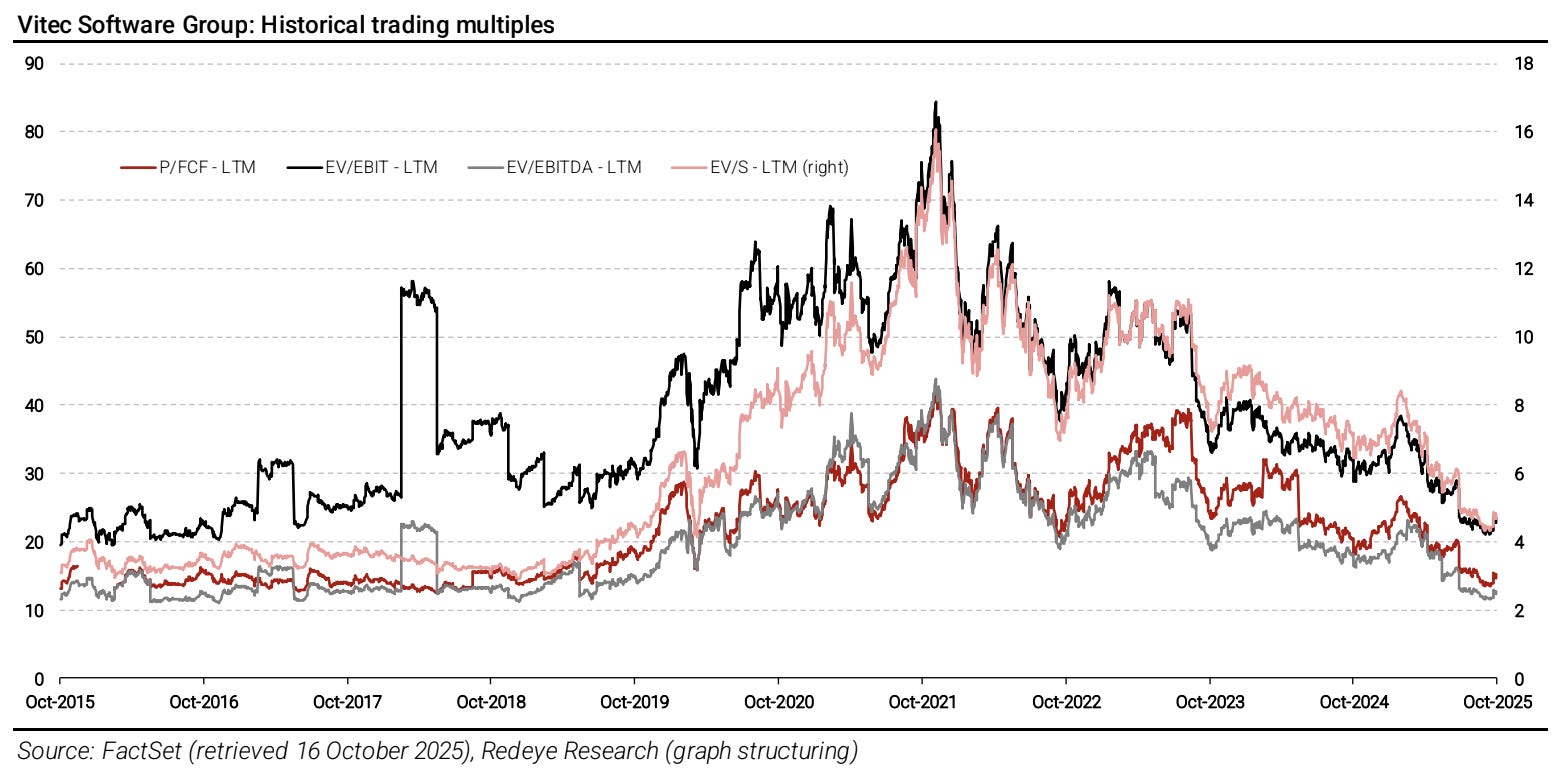
Vitec reached an Enterprise Value of $2.8Bn in early 2025 (53x LTM FCF), and as of December 2025 is down almost 50% to $1.5Bn EV (24x 2025E FCF). Even with this recent price decline (or multiple reversion to the historical mean), Vitec investors have seen a good return. A 10x in the first decade from 2004 to 2014, and 12x from 2014 to today.
In parallel to Vitec, a similar company was growing from Canada. Constellation software. They are similar in that they started their niche software acquisition strategy at similar times (Vitec in 1998, CSU in 1995), its different in how much and how fast they leaned into scaling the acquisition strategy. Vitec is a software company that happens to acquire other similar companies; Constellation is an acquisition company that happens to acquire software
Today Constellation is 35x bigger than Vitec ($1.5Bn vs $50Bn TEV). Why?
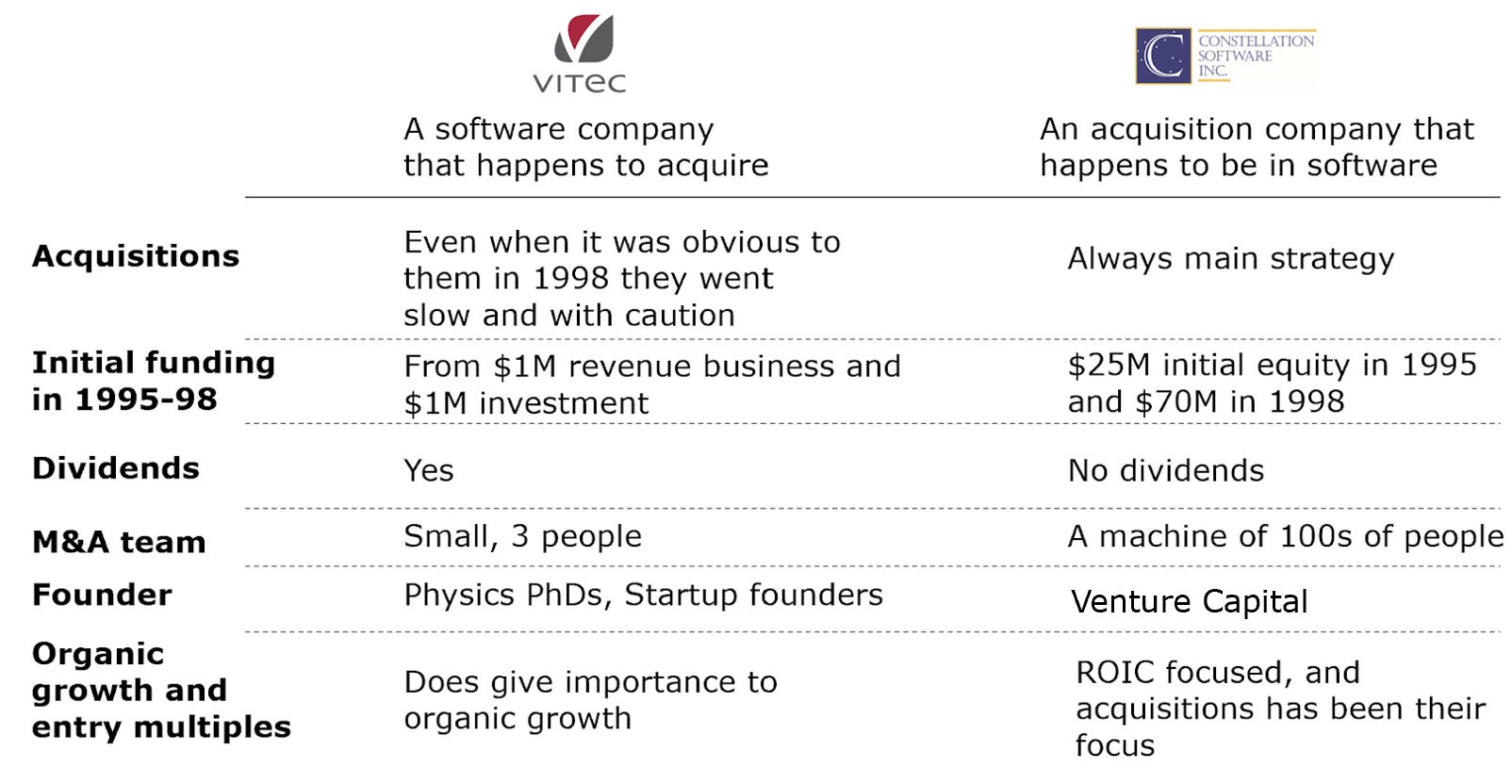
Early on, Vitec moved cautiously while validating the model, faced investor resistance to no-synergy deals and expansion beyond real estate, and until 2015 typically acquired only one to two companies per year. This conservatism was reinforced by a very different starting point: Constellation began with ~$25M of equity from OMERS (and additional capital later), while Vitec raised ~$1M in 1998 on ~$1M of revenue.
By 2001 Constellation was 10x bigger than Vitec ($5M vs $50M in revenue). By 2006, Constellation had done 45 acquisitions, and had $200M revenue scaling fast. Vitec had done 6 acquisitions and had $8M in revenue. Vitec was only acquiring 1 company per year, Constellation was acquiring 20 per year and accelerating.
Vitec has also operated with a very small M&A team (3 people), relying heavily on inbound opportunities and advisors, whereas Constellation built larger teams actively reaching out to companies.
Finally, the companies were founded differently. Constellation was designed from the outset as a serial acquirer by a financially oriented founder, while Vitec originated as a single-vertical software business that turned to acquisitions after hitting organic growth limits. Vitec has also historically emphasized organic growth in its messaging, whereas Constellation explicitly prioritized acquisitions as the superior driver of long-term ROIC.
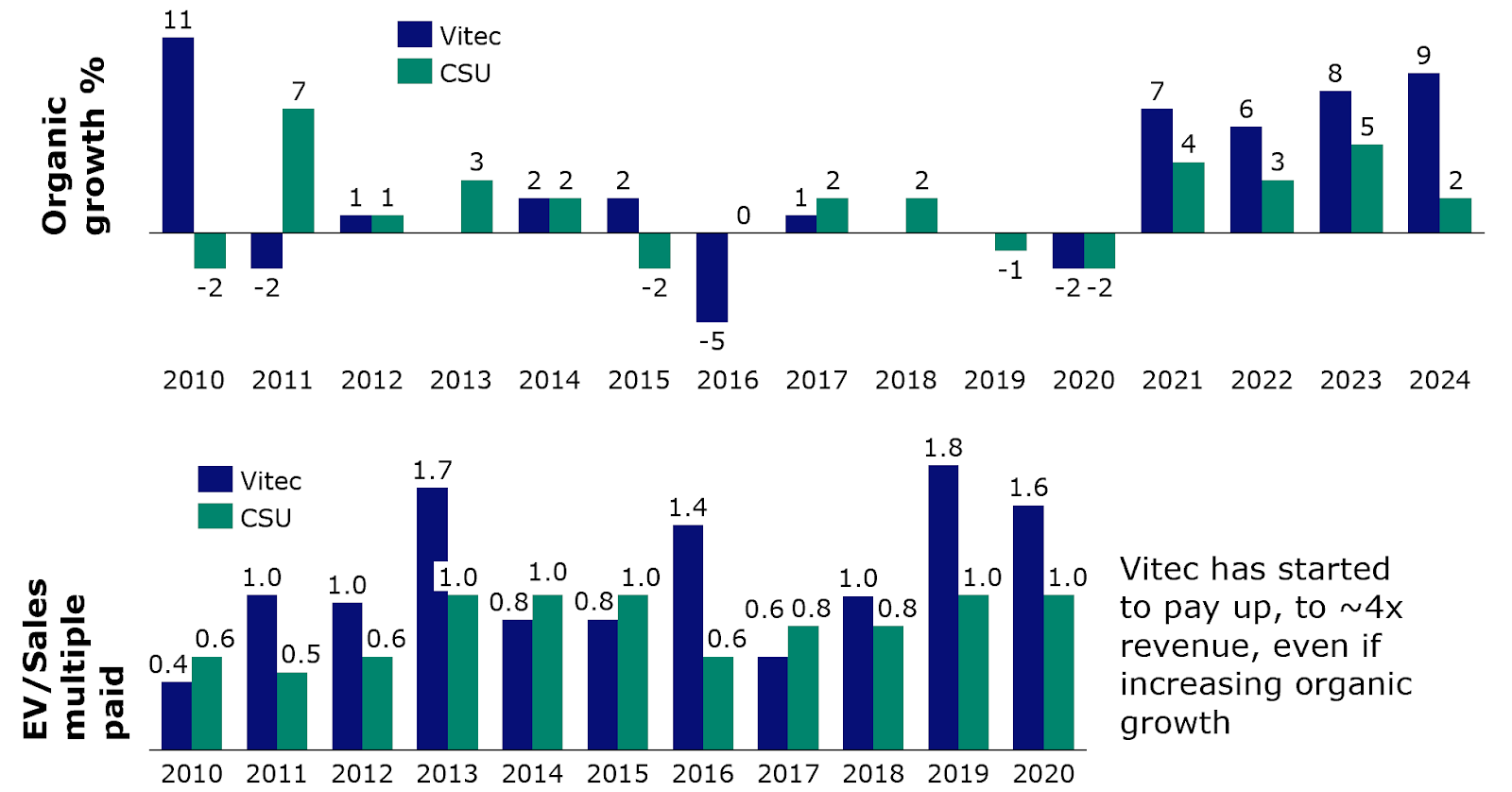
Vitec is currently trading at valuation multiples not seen since 2017. While this de-rating has also affected Constellation, we focus here on Vitec. ~24x LTM FCF, slightly above Constellation but supported by higher organic growth (we look at FCF for Vitec because they capitalize R&D). Share price is down ~50% from early-2025 highs.
The decline seems mainly attributed to two factors:
AI risk: that AI is going to make it easier for incumbents to code these softwares inhouse, or that competitors will pop up that code with AI and can replicate for cheaper.
I think this risk is mitigated by 2 factors:
(1) if you code you know that the maintenance of the software is a big piece in why you buy external software.
(2) if you know vertical software, you know customers don’t look only for the cheapest new option, but default to staying with the current solution, because there is a high cost to change, while the software cost is only a small fraction of the overall company expenses.
We gain additional comfort in that Vitec has already gone through several technological revolutions. First the transition from command lines to Windows interfaces, the internet, the cloud, Saas, and mobile.
Slower revenue growth in 2025. This is driven by a type of revenue that is not subscriptions, but transaction-based, which is a type of revenue that is needed in some verticals to complement the subscription-based product. I think that the reduction in revenue driven by this type of revenue should not be accounted as an structural slowdown in growth.
In addition to the above, we see two real risks that receive less attention:
Prices for acquisitions are increasing.
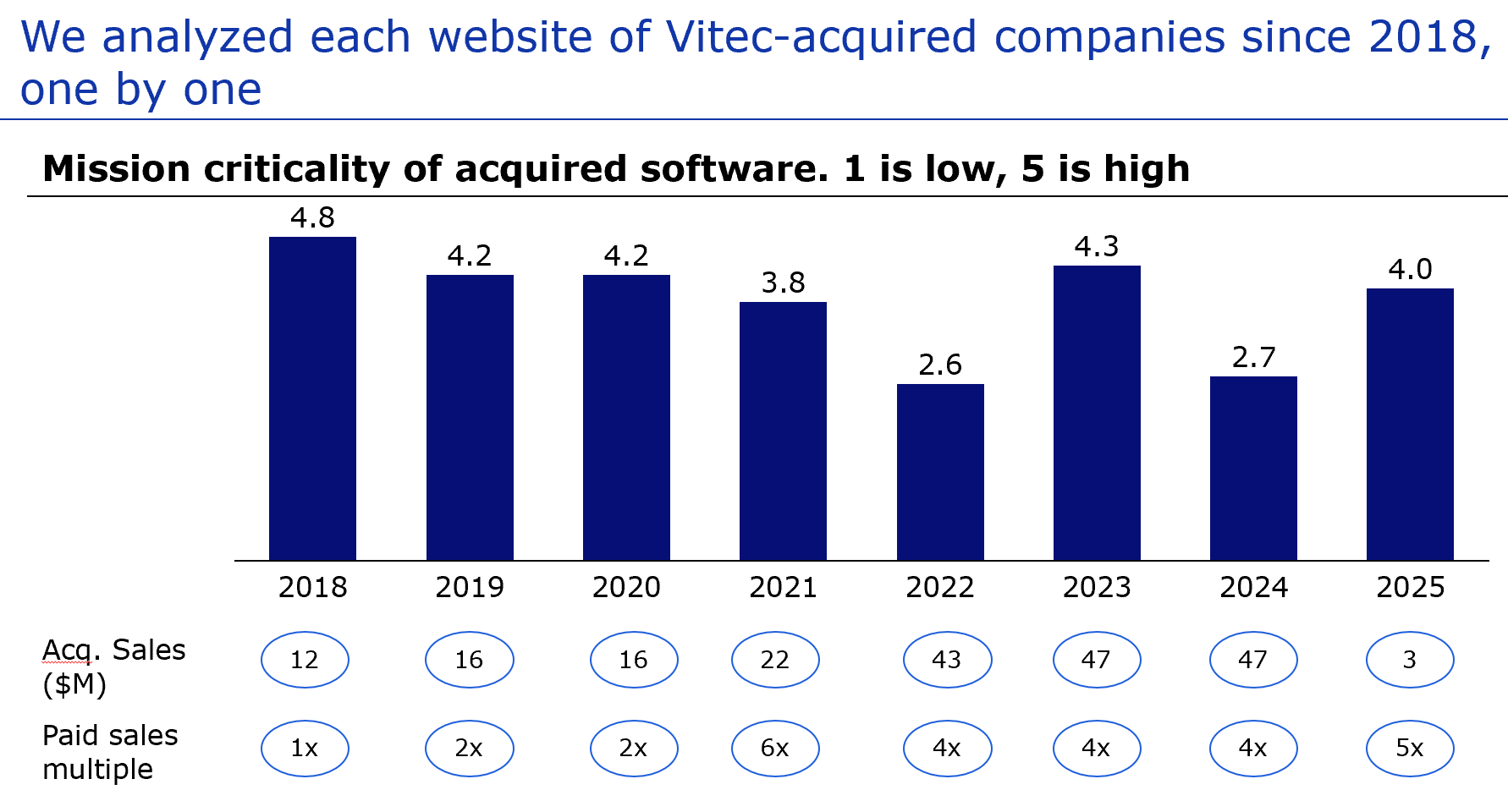
Quality of acquisitions may be going down? This is a subjective measure of mission criticality by looking at the website of each acquisition and seeing that in the last years there are acquisitions of companies that look more horizontal. For example, roidu.com, which is a survey software that although it mainly targets healthcare, is a horizontal application that could be easy to replace, it does ~$2.5M ARR. Another example is bidtheatre.com, which is a horizontal marketing tool, it is more significant with ~$13M ARR. In appendix we attach an analysis of mission criticality of all acquisitions since 2018.
Valuation assumptions
Bringing the analysis together, we assume:
All FCF after dividends is reinvested into acquisitions at recent pricing (~3.6x revenue, ~11.5x EBITDA).
Leverage levels remain constant.
Share issuances continues at ~1% per year.
Organic growth continues at ~6%.
FCF margins remain stable.
Valuation multiple remains at ~24x FCF. If the previous acquisition assumptions continue to be true until 2050 (we believe there is market size for this), and we valued the cashflow then with 7.5% perpetuity discount rate, and 3% terminal growth rate, and brought it back to present at the same 7.5% discount, that would be a 24x FCF multiple.
Under conservative assumptions, I estimate ~2x upside in the size of the business by 2030, implying a ~15% IRR if margins and multiples stay constant. For comparison, over the past 15 years, Vitec has ~tripled in sales and EBITA every 5 years.
At current price levels, Vitec (and their peers) may be entering a valuation range that merits monitoring.
No posts
Comments
Nothing yet. Say the first thing.
Sign in to join the conversation.