
Copart is one of the largest car auction sites in the world, and the leader in auctions of damaged cars (e.g. a car that has been in an accident). It was started by the operator of a single car junkyard, who acquired his largest supplier of cars - a car auction yard -, and through serial acquisition of competitors scaled to a multibillion market cap company, today valued at ~$32Bn, and returning >250x to IPO investors. Copart won in part by being at the edge of innovation, some of which was technological. They were one of the first to use an ERP in the early 80s, the first to digitize paper processing of cars with the DMV, and the first to let buyers bid on cars through the internet in the mid 90s, revolutionizing the unit economics of the business.
Some themes drive the Copart story:
Founder was an industry insider
Disciplined on metrics to value acquisitions, but not afraid to swing big: on some big initial acquisitions, on doing buybacks, or on investing capex
Heavy integration, with a repeatable playbook to improve companies (he was acquiring 10% EBIT companies and operating them at 25%+) but he created that playbook after the first acquisitions.
Technology is a key element in its success. Which is a parallel to what some rollups are trying to achieve today with LLMs.
Willis Johnson grew up around car scrap. His father was a small entrepreneur, but didn’t know how to read and could never scale them, his most enduring venture was a car dismantling junkyard, where Willis worked being young. After a stint in Vietnam, Willis returned to California and worked at his father’s junkyard, but after disagreements with his increasingly alcoholic father, eventually bought his own yard in Sacramento. It was a succession situation and he paid $75k for it, $15k down, the rest in seller loan.
He sold his house and moved his family into a trailer on-site to pay for the business. The sacrifice paid off: Johnson turned the yard into a quiet cash machine by innovating. He bought the car brands other yards ignored, broke down parts to finer SKUs, and made a point to keep facilities clean for customers. He ended up starting several junkyards focused on different niches, like trucks or self service. By the early 80s Willis was buying $10,000 worth of salvage cars a week in order to dismantle them.
One of the things that jumped out to me is that in the late 70s he bought a $110,000 computer — more than two houses at the time — and built one of the earliest digital inventory systems in the industry. While his peers tracked parts with paper, Willis understood his business on a SKU-level. This started a thread that woud be relevant throughout his career: technology can significantly improve your business.
What he didn’t know was that his biggest business would not be dismantling, but auctions, and that technology would revolutionize his next business even more.

In 1982, a key supplier of cars — Bob’s Tow Service (BTS) — came up for sale. BTS was a salvage-auction operator. Johnson knew it well, and he was the largest single customer.
It was a succession situation and the children didnt want to operate the business. The owners wanted 15× pre-tax earnings ($1M), an aggressive price for a small business in a dusty niche. But Johnson thought he could improve it enough for the purchase to make sense. He put in $50k, brought in a partner for another $50k, and borrowed the remaining $900k against his junkyard chain.
He bet on his ability to improve the business: got from sealed bids to real time bidding, open up bidding to non professionals, clean cars to raise sale prices, eliminate unproductive family payroll, and in parallel secure his junkyards access to cars - at that time, Willis was buying $10k worth of cars a week.
He folded the business into an entity he already owned — a small auto-parts magazine called Copart — simply because incorporating a new company was too expensive. The name stuck.
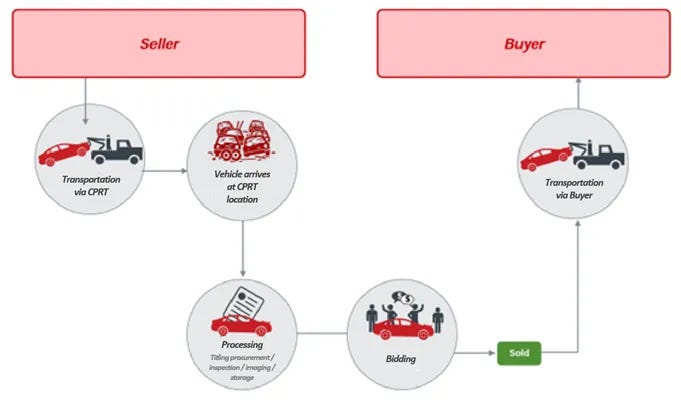
Over the next decade, Johnson began to shape the basis to run car auction sites better:
1. Switching from fixed fees to revenue share
Auction operators typically charged insurance companies a flat $200 per car. Johnson flipped the model:
10% of sale value for normal cars
20% for badly damaged ones
This aligned incentives. If Copart raised the sale price, everyone won — especially Copart.
2. Increasing density to reduce towing cost
The business’s biggest cost was the distance between the accident site and yard. More yards in the bay area meant shorter tows. Shorter tows meant higher margins. Johnson opened and acquired locations in northern california to have better density but still cover a wide area for his insurance clients. In a lot of cases it was more efficient to acquire because you needed permits and car supply contracts.
3. Digitizing bottlenecks
In 1989, Johnson’s son-in-law Jay joined and identified the DMV titling process as the biggest choke point. Copart spent $40,000 on another computer system and negotiated with the DMV to automate title transfer. Competitors couldn’t match it for years.
By 1992, Copart had five locations, a slightly superior cost structure, and a business model tuned for scale.
Meanwhile, a rival had been emerging.
In parallel to Copart, a company called IAA was growing slightly faster in southern California. Started in 1982 as Los Angeles Auto Salvage, IAA was a salvage-auction operator with five branches processing about 30,000 vehicles a year by 1990, helped by innovations like centralized inspection centers and standardized live auctions.
In January 1990 the business was bought in a leveraged buyout, and in November 1991 it IPOed on NASDAQ with $60 million revenue (>10x Copart at the time), raising capital for further acquisitions.
IAA is ironically the reason CoPart became big. At the IPO, Willis and Jay looked at the Prospectus and saw that Copart had better operational metrics per yard than did IAA. If IAA could raise Wall Street capital to accelerate acquisitions Copart could too — and it had to do it fast to not let IAA win the market.
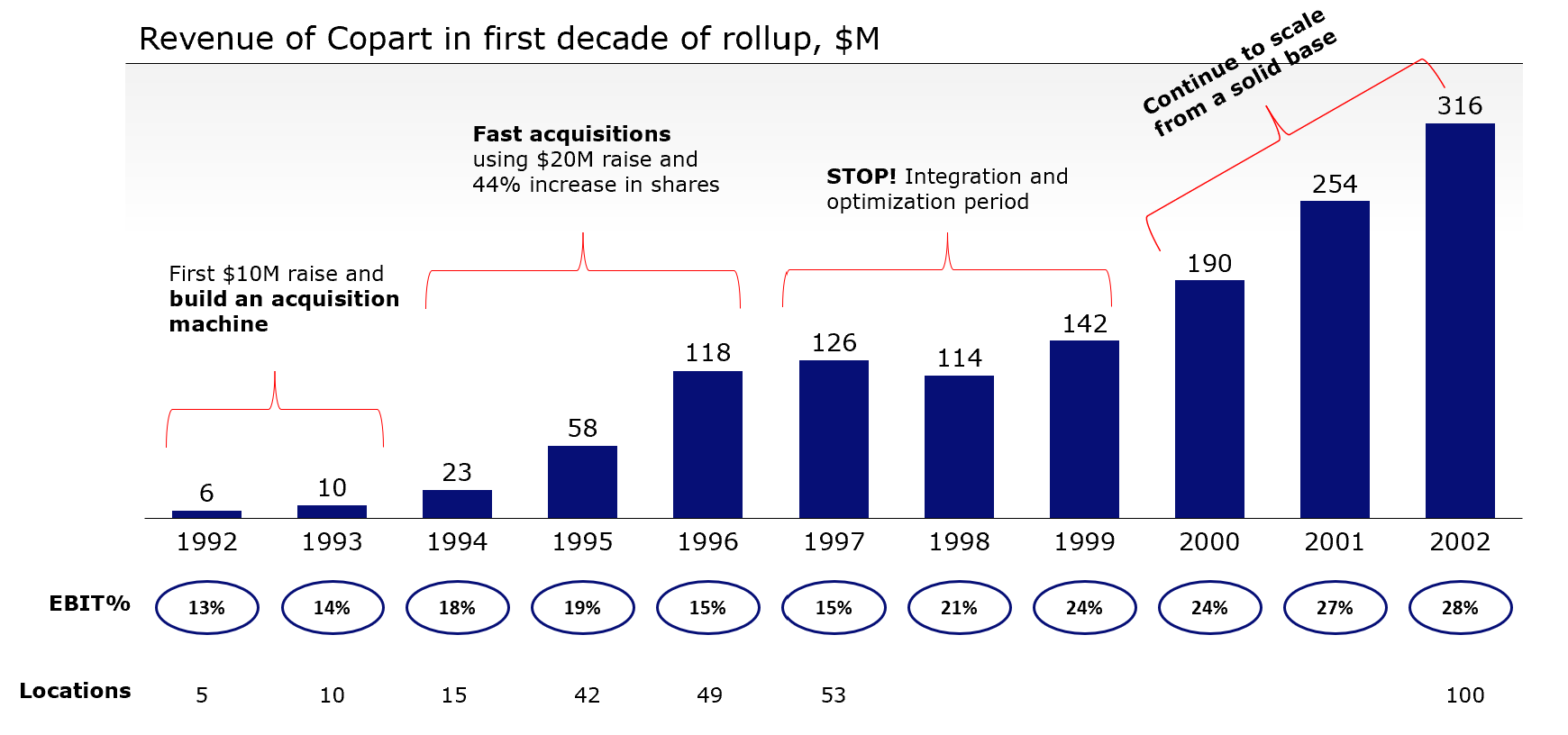
In 1992, after a year of receiving lots of rejections, Copart raised a $10M convertible note, giving up 26% of the company at an implied ~$38M valuation. It carried 8% interest.
With it, he acquired ten more yards. Revenue jumped from $6M to $22M; EBIT from $0.8M to $4M. The model scaled exactly as Johnson predicted: more yards → lower towing cost → more cars → more buyers → higher sale prices → higher margins.
In 1994, Copart went public at an $80M valuation, raising $20M in the process. Within two years, Copart caught up to IAA in size.
Post-IPO, Copart moved fast. It made a string of acquisitions, including a large multi-yard chain paid partly in stock (diluting the share count by 44%). Revenues tripled, then doubled again. But by 1996, integration was a mess: three different ERPs, uneven practices, and some cars were being towed to non optimal auction sites because there wasn’t coordination.
They had scaled, but now they needed to optimize. Johnson temporarily hit the brakes on acquisitions.
For the next three years, Copart grew top-line slower — $120M → $140M — and focused on operational improvements.
Brought all acquired companies to a single modus operandi
Integrated into a new ERP custom built for the operation
And tested allowing real time bidding through a recent new technology: the internet. This one had a profound impact
In 1997, Jay realized out-of-state buyers were dispatching local reps to bid on cars in person. A rep would represent 30 buyers at the same time. Copart realized something simple: people are willing to buy the cars without seeing them in person, they care about seeing a larger variety.
Testing at first on one auction yard in 1997 they saw it significantly improved demand and sale prices (increasing their top line) — once the test was successful, they expanded with conviction.
Impacts:
Buyer pool expanded globally, people from Mexico would bid on the cars and travel across the border to pick them up
Clearing prices rose the higher the number of buyers
Cost of operations lowered, as a main cost of the auction houses was the space and staff to run the auctions
The internet and other initiatives expanded margins from 15% in 1997, to 24% by 1999. The market didn’t cheer too loudly (market cap was almost flat from IPO until mid 1998 while IAA was a wall street darling acquiring trophy sites. But Copart continued executing with discipline. By 2007, Copart was running 37% EBIT margins, up from 13% in 1992.
Copart continued to acquire and grow sites. By 2003 it had over 100 sites and expanded to the UK. Today, Copart has 280 sites. But the internet allowed them to scale customers at a much faster pace than sites, being able to bring significantly additional demand to any site they acquired.
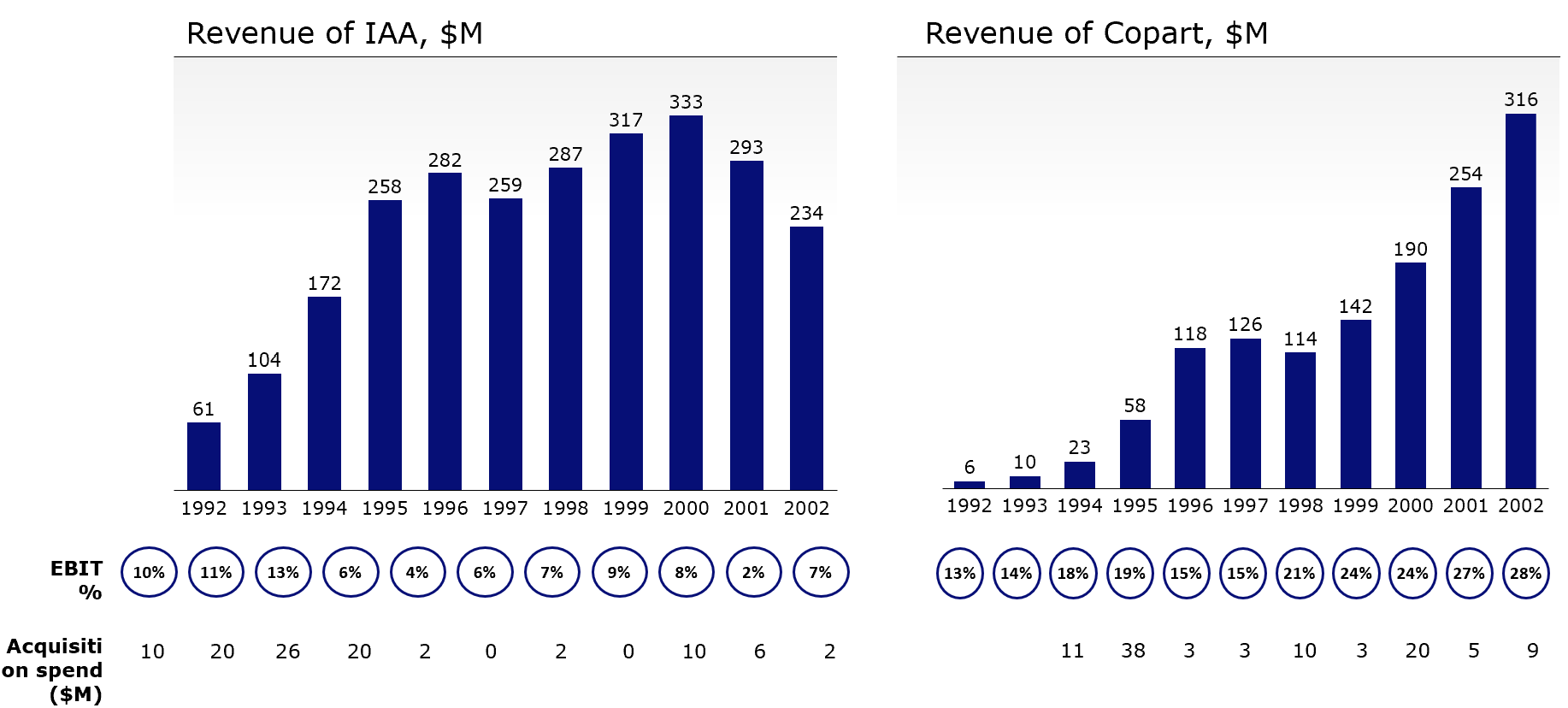
On the surface, IAA and Copart were doing the same, however they produced very different results for investors.
Operational focus. They were generally acquiring the same broad type of asset as Copart – regional salvage and auto auction yards with insurer contracts – but Copart was more laser-focused on insurance total-loss salvage pools, whereas IAA was less focused and also bought mixed-condition auto auctions.
Business model design. Copart ran an asset light business model charging insurance companies a % of the sale price of the car, while IAA took inventory risk, they would buy cars from the insurers at a % of the car value and then owned and resold cars. Copart engineered a higher ROIC, less capital consuming model. IAA later changed to the old model where they would get paid a fixed fee by the insurer and transitioned part of the business to a model similar to Copart.
A hidden feature of the Copart operating model was significant negative working capital, as the cash for cars is paid to Copart immediately by the buyer, and Copart would not pay out the seller until the car transfer papers have been processed.
Discipline on acquisitions. Buying a unique metric that you can better turn into cashflow as an acquirer. Copart was buying density so their towing expenses could lower and they could gain share of wallet with the insurance companies. They would buy companies based on car throughput. IAA would buy companies based on EBIT, focusing more on growth than on operational excellence post acquisition. Copart focused on optimizing what yards could earn under them, not what they earned before acquisition. In the late 90s Copart would buy yards operating at 5-10% EBIT and integrate them into their system to earn 25% EBIT. IAA was operating at 6-7% EBIT margins which left little room for value capture post acquisition, if they had focused on operations to add more value post acquisition maybe their story would have been different
Copart avoided expensive “trophy” assets, and focused on smaller rural assets they could acquire for cheaper. IAA focused on scale at all costs and bought trophy locations in cities. This shows a shocking parallel with the story of TCI in the cable TV industry a decade earlier, which avoided buying overpriced city-center cable franchises, and competitor Cablevision, who bought the ‘hot’ city permits. Copart is parallel to TCI, while IAA is parallel to Cablevision.
This resulted in Copart performing significantly better than its competitor in the first decade, and to today
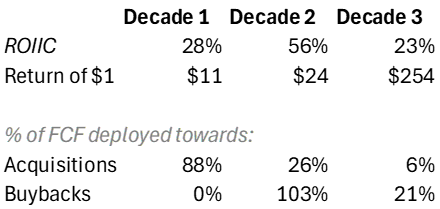
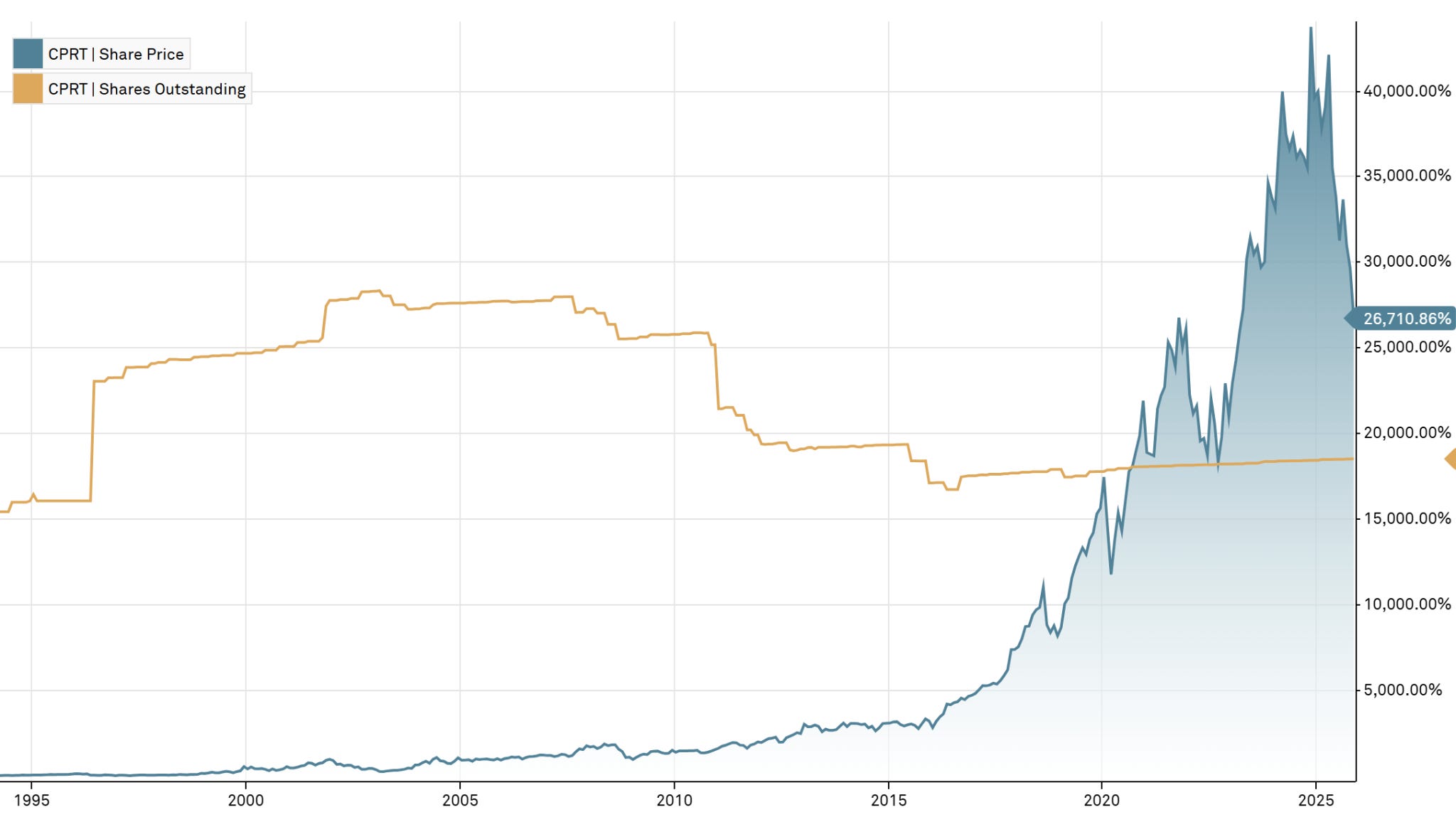
Copart is today worth $32Bn while IAA was worth $5Bn before it was acquired in 2023. Copart does $4Bn in revenue and $1.5Bn in EBIT (37% margin). $1 invested at IPO would have compounded to $11, a decade later in 2004 (10x), to $25 in 2014 (25x), and to a whooping $250 today (250x).
Part of this result is that Copart was more disciplined in the rollup playbook (the focus of my analysis), but Copart was also a better capital allocator over the past 30 years:
stopping acquisition spree when they had the operational network they needed and then investing in capex to improve existing sites.
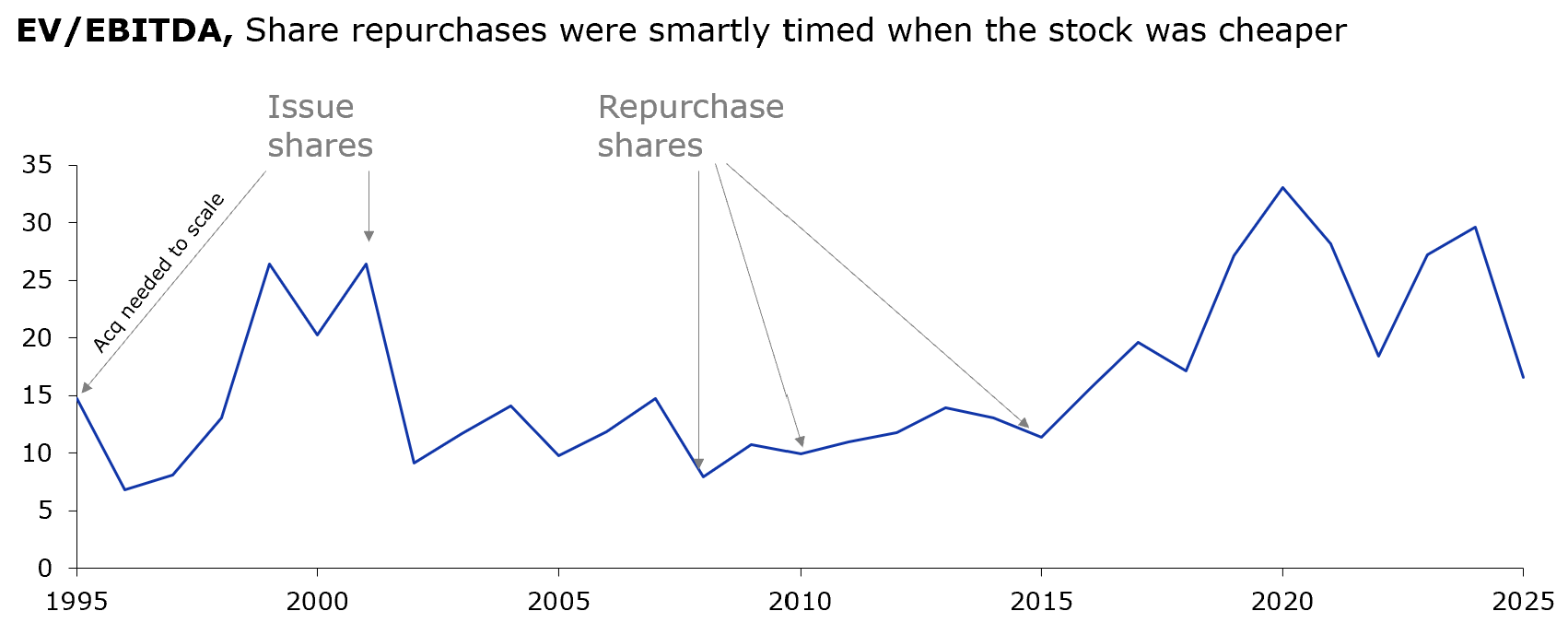
They aggressively bought back stock when its stock was down in the 2008-2015 period. They issued shares when they needed it during the rollup period and when their stock was at 26xEBIT in 2001, and aggressively bought back that stock at the lowest points of 2008 and 2011.
Now Copart has the largest accumulated cash balance it has ever had by far: $4.7Bn. Will they be able to continue to re-deploy it efficiently?
Copart used technology as a lever in a few elements:
ERP to track inventory and shorten inventory days
Internet to increase the number of buyers at each auction (the biggest)
Routing software to predict what site should take a job
However,
technology was not applied blindly everywhere, and they didn’t know where it was important coming in. Willis and Jay ran tests of what technology or practice could improve the business, and scaled those that worked. Being open to invest in technology led to their success, but without the other operational elements they brought to the table, the success would not have happened.
First came an initial phase of the rollup to get scale (3 years), then came a 3 year phase of operational improvement to set the base of the future, and then they continued to grow again via acquisitions. There are parallels in other rollup stories like TCI
Maybe it’s a good idea to go into a business the team knows, start by focusing a few years on the acquisition machine, but then be disciplined to stop and create a business that’s better than the future ones you will acquire.
What Copart didn’t do is start by building the tech in isolation before scaling enough, and they didn’t fall in the same trap as IAA who could not create a better business model than the ones it was buying.
If you are interested to learn more, my main source was a book I read this summer on the history of Copart called “Junk to Gold”.
—----------------------------------------------------------------------------------------
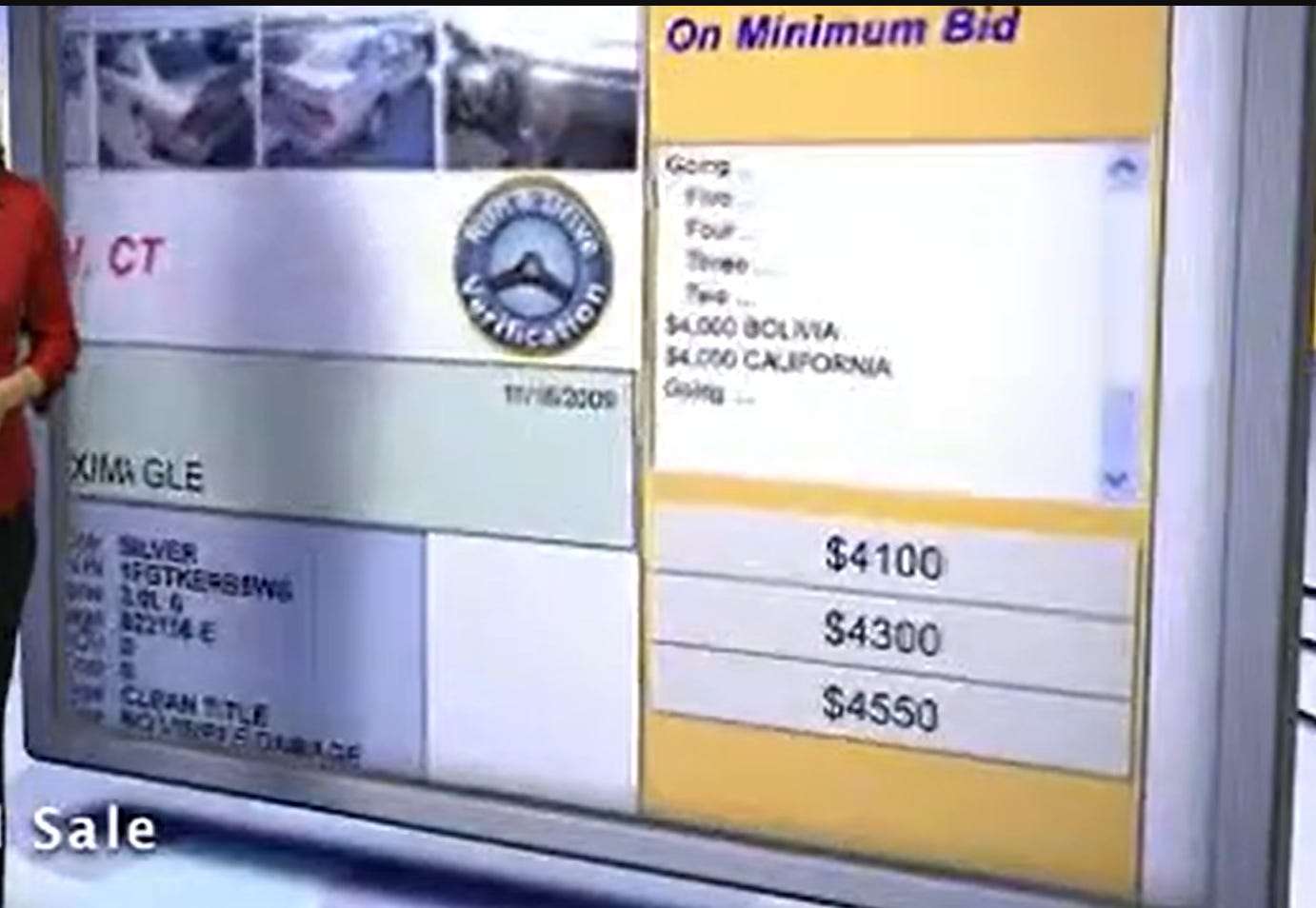
One of Copart’s initial online auction products (VB2)
Copart stock price and shares outstanding. Source CapIQ
EV/EBITDA at the time of buybacks
No posts
Comments
Nothing yet. Say the first thing.
Sign in to join the conversation.