
Generative AI has the potential of changing the way consumers interact with the internet, from the way we search, take action, and the channels we interact through.
From keyword searches to having a real conversation.
From a one-way relationship (if that) with your Google Search bar, to a personalized relationship with an assistant that understands intent.
From navigating internet browsers, to being able to speak through WhatsApp or Meta glasses.
From needing to navigate a UI to book a flight, to just asking for it - like you would with a travel agent back in the day.
In this future, Trust in the AI assistant and Access to it are essential. Once that trust is established — and a company owns the assistant that becomes the primary way people interact with the internet — it unlocks powerful value for both the user and the business. The result is not only deeply useful, but also highly defensible.
This future is starting now: Adobe Analytics reports that between July 2024 and February 2025, traffic from generative AI sources to U.S. retail websites surged by an astounding 1,200% (and by 1,700% to travel websites). This influx is reshaping the entire consumer journey, with 55% of users leveraging AI for research, 47% seeking product recommendations, and 43% hunting for deals. Traffic from conversational AI sources also show 8% higher engagement.
Luzia has built a trusted AI assistant on whatsapp and their app, used by 65 million people, mostly in Spanish and Portuguese (the 2nd and 5th most natively spoken languages globally).
Luzia’s team is customer-obsessed: their north star is radical accessibility and usability. Alvaro, the founder, is the most strategically thoughtful person I’ve met building AI for consumers. Check out his Substack.
Alvaro and I have known each other for two years, I reached out to him shortly after he launched Luzia, and I’ve had the benefit of co-ideating with him since. We recently decided to partner, with Prosus leading a $13.5M investment in Luzia (news in Spanish and English).
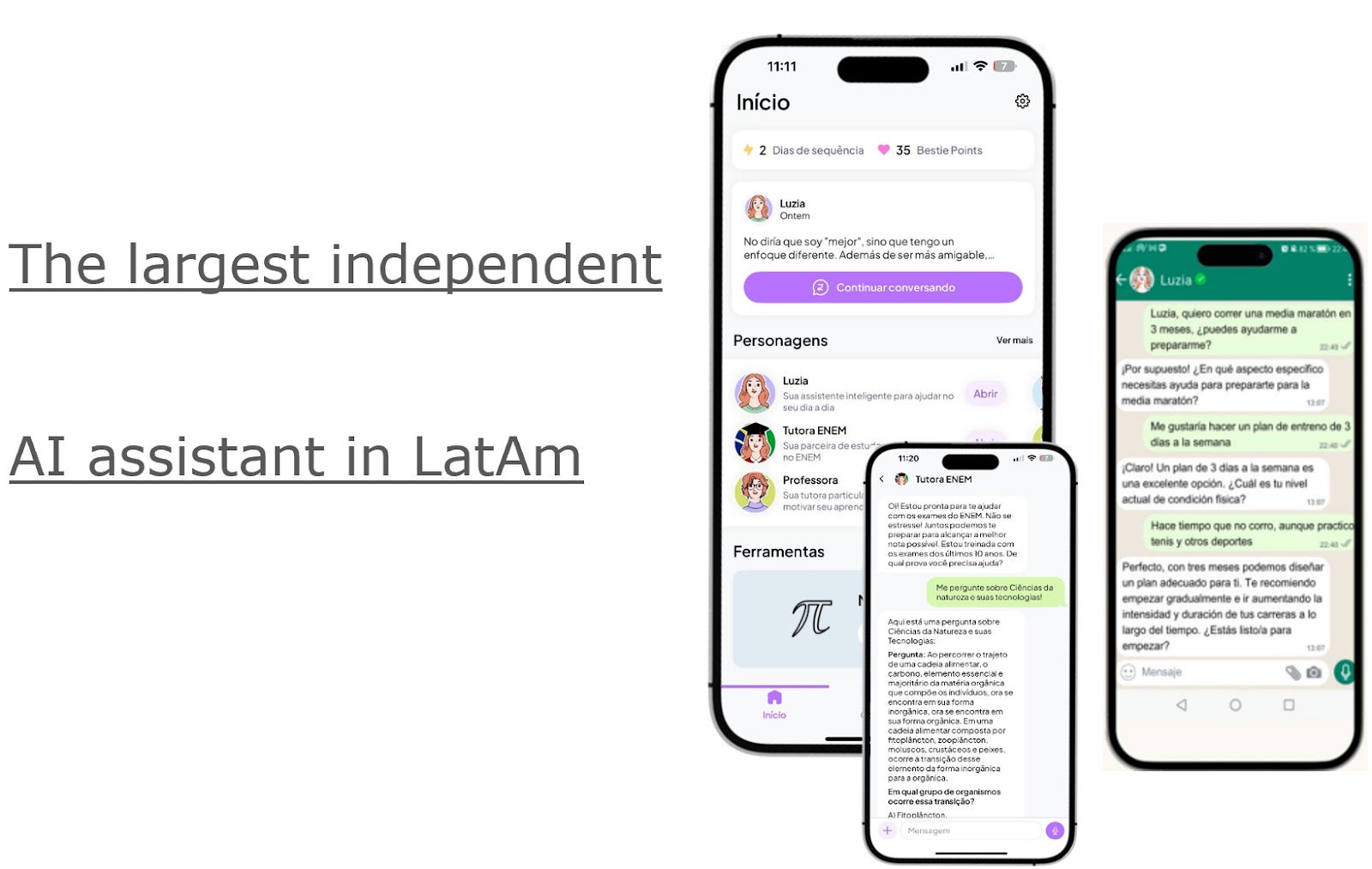
Why I think Alvaro’s strategic choices make a lot of sense:
Focus on the user over the tech: In a world where a lot of LLMs deliver similar performance, and changing between LLMs is seamless, the LLM provider becomes a commodity, and the power shifts to the application builder that owns the customer (Luzia, ChatGPT, Perplexity). I recommend reading Alvaro’s post “we are not lazy; we play smart”, which in 2023 already predicted that focusing on UX would yield better returns than training LLMs. This was not the consensus choice then and Alvaro resisted the hype.
Why build for consumers: Some of the largest internet companies have been customer-facing. It is a steep hill, but the summit can be higher.
Why an AI companion can retain users: When someone uses an AI assistant consistently over time, they begin to return out of habit, not just utility. Trust builds. So does familiarity. Over time, the relationship can start to feel personal and even emotional. Just like with a real friend, people don’t switch to a “slightly better” friend; the bond matters more than marginal gains.
This is why Luzia’s brand and personality are so powerful. They drive both retention and referrals. Many users I’ve spoken with start their queries by addressing Luzia by name, even giving it nicknames like: “Hi Lu, hope you’re well…” — something I’ve rarely seen with ChatGPT. ("Hi ChatGPT" is not a thing).
That small behavioral signal points to something much bigger: a real relationship is being formed. And that kind of stickiness is hard to replicate.
Why not build more complex features to ‘differentiate’: feature building is prioritized (and also removed) by listening to users. More features does not necessarily equal a better product. There is a very complete product roadmap, a low bar to test features, and a high bar to keep them in production.
Why it can be a valuable business. Once an AI has a relationship of trust with a user, it can add value in transactions. Nobody will know the user better than the AI friend to recommend relevant products and services.
My vision of the future is simple:
There are going to be many LLMs. Most winning AI products don't need to train proprietary LLMs, but focus on the user workflows.
Conversational AI interfaces are growing a center for online discovery and transactions. Like web pages did. So owning the interface for those conversations can make the future gateway to the internet.
Martian (LLM routing), Nexad (conversational ad network), and Luzia (AI assistant), are all working in different and important parts of this vision of the future.
No posts
Comments
Nothing yet. Say the first thing.
Sign in to join the conversation.