

Imagine a company that grows not organically, but by consistently acquiring well-established, profitable businesses. These companies exist, and the successful ones have generated venture outlier returns for early investors. You can find an introduction to serial acquirers in this previous article. In this piece I outline how I categorize the different types of serial acquirers.
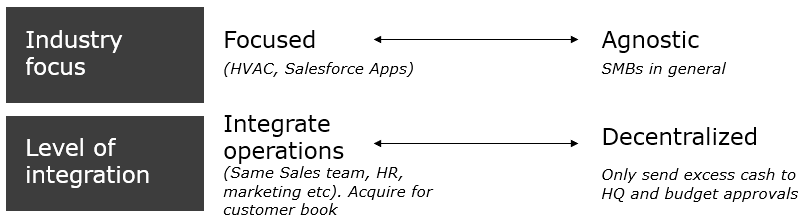
Serial acquirers can be categorized along two key dimensions: the degree of integration among acquired companies and the breadth of their industry focus. Generally, those with a narrow industry focus tend to integrate more deeply, while a broader focus often results in more decentralized structures.
I classify serial acquirers into three archetypes:
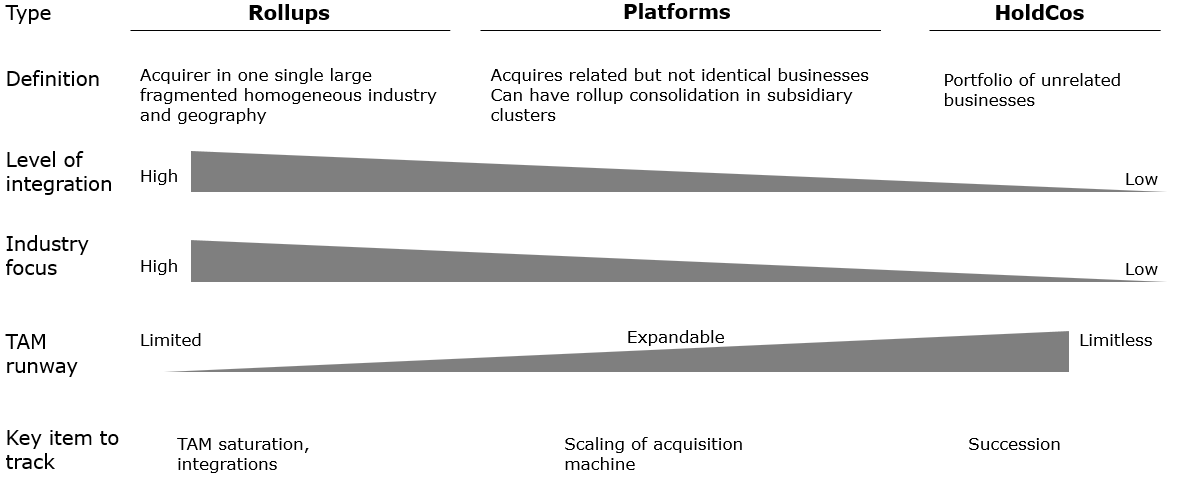
Focusing on one homogenous large industry, with scale-driven synergies. Usually geographically focused.
Upsides: more synergies.
Can create more monopolistic markets (creating the ability to raise prices or reduce quality without affecting demand).
Homogeneous businesses may enable to consolidate back office, or procurement, and cross-sell.
Single market focus can facilitate DD, network, and integration playbook
Faster to prove their success.
Downsides: smaller TAM runway.
TAM can get constrained quicker, stopping the M&A growth engine earlier, or what is worse leading to buying bad assets and paying higher prices.
If the space becomes popular prices can grow quickly (e.g. e-commerce rollups in 2020/21), preventing the rollup from reaching critical scale
What to look out for:
Market share of top consolidators in the industry, with the total TAM being the companies that are real targets (not those too small or too big, not those of low quality).
EV/EBITA multiples paid over time (beware of this rising too much).
Possible expansion avenues (international or adjacent markets).
A compromise between rollups and agnostic holdcos. Platforms have some industry or business model focus (e.g. vertical software, industrial distributors), and can have varying levels of decentralization across the org. Parts of a platform may operate like mini-rollups where integration is pursued.
Upsides:
The TAM expansion ability of HoldCos
Some of the M&A process standardization of rollups around sourcing, diligence, and management.
It can target very niche industries that rollups can’t because of TAM issues
Downsides:
Slower to prove ability to invest.
What to look out for:
Ability to scale deal volume above ~10 deals a year without the leader being a bottleneck and without having to go to larger deals that are more expensive.
Agnostic to industry or business model, and fully decentralized (e.g. Berkshire Hathaway). In some cases, it can be an accumulation of platforms, rollups, and companies in unrelated industries.
Upsides: low-cost exposure to a potentially good investor, with unlimited expansion runway.
Downsides:
Hard to standardize a process around target discovery, relationship management, due diligence, valuation, integration, and ongoing monitoring.
The more heterogeneous their acquisition targets, the harder they have to work and the more paranoid they have to be to ensure that they understand all the nuances of the industry and that there are no hidden issues beneath the surface.
This can lead to lower M&A velocity and larger deals being pursued at higher prices (harder to have above-market IRRs than buying small).
High dependency on the capital allocator leader at the helm. This can lead to succession risk.
I’ve seen agnostic holdcos be common in emerging markets, where family businesses that get big reinvest capital into new often unrelated industries. The US and Europe have several successful examples as well.
The lines can be blurry between these archetypes, a rollup can evolve into a platform as they look to expand their TAM, and a platform can look more like a holding company if they start to play in very different industry groups.
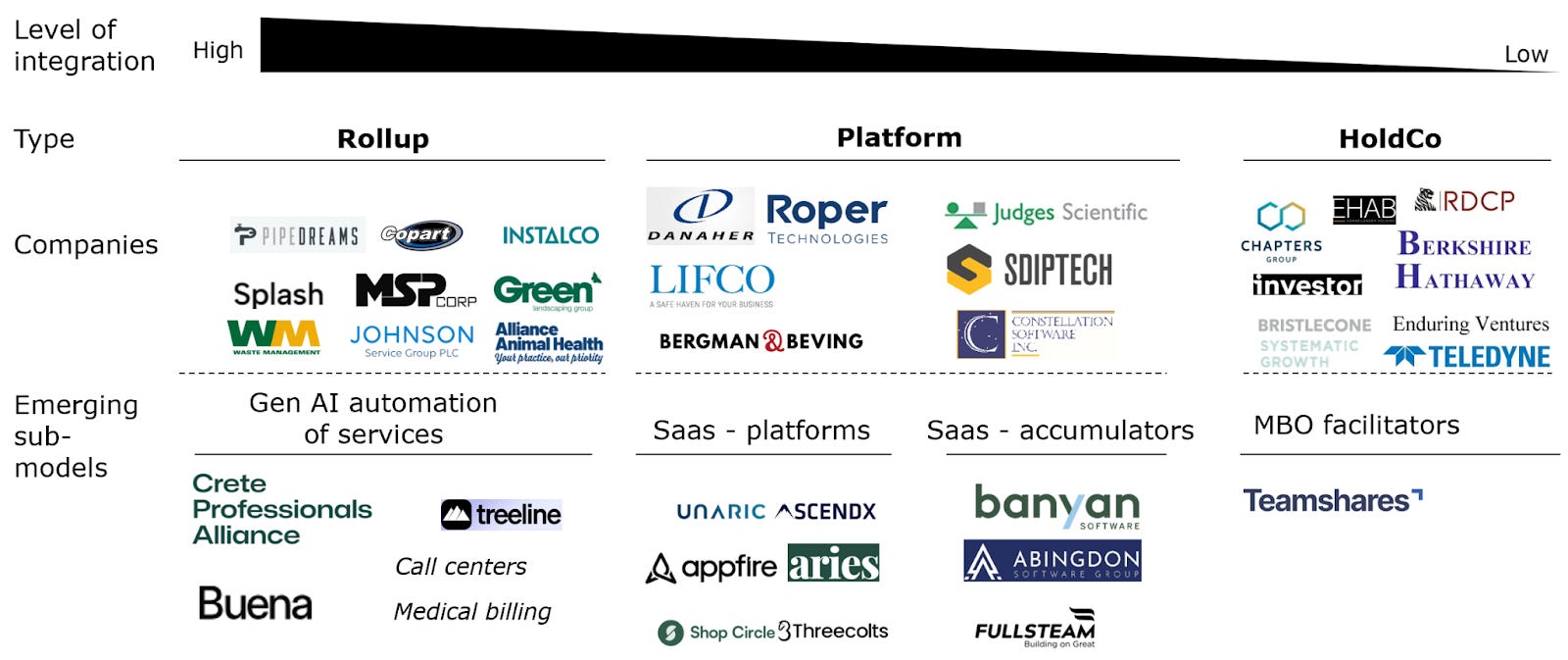
I am seeing emerging types of sub-categories, where I’ve met a number of new teams starting serial acquirers. I think each of these can work to create large enterprises if executed correctly.
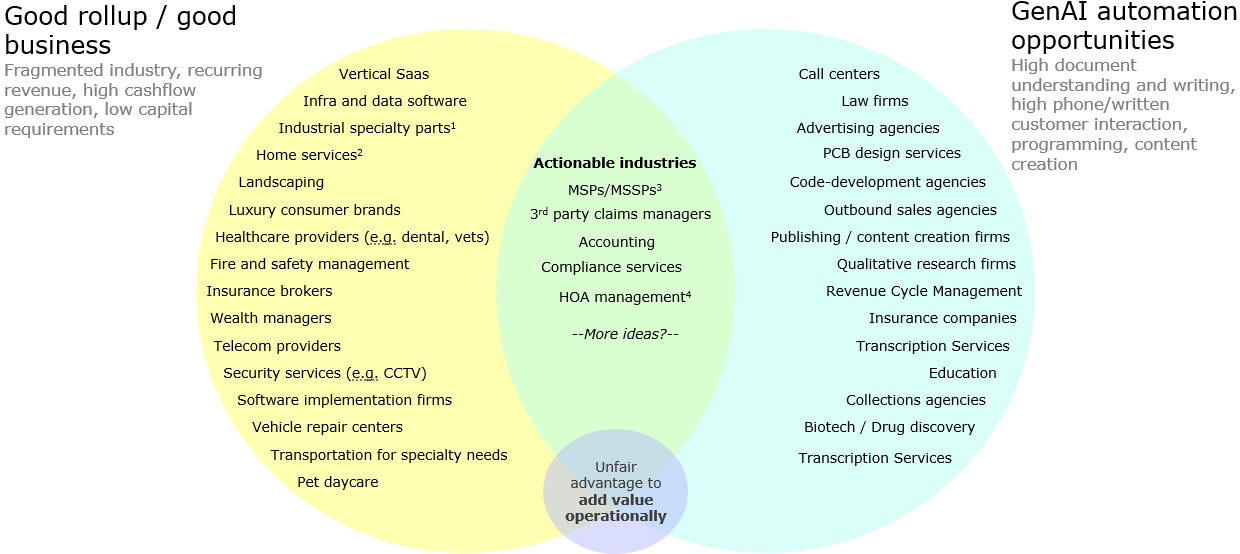
Buying services companies where large parts of the COGS can be automated with LLM technology. I have seen teams buying call centers, medical billing processing firms, managed service providers, accountants, and many others.
They usually have a tech team that builds proprietary tech or are early adopters of the latest technology.
Looking for ideas in this space? This is the framework I would use to look:
Buying vertical software following the success of Constellation Software.
This is a popular space where smart founders are raising capital. I counted 120 serial acquirers in this bucket, 75 started in the last decade, 55 started since 2020.
The easy opinion in this space is to think ‘it's crowded’ because it is getting more popular. On the other hand there are a lot of targets, it is a fast growing end market, and some businesses can be very high resiliency (vs what we saw with ecommerce merchants). New teams can differentiate by industry, by geography, or by saas type (e.g. targeting software vendors in a specific app exchange, such as AscendX, Unaric, or Appfire do).
There are >150,000 vertical software businesses, if 5-10% get sold every year that is 7,500-15,000 targets a year, and given software is a fast expanding market the number of companies may be growing faster than they are acquired. A fair question is how many of those 150,000 are real acquisition targets (large enough, with enough client diversity, decent retention, and not a custom-software shop). By my estimation, current acquirers are acquiring in the order of a few thousand Vsaas companies a year. Constellation is acquiring just over 100 Vsaas companies a year.
So is it still a good time to start a Vsaas serial acquirer? On one side it is harder than 10 years ago, on the other hand, analysts were worried that Constellation was going to hit a TAM ceiling back in 2013 (it didn't happen).
The question is how big is the TAM really - how many of the ~10,000 vertical Saas businesses that get sold every year are high enough quality, and therefore how much space there is for new quasi-Constellations acquiring 10-100 businesses a year. I don't have a formed enough opinion.
An agnostic buyer of small businesses where the owner is retiring and wants to transition the business to his employees. This value proposition can attract the right kind of sellers at attractive prices, and create better long-term performance in the acquired company. Teamshares is a good example.
This is the typical structure they follow (credit to Alex at RollupEurope).
Acquisition: Teamshares buys 90% of the business at a low multiple: typically 4-5x EBITDA. The retiring owner retains 10% and the acquired business issues 10% new shares to the employees and 5% to the new “president” - whether it be an internal promotion or an external hire.
Distributions: cash distributions start. Every year, businesses pay out 1/3 of cash flow in the form of a shareholder dividend (or debt reduction) and 2/3 in the form of buy-back. Buybacks occur at 8x EBITDA and is what transitions ownership from Teamshares to the employees.
End state: after ~20 years the employees reach 80% ownership and teamshares retains 20%.
Teamshares targets to make 10-20x+ on their equity and also will make a royalty from extra services provided to the portfolio companies (e.g. a unified payroll).
This works well in the US, where the general population values Company Equity more than in other cultures around the world, I still have to see examples in other geos, if you know one please let me know.
My categorization has been informed by studying over 100 serial acquirers - from those raising their initial equity, to publicly traded.
No posts
Comments
Nothing yet. Say the first thing.
Sign in to join the conversation.