
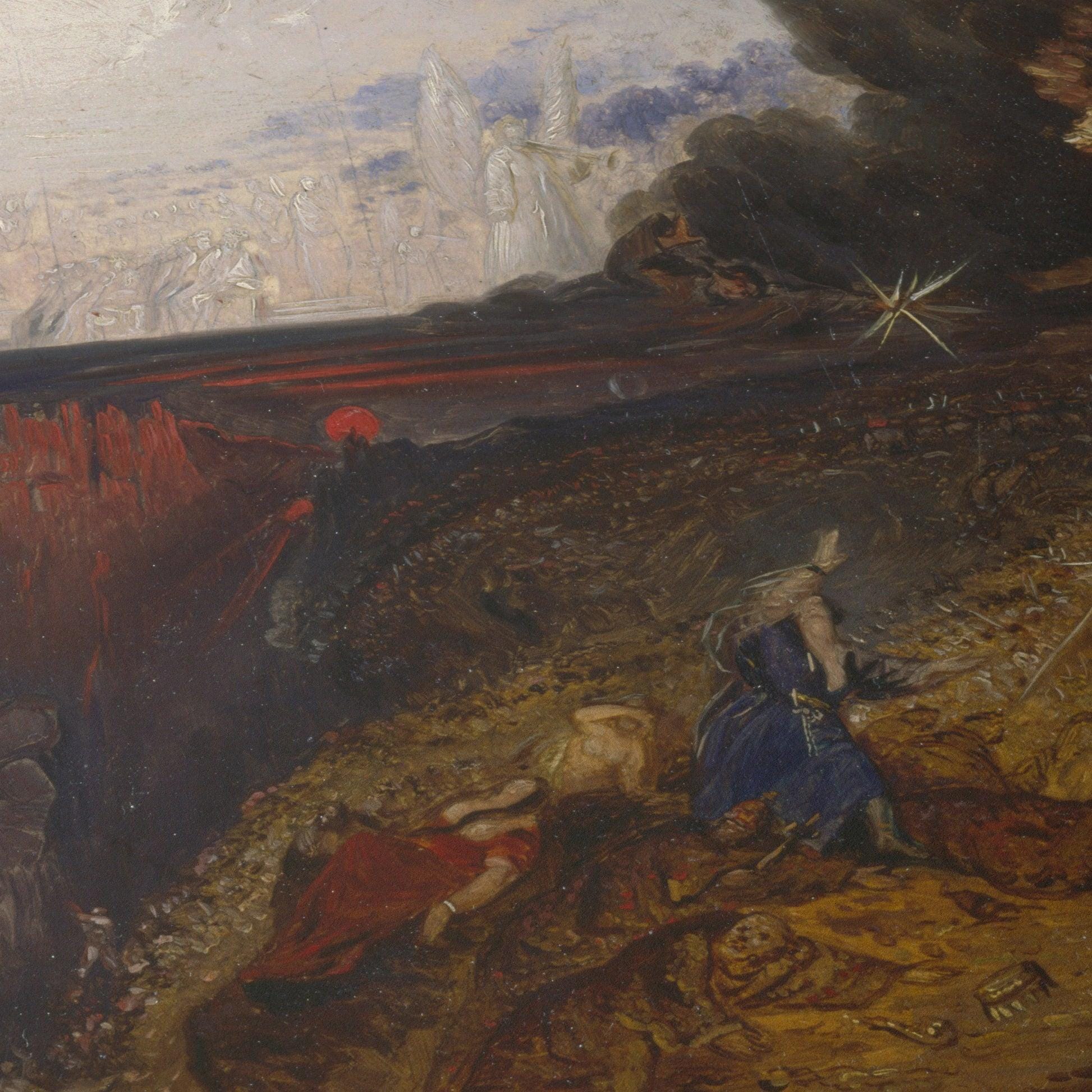
The Second Coming
Turning and turning in the widening gyre
The falcon cannot hear the falconer;
Things fall apart; the centre cannot hold;
Mere anarchy is loosed upon the world…
The blood-dimmed tide is loosed, and everywhere
The ceremony of innocence is drowned;
The best lack all convictions, while the worst Are full of passionate intensity.
Surely some revelation is at hand;
Surely the Second Coming is at hand …
WB Yeats
It is hard to read Yeats now without feeling like he is describing our world.
The world feels like it’s coming apart. The news, our conversations, the anxiety in the room. You reach for meaning, and instead, you get more confusion.
And the thought comes relentlessly:
“Is this the end?”
Years ago, when I was living in Laie, I had an experience that still stays with me — informing my views on the Second Coming.
One afternoon I was standing in line at our local grocery store, Foodland, when a community member tapped me on the shoulder. They had heard that I had just returned from the Middle East, where I had been working with Israelis and Palestinians.
After a bit of conversation about my trip, they asked, “Don’t you believe what the scriptures say is going to happen there?”
And then, more directly, “Why are you trying to fix something God has ordained can’t be fixed?”
I was taken aback. The question was well-meaning. They were concerned about my safety and all the time, effort, and risk I was putting into what, they believed, was an impossible situation. The question got me curious about how we understand eschatology. Eschatology refers to our beliefs about how the world ends, and it can deeply impact how we see the world we live in and what our role is in making the world a better place.
That question is central to a ten-year research project and academic article I co-wrote, trying to understand how Latter-day Saints actually think about the end times. People tended to hold one (or sometimes more than one) of three beliefs about the end times.
Some believe that Jesus will come and set everything right at the Second Coming. The world’s problems will be resolved through divine intervention.
Others believe that we are called to build Zion now, that the work of creating a more just and peaceful world rests largely in our hands.
And then there are some who hold both ideas simultaneously, even if they don’t have language for it. Those folks believe that God and humanity are meant to work together — what we called the Dual Action Model.
Those beliefs had a significant impact on how people lived their lives. Those who leaned more toward divine action emphasized personal righteousness, inner peace, and taking care of their family as the primary values of Christianity. Those who leaned toward human action focused more on social peace or justice, redeeming the “least of these” and reforming social structures that created oppression. Those holding the Dual Action model often just lived with the tension between the two.
It turns out eschatology is not just about what will in the future, but about what kind of discipleship we practice now.
Those who emphasized one belief strongly over the other — Divine Action or Human Action — often carried significant blind spots. Those that believed that God will fix everything often took a step back from the work of engaging a broken world. They can see suffering as inevitable, even necessary, part of a divine timeline. Why waste my time on something that can’t be fixed? On the other hand, if they believed that everything depends on us, they can quickly find themselves overwhelmed by the scale of the problems we face. The weight becomes too much, and burnout is never far behind.
One of the most hopeful discoveries was that if we can inhabit both beliefs, we become both hopeful and engaged.
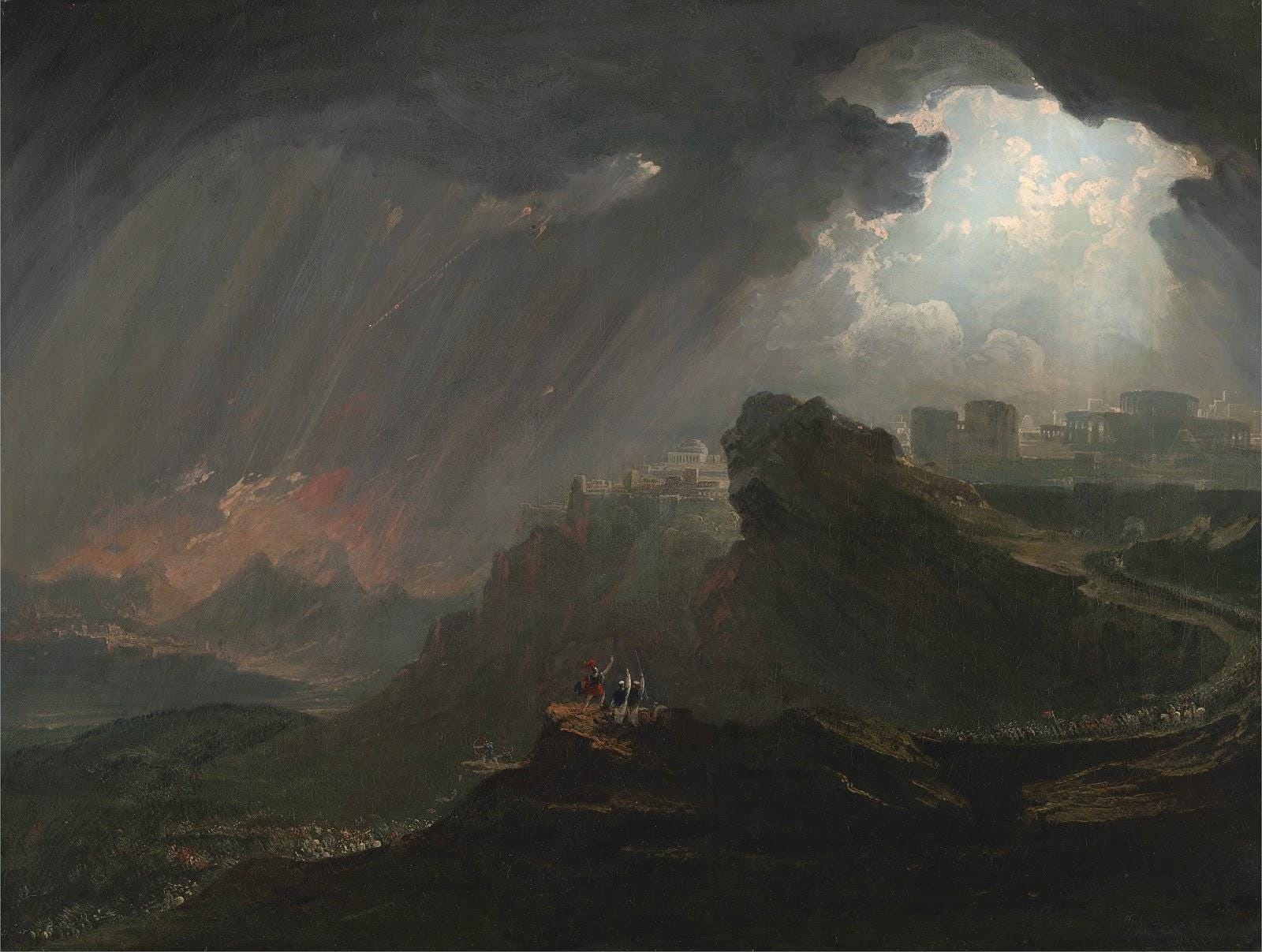
Our moral imagination says much about how we engage both God and the world. It even influences how we read scripture. For many, the book of Revelation is a script for a violent Jesus returning as a conquering king. Robes bathed in blood, wielding a sword, defeating his enemies through force. That image of Jesus comes from a Divine Action only eschatology and has taken deep root in Christian imagination.
There is, however, another way to see the same passage of scripture and the larger image of Jesus.
It is possible to see a Jesus who refuses violence even when it costs him everything? To see a Jesus who would rather die than kill? To see a Jesus who reveals that love, not force, is the way God confronts evil?
It’s hard for me to imagine this same Jesus returning at the end of history destroying the people he died for, suggesting that the cross was not the final word on our redemption. Admitting that his love and God’s love was not enough. Conceding that, in the end, he must use the very tools he refused in his life.
Can we see a Jesus who appears with a robe already dipped in blood—not the blood of his enemies, but his own? Can we see the armies standing behind him, but not engaging in violence? Can we hear the apostle John suggest that Jesus defeats evil through the “sword” of the Word and “by the blood of the Lamb”—not by taking life, but by giving it?
Jesus defeats evil not through domination, but through reconciliation.
That alternative way of seeing Jesus creates a different eschatology pointed toward restoration—the bringing together again of what was fractured. Heaven and earth reunited . God dwelling with humanity.
And yet, in moments of fear and uncertainty, we often find ourselves asking a different set of questions. Writes Reverend Benjamin Cremer:
“Instead of asking: “Who is suffering, and how can we help?”
We start asking: “Is this the moment Jesus returns?”
Instead of grieving the loss of life, we begin interpreting it.
Instead of resisting violence, we risk normalizing it. And in some cases, even welcoming it with excitement.”
We look for signs. We look for patterns. Sometimes, without meaning to, we forget what Jesus called us to do in anticipation of what he is going to do.
This is where I find Martin Luther King Jr.’s insight so helpful.
“How can evil be cast out? There are two ideas that men have usually held about the way evil is to be eliminated and the world saved. One idea is that man must remove evil with his own power. It is the strange conviction that if man goes on thinking, inventing, and governing, he will be able to conquer by his own strength and ingenuity the nagging forces of evil. Just give people a fair chance and a decent education, and they will save themselves …
The other idea concerning the way evil is to be removed from the world says that man must wait on God to do everything. Man must lie still, purely submissive, and God in his good time will redeem the world …
What, then, is the answer to life’s perplexing question? How can evil be cast out of our individual and collective lives? If the world is not to be purified by God alone or by man alone, who, then, will do it?
The answer to this question is found in an idea which is distinctly different from the two we have been discussing. It is not either God or man that will bring about the world’s salvation. It is both man and God, made one by a marvelous unity of purpose, by an overflowing love ad the free gift of himself on the part of God.”
There’s echos of this vision in Joseph Smith’s vision of Zion.
“And now, I ask, how righteousness and truth are going to sweep the earth as with a flood? I will answer. Men and angels are to be co-workers in bringing to pass this great work, even the building up of Zion.”
Does our eschatology asks something of us now? Does it call upon us to act on our faith? To get off our knees and build the Kingdom of God here?
This is not an easy task. There are no guarantees. We act out of a sense of rightness, not because we are assured of success. We strive for peace even when the evidence suggests that it is fragile, temporary, or beyond our grasp. We embark on the larger mission of healing a broken world, trusting that somehow, in ways we cannot fully comprehend, taking the leap of faith—in God’s love and in each other—will be sufficient.
That research has led to a personal conclusion for me. My own sort of eschatology says: the outcome belongs to God, but the action belongs to us.
We plant gardens even when we’re uncertain whether we will partake of the fruits. We venture into the unknown depths, unaware of what we’ll discover. We build, knowing that our work may not be finished in our lifetime.
There is a line from the Mishnah that captures this tension better than anything I know.
Do not be daunted by the enormity of the world’s grief
Do justly, now.
Love mercy, now.
Walk humbly, now.
You are not obligated to complete the work
but neither are you free to abandon it.
What does it mean to live in the last days?
I don’t believe it is looking for signs. Nor is it waiting for the world to collapse. The last days isn’t about escape. It’s about the restoration of all things.
Being part of the restoration is refusing to abandon a suffering world. Refusing to let violence have the final word. Refusing to believe that things have fallen apart beyond repair.
The restoration is choosing, again and again, to step toward what is broken.
To love.
To build.
To act.
Because this is the paradox at the heart of the gospel:
We live in a dangerous world. And we follow a dangerous Jesus.
Dangerous not because he brings violence—but because he refuses it.
Dangerous because Jesus tells us to love our enemies when we would rather defeat them. To forgive when we would seek vengeance. To turn the other cheek when every primal instinct tells us to strike back.
Jesus is dangerous to every system built on fear, power, and exclusion. And Jesus can feel dangerous to us—because he does not leave us the option of staying comfortable.
Jesus calls us to love in ways that feel impossible. Even dangerous.
Because the type of love Jesus invites us to is active, not passive. It is the kind that moves without guarantees and the kind that stays when our self-interests tell us to walk away.
Yes, the world is falling apart. Yes, the world is being restored. The question is who we will become in the midst of both the beauty and the tragedy?
The Second Coming is not just something we are waiting for. It is something we are meant to live.
Right here.
Right now.
In a dangerous world.
With a dangerous Jesus.
Practicing a dangerous love.
I just did an entire podcast on this research and this topic with Pioneering Paradoxes if you really want to dig into eschatology, the second coming, and Jesus at the end of the world.
You can listen to it on Spotify …
Or on Apple Podcasts
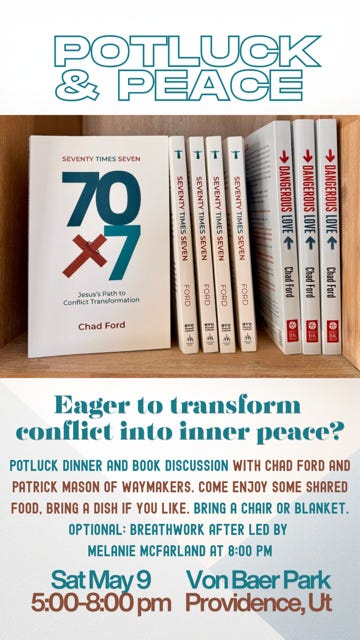
Come join me, Patrick Mason of Waymakers, Casey McFarland of Pioneering Paradoxes and the folks at That’s Church for a Peace Picnic at Von Baer Park in Providence, Utah on Saturday May 9 from 5 to 8 pm.
We wil have a potluck, some games and a cool, interactive discussion of my book Seventy Times Seven. I’d love to see you there.
Peggy Fletcher Stack wrote a really interesting piece in Sunday’s Salt Lake Tribune asking why LDS leaders haven’t been more outspoken, like the Pope, about the war in Iran.
She includes several quotes from me in the article including this one:
Preserving the church’s “religious freedom to do the things it needs to do could be at the top of President Oaks’ mind right now,” Ford says. “But that doesn’t release us from wrestling with the issue and making moral decisions ourselves.”
Any close observer of the global faith in the past few years, he says, would have to recognize that its leaders have repeatedly urged members toward “the personal practice of peace.”
That, Ford says, is the “most impactful thing we can do.”
Highly recommend the entire story.
Comments
Nothing yet. Say the first thing.
Sign in to join the conversation.