
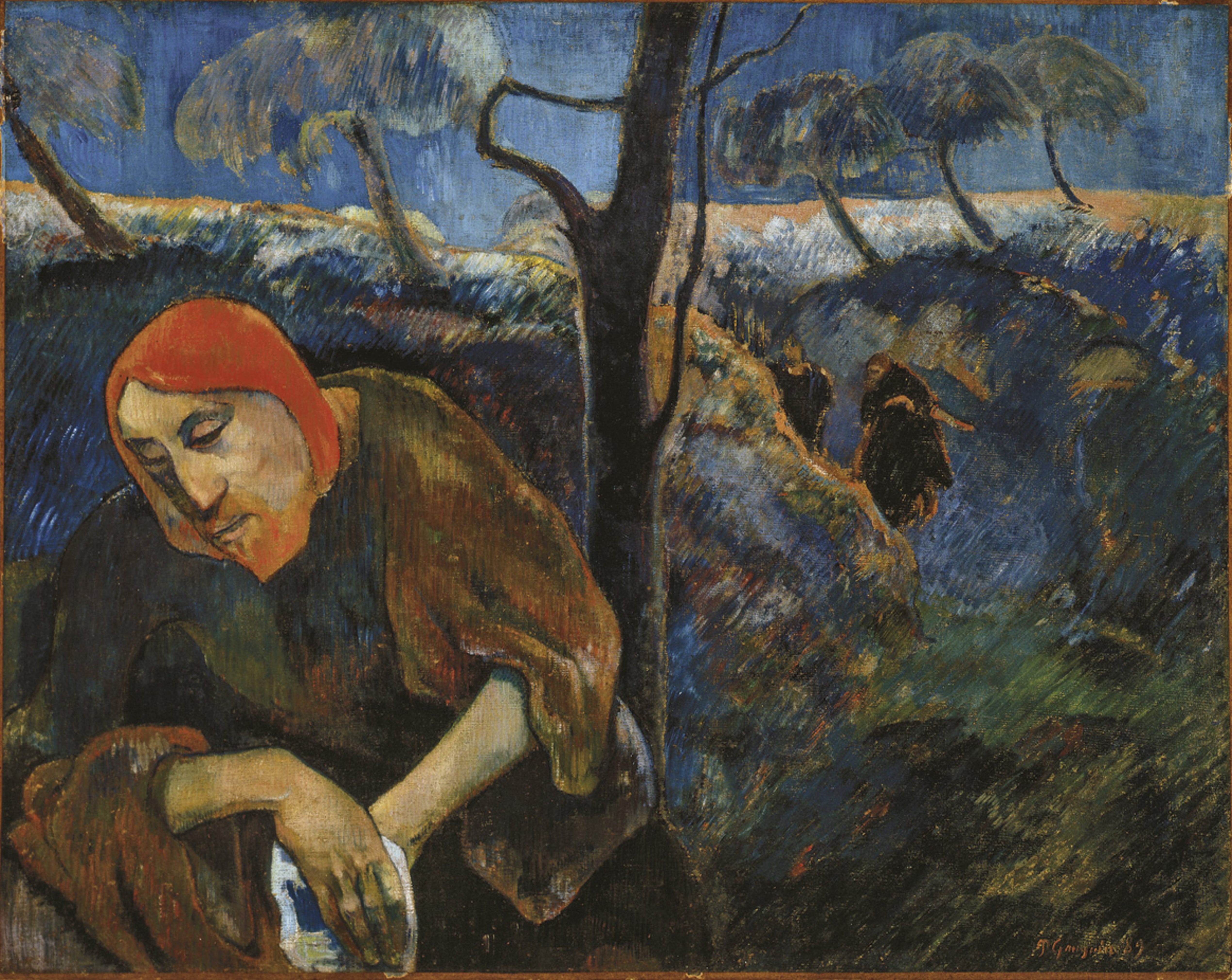
As Easter approaches, we turn our hearts again to the final days of Jesus’s life—the love, suffering, sacrifice, and restoration that define this sacred season.
The following is an excerpt from Seventy Times Seven. It reflects on what it means to follow Christ not just in belief, but in how we love, forgive, and make peace. Easter is not only about what Jesus did—it is about the invitation he extends to each of us:
Come, follow me.
Come, follow me.
(Matthew 4:19)
Perfecting the practice of 70x7 can take a lifetime. It isn’t easy. We will stumble. Despite our devotion to being disciples, we sometimes fall short of the standard Jesus set for us.
When we fail to be all that we aspire to be, we may start feeling like the problem isn’t with Jesus’s way. Instead, “I’m the problem. It’s me.” We believe we are too weak, too flawed, too insignificant to partner with Jesus on his mission of restoration. We may feel deeply unworthy to accept the call.
We find the eyes of our hearts dark. We discover that we have held onto our collection of stones, and when provoked, we still throw them as hard as ever. We catch ourselves turning away from embracing those who have hurt or failed to see us the way Jesus sees us. We may not even want restoration with some folks, holding out hope that heaven may be reserved for only those we like or those who have shown us kindness along the way.
Jesus lifts the downtrodden, succors the weak, and promises to help us see each other and ourselves as he sees us. By doing so, he ends the cycle of revenge, remorse, and anger that threatens to consume us and creates a path toward understanding that bridges the divisions among us so we can unify. The conflicts hurting our lives today can be transformed by loving our way to each other.
God is love. And love always, ALWAYS wins. That love applies equally to you as it does to me and everyone else.
Are you a sinner? Have you made horrible mistakes? Do you feel far from Jesus’s grace? Jesus can work with that.
Jesus spent most of his time with sinners, the poor, the sick, and the broken-hearted. He came to help those who were bruised or felt captive. The least of these were his favorite people. Many of them ended up being his most devout followers.
Can we follow Jesus and love our enemies?
Can we put down the stones we use to blame and justify hurting ourselves and each other and instead join with Jesus in his great work of salvation?
Can we have the courage to open our arms and embrace Jesus and those with whom we disagree?
Can we embrace his love and embrace each other?
Can we put aside our fears and partner with Jesus in his ministry of restoration?
Jesus calls us in again and again. “Come, follow me.”
After Jesus is almost thrown off a cliff in Nazareth, he journeys to the Sea of Galilee, searching for disciples willing to lose their lives to find them. Jesus begins his movement not by recruiting prominent religious or community leaders but by calling fishermen.
As Jesus was walking beside the Sea of Galilee, he saw two brothers, Simon called Peter and his brother Andrew. They were casting a net into the lake, for they were fishermen. “Come, follow me,” Jesus said, “and I will send you out to fish for people.” At once, they left their nets and followed him. (Matthew 4:18–20)
Jesus’s admonition to “come follow me” or some variant is repeated multiple times in the New Testament. Some, like Peter and Andrew, respond immediately. Others feel overwhelmed and walk away. Jesus’s invitation doesn’t come with caveats. It doesn’t change when the path becomes rocky or the situation becomes perilous. “Whoever wants to be my disciple,” Jesus declared, “must deny themselves and take up their cross and follow me. For whoever wants to save their life will lose it, but whoever loses their life for me will find it” (Matthew 16:24–25).
When Paul prayed that the eyes of our hearts might be “enlightened,” he did so “in order that you may know the hope to which he has called you” (Ephesians 1:18).
Having the eyes of our hearts enlightened allows us to see ourselves the way Jesus sees us.
With the eyes of our hearts enlightened, we feel his love, and our selfish desires dissipate.
We no longer yearn to throw stones at others or ourselves.
We quit running from conflict and, instead, embrace others and ourselves.
We join Jesus in his mission to restore us, heal us, deliver us from captivity, recover our sight, and set us free when we are bruised.
We join Jesus in calling for and making Jubilee happen at home, in our communities, and in the world.
We yearn to lift, serve, succor, and love as Jesus does, even when we feel inadequate. We feel called to replace enmity with empathy.
When we are in conflict, we must both receive and give the gift of Jesus’s love. He gave us his one beautiful life as a perfect model.
While visiting Jerusalem, I decided to walk from where Christians commemorate the Last Supper to Gethsemane. I walked approximately twenty minutes down a steep hill. A modern road takes tour buses from one part of the old city to the other. I traveled the much older dirt road that slinks through the valley until it reaches the Mount of Olives.
Walking down the windy, dusty path, I was startled when I reached the bottom to see the road’s name. It was the old Jericho Road. Whether this was the actual path Jesus took that night is impossible to know. But seeing the sign left me with a powerful impression: on the night of atonement in Gethsemane, Jesus was living the parable of the Samaritan in Luke 10. Jesus was walking the Jericho Road.
This time, no “certain man” was lying on the side of the road. Now, humanity lay on the wayside—beaten and bruised by heartbreak and sin. The cost of stopping and helping us would be unimaginably painful. The Samaritan risked being attacked by thieves. Jesus was about to take upon him the sins of the world and bleed from every pore.
The last week of Jesus’s life in Jerusalem is a love story—one of sacrifice and suffering, brokenness and healing, forgiveness and renewal. In this love story, all things can become new in this life and the world.
The love Jesus models for us is universal, altruistic, and dangerous. Jesus shows us how to become co-creators with God to improve this world so that we may gain entrance into the next. John captures this story in three words: “God is love” (1 John 4:16).
In the final few days of his mortal ministry, Jesus gave the world his model for peace. He offered us a way out of the hatred, pain, and sorrow endemic in his time and ours. He calls us to become peacemakers despite our propensity to destructive conflict. He believes we can change. Do we believe him?
Jerusalem was thronged with pilgrim crowds. Many were waiting in anxious anticipation of Jesus. Jesus’s fame and talk that he might be the Messiah had spread so far that the crowd began working themselves up into a frenzy before he reached the city’s gates.
Onlookers spread garments and cast palm fronds, carpeting the way for the passage of a King. As he approached, they shouted: “Blessed be the King that cometh in the name of the Lord. Peace in Heaven, Glory in the Highest!” (John 12:13 KJV). They cried, “Hosanna,” which translates to “save us now.”
Jesus could hear the commotion far from the walls of the city. A weeping Jesus entered the gates of the city to the throng (Luke 19:41). Jesus’s opponents grew more urgent, saying, “The whole world has gone after him!” (John 12:19). The scene made the religious authorities of Jerusalem so uncomfortable that they asked Jesus to calm down the masses. Jesus responded, “If they keep quiet, the stones will cry out” (Luke 19:40).
Despite the jubilation, Jesus’s heart continued to be heavy. “Now my soul is troubled, and what shall I say? ‘Father, save me from this hour’? No, it was for this very reason I came to this hour” (John 12:27).
After Jesus entered Jerusalem, the apostles prepared for the annual Passover feast. As Jesus entered the feast, the apostles were bickering among themselves. After three years of spending every waking moment by Jesus’s side, many of his teachings still had not sunk deeply into their hearts. Jesus had taught, “The greatest among you will be your servant” (Matthew 23:11). Yet, they argued about who among them was the greatest (Luke 22:24).
Jesus’s response? He knelt and washed the feet of his apostles. Jesus taught them that if he could lower himself to wash the feet of his followers, they should wash one another’s feet: “No servant is greater than his master, nor is a messenger greater than the one who sent him. Now that you know these things, you will be blessed if you do them.” (John 13:16–17).
After Jesus washed their feet, he blessed the first sacrament (Matthew 26:26–29). The sacramental prayer Jesus taught in the Americas clarifies the symbolism of the ritual. When we eat the bread, we promise to remember the body of Jesus Christ and take upon us his name. We commit to keep the commandments that he has given us. If we do so, we are promised that we may always have his spirit with us (Moroni 4:3).
After administering the sacrament, Jesus preached his last sermon. With his agony at Gethsemane and the cross at Calvary hours away, Jesus took his last opportunity with his apostles to explain the true nature of his mortal ministry.
A new command I give you: Love one another. As I have loved you, so you must love one another. By this everyone will know that you are my disciples, if you love one another. (John 13:34–35)
It would be the first of four times that Jesus would repeat this phrase that night. In his last gathering with his apostles, he tried to distill his ministry so that even a child could understand. Once again, Jesus was calling for us to love each other. There was little doubt that everyone left in the room had a deep love for Jesus. Jesus reminded them, however, that loving the least of these is essential to our continued love of Jesus.
Even while anticipating Gethsemane, Jesus lived what he preached. That evening, he had every right to be caught up in his problems and pain. But instead of turning inward to be consumed by despair, he turned outward and comforted his apostles. He reassured them and told them he would prepare a place for them. When Thomas confessed that he was confused, Jesus told him, “I am the way and the truth and the life. No one comes to the Father except through me” (John 14:6).
Jesus then promised that though he would leave his apostles’ earthly presence, his spirit would always be with them (John 14:15–18, 26). He promised his followers the most elusive of all things in this world: “Peace I leave with you; my peace I give you. I do not give to you as the world gives. Do not let your hearts be troubled and do not be afraid” (John 14:27).
It’s not until we understand the context of the events of that wonderful and terrible night that the true meaning of his words becomes clear. Most definitions of peace focus on the external. Security, justice, and the lack of violence or conflict are often considered preconditions to peace. Peace, many believe, comes from the outside. This is the passive peace most of us want. Instead, Jesus promises internal peace. True peace, according to Jesus, is rooted in our hearts. But it doesn’t stop there. Inner peace moves outward. Peace is more than a feeling. Peace is a verb.
After these words of comfort, Jesus talks about the responsibility that comes with the blessings he imparts. If we follow the commandment to love one another, we will have joy and all that the Father has (John 15:9–12). And what does that love look like? Jesus explains, “Greater love has no one than this: to lay down one’s life for one’s friends. You are my friends if you do what I command” (John 15:13–14). To me, the ultimate manifestation of “as I have loved you” is practicing 70 × 7.
Here, Jesus teaches us the power of his way of transforming conflict. The peace that Jesus offers comes through living as he did, loving as he loved. Peace comes from loving one another, the stranger, and our enemies as he loved us. This is the peace we need.
After he was done teaching, Jesus knelt with his apostles and prayed to his Father: “I have made you known to them, and will continue to make you known in order that the love you have for me may be in them and that I myself may be in them” (John 17:26). From there, Jesus would depart toward Gethsemane.
As he reached the Garden and knelt, I wonder if he had a moment when he asked, “What will happen to me if I stop to help them?” Perhaps it was when he prayed, “Father, if you are willing, take this cup from me” (Luke 22:42). Then Jesus reversed the question. He asked, “What will happen to them if I do not help them?” He prayed, “Not my will, but thine be done” (KJV). God couldn’t take this cup from Jesus. It was his alone to drink.
So, Jesus asked his closest friends to help him, to stay awake and wait with him in his suffering. In his agony, Jesus teaches us about the critical role of the Messiah and how to suffer. He tells his apostles that he needs them to be present and suffer with him.
They fall asleep.
I wonder if there’s a lesson for all of us in that vulnerable moment in Gethsemane between Jesus and his apostles. There are some troubles in life that we can’t take away. When we need to drink from the bitter cup, all we can do is ask for help to bear it. When others need to drink from the cup, we can be the ones who stay awake and help others through it. We can be with the least of these, side by side, mourning with those who mourn, suffering with those who suffer, comforting those who need comfort (see Mosiah 18:10–12).
Sometimes, mourning with those who mourn and suffering with those who suffer is all God will do. Sometimes, it’s all that we can do. But that succoring means something. Mutual suffering ties us together. Selfless love is the antidote to everything wrong with us and the world today.
We weep. We hold hands. We love one another exactly as he loved us. We suffer. We succor. We stay awake. We stay connected to each other in joy and heartache. We find our lives when we lose them in the lives of others. And somehow, the suffering together heals the pain, brings peace, and makes everything new.
Writes philosopher Terry Warner:
How can we ever throw off these bands and chains and make things better in this world? May I suggest again: in Jesus’s way. Rather than resisting evil, He suffered. Rather than compromise, He suffered. Rather than rejecting any of us—though every possible provocation to do so was laid upon Him—He suffered. He outlasted all these provocations. He conquered the forcefulness of force. He defeated all the pressures that pushed humanity toward enmity and discord.
The Savior seems to say to us: “Come unto me, and I will give you such assurance and hope and strength that you cannot be taken hostage by anyone who seems to do you harm. I will liberate you into love. And then you will no longer give anyone cause to resent or fear you. Instead, they will respond to the love which I have bestowed upon you. By abiding in me, you will do much good, bear much fruit.”
How then shall we come unto Christ, so that everything will be different from what it could possibly be otherwise? By sacrificing all taking of offense. By giving up criticism, impatience, and contempt, for they accuse the sisters and brothers for whom Christ died. . . . By renouncing war in every form and proclaiming peace.
In Gethsemane, Jesus performed the most audacious act in human history. He bled from every pore for our sins (Mosiah 3:7, Luke 22:43-44). He took upon himself the infirmities, trials, sufferings, and sicknesses of humankind to succor us completely (Alma 7:11–12). He suffered everything for our comfort and peace. While we can never do for others what Jesus did, we can follow his example in transforming conflict with others.
In the next twenty-four hours, Jesus was betrayed by friends, arrested, sentenced to death, whipped and beaten, crowned with thorns, and forced to carry his cross. On Golgotha, he died a gruesome death while soldiers gambled for his clothes at the foot of the cross.
Three days later, he rose again, having rolled away the ultimate stone of disconnection and death. Jesus gave us all of that. It’s ours. Can we embrace him the way he embraces us?
In 2005, I received the most harrowing phone call of my life.
“Your dad has pneumonia,” a nurse said. “His lungs are filled with fluid. There is not much we can do. You need to get here to say goodbye.”[iii]
I rushed to the airport and endured a torturous flight. I prayed to see him and tell him I loved him one last time. One of his closest friends picked me up, and we sped through town to the hospital. I rushed up the stairs to his side. My father was weak and barely conscious. It took several minutes to rouse him. When he awoke, he smiled weakly and clasped my hand. He asked me softly, “What took you so long?” And then smiled again. He whispered he loved me. I told him I loved him. He didn’t pass away, however. He kept hanging on. He lost consciousness for the next twelve hours but refused to die. Every breath he took was a tortured one. The doctors were baffled. Why wouldn’t he pass?
After everyone else in the family went home to shower the next day, my father squeezed my hand, opened his eyes, looked at me, and whispered, “I’m scared. I’ve made so many mistakes in my life. I’ve hurt so many people. I’m not sure God wants me back.” My father was afraid to pass on, fearful that the mistakes that he had made in his life would lead to God’s rejection in the next life.
My dad had been giving gifts and saving people his whole life. He cared for the least of these, forgave, and embraced his enemies. Still, he was uncertain whether Jesus loved him. He questioned whether he had been “enough.” I hear the phrase “not enough” a lot in conflict.
“The apology wasn’t enough.”
“They didn’t do enough.”
“I’ll never be enough.”
When we focus on “enough,” we aren’t asking the right question. We never get to peace by waiting for others or ourselves to be enough. Life is not about whether we are enough. Jesus is enough. He is enough for you, me, and our enemies.
I told him, “Don’t be afraid, Dad.” He held my hand and uttered the word “Blessing.”
I had given blessings many times to my sick children and even occasionally to strangers. I had never given one to my father. I knew it was the most important one I’d ever give. I laid my hands on his head and was overcome by the most overwhelming feeling I’ve ever experienced. No words can describe what I saw or felt at that moment. All I remember was beautiful, powerful light flooding my mind, surging through my body, rushing to my heart. That power made its way through every limb, eventually out of my hands and onto him.
I kept mumbling over and over, “I had no idea. I had no idea. I had no idea what it means to really, really love.” Then the words came. “Dad, you are loved more than you have ever known. It’s time to go home.”
The blessing ended. Fifteen minutes later, I held my father’s hand as he slipped away. As he took his last breath, a single tear rolled down his face.
It wasn’t until my father’s last breath that he realized Jesus was with him all along. Jesus’s love is enough and never ends. That blessing was a pivotal moment in his life. However, I can’t help but wonder what would have been different for him and me if he had embraced Jesus’s love much earlier than the last minutes of his life.
Can we allow Jesus to inspire us to build heaven here with the lost, the broken-hearted, even our enemies? President Thomas S. Monson assured us that we can.
All of us can walk the path He walked. . . . He tells us to be merciful, to be humble, to be righteous, to be pure in heart, to be peacemakers. . . . He teaches us to love and to serve our neighbors.. . . He teaches us to improve ourselves and to strive for perfection. . . . He instructs us to go to the rescue of those who have left the path and have lost their way.
There is no higher end than this, that we should choose to accept His discipline and become His disciples and do His work throughout our lives. Nothing else, no other choice we make, can make of us what He can.
Days after Jesus was crucified, resurrected, and ascended to heaven, his disciples made a curious decision. After spending three years in the ministry of restoration with Jesus, they were faced with the ultimate question: “What’s next?”
After some discussion, Peter decided to go fishing, and at least six other apostles joined him. Elder Jeffrey R. Holland imagines Peter’s justification for going fishing this way:
“Brethren, it has been a glorious three years. . . . But that is over. He has finished His work, and He has risen from the tomb. He has worked out His salvation and ours. So you ask, ‘What do we do now?’ I don’t know more to tell you than to return to your former life, rejoicing. I intend to ‘go a fishing.’”
In Elder Holland’s re-telling of the story, I think the lines “He has finished His work” and “He has worked out His salvation and ours” are telling.
It’s impossible to know precisely what those grieving apostles who had just witnessed the death of Jesus were thinking. The situation was unprecedented. However, perhaps one interpretation from Elder Holland’s re-telling is that Peter and the other apostles still understood the gospel primarily in terms of personal salvation instead of restoration. They were saved! What else could Jesus want?
After all the horror they endured in Jerusalem, I’m sure fishing sounded great. Jesus’s mission, however, wasn’t finished. The great work of restoration had only begun.
Jesus had invited Peter and Andrew to follow him on the same Galilean seashore three years ago. The resurrected Jesus appeared again to his apostles and invited them to continue his work. Standing before a pile of fish, he asked Peter a penetrating question: “Do you love me more than these?” Peter said, ““Yes, Lord,” he said, “you know that I love you.” To which Jesus responded, “Feed my lambs” (John 21:15).
Elder Holland imagines Jesus’s follow-up conversation with Peter going something like this:
“Then Peter, why are you here? Why are we back on this same shore, by these same nets, having this same conversation? Wasn’t it obvious then and is not it obvious now that if I want fish, I can get fish? What I need, Peter, are disciples—and I need them forever. . . . I need someone who loves me, truly, truly loves me, and loves what our Father in Heaven has commissioned me to do. Ours is not a feeble message. It is not a fleeting task. It is not hapless; it is not hopeless; it is not to be consigned to the ash heap of history. It is the work of Almighty God, and it is to change the world. . . . [and to all the apostles:] Children, did not my life and my love touch your hearts more deeply than this?”
Something changed for Peter and the apostles at that moment on the shores of Galilee. The eyes of their hearts were enlightened again. Jesus revealed a mission that was larger than they had previously understood.
Jesus’s invitation to restoration was as urgent for the Galilean fishermen as it is for us today. The flawed fishermen, still struggling to grasp the enormity of Jesus’s work and love, realized that Jesus had taught them to become fishers of humanity (Matthew 4:19, Mark 1:17).
So, they laid down their fishing nets and devoted their lives to gathering people to the body of Christ, the Church.
Jesus invites everyone: “for the arms of mercy are extended toward them, and he saith: Repent and I will receive you” (Alma 5:33). Once we have “experienced a change of heart” and “felt to sing the song of redeeming love” of Jesus, we too are called to the humble path of the peacemaker (Alma 5:26).
We are called to strip ourselves of pride and envy.
We are called to no longer mock our enemies or respond to hate with more hate. We are called to love our enemies.
We are called to roll away our stones.
We are called to take the risk of embrace.
We are called to join Jesus in his eternal work of restoration.
This new definition of love is the key to transforming the conflicts that rage in our world.
It is a love that is universal, a love that applies to everyone, every race, every religion, male and female, sinner and saint.
It is a love that is selfless, seeks not its own, loves for the sake of love, not gain (1 Corinthians 13:4).
It is a love that is dangerous, pushes us out of our comfort zones, and asks us to make peace with our enemies.
It is the promise of Easter. Restoration of the children of God to God. And restoration of the family of God to each other.
Happy Easter.
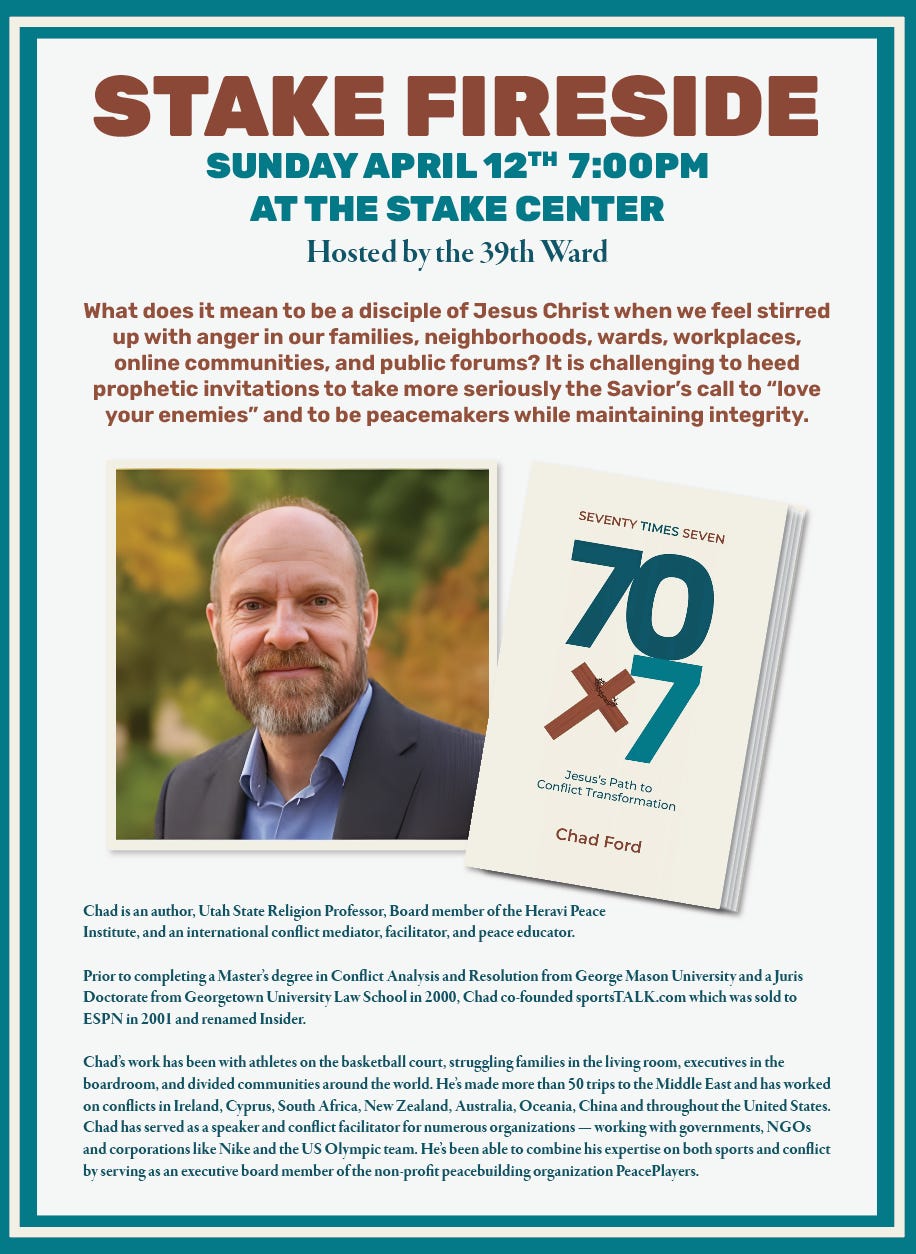
April 12: Stake Fireside, Highland, Utah
11605 North 6000 West
Highland, Utah 84003
Comments
Nothing yet. Say the first thing.
Sign in to join the conversation.