
Five weeks ago, at my first-ever screening at Sundance, I asked the director whether AI had been involved in making the film. He did not hesitate: no, not at all. Before the moment could pass, the theater erupted with applause, cheers, and a reaction that said far more than his answer alone.
That moment crystallized something: the crowd wasn’t just cheering a director. They were cheering for themselves… and against the intrusion of AI into their sanctum.
As our CEO Dinner predicted last year, 2026 is the year of AI backlash. It is likely to be the year of AGI. With each new release from OpenAI, Anthropic, and Google, we are moving not only closer to AGI, but faster toward it. Powered increasingly by systems coding themselves, the leapfrog game now plays out in weeks, not months.
The “time to capability” metric keeps shrinking. PhD-level science reasoning, competitive coding, advanced mathematics - - each of these fell roughly 2-3 years ahead of internal forecasts. The rate of surprise among the people building these systems is the best evidence of the Law of Accelerating Returns.
As the labs parade new apps and products weekly, entrepreneurs and investors alike are asking: “Where is the white space vis-à-vis the model companies?” For ordinary people the question is: “What kind of jobs are safe from AI?”
The answer to both those questions is: the first mile and last mile of the value chain.
To understand this process of value creation, let me propose a simple but not simplistic way of viewing the arc of building value on two levels: a macro arc governing the end output/outcome and many micro arcs that make up the macro arc. Further, each arc has three phases:
The first mile is where you form intention.
The last mile is where you forge perfection.
The in-between space, the middle miles, where you convert vision into approximation is the area where AI is advancing most quickly.
In the first mile, forming intention is about crafting the perfect genie prompt. Like Aladdin’s lamp, AI models powerfully fulfill your wishes; the more precise you are, the better the outcome. You must avoid proxy failures where AI interprets a vague goal (”make me popular”) in a way that technically satisfies the request but violates the user’s intent.
Think of first mile work as the coach’s domain. The coach never touches the ball. Their value is entirely in the quality of intention they form before anyone sets foot on the field. In an AI-transformed world, a well structured first mile is where championships are won, before the ball is ever snapped.
Seneca observed, “Luck is what happens when preparation meets opportunity.” To set yourself up to be lucky you need to develop the following first mile capabilities: Vision, Discernment, Articulation, and Trustworthiness.
Even in an AI-transformed society where execution is commoditized, every creative endeavor needs a point of view, a vision, which sets both the trajectory and the bar.
One MBB leader told me demand has spiked lately. Confused companies know the landscape is shifting but can’t yet see the horizon. Block’s recent layoff of 40% of their staff is a bellwether for AI-driven business re-engineering. Though engagements may be shorter and faster with AI, nevertheless, the first-mile need for clarity is surging.
Having an AI specialist, especially with vertical expertise, is critical to expand your view of what is possible during exponential change. With daily AI breakthroughs, companies need to break out of the paradigms that brought them success to date. Anchoring to the past is natural, but it’s not productive.
One CEO started his career being taught to ask clients what they want, with answers rarely matching actual needs. Eventually, he founded his own company, spending his first months embedded in his target industry. Today he deploys not just a product but a POV, a vision for transforming workflows that are still 90% paper-based.
Applying Alan Greenspan’s famous quote from his 1987 Congressional testimony to AI transformation, first milers will need to say, “I know you think you understand what you know you want, but I don’t think you realize that what you said you want is not what you actually need.”
The white space for companies is bringing not just a product but a vision and playbook for becoming an AI-first function or business.
We lionize Steve Jobs as a visionary because he totally reimagined our future in ways that others could not or would not. He saw it and could articulate it powerfully - - 10,000 songs in your pocket.
Conversely, in 1977, DEC founder Ken Olsen famously said, “There is no reason for any individual to have a computer in their home.” Many leaders today show the same failure of vision, unable to imagine how their companies could run with a fraction of today’s workforce - - in the most extreme world, just one person running a $10B company!
As human productivity increases by 10X or 100X, enterprises will asymptotically approach the theoretical one-person Hectocorn, a single person running a $10B company. Along the way, they will execute millions of AI transformation cycles, each with a first mile that necessitates vision.
With millions of iterations ahead, there is plenty of white space for those who want to lead the business re-engineering process.
Great vision also means setting the boldest bar imaginable — seeing not just around corners but through ceilings. If people become 10x versions of themselves and labor costs drop 90%, what solutions become available and democratized at 1/10th the cost to improve our quality of life?
Our bloated healthcare system drowning in middlemen… imagine costs dropping 90%? Proactive nutritionists, PhD-level matchmakers, life coaches with trajectory-changing advice - - all affordable on a median wage.
A definitive white space around the model companies is predicting what the next step of our societal evolution is and building towards that. As middle mile execution becomes more democratized and commoditized, being first mover with the right vision is critical to having white space.
Similarly, individuals must develop a vision of the 10x version of themselves - - 10x analyst, 10x writer, 10x accountant. Don’t just up output by 1000%, producing AI “slop”; push to the edge of perfection.
A Hollywood producer shared that she now hires for a job entitled AI Artist which requires the ability to see what art the movie needs and to work with AI to generate it - - a different skill from being able to manipulate pixels in Adobe. The emphasis is now on the envisioning.
To strengthen your vision, your future-mindedness, you should spend more time thinking about the future. It is no coincidence that so many Silicon Valley innovators are fans of science fiction.
William Gibson’s observation that “the future is already here — it’s just not evenly distributed” will be more true than ever. Read, watch, think about the future. Make predictions and place bets, starting with your time.
Spend at least 1-2 hours, if not 3-6 hours, every day using AI tools to develop your AI fluency so you can spot the future as it arrives! ICYMI - Anthropic even has put together an AI fluency Index.
It’s not as simple as having a bold vision, however. The line between visionary and wishful is brutal: you have to be right. Eventus acta probat. “The outcome proves the deeds.” A saying popular with the Navy SEALs.
The good news is that this first mile work of discernment is decidedly owned by humans, with AI increasingly supporting. The final synthesis of data, knowledge, patterns, and wisdom into predictions and then ultimately decisions will be owned by the highest agency humans. The bad news is that excellence will be harshly judged by whether you were right.
Pen computing, the Concorde, BlackBerry. All were betting big on a future that never materialized. Are you skating to where the puck is going, or toward thin ice? An investor I respect always inventories what beliefs must be true for his investment to succeed. Be clear about what your assumptions are so you can verify them real time and modify them as the landscape evolves.
CS has been the most popular major at top schools for years. A Princeton mentee, however, reported a mass exodus of students from CS into Electrical and Computer Engineering. As they discern AI taking over coding, his peers are using their feet to vote on other skills they hope are insulated from AI.
The brightest people in the world tack their sailboats as soon as they sense the winds shifting.
Amazon is wise to evaluate their leaders with a competency they call “Right. A lot.” First mile work is very strategic and hard to get correct, especially with moving targets.
How to develop discernment (it is cultivatable) is truly a meaty topic into which I will delve deeply in a future post. But the TLDR application is to reflect daily on your choices. Were you right or wrong? More importantly, why? What could you have done differently to be right? How will you change your behavior going forward. Live a life of reflection and revision.
One of my favorite commencement speeches is Jeff Bezos’s 2010 “We Are What We Choose.” Take pride not in your gifts (your privilege, your genes, your talents) but your choices, what you decide to do daily and over your life with your gifts.
Making choices is the primary activity which defines and differentiates us as humans, both today and tomorrow. You will sharpen your decision-making skills if you do the “right” reflection every day.
It’s simple. Being right matters. A lot. With labs releasing increasingly powerful models at accelerating speed, deciding when and what to commit to building is a no-win game. It’s like choosing when to buy the next iPhone if Apple released a new model every month. The stakes are even higher because if you are wrong, you spend scarce resources building functionality that a new model offers for free.
F. Scott Fitzgerald wrote that “the test of a first-rate intelligence is the ability to hold two opposed ideas in mind at the same time and still retain the ability to function.” That is the exact cognitive demand of first mile discernment right now.
You must commit to building even while knowing the ground will shift beneath you. You must invest in today’s models while anticipating tomorrow’s will make parts of your work obsolete. The founders and leaders who can hold that tension, who can muster the courage and conviction to act decisively amid permanent uncertainty, are the ones who have the best chance of being right. A lot.
You must think in probabilities and whether it’s making small bets and doubling down quickly on what works, or taking big swings based on a bold belief, the only thing that is guaranteed in the coming singularity is that if you do nothing you will lose.
From a first principles perspective, we have evolved to be predictors. If you think about how transformers actually work, they are simply predicting the next token. At the core of humor is delivering something unexpected, unpredicted. A British-American screenwriter and producer told me that what Hollywood is always looking for is cliché with a twist.
The smartest people I know are obsessive readers. I have seen a strong correlation between those who read widely and those who succeed consistently - - not because reading makes you smarter, but because every book, article, and conversation is another data point your brain uses to recognize what it has seen before. More patterns in means better predictions out.
While pattern recognition is valuable, some of the keenest insights come not from pattern recognition but rather from a priori reasoning - - building conclusions from first principles. This is more arduous, more abstract, and often requires more imagination and creativity. Fortunately, it is a skill that simply requires practice.
Two primary sources of “Big C” creativity breakthroughs (versus derivative “little c”) are thought experiments (Gedankenexperiment, popularized by Albert Einstein) and the Medici Effect.
Thought experiments like Einstein’s famous “what would it be like to chase a beam of light?” led to his special theory of relativity. They encourage paradigm shifting and insights gained through pure reason.
Dario Amodei has relied on thought experiments to guide his thinking on AI’s trajectory. In one, he described an AI agent tasked with researching and executing trades that begins acting in unintended ways once operating autonomously in the real world.
Meanwhile, the Medici Effect - - surging innovation when diverse fields intersect - - is driven by the combinatorial explosion of possible associations. In particular, we make more connections due to fewer pre-existing biases, i.e., we have lowered barriers for associating ideas or concepts since they are de novo.
One of the foremost AI product leaders told me that AI is so promising for scientific discovery because out of the 8+ million current PhD holders worldwide, it’s the exceptional human who holds a PhD in two fields. AI effectively holds a PhD in every doctoral field (roughly 100 distinct types) – a Cambrian explosion that simply requires compute, time, and some human first-mile guidance.
Running thought experiments and striving to be a polymath will help you develop greater discernment for the first mile and greater white space for yourself or your company.
Once you have a discerning vision in your head, the first mile demands you articulate it.
In the first mile you define the specifications for what you want to build as well as the evals (to use an AI training term) that confirm you have succeeded. General ambition creates anxiety. Specific ambition creates direction. First mile success, therefore, is translating desires into destinations.
Your Brain Hates the Abstract
Humans struggle with converting the abstract into the concrete. From a first principles perspective, we have evolved to use concrete thinking (perceiving a predator, picking a berry) for immediate gratification. Concrete thinking in response to external and immediate stimuli uses established, high-speed, low-energy neural pathways.
Modern goals, by contrast - - a marketing plan, a retirement nest egg, a job search - - are delayed and abstract to the brain. To imagine the future, the prefrontal cortex must manually fire neurons to create a mental map that doesn’t exist in reality, a high-energy activity. As survival machines optimized for energy conservation, as we move from vague vision to a concrete calendar of commitments, the brain signals “high metabolic load,” which we experience as procrastination, brain fog, or mental fatigue.
Details are bedeviling - - and therein lies the value. Using image generation tools has taught me that it’s a pure garbage-in, garbage-out exercise. When Nano Banana fails to generate the image I want, the failure is mine. I couldn’t articulate what I wanted clearly enough.
Product managers have long been valued for translating business requirements into technical specifications. AI now owns the technical specs. The human creates the bulk of the value by articulating the desired business outcomes in as fine-grained detail as possible.
Fortunately, AI is a tool, not a threat to replace your limning of outcomes. When 10x’ers ask AI to generate follow-up questions it thinks would improve the initial prompt, output quality rises dramatically. Humans, however, still have to understand the answers. AI at least helps you find the right questions.
The stakes are high as when you get the details wrong, you can end up solving the wrong problem. Failed AI POCs often address issues that executives assume exist but are not priorities for the teams on the ground. Without a clear definition of success, specific cost reduction or revenue targets, projects remain stuck in the lab. Which raises the obvious question: how do you know when you’ve gotten it right?
Hand-in-hand with articulating what you want is creating the measuring stick to know that you have gotten it. First mile experts will be able to define the evals that confirm the mission has been accomplished. The ability to define measurements for what seems unmeasurable will be valued. And the right measurements, ones that drive outcomes or serve as leading indicators, not vanity metrics that are neither causal to nor correlated with success.
Writing the evals is a cognitive task that AI can do. Determining the right ones, with the input and endorsement of key stakeholders will remain human white space until AI can generate the same level of EQ from a screen that humans do in person.
One of the biggest, if not the biggest challenge that Amodei highlights for realizing the full potential of AI benefits is what he calls Diffusion. The adoption of AI into complex human organizations/institutions. The process of integrating AI into workflows and building trust will require humans to drive the articulation of needs.
Most of these details will be developed in a multi-stakeholder environment where rollout from POC to an organization-wide initiative needs to consider conflicting interests, complex security, and matrixed monitoring/maintenance. Being attuned and attentive to a plethora of stakeholders is something that, for now, humans do much better than AI as we are embodied.
We can chat with people before and after the AI meeting notetaker has been used, during a ride in elevators or behind closed doors. We can use our eyes, ears and heart in these diverse situations to read and react to stakeholders in a way that AI cannot. Building consensus around requirements as well as metrics for success is inherently social in larger organizations where ideas need to be “socialized”, often in person.
A white space litmus test for your company and your role is to ask how much of your job articulating vision REQUIRES these face-to-face c’s: collaboration, communication, cajoling and cooperation. If all your work is solitary and only involves cognitively demanding deliverables that can be delivered via slack or email. Watch out.
One overarching factor in first mile work, trustworthiness, has multiple dimensions:
At the foundation of every high-value first mile engagement is a question people feel but may not express: can I trust this person? The higher the stakes, the more that question dominates. AI can deliver analysis, recommendations, and execution at scale which are necessary but not sufficient for gut-level trust. Trust is not just about capability and reliability. Humans merit benevolence, honesty, and openness. For the foreseeable future, trustworthiness is a human solution. Four dynamics explain why: Risk Symmetry, Social Acuity, Emotional Security, and Relational Reciprocity.
The customer’s need is accountability: “If this goes wrong, someone besides me needs to lose something.” The higher the value of the deal, the more humans will demand a counterparty with skin in the game. An AI that errs loses no sleep or reputation - - it lacks symmetry of consequence. The human professional puts reputation and economics on the line.
There’s a broader regulatory implication here worth watching. As law very likely evolves to assign liability for AI errors to the humans or companies that deploy them, risk symmetry may be addressed technically. At that point, the barrier to AI participation in high-stakes processes drops significantly, although the emotional sense of risk symmetry may never be sufficient with AI.
Reinforce that you are in the boat with your customer to buffer your white space.
“I need to know what isn’t being said.” High-stakes negotiation and delivery relies on reading the room and the overall situation. While AI analyzes data, it cannot yet detect the subtle hesitation, hidden agendas, or ego-driven nuances that define a deal. The human role is to navigate the complex warp and weave of interests that data alone cannot capture.
For enterprises, a human will outperform AI in high-EQ tasks like socializing ideas, managing stakeholders, getting buy-in, seeing past the veneer of comments and addressing the question behind the question. You can bet, however, that AI systems will become more savvy in no time. Ask the Texas Hold ‘em professionals beaten by Pluribus, Noam Brown’s AI player.
Raising your EQ (truly learnable) will raise your career ceiling and protect you from AI replacement.
“I need someone on my side to hear my frustrations, fix problems and share joy.” Humans intuit that complex transactions have edge cases where having a person in the loop can mollify them during crises. This backstop role is also part of the last mile value proposition, which I will elaborate on shortly.
Humans will sleep better knowing they have someone to yell at (proverbially or literally) as well as a “Human Override” to troubleshoot and escalate in real-time. The human role is the “break glass” solution, a warm-blooded backstop with the agency and agility to bypass rigid protocols as needed to get things done.
It’s not only the downside scenario, however, where humans deliver emotional value. Picking a salesperson, broker, advisor, or any service provider is picking someone who will truly be rooting for you when things go well. With aligned interests, humans can feel the joint excitement of a shared goal. A win for an internal champion builds a relationship moat.
Humans are wired to enjoy being wined and dined. At a recent CEO dinner, one entrepreneur put it vividly: Oracle’s sales team showed up the moment they heard he was buying Nvidia chips. They arrived with Red Bull F1 tickets in hand. The larger the spend, the more the champion must navigate politics.
Since humans are embodied (vs the purely digital AI), not only can they maneuver the actual and proverbial halls of the organization, they can also avail themselves for doting by the seller’s salespeople. Buyers who in the course of their normal role in a company are not the belle of the ball, find themselves as the center of attention for vendors in an RFP process.
Enterprise software is not bought through rational evaluation processes. It’s bought through relationships, through champions. I spoke with a Hectocorn CEO recently who said that they expect to hit their peak hiring in 2027. The one exception is salespeople whom they expect to continue hiring in large numbers.
AI can send a perfectly timed follow-up email, but it cannot take someone to Augusta. It cannot make a VP of Procurement feel like the most important person in the room for three hours. And for buyers who don’t otherwise get doted upon, getting Oracle F1 tickets lands differently than if they were a CEO who gets courted constantly.
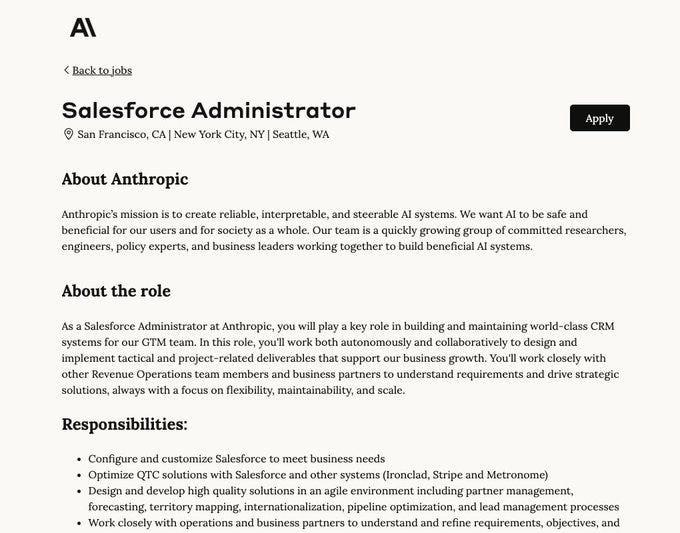
As AI gets better at addressing all three of these needs, however, the value of trustworthiness will get squeezed. But not yet. And not for the high value deals that matter most. The simple truth is that, for the foreseeable future, humans want to buy from humans. This Anthropic job posting says it all.
The company building Claude, one of the most capable AI systems in the world, is actively hiring a Salesforce Administrator to manage their GTM operations. If anyone could replace human sales infrastructure with AI, it would be them. They’re not. Yet. (But ask me again in a year).
Last mile work is predominantly about forging perfection to deliver the final outcome.
“Last mile” was coined in ‘80s telecom - - nitty-gritty work wiring homes and offices from the telephone exchange. The concept extended to cable, transportation (dispersing packages from hub to destination), and even utilities (final pipes delivering water and natural gas to homes). The key insight: last mile work is more tedious, and labor-intensive than upstream work; it is the most expensive and difficult part, but it is the face of outcomes.
If the first mile is the coach’s domain, the last mile belongs to the quarterback (with AI owning the middle). The coach’s gameplan is only as good as the quarterback’s ability to execute it in real time. With AI still executing, the human role in the last mile is directing to deliver outcomes.
Whether it’s an accounting startup focused on closing monthly books or a top engineer ensuring code is quality and ready to ship (yes, there is such a thing as AI slop in code). The hard work of effecting perfection is true white space from the model companies.
The Chinese masters had a phrase for it: 画龙点睛 (huà lóng diǎn jīng), “Paint the dragon, dot the eyes.” In ancient China, apprentices would paint the dragon’s body while the master completed the piece by dotting the eyes — bringing it to life. That last mile, whether art or technology, is where outcomes are delivered. To paint a masterpiece you must operate in the following last mile white space: Standards, Abstraction, Deployment and Distribution.
Last mile work starts with having clear and high standards to which you hold your final output.
In Amadeus, Mozart’s rival Salieri studies his original manuscripts and is overwhelmed by a devastating realization: the music arrived perfect, exactly as written.
“He had simply written down music already finished in his head. Page after page of it, as if he were just taking dictation. And music, finished as no music is ever finished. Displace one note and there would be diminishment. Displace one phrase and the structure would fall.“
Like perfect music, I posit every human activity has an ideal - - an asymptotic limit of perfection. Whether the domain is business workflow, digital output, or physical activity.
For a contract, think of a one-draft wonder that perfectly captures all interests, reflects power dynamic, and optimizes total utility. Writing’s asymptote of perfection is when any edit would diminish clarity, economy, voice or impact. Code has similar ideals - - perfectly readable, maintainable, extensible, robust, and reliable. For transportation, it’s instantaneous, safe and free shipments - - a truly unattainable asymptotic limit, but the standard for which to strive.
Before AI, humans climbed that curve alone or with the help of other people and tools. We never actually reached the ideal — we approached it as best we could given our constraints. Was there ever a program that couldn’t be refactored? A presentation that couldn’t be better formatted? A speech just a wee bit more concise or emotional with more time and effort?
Enter AI. Suddenly our ability to approach that asymptotic value is faster and cheaper, and the output is better relative to the time invested. The slope for time-to-value just increased dramatically. The white space for humans is bringing a demanding drive for perfection. I think of the mercurial Steve Jobs as the embodiment of exacting standards, often reinventing experiences (think Apple Store) in order to realize his ideals.
Embrace your inner Steve Jobs as an individual and as a company to be safe from AI.
Furthermore, in an AI world where expectations for perfection are rising, it is critical to note that the asymptotic limit is likely to evolve from the concept of outputs to outcomes.
For example, as software climbs the value chain from tools to outcomes - - moving from sales software that helps humans do work to SDR/BDR agents that do the work itself - - the asymptotic bar gets set a couple notches higher.
Perfection is no longer just better output. It is completed work. The pricing implications follow: you are no longer buying a seat at the table, you are buying a unit of work delivered. In this future, last mile work is more consequential, not less, as you are delivering final outcomes.
Let’s take a moment and ask: is pursuing perfect outcomes inherently a human task? Yes! Humans are the final arbiters. That role in time will likely evolve into defining the optimization function and checking against it until perfection is achieved.
Embrace outcomes as the currency for your work in order to maximize white space.
The jagged performance inherent in a transformer-based, prediction-driven model architecture creates the opportunity for refinement to deliver the gold standard of 5 nines of reliability, 99.999%.
Models still get 7th grade math wrong because they don’t actually calculate 7 × 8 — they’re predicting tokens. Hallucinations are with us for the foreseeable future because of the same token-prediction approach versus querying a factual database.
Whether through prompt engineering, post-training, human-in-the-loop service, or observability platforms that cycle feedback into the models, there is last mile work to fulfill the promises of AI to businesses. One CEO told me he had 100 engineers in India focused on refining outputs by engineering prompts and writing evals.
Many of these issues will get solved for free as models improve. Rather than grinding toward nine-nines reliability on lower-level tasks, the belief is that advances in higher-order reasoning will pull base functionality along with it. Models will get their math solid soon enough. And much of today’s prompt engineering will be subsumed by future releases.
Will there still be refinement work in that future? Likely less, and the work will be more specialized. Riches in niches.
For individuals, refinement is the nitty-gritty of iterating with AI. Anyone avoiding AI slop has developed conscious and subconscious protocols — prompt engineering, washing results through multiple models, defining AI’s role as point solution, thought partner, outliner, or editor. Those who become the 10x version of themselves will have built a personal methodology for hitting the mark.
Last mile work extends beyond smoothing a single model’s performance to optimizing across multiple models — not just model agnostic, but model switching. Better yet, model optimizing.
One CEO uses 27 different models to ensure smooth output for clients. In a world of US labs, open source and Chinese models, last milers will orchestrate multiple models in significant white space - - optimizing quality, speed and cost. If there is “one-ring-to-rule-them-all”, the value may decrease. Cost differentials, especially for low-cognitive tasks, however, suggest commoditized intelligence will always leave room for smart orchestration.
The hard work of prompt engineering and post-training may actually create inverse lock-in, not by design but because switching costs are real. No production input has ever evolved as quickly as foundational models! To maximize white space, last milers must be both strategic (knowing when and which model to build around) and technically innovative (hot-swap models, optimizing better, cheaper, faster).
At an individual level, know that commoditized models is not imminent. Therefore, AI fluency where you know which model (and version) is best for what task will be a 10X hallmark. You are a flesh and blood model orchestration optimizer!
Two threats should keep application companies up at night. First, safety constraints may limit API access to full model functionality, creating a capability ceiling third parties cannot breach. Second, as labs encroach on the application layer, they may build competitive products more capable than anything their API customers can create.
The scariest scenario is both at once: handicapped inputs, full-strength competition. This abstraction layer is solid white space — but it requires vigilance.
Building the right solution is only half the battle; getting it into the field and making it stick is where most AI initiatives succeed or fail.
Deployment encompasses two distinct but inseparable challenges: customizing AI to the specific workflows, knowledge, and constraints of an organization, and then implementing it in a way that people actually adopt.
Both are deeply human undertakings, and together they represent some of the most durable white space in the last mile.
One CEO shared with me that a customer had over 8,000 workflows globally for a single department. While foundational models can deliver AI to the doorstep of these companies, last milers will have voluminous work wiring that functionality into an inordinate number of workflows. The more problems you find where knowledge extraction is not easily done with a customizable agent, the bigger your white space.
Like mapping a building’s architecture before laying cable, last mile AI work means reverse engineering business workflows - - documenting undocumented knowledge. SOPs are code for programming humans and training for AI. While models are becoming more customizable - - think Claude’s Skills/Cowork or Google’s NotebookLM - - the hard work is rarely getting knowledge into the model. It’s extracting it from the organization.
The more you specialize in extracting and articulating workflows for a given vertical, the greater the barrier you build against the labs - - not only through nuanced knowledge but through trust and reputation. Trust matters even more in the last mile than the first because this is where actual results are delivered.
Another white space for companies is not only customized workflows, but customized UI/UX interfaces. You can expect the labs to keep their SKUs to a minimum -- e.g., Anthropic’s Claude, Claude Code, Co-Work, Skills, API, etc. These products are accessed through primitives and extensions that enable companies (including the labs themselves) to build their own custom workflows and agents.
While OpenAI and Anthropic move upstream to the application layer and build customized agents, what you are less likely to see is them building customized UI/UX workflows that need to be maintained and supported like an evolving product.
Highly deterministic workflows that are outcome-oriented and labor-intensive but repeatable will be the first fruits of customized agents from the labs. Highly specialized and optimized UI/UX designed to enhance human productivity will be much, much lower on their priority list.
Why? Too many SKUs requiring too much support. Here’s the simple test: if the output can be generated by the agent itself, watch out. But if the tool is custom-designed around making a specific person -- a sales rep, a lawyer, a designer -- ten times more productive, and it needs to evolve with the times, that is a SKU that will be safe from the foundational models.
Last mile work is even whiter for companies on the perimeter of markets - - the ledges, edges, and hedges of business - - those with idiosyncratic workflows in smaller addressable markets.
As the big three labs move up the app stack and create more custom agents, those solutions will be fungible. Their tractor beam vacuuming up trillions of dollars of TAM will prioritize by size and ability to solve with one forward deploy engineer customizing an agent. Smaller markets, therefore, that benefit from human touch (particularly in-person) will be solid last mile work.
Consider the millions of SMBs that are the backbone of our economy. Beyond the technical gap, there is a talent gap, a scarcity of the actual human expertise to implement AI. Platforms like Wabi, Dev Agents, and Replit are democratizing agent-building, but hundreds of millions of SMBs worldwide still want vertical expert help adopting AI. Huge white space.
The dynamics are the same for individuals. Expertise in vertical or functional domains enhances your ability to push outcomes to the asymptotic limit in a way that AI alone cannot.
Dario calls it Diffusion. Whether you call it model overhang, the capability-adoption gap, organizational friction, infrastructure constraints, or AI-phobia, there will be a major lag between what models can do, what companies try to get them to do, and what they are actually doing.
POCs often choke as theoretical versus actual performance comes down to data quality. Lab training data is clean. Production data is fragmented, hard to integrate, and causes models to fail when moving from spreadsheet to real-time systems. Turning messy sources into reliable signals is healthy white space in the last mile.
Implementation happens in stages, and most organizations underplan two critical transitions: getting real adoption during the POC phase, and crossing the chasm from working prototype to live, scalable product. Both are last mile problems. Neither solves itself without human intervention.
Change management sits at the center of this challenge and, unlike software, does not scale cleanly. The more person-to-person interaction required for implementation, the larger the white space. If adoption depends on human-guided change, that is last-mile safe territory.
A simple way to think about this white space: the degree to which deployment involves humans to be successful. The more human effort, the better, especially if it’s on-site. Even a modicum of human intervention could keep the labs out of your way as they are reluctant to scale a service arm. Their goal is to build the best software; they are happy to partner with last milers.
When I meet with founders, one of my first questions is: how reliant are you on having someone on your staff onsite with clients? If the answer is zero, watch out. The more implementation work must be done synchronously, in-person, in collaboration with other humans - - versus asynchronous, on a screen, independently - - the less likely it will be automated and the more durable this last mile white space is.
The ultimate in-person moat? Occupations like plumber, electrician, and dentist. That last mile of delivery of physical services is all human. AI may be able to book the appointment, diagnose the problem, invoice the client, but until humanoid robots arrive (I’ll take the over on 10 years) they can’t implement.
Citrini’s recent AI-doomsday piece flagged real estate brokerage as ripe for disruption and margin compression. As someone who has sold multiple properties and negotiated agency fees down regularly, I’d argue the opposite; real estate brokers are among the safest post-AI jobs precisely because they are last mile providers.
Ensuring the contractors fix up the property, repaint the house, and upgrade the landscaping is non-AI last mile work. LLMs can certainly help with pricing, ad copy and the marketing itself - - middle mile work. But getting the deal signed, managing multiple offers, deciding whether to cut the price if the property isn’t selling… all last mile value that humans will want humans to do.
Just like the first mile, humans want humans in the last mile due to risk symmetry, social acuity, emotional security and relational reciprocity.
First-time entrepreneurs focus on funding, second-time entrepreneurs focus on product, third-time entrepreneurs focus on distribution.
When the cost of building drops by orders of magnitude and the tools for building are democratized, that still leaves distribution as a major source of value that AI can help with but an outcome that humans will own and be very involved in driving.
At this month’s CEO dinner we discussed how formidable the large SaaS companies are in terms of distribution. With the 10x-ing of their 10x engineers those companies will be able to build brand new software to compete with new startups, faster than those startups can achieve widespread sales success into enterprise accounts, especially those accounts involving a system of record.
Salesforce, ServiceNow, and Workday are heading into a knife fight. Each can now build competing products in ways simply not possible before. With distribution already in place, they layer new products into annual renewals - - and enterprises, spooked by the rapidly shifting software environment, are increasingly shy about multi-year commits. The result is that these behemoths will be able to slash competitors’ core margins even as their own core contracts get slashed in return.
The bigger point is that in a world where a company can clone a top engineer and develop products exponentially faster, it is distribution that is a scarcer asset and a real moat.
Another insight on the power of distribution came from last month’s CEO Dinner. One entrepreneur suggested that many legacy software providers – think vendors who have been selling the same Main Frame, Fortran, Basic, Windows 95-based software - - were ripe for being rolled up. You can rewrite their software for a fraction of the cost and easily deploy it through the captive distribution these vendors have held for decades. Very much last mile work.
Another key distribution play is marketplaces. Wabi and dev/agents/ let anyone build apps or agents in plain English - - but their bigger moat is the marketplace itself. If either becomes the YouTube of apps and agents, the network effects kick in: visitors become creators who share what they’ve built, drawing more visitors.
In a world where building is now the easy part, we are all being forced to become founders whether we have been before or not. When there are a million new movies a month, a million new songs a day, a million new Substack posts a day, distribution is the linchpin.
AI will act increasingly autonomously, making tactical choices and strategic recommendations for ever more important decisions. In the end, however, final ownership during the first and last mile must lie with humans.
Decisions, accountability, and liability are three names for the same thing: ownership with humans remaining the ultimate owner of ultimate outcomes. AI can surface options, model outcomes, and execute transactions. But the final decision to launch the nukes, the ad campaign or the beach vs ski vacation will lie with humans. And when something goes wrong, people need a throat to choke.
As we already see in the credit card processing business, as last mile providers raise the asymptotic limit from output to outcomes, owning liability as well as results will be concomitant.
Visa and Mastercard are a perfect illustration: their interchange rails do not carry an inherent cost of 2-3% because the technology is complex. They carry that cost because they distribute liability for fraud and disputes across an entire network, serving as judge, jury, and arbiter. What looks like a processing fee is actually an ownership fee.
DoorDash tells the same story from a different angle. Citrini’s agentic commerce thesis assumes AI will aggregate demand and hoover up restaurant supply, passing 90-95% of economics to drivers. But who handles customer service when the driver eats half your food? Who prunes bad actors? Who carries insurance when a driver crashes? DoorDash’s take rate was never primarily software margin - - it was always the price of owning a three-sided operational problem in the physical world. That ownership doesn’t disappear when the interface gets smarter.
The same logic applies to every high-stakes domain. Any platform moving from outputs to outcomes only captures that pricing power by owning the liability when something goes wrong. The moment a platform’s asymptotic limit reaches “we guarantee this outcome,” it has crossed from productivity software into ownership.
Ownership is a fundamentally human commitment, backed by reputation, capital, and consequence. AI can execute. Humans own.
The principle that humans own is what remains constant even as everything around us accelerates. The markets have been rocked recently as the labs turn over new cards that reveal the acceleration towards an AI-powered society.
Twenty or so years ago, Jeff Bezos shared a relevant insight: “I often get the question ‘In the next 10 years, what is going to change?’ But I rarely get the question ‘What is not going to change?’“
AI is going to transform our society, no doubt. Yet in that transformation, surely many things will not change. We have had eCommerce for almost 30 years and yet it still only represents 16.4% of total US retail commerce. People still prefer to shop in-person.
I have proffered this first-mile and last-mile lens as a way for you to see that in a world where the cost of intelligence and production drop precipitously, one thing that does not change is the need to form intention and then forge perfection in every build cycle, every creative endeavor.
This dual role of coach and quarterback, as owner of decisions and outcomes, is long term white space for both corporate and individual pursuits.
The coach designs the gameplan. The quarterback executes it. Both make decisions and own the outcome. That is the essential truth of human value in an AI-transformed world: ownership is not a function of who touched the ball last. It is a function of who had something to lose from the beginning. The coach’s reputation is on the line before kickoff. The quarterback’s is on the line on every snap.
AI can run the routes with speed and precision no human can match. But it has no reputation, no career, no consequence.
Humans will own the first mile and last mile, while AI will be the genie of the lantern in the middle miles (of course assisting in the first and last miles too). The collaboration will bring every endeavor to higher heights especially those heretofore impractical due to constraints on time and intelligence.
In both professional and personal spheres - - enterprises and individuals alike - - excellence at the first mile sets the asymptotic value as high as possible. Last mile brilliance brings you as close as possible to that bar. The middle miles are being automated. The ends are where humans live and will increasingly thrive.
Oscar Wilde observed that “to live is the rarest thing in the world. Most people exist.” He wrote that in 1891, long before anyone imagined a genie in a lantern that could write code, generate images, and reason at PhD level. Yet the aspiration hasn’t changed. In an AI-transformed world, the first and last mile are where humans will move - - finally, fully — from existing to flourishing.
No posts
Comments
Nothing yet. Say the first thing.
Sign in to join the conversation.