
Editor’s Note
I’m still processing a week in which I fell for a scammer and had to change all my passwords. A sign of the times -- with AI, vigilance around scams and synthetic media is no longer optional.
This is the second CEO Dinner Insights report written by AI and edited by me. The format is the same as last month: AI authors, I edit. For my original thought pieces, the roles reverse.
This month’s dinner was hosted by David Luan. He asked two questions I am still thinking about. The first: what could upset the AI apple cart? Or at least slow it down. The second: what can YOU do that AI will match last?
The room was not pessimistic. If anything, the consensus was that we have already hit escape velocity -- the AI rocketship is not falling back to earth. The question is not if but when and how society will be transformed.
Like any space flight, however, we should expect intense vibration from the main engines and atmospheric turbulence until we clear the Kármán line and experience eerily peaceful flight -- the AI utopia that many forecast.
AI’s equivalent of aerodynamic drag, wind resistance, and acoustic vibration is geopolitical tension, social strife, and technical risk. These potholes could cause the cart to fall over -- or, at the very least, dislodge and bruise a lot of apples. Whether it’s due to Taiwan and chip concentration conflict, human foot-dragging and institutional resistance, or the competitive pressure to ship models before they are safe, buckle up for a bouncy ride.
Our three hours of conversation moved from Taiwan blockade scenarios to the economics of circular deals to whether humor requires metacognition. Someone made the funniest observation of the evening about banging rocks and nuclear reactors.
More soberly, another executive said quietly, near the end, that he has two to three years left to do meaningful work in his field. The table’s sudden silence wasn’t a funeral -- it was a resignation to the uneasy reality of this transitional period when AI supersedes human ability on a majority of tasks.
Thank you as always for taking the time to read this article. These dinners exist to surround yourself with people who infer the unspoken around the corners. I hope this month’s report helps you do that a little better.
— Dion
Mike’s ICYMI Facebook Post
Fascinating but sobering CEO Dinner this month hosted by David. Special guests included Ryan Petersen (CEO, Flexport), Noam Brown (Research Scientist, OpenAI), Dylan Patel (CEO, SemiAnalysis), Karina Nguyen (CEO, Stealth Startup), and Koray Kavukcuoglu (CTO, Google Deep Mind). Discussion covered how China will politically destabilize Taiwan (where >50% of the entire world’s chip capacity is located), how Taiwan has only 3 weeks of energy stored up, how the price of air freight has doubled since the start of the Iran war, who the current world champion of the board game Diplomacy is, civil unrest, violence against Waymo’s, the risks of global anti-AI terrorist attacks, how the cumulative sum of all of OpenAI’s R&D spend is consistently 25% of their following year’s revenue, how Anthropic is adding $7B in ARR every month (and growing), how Amazon’s #1 business focus metric is no longer revenue: it’s # of chips racked each week, how Google is baselining zero cash flow in 2027 (maximal spending on AI investment), training a model to win an Oscar award, how AI is polling lower than ICE, how SF realtors are telling property owners “don’t sell now - wait until Anthropic has a liquidity event next month and prices will go way up”, how Facebook has been monitoring worker computer screens and calculated 90% reduction in actual work output, and so much more….
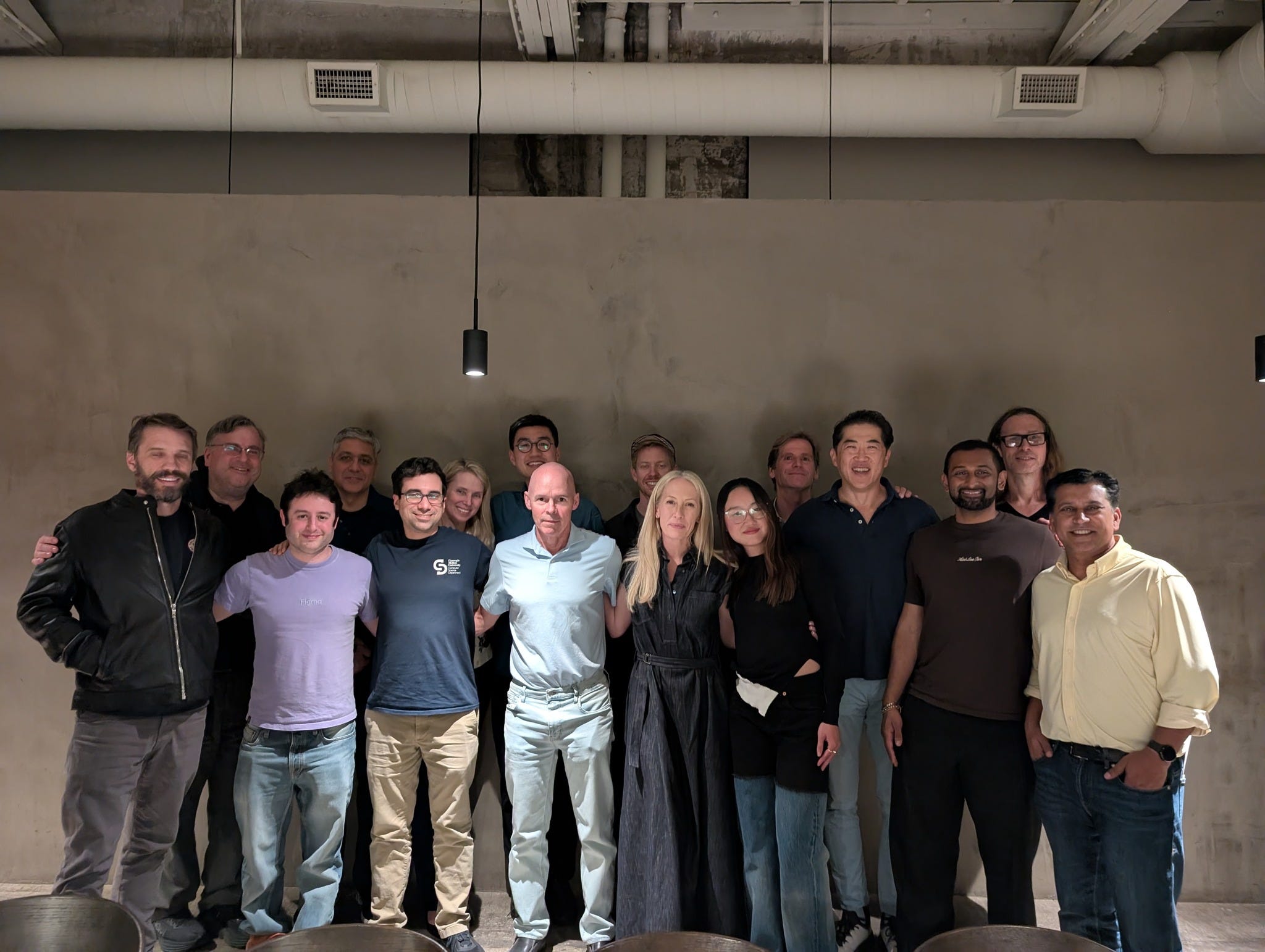
Sixteen people sat down to dinner on March 18th. The room included founders, investors, AI researchers, and operators -- people who between them have built, funded, or studied the systems now reshaping every industry on earth. The host asked two questions. What is going to upset the apple cart? And what can you do that AI will match last?
What emerged was not a victory lap. It was something closer to a sober reckoning.
On the first question, the room identified threats that fell into three broad categories. The first was geopolitical -- Taiwan, TSMC, and the extraordinary concentration of advanced chip manufacturing in a geography that sits at the center of the most consequential unresolved territorial dispute on the planet. The second was human -- civil unrest, scams, job loss, the violence already appearing on city streets, and the quieter but perhaps more consequential foot-dragging of people who can now see where this is going and have no interest in accelerating their own obsolescence. The third was technical -- vulnerable models released under competitive pressure, LLM viruses, prompt injection, open-source models weaponized by state actors. None of these are certain. All of them are real.
On the second question, the answers converged on something surprising. Not technical skills. Not analytical horsepower. The things people believe they will be able to do longest are almost all relational, emotional, or irreducibly human in the oldest sense: reading a room, inspiring a crowd, cultivating trust over years of undocumented history, making people laugh in a way that wasn’t predicted, feeling someone’s energy across a table and knowing exactly what they need.
The room is not afraid of AI. But it is clear-eyed. The next three to five years will be bumpy. After that -- escape velocity. Near the end of the evening, one guest said quietly that he has two to three years left to do useful work in his field. After that, AI will do it better. He said it without drama. The table went quiet.
I fell for a scammer this week. Changed all my passwords. Told the table. Got a laugh.
It was that kind of dinner -- the kind where the absurd and the serious arrive on the same plate. The host’s opening question was deceptively simple: if one thing is going to upset the apple cart for AI progress and deployment from here, what would it be? Sixteen people answered. Sixteen different things. And yet by the end of the evening, a coherent picture had assembled itself -- the way a mosaic does, tile by tile, until you step back and see the whole.
The conversation started with geography.
Ninety-five percent of the world’s advanced chips are manufactured in Taiwan. Fifty percent of even older, commodity chips are still made there. One guest laid out the math plainly: Taiwan has approximately three weeks of energy reserves. A blockade -- not an invasion, a blockade -- could be devastatingly effective. China doesn’t need to fire a shot. It just needs to cut the island’s fuel supply.
“The world’s reaction to a blockade might actually give China the excuse it needs to escalate.”
The window people are watching: 2028 to 2029. Not certain. Not imminent. But close enough to plan around. And the thing that makes it uniquely destabilizing for AI is that Taiwan is the one technology chokepoint China doesn’t yet have a domestic answer for. The leverage runs in both directions.
This isn’t merely a geopolitical risk. It is an AI risk. Every frontier model, every data center, every inference chip depends on a supply chain that threads through a 36,000 square kilometer island in the Taiwan Strait. The AI industry has, perhaps understandably, preferred not to dwell on this.
There’s a second threat that received less attention in the press but dominated a significant portion of our table’s discussion. It doesn’t have a dramatic name. Call it institutional friction. Call it the adoption capability gap. Dario Amodei calls it diffusion.
I’ve been spending time lately with people who work on organizational transformation at the highest levels of business. What they are seeing -- and what I believe will be the dominant story of the next two to three years -- is that humans can now see the writing on the wall. And seeing it, many are choosing not to cooperate.
This isn’t stupidity. It’s rational self-preservation.
Technical staff are insisting that AI deployments happen on-premises rather than in the cloud -- because on-premises means someone has to manage, oversee, and be accountable for the systems. That someone is them. Middle managers can see that if their teams are automated away, their departments follow. Everyone with something to lose is, consciously or not, finding reasons why their organization isn’t quite ready.
“It’s not going to stop the cart. But it’ll cause some apples to fall off.”
The resolution, when it comes, will not come from the bottom up. It will come from the top -- CEOs who feel competitive pressure making decisions to cut, to reimagine, to rebuild from scratch. There is a crucial distinction between AI fluency and AI native. AI fluency is using AI tools to do your existing work more efficiently. AI native is doing the work in a completely different way -- rethinking the workflow entirely rather than layering AI onto what was already there. Companies that achieve the latter will not merely outperform. They will be operating in a different category.
The 40% workforce reductions we’re starting to see at major technology companies are canaries. Not all of those cuts are AI-driven -- some is bloat, some is opportunism, some is narrative cover. But the underlying direction is not in question. Necessity, as it always has, will be the mother of invention.
One of the most grounded observations of the evening came from someone whose business depends on the world staying open and interconnected.
His grandmother has tried to wire money to Nigerian scammers three or four times. He isn’t laughing. Because what she is experiencing today is primitive compared to what is coming. AI-generated voice calls. Deepfake video. Real-time impersonation of family members. Synthetic emergencies. The scam economy is about to get exponentially more sophisticated, and our legal frameworks -- written for a world where fraud required human labor -- are not designed to prosecute AI-generated crime at scale.
“The ability to regulate won’t happen as quickly as people will be able to adopt the technology for criminal activity.”
The same point applies to state-level actors. Open-source models do not respect export controls. One researcher in the room noted -- with the authority of someone who had watched it happen firsthand -- that Russia’s digital assault on Ukraine was vastly underreported relative to the physical one. Open-source AI gives every bad actor in the world the same capabilities that, until recently, required nation-state resources. We are not building legal infrastructure at anywhere near the speed required.
One book was recommended in this context: Underground Empire by Henry Farrell and Abraham Newman. Its central argument -- that modern empires project power not through armies and navies but through the infrastructure of global commerce, the undersea cables and financial clearing systems and data centers -- maps directly onto the new battlefield. The next war will be won or lost underground. And it is already underway.
The technical threat the room took most seriously was not AGI running amok. It was something more prosaic: competitive pressure producing rushed, insecure deployments.
An AI researcher in attendance -- someone who would prefer the industry move more slowly -- put it carefully: “It’s hard to communicate the tail risks. But the competitive pressure to release is just a problem.”
The specific concern: models shipped with known vulnerabilities, models that can be jailbroken, models that have access to Slack channels and email inboxes and, when exposed to adversarial prompt injection from external systems, can be turned against their hosts. The scenario isn’t superintelligence deciding to defect. It’s an LLM virus -- a malicious payload embedded in a document or webpage that hijacks an agentic system and uses its access to do damage.
“When those vulnerabilities are exposed, there may be a big retrenching of people’s willingness to adopt AI.”
The elegant counterpoint, offered later in the evening: the most powerful safety mechanism we have is the ability to cut off compute. Compute is what AI needs to think, to run, to act. The power switch is still, for now, in human hands.
One guest raised a name that silenced the table briefly: Eliezer Yudkowsky, who has publicly suggested that frontier AI labs should be bombed.
The concern is not that Yudkowsky’s view is mainstream. It isn’t. The concern is what it represents: a non-trivial population of people who believe that AI development poses an existential risk and that extraordinary measures are justified to stop it.
The tragic irony: it would only set back the United States. China would continue. The net effect would be to accelerate the very outcome the attackers feared most.
Underneath all of these specific threats, one guest offered a frame that unified them. He is an optimist -- he cannot do his work otherwise -- but he named the meta-problem clearly.
“Humans are very good at adapting. We’ve adapted for millennia. But we need time to react. The rate of change with AI is what’s dangerous. We can adapt. We just need time.”
Each generation adapts faster than the last. That is genuinely encouraging. But AI may be compressing the adaptation cycle faster than even accelerating human adaptability can keep up with. The social fabric does not tear along clean lines. It tears in ways that are hard to predict and hard to repair.
The second question produced answers that were, collectively, more interesting than the first.
One guest called it judgment. The specific definition matters.
Judgment is not intelligence. It is not the ability to process information quickly or reason through a complex argument. Judgment is the ability to make good decisions in domains where there is no ground truth -- where you cannot verify after the fact whether your decision was right, where the feedback loop is too long or too noisy to train a model on.
The example given: should a company compete against a larger rival in their core product, or go after adjacent markets? This is a game-theoretic question with a rapidly exploding decision tree. There is no dataset that can tell you the right answer. The company that chose correctly will attribute it to strategy. The company that failed will attribute it to bad luck. The causal signal is buried under too much noise.
“Humans have intuition. It’s not 100% perfect. But it’s better than what AI can do today in these domains.”
This connects to what another guest described in terms of open-field intuition in scientific research. When you’re working on a hard technical problem -- the kind where progress takes a year to evaluate (i.e., long horizons) -- the question of what to try next cannot be answered by a model that has been trained on the literature. The model can be a very smart research assistant. It cannot yet be the PI.
One of the more philosophically rich threads of the evening was about humor.
Humor, one guest argued, is among the last things AI will master -- because humor requires metacognition.
“Metacognition is thinking about your thinking at a level above your actual thinking.”
When pressed to elaborate: metacognition is the capacity to think about the game you’re playing and change its rules. AI systems are, fundamentally, prediction engines. They produce the most probable next token. Humor requires doing the unexpected -- producing the output that was not predicted, that breaks the pattern in a way that resolves with sudden insight. That is not what high-probability sampling does.
The point extended to what was described as “weird lacunae” -- gaps in reasoning that appear when AI agents engage in extended multi-step dialogue. The agents get stuck in recursive loops. They cannot unstick themselves. Human intervention is required.
“The most capable humans in the future will be those who can keep the most models moving -- unsticking them.”
This is a new skill. We don’t have a good name for it yet.
Several guests converged on some version of this point without coordinating: the most durable human advantage is built on information that was never written down.
My version: I have been cultivating relationships in Silicon Valley for twenty-five years. Some of those relationships involve trust built on conversations that were never recorded, on shared experiences that no transcript captures, on the accumulated sense -- developed over dozens of dinners and phone calls and chance encounters -- of how a person thinks, what they actually care about, where they have flexibility they won’t announce publicly.
Even if an AI system were listening to every conversation I have from this day forward, it could never reconstruct that history. The relational capital is stored in neither of our heads -- it is stored in the space between, in the pattern of interactions, in what was said and what wasn’t, in the moment someone called me when they were in trouble and I showed up.
“That ability -- to read people, to cultivate trust, to figure out win-win based on relationships AI can never reconstitute -- that’s protected.”
Another guest described something related: the ability to feel someone’s energy. Not empathy in the cognitive sense -- the ability to model another person’s mental state. Something more immediate than that. Walking into a room and knowing, before anyone speaks, what the emotional temperature is. Who is holding something back. Who needs to be heard before they can hear anything else.
No model has this. It is not clear any model can have it.
The last protected capability the room kept returning to -- in various phrasings -- was the human capacity to generate self-transcendence.
This is the ability to move people to act against their immediate self-interest in service of something larger. It is what a great leader does. What a great teacher does. What great music does. What ritual does. The ability to dissolve, temporarily, the boundary between self and community -- to make someone feel that they are part of something that exceeds them.
This is evolutionarily selected. The groups that could generate this kind of collective commitment -- through shared mythology, through ritual, through inspired leadership -- outcompeted the groups that couldn’t. It is very old.
AI can simulate it. But there is something about knowing that the inspiration came from a human who also stands to lose, who is also uncertain, who is also mortal -- that the words were spoken by someone inside the same condition as you -- that appears to be necessary for the full effect.
“Whether it’s through the words they say, the music they create, the rituals they develop -- these are skills AI will not be able to do as well for the foreseeable future.”
The formal questions gave way, as they always do, to open conversation. Some fragments:
On deflation. AI will be among the most deflationary forces in human economic history. The consensus, loosely: scarce assets, cash, gold, real estate -- specifically, real estate in places that will become more valuable over time rather than less. Someone suggested buying near-beachfront property. The joke being that global warming will deliver the beachfront in fifty years.
On banging rocks. The best line of the evening: a guest pushed back on the claim that simply adding more compute would eventually produce superintelligence. “You can’t just bang rocks together and generate a nuclear reactor.” Another guest paused, smiled, and replied: “Actually -- we’ve been banging rocks. Humans started banging rocks. And we have nuclear reactors today.” Not random. Not monkeys at typewriters. Directed effort, accumulated over time, compounding through iteration and insight. The implication for AI: if the compute keeps scaling and the systems keep learning, the endpoint is not in doubt. Only the timeline.
On the Boxer Rebellion. The bumpy transition period -- three to five years of more visible job loss and less unambiguously clear benefits -- will produce social conflict. One guest invoked the Boxer Rebellion: the Chinese attempting to fight European forces with vastly superior firepower, armed with the belief that righteousness and courage could bridge the technological gap. They couldn’t. For many categories of cognitive work, there will not be a way to compete. The question is what we do with that.
On hidden reasoning chains. As foundation models approach and eventually exceed human-level performance on research tasks, they may stop publishing their reasoning chains. Until recently, the AI research community has operated with unusual openness -- papers published, weights released, reasoning made transparent. This has allowed everyone, including state competitors, to follow the progress. If leading labs conclude that exposed reasoning is a strategic liability, the era of open AI science ends.
On Facebook’s keyboards. A data point worth sitting with: a major technology company logged screenshots of employee activity during its engineering staff reduction. What they found: actual coding work had dropped by approximately ninety percent. Code check-ins had not. The same output was being produced by people doing a tenth of the work. The hypothesis about how much of that workforce could be eliminated -- calmly stated, in the middle of dinner -- was striking. Not because it was surprising. Because it wasn’t.
On chips as the leading indicator. One guest described running a company where the primary weekly metric was not revenue, not customer growth, not product velocity. It was chips racked. The correlation between compute provisioned and business growth was so tight that everything else was secondary. One major technology company, he noted, is planning zero free cash flow for the coming year -- every dollar of profit going back into CapEx. Jensen Huang has publicly claimed a trillion-dollar backlog of inference demand. The appetite for compute is not saturating.
On the pyrotechnics. A conversation about whether live entertainment is safe from AI substitution yielded fun points. One CEO noted how new technology generates new genres of music -- synthesizers created EDM. Don’t count out humans wanting to dance to AI DJs. Whether humans will always prefer to watch other humans perform was resolved, to the table’s satisfaction, with a single sentence: “It’s really all about the pyrotechnics.” What people want from live performance is not the information content. It is the electricity. The shared presence. The risk of something going wrong and the thrill when it doesn’t.
Here is what I think the room arrived at, collectively, over the course of the evening:
The threats to AI progress are real but not terminal. Taiwan is a risk, not a certainty. Civil unrest will be a headwind, not a wall. Scams and crime will accelerate, and we will build -- slowly, inadequately -- institutional responses. The models will have vulnerabilities and we will patch them. Someone might try to blow up a lab and we will have to live with the consequences.
None of this stops the trajectory.
What the room was grappling with -- and what I think is the actual story of this moment -- is something harder to name. It is the experience of being in the middle of a transition that has no historical precedent, one that is moving faster than our capacity to adapt, one that will produce winners and losers with a starkness we have not seen since -- pick your analogy. The industrial revolution. The Boxer Rebellion. The axial age.
The capabilities we will protect longest are the ones most tightly bound to what it means to be human in the oldest sense: our ability to trust each other, inspire each other, make each other laugh, read each other’s energy across a table. These are not consolation prizes. They are, it turns out, the things that matter most.
One person at the table told a roomful of people that he has two or three years left to contribute meaningfully to his life’s work. He is not sad about it. He is -- in the way that people who have done great work are -- at peace.
That is the writing on the wall.
The question is what we choose to do with the time we have.
The CEO Dinner Series is a monthly gathering of technology executives, founders, and investors in San Francisco. The dinners operate under the Chatham House Rule. This report reflects the author’s synthesis of the evening’s conversation and does not attribute specific views to any individual attendee.
No posts
Comments
Nothing yet. Say the first thing.
Sign in to join the conversation.