
Editor’s Note:
I have a dozen or so original posts coming up including imminent ones about the white space around AI, taste, and discernment. I have made the editorial decision to collaborate on a new approach to the monthly CEO Dinner Insight Reports. AI is going to be the author and I am the editor. For my original thought pieces, it will be the inverse.
The principles guiding my decision were the following: 1) unique take principle - voice matter less for fly-on-the-wall reporting vs. my original thought pieces, 2) timeliness principle - faster is more important than voice in terms of getting content to readers. 3) availability principle - I have recently committed to a big project and I no longer have the time to commit to be the lead writer on all content.
Writing has a clear bar of perfection: the asymptotic limit is when I cannot add, subtract, or change one word without diminishing clarity, impact, and voice. I have rarely had the time to be able to meet that standard. Today, I certainly do not.
I accept that this decision may frustrate some readers, even to the extent that they unsubscribe. I totally understand. I will be sure to disclose up front what the roles for AI and humans were in each piece to allow readers to self-select.
For those who decided to read these AI-written, human-edited posts, I am hopeful you will find the insights well worth your time as well as your patience. Putting up with content which has clearly been written by AI does have its rewards.
— Dion
Mike’s ICYMI Facebook Post
Delightful CEO Dinner this month hosted by Bret. Special guests included David Singleton (CEO of Dreamer) and Winston Weinberg (CEO of Harvey). Discussion topics included what a for profit OpenClaw looks like, the Saas-apocalypse, the future of Asana, the strategy of shorting public companies that are about to go through an ERP migration, how the IBM mainframe business is still over $10B/year, the increasing trend of people having more than one career in their life, being bullish on legal prostitution because sex with robots will be weird, the definition of AGI being “when more than 50% of code at top AI companies is being written by AI” (currently: Google > 50%, OpenAI > 80%, Anthropic > 80%), how the most critical success factor is the quality of the top 5 software developers at a company (because you can AI clone them) - then after that whichever company has the most compute power wins, how Shopify has the culture and the system of record to win, the strategy of 1) buying a company that has a sticky user base 2) moving all the employees from a place with a high cost of living to a place with a low cost of living and 3) raising prices, and so much more.
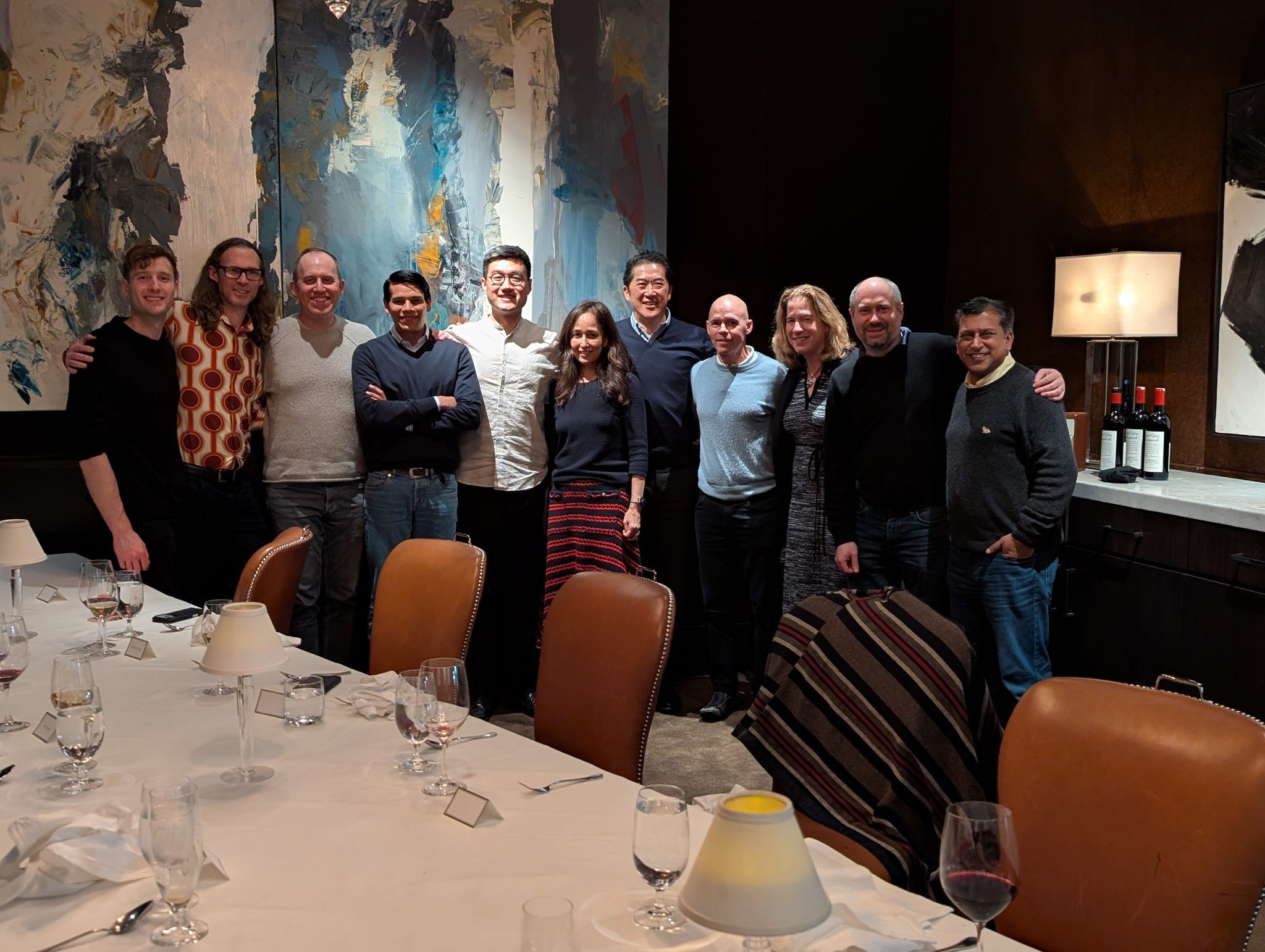
The evening opened with a deliberately extreme question — call it the Jeffersonian provocation: Is this SaaS Armageddon?
Not a polite question. Not a warm-up. A detonator. The host wanted people’s unfiltered take on the software market: Was the disruption a temporary blip? Could SaaS companies capture new value further up the stack? Which companies were undervalued, which were terminal, and which doomsday scenarios were real versus theatrical?
What followed was one of the more rigorous evenings we’ve had — eleven people around a table who collectively operate or invest in billions of dollars of software, and who disagreed with each other in productive and illuminating ways. The apocalyptic framing turned out to be less a forecast and more a useful provocation. By the end of the evening, “SaaS Armageddon” had been replaced by something more precise and more interesting: SaaS reallocation.
Software is not going away. But the economics of software — where value is created, where it is captured, and who captures it — are being fundamentally repriced. The dinner mapped that repricing across five intersecting themes: the migration of software up the value stack from tools to outcomes; the expansion of the software TAM into labor markets; the durability of systems of record; the collapse of the UI as a strategic moat; and the enduring primacy of distribution and trust in enterprise buying.
This report synthesizes those themes, preserving the friction and specificity of the actual conversation.
The host opened with a taxonomy of doomsday scenarios, not because he believed them, but because precision matters. “Software is going away” is too vague to be useful. The actual claims worth examining are more specific:
Seat-based expansion economics collapse as headcount shrinks
Workflow tools get commoditized when agents can execute work directly
Contract duration compresses from five years to one, destroying revenue visibility
UI differentiation disappears as interaction becomes prompt- and agent-mediated
Incumbents face replatforming risk if switching costs collapse
Each of these is a distinct mechanism with distinct evidence. The evening kept returning to them — sometimes explicitly, sometimes sideways.
The early consensus was that the last twenty years of SaaS were defined by a specific configuration: package workflows into navigable interfaces, monetize via seats, scale via long-term commitments, iterate incrementally on features. AI doesn’t destroy that configuration overnight. But it does put each element of it under pressure simultaneously. That’s what makes this moment unusual. It’s not one disruption. It’s five at once.
One framing early in the evening captured it well: the “SaaS-pocalypse” is not a claim that software demand evaporates. It’s a claim that the old foundations of value capture may no longer hold. The question isn’t whether software survives. It’s which software, under what economic model, with which moats intact.
When the host asked for specific undervalued names, the first answer came fast and with conviction: ServiceNow.
The reasoning was not about product roadmap or AI integration. It was simpler and more durable: anyone who implements ServiceNow is going to defend it until they retire.
That single sentence generated more discussion than almost anything else in the first hour. It’s not a compliment to ServiceNow’s product design. It’s a statement about organizational inertia. People who implement enterprise software don’t just use it — they become professionally identified with it. Their reputation is bound up in the decision. Their career is a partial defense of that purchase. Switching doesn’t just mean new software. It means implicitly admitting the old decision was wrong.
This dynamic — call it the implementer’s dilemma — was treated as a genuine and underappreciated moat. Not a technical moat. Not a network effect. A political and psychological one.
Salesforce was also named as undervalued, though the reasoning differed. Salesforce’s moat isn’t just the CRM. It’s the ecosystem: the thousands of ISVs, the AppExchange, the certified administrators, the consulting industry built around it, the entire economy that exists because Salesforce exists. Ecosystems are stickier than products. Products can be replaced. Ecosystems require a coordinated migration of an entire supply chain. And humans need to buy from humans means sales roles will be among the last to be fully automated.
One additional lens on Salesforce that emerged later in the evening: the distribution argument. First-time entrepreneurs focus on funding. Second-time founders focus on product. Third-time founders focus on distribution. Salesforce has the best distribution in enterprise software. That means they can push new products — including AI agents — into existing relationships faster than any startup can penetrate those accounts from the outside. As headcount falls and margins improve, Salesforce could become a distribution engine rather than a product company. That reframe is worth sitting with.
One of the sharpest empirical contributions of the evening came from a participant who described a hedge fund strategy built entirely around one insight: short any company doing an ERP migration.
The logic: most companies doing ERP migrations are doing so because their current system’s license has expired or the software is no longer supported. They are not migrating from a position of strength. They’re migrating because they have no choice. And migrations are brutal — operationally, politically, financially. The correlation between “company announcing ERP migration” and “stock price falling” is strong enough to build a fund around.
This is not an edge case. It applies to SAP migrations, Oracle migrations, and the long tail of legacy ERP systems that still run vast portions of global industry. The mainframe is not dead. IBM still does roughly $10 billion in mainframe revenue. Amazon has an entire internal line of business dedicated to helping clients migrate from mainframe to cloud — and still the mainframe persists.
What does this tell us about the SaaS disruption thesis? It suggests that switching costs are not primarily a technical problem. They are an organizational one. The cost of migrating is not just rewriting code. It’s retraining people, re-establishing processes, absorbing operational risk, navigating internal politics, and managing the career implications for everyone who championed the old system.
AI may eventually reduce the technical component of that cost — schema translation, code generation, integration layer creation. But it does almost nothing, at least today, to reduce the organizational component. That asymmetry is important. Systems of record are not defended by their code. They are defended by the human systems built around them.
The unresolved question — and the hinge point of the entire evening — is whether AI will eventually reduce switching costs enough to make replatforming waves realistic. The honest answer: for some workflows, yes, soon. For core systems of record, probably not for a long time.
The most consequential idea of the evening, and the one that kept resurfacing in different forms, was this: AI enables software to climb the value chain.
For most of SaaS history, software lived at the tool layer. It supported humans who did work. It made them faster or more organized, but it did not complete the task. When a sales team needed to prospect, qualify, outreach, and follow up — software helped them do those things. It didn’t do them.
Agents change that. When software begins to execute tasks end-to-end — prospecting, drafting, filing, routing, reconciling, scheduling — it stops being a tool and becomes a worker. And that changes what it can charge.
The example that crystallized this: as Salesforce begins offering SDR and BDR agents, companies need fewer SDR and BDR people. Software isn’t just competing with other software anymore. It’s competing with payroll. And payroll is a much larger market than the IT budget.
This is the TAM expansion thesis, and it’s not theoretical. The ROI calculation is becoming straightforward in category after category: the cost of software that performs a function versus the fully loaded cost of the people who used to perform it. Even partial replacement — slower headcount growth, reduced contractor spend, higher throughput per employee — shifts dollars from payroll to software.
The pricing implication is significant. If software delivers outcomes rather than access, consumption-based pricing becomes natural. You’re not buying a seat. You’re buying a unit of work. That’s a structural change in how software is monetized — and it creates pressure on every company still selling seats to functions that agents can now perform.
One participant put it plainly: some SaaS companies may have a terminal value of zero. Not because their software is bad, but because they have no system of record to defend and no interesting data strategy. If you’re a workflow tool with no moat below the interface, you’re in trouble.
One of the clearest areas of consensus — unexpected given the sophistication of the group — was that enterprise software buying remains fundamentally a human activity, and will for the foreseeable future.
The argument was made through the lens of how sales actually happens. One participant described receiving outreach from Oracle’s sales team the moment they heard he was buying Nvidia chips — Red Bull F1 tickets included. Enterprise software is not bought through rational evaluation processes. It’s bought through relationships, through champions, through risk management, and through the deeply human need to have someone to call when things go wrong.
Three mechanisms were articulated for why this persists:
Risk symmetry. When a human salesperson sells you software and it fails, there’s someone accountable. They have skin in the game. Their career, their commission, their relationship are all on the line. When an AI sells you software and it fails, accountability is diffuse. Institutions need someone to blame. Someone to escalate to. Someone whose neck they can wring.
Social acuity. Enterprise buying involves aligning multiple stakeholders across functions and seniority levels. That requires reading rooms, managing politics, building coalitions. AI is not yet equipped to navigate those human dynamics.
Relational security. Long-term relationships between enterprise buyers and sellers are repositories of trust and institutional knowledge. They’re slow to build and valuable to preserve. That dynamic doesn’t go away because the software got smarter.
The practical implication: CRM is not going away. The argument was made that salespeople follow a consistent evolutionary path — deals start in their head, move to a whiteboard, then to a spreadsheet, and eventually you need a system. As long as humans are selling to humans, that system has value. Salesforce is a bet on the durability of the human sales process, not just the durability of its technology.
The counterpoint was implicit: as agents improve and as buyer behavior evolves, these dynamics may shift. But the timeline is longer than the disruption narrative suggests. The people buying enterprise software today were trained in a world where relationships and accountability matter. That doesn’t change with one product cycle.
The sharpest technical claim of the evening: the value of user interfaces is going to zero.
The reasoning starts with a historical observation. When Gmail launched, the question was raised internally: why do we need designers for the interface? Shouldn’t the interface design itself? It was a prescient question, asked too early. It may be the right question now.
In a world where AI agents mediate experience — where users describe intent and systems produce outputs and execute actions — the workflow is composed dynamically rather than navigated through predesigned screens. UI familiarity stops being a moat. The friction of learning a new interface disappears. Software whose differentiation is primarily visual design and workflow packaging loses its advantage.
Adobe was named as a short for this reason. Consumer creative software built around interface mastery is vulnerable when generation models can produce outputs directly and when agents can operate existing interfaces on behalf of users. Atlassian was also mentioned as a short — workflow management tools whose primary value is structured interfaces for coordination are in a structurally difficult position as coordination itself becomes agent-mediated.
If the interface moat weakens, durable value migrates to:
Data ownership and governance
System-of-record authority
Permissions, compliance, and security
Orchestration and action-taking capability
Figma is an interesting case study here. It was named as both potentially vulnerable (if vibe coding and AI prototyping reduce the need for structured design) and potentially durable (as a work platform — a place where teams actually collaborate, where the social and coordination layer matters as much as the design layer). The resolution: Figma’s value isn’t the interface. It’s the collaborative surface. That’s different.
The labor analogy offered to close this thread: at one point in history, 98% of the workforce worked in agriculture. Today it’s 2%. The transition didn’t happen overnight, and it didn’t destroy economic value — it redirected it. Technology may follow a similar arc. Vast numbers of people work in technology today. In the future, far fewer may. Technology becomes a tool you use, not an industry you work in. The software companies that survive are the ones that become infrastructure, not the ones that remain destinations.
One of the most practically actionable ideas of the evening was an investment thesis that combines the collapse of coding costs with the durability of distribution.
The playbook: identify industries where old-school companies have deep customer relationships but terrible software. Buy them. Rewrite the software with AI. Keep the relationships. Extract pricing power from sticky users who have no better alternative.
Bending Spoons was cited as the clearest current example — a company that has systematically acquired legacy consumer brands like Evernote and Eventbrite, centralized development, raised prices, and harvested the loyalty of the users who stayed. The users who churn were never going to pay more anyway. The users who stay are deeply embedded. The math works.
The broader opportunity: private equity software roll-ups built on seat-growth assumptions are broken. But a different kind of roll-up — focused on acquiring distribution and operational relationships, then upgrading the underlying software with AI — may be more interesting than ever. The cost of the “rewrite the software” step has fallen dramatically. The value of the “own the customer relationship” step has not.
This also applies to vertical software in industries like hospitality, real estate, healthcare, and professional services — places where the software is historically weak but relationships are strong, and where no AI-native competitor has yet achieved distribution. The opportunity is to buy access, not technology.
The most sobering contribution of the evening came through a discussion of organizational culture — not as a values exercise, but as a hard constraint on how fast companies can change.
One participant shared a turnaround story: when he took over a struggling company, he was advised by experienced VCs to fire all his good people first and start with a clean slate. His instinct resisted. But in hindsight, they were probably right. He fired half the company. The lesson: it is faster to bring in new people than to change how existing people think and behave.
AI forces paradigm change. And organizations rarely discard paradigms that made them successful. The software companies most at risk are not the ones whose technology is weakest. They’re the ones whose culture is most dependent on the old model — companies where the entire revenue motion, incentive structure, and identity are built around seat-based growth. Those companies may not die quickly. They’ll die slowly, as their economics are repriced and their customers gradually migrate.
Culture, in this framing, is not a mission statement. It’s a set of rituals. The companies that adapt fastest are the ones whose rituals are built for change — where shipping products that cannibalize old revenue is normalized, where reorganization is frequent, where new tooling adoption is expected. The companies that fail are the ones whose rituals were built to defend what they have.
Several companies were named as having genuinely distinct cultures worth defending: Gusto, HubSpot, Shopify. The common thread isn’t any particular set of values. It’s that the culture is actually practiced, not performed — that it shapes how decisions get made, how people are evaluated, and what behaviors get rewarded.
Shopify was specifically flagged as a long: a system of record with leadership that has consistently demonstrated willingness to embrace change, a platform with real network effects between buyers and sellers that have yet to be fully realized, and a culture that talks about culture and actually means it.
Running through much of the evening was a macro claim that deserves to be stated plainly: the optimal company size is about to fall dramatically.
The reasoning: management exists because coordinating humans is expensive and doesn’t scale linearly. More people creates more communication paths, more incentive misalignment, more process overhead. Agents reduce the need for large human teams. A small team with strong AI leverage can execute what previously required hundreds of people.
One participant estimated the future “natural” company size at 100 to 150 people. Not a startup. Not a Fortune 500. Something in between, operating with the leverage of a much larger organization.
The counter-observation was sharp: managing people is genuinely hard in ways that don’t simply disappear with AI. If you gave someone 10,000 people to build a bridge, they wouldn’t suddenly become incredibly powerful. Managing complexity is a skill, and that skill doesn’t go away — it may simply be applied to smaller teams doing more with better tools.
The software implication: entire categories of software exist to coordinate large organizations. As organizations shrink, some of that category demand changes. Workday was named as a bear — built for large enterprises managing large workforces, in a world where both may be smaller. The bear case is not that Workday fails. It’s that its total addressable market gradually compresses.
A theme that emerged late but landed hard: AI capability is advancing faster than organizations can absorb it.
Several data points were offered. A significant mathematical conjecture has been solved by AI. A physics paper with novel insights has been attributed primarily to AI. OpenAI reports that AI is now contributing roughly 80% of the code to its own systems. The engineers reviewing that code increasingly don’t fully understand what they’re reading.
And yet: enterprise AI deployment remains predominantly document extraction and summarization. Agent workflows are still described internally at many companies as “toy experiments.” The implementation gap between what AI can do and what companies are actually deploying is enormous.
This supports a view that disruption is large but slow. The bottleneck is not the technology. It’s the organizational capacity to absorb it — leadership bandwidth, change management, risk tolerance, talent availability, and the sheer difficulty of integrating new paradigms into legacy systems and legacy cultures.
The talent constraint is real. The companies that can move fastest are not necessarily the ones with the best AI access. They’re the ones with the people who can lead the transition — who can identify what to rip out, what to keep, and how to migrate without destroying the institutional knowledge embedded in existing systems.
One participant offered a useful frame on talent: if you were a 10x engineer before, there are now 100x engineers. If you were average, you’re now a 10x engineer. The ceiling has risen dramatically. But the floor has also risen — which means the gap between the people who can lead AI transformation and the organizations that need it has widened, not narrowed.
The macro investment lens that recurred throughout the evening: atoms over bits.
The core claim: software was valuable partly because it was scarce. Engineering talent was scarce. Technical know-how was scarce. Software production capacity was scarce. If AI makes software abundant — if generating code becomes as easy as generating text — then the scarcity migrates.
Where does it go? Toward what software cannot easily replicate: physical infrastructure, logistics, hardware, regulated environments, real-world constraints. Defense. Satellites. Energy. Manufacturing.
Several participants expressed positions in this direction: long on defense companies, long on satellite companies, long on atoms-adjacent infrastructure businesses. The implicit argument is that the next decade rewards businesses with physical leverage that AI cannot simply generate.
Apple was named as a long for exactly this reason — the combination of hardware, taste, and ecosystem that creates scarcity at the intersection of atoms and bits. AppLovin was cited as a company whose leadership has been ruthless about concentrating on what actually creates value, shedding what doesn’t.
A secondary scarcity argument: taste. When generation is abundant, curation and judgment become the scarce resource. This is why product quality keeps mattering in ways that pure distribution might not predict. Google Shopping exists and nobody uses it, despite Google’s distribution dominance. Product quality is not sufficient — but its absence is disqualifying, even with perfect distribution.
By the end of the evening, the apocalypse framing had been quietly set aside. Not because the disruption isn’t real — the table believed it was, and believes the magnitude is large — but because “Armageddon” implies software demand evaporating. That’s not what’s happening.
What’s happening is a reallocation:
From seats to outcomes
From UI to infrastructure
From IT budgets to payroll budgets
From feature moats to distribution, trust, and governance
From large organizations to smaller, flatter ones operating with AI leverage
In some cases, from pure bits toward atoms-integrated leverage
Software’s future is not to sell more tools. It is to do more work. The disruption isn’t that software becomes less important. It’s that software becomes the operating substrate — absorbing value that used to flow to human labor, managerial coordination, and professional services.
The companies that win will do three things simultaneously: ship agents that credibly deliver outcomes; price against payroll and assume accountability for results; and adapt culturally fast enough to cannibalize their own past.
That last requirement is the hardest. The technology is not the bottleneck. The culture is.
Which is why the most durable insight of the evening was also the simplest: the implementers will defend their implementations. The ecosystems will outlast the products. Distribution will beat feature sets. And the companies that can eat their own lunch will be the ones who don’t starve.
That’s not Armageddon. That’s a reshuffling — and an unusually interesting one to watch.
Compiled from positions shared during the evening. All views are those of individual participants, not the group collectively. Chatham House Rule applies.
Salesforce — A system of record with the best distribution in enterprise software and a vast ecosystem of ISVs, admins, and partners that is stickier than any individual product. As headcount falls and AI reduces internal costs, Salesforce’s margins may improve while its distribution advantage compounds. CRM remains durable as long as humans buy from humans.
ServiceNow (contested) — The implementer’s dilemma makes ServiceNow nearly impossible to displace — the people who deployed it are professionally and reputationally bound to defend it. Counterpoint: if enterprise headcount shrinks significantly, IT ticket volume and workflow demand may compress with it.
Shopify — A system of record for commerce with genuine network effects between buyers and sellers that remain underexploited, led by a culture that has consistently demonstrated willingness to embrace change. Small-team, AI-leveraged commerce aligns naturally with its architecture.
Apple — The clearest embodiment of the atoms-over-bits thesis — hardware, taste, and ecosystem combined in a way that creates scarcity AI cannot replicate. The intersection of physical and digital leverage makes Apple relatively insulated from software commoditization.
AppLovin — Leadership that has been ruthless about concentrating value and shedding what doesn’t matter, including aggressive headcount reduction. A case study in the operator playbook working as intended.
Amazon (lean) — Viewed primarily as an atoms, logistics, and infrastructure play rather than pure software. Strong leverage in physical systems; some uncertainty about long-term software positioning.
Defense companies — Physical infrastructure with regulatory moats and sovereign demand is exactly the kind of scarcity that appreciates as software becomes abundant. AI cannot generate a weapons system or a cleared facility.
Satellite companies — Real-world physical constraints create durable competitive position that software commoditization cannot erode. Infrastructure scarcity and capital intensity are the moat.
Figma (lean, contested) — Valued as a collaborative work platform rather than a design tool — the social and coordination layer matters as much as the interface. Risk: AI-native prototyping could commoditize design workflows. Strength: Figma stays relevant if it remains where teams actually do things together.
Broadcom — Strong desire to own the underlying chip leverage; more ambivalence about the operating company itself. Hardware scarcity is real; corporate leadership risk was noted.
Workday — Built for large enterprises managing large workforces, in a world where both may shrink. The TAM compresses as organizations flatten and headcount falls. Not a product failure — a market structure problem.
Adobe — Consumer creative software built around interface mastery is structurally vulnerable when generation models produce outputs directly and agents operate interfaces on behalf of users. The UI moat is eroding faster than the product roadmap suggests.
Atlassian — Workflow coordination tools whose primary value is structured interfaces are in a difficult position as coordination becomes agent-mediated. Without a strong system-of-record layer beneath the interface, the moat is thin.
Asana — Lost its founder, lost its core talent, and faces user churn driven by the fact that loyalty is to the person, not the platform — when employees change companies, Asana doesn’t always follow. No system-of-record gravity to compensate.
Unity — Execution concerns and vulnerability to platform shifts in game development tooling. Less structural moat relative to AI-native creation tools entering the space.
UiPath / RPA category — Robotic process automation exists to automate what humans do manually in software. As AI agents perform those tasks natively and flexibly, the RPA abstraction layer becomes redundant. The category’s core premise is undermined.
Bitcoin — Skepticism toward the digital scarcity thesis in a world repricing toward atoms and physical infrastructure.
Coinbase — Exposed to crypto cyclicality and a digital scarcity narrative that is under structural pressure from the atoms-over-bits reallocation.
Systems of Record — Deep embed, organizational inertia, and migration friction create durable moats — conditional on switching costs remaining high.
Distribution Moats — In an AI-abundant world, distribution is scarcer than product quality. Installed base and trust beat feature superiority.
Outcome-Based Software — Agents allow software to capture labor TAM. Pricing shifts from seats to units of work delivered.
Consumption-Based Pricing — Natural monetization model for agent-delivered outcomes. Aligns cost with value; grows with usage rather than headcount.
Roll-Up + Rewrite Strategy — Acquire customer relationships in legacy verticals, rewrite software cheaply with AI, extract pricing power from sticky users who have no better alternative.
AI-Native Software Companies — Less cultural baggage, architected for an agent-first world. Higher probability of shipping outcome-based models quickly without cannibalizing existing revenue.
Small, High-Leverage Organizations — AI reduces coordination overhead. Teams of 100–150 people can operate with the output of organizations ten times their size.
Atoms Over Bits — Scarcity migrates from software creation toward physical infrastructure, logistics, defense, hardware, and regulated assets as code becomes abundant.
Trust and Relational Sales — Enterprise buying remains human-driven due to risk symmetry, social acuity, and relational security. Durable as long as institutions require accountability and escalation paths.
Seat-Based SaaS Model — Headcount compression plus contract duration compression plus the shift to outcome pricing creates simultaneous pressure on seat expansion economics.
Five-Year Contracts — Buyers shifting to one-year terms due to AI uncertainty. Revenue visibility and customer lock-in deteriorate together.
UI-Centric Moats — Agent-mediated interaction reduces the defensibility of interface-driven differentiation. The interface layer is becoming a commodity.
Large Bureaucratic Enterprises — AI efficiency reduces the need for large headcounts. Management layers that exist to coordinate people compress when agents coordinate tasks.
PE Seat-Expansion Thesis — Private equity software roll-up models built on selling more seats break structurally if the workforce they’re selling into shrinks.
Traditional RPA — Rule-based automation is replaced by more flexible AI agents that can reason and execute dynamically rather than follow predetermined scripts.
Management Bloat — Coordination overhead is less valuable in AI-leveraged organizations. The ratio of managers to output tilts sharply as agents absorb execution.
Most longs cluster around systems of record, distribution, physical-world leverage, and agent-enabled outcome capture. Most shorts cluster around seat-based monetization, UI-driven differentiation, and workforce-scaling assumptions.
The hinge question that remained unresolved: Does AI reduce switching costs enough to destabilize systems of record? If yes, incumbents face replatforming waves. If no, they have long runways to deploy agents and absorb labor economics from within their installed base. The honest answer is probably both — unevenly, by category, over a longer timeline than the disruption narrative suggests.
CEO Dinner Insights is published monthly. Chatham House Rule applies: insights shared freely, sources protected.
No posts
Comments
Nothing yet. Say the first thing.
Sign in to join the conversation.