
What reasons do young adults offer to explain their decision not to have children of their own?
This is the fourth (and final) part of our series exploring whether young adults in Canada are interested in becoming parents. Earlier, we presented findings that acknowledged the importance of financial security as a factor shaping decisions about whether to have children, while suggesting it wasn’t the sole – or even the most important – consideration. Other factors, including relationship status (especially whether or not someone is married), religiosity, feelings of well-being and optimism about the future, and engagement with the community also come into play. This, we argued, should lead us to ask whether we’re doing everything we should as a society to ensure that young people feel healthy, confident and well-supported (as well as financially secure).
Now, we have some additional findings to bring into the discussion.
You can revisit the earlier parts in this series here:
Who wants to have children? Easing into the debate on declining fertility rates
Culture and community: a second look at who wants to have children
In the 2025 YMCA-YWCA National Survey on Child Care Policy in Canada, we repeated the question about whether or not someone would personally like to have children in the future – a question asked of those between the ages of 18 and 44 who are not already parents. In this survey, 31 percent of those in this group said they definitely or probably would not have children.1
What was different about this survey is that it included a follow-up question asking why. Specifically, we asked those who said they either definitely or probably would not have children:
“What are the main reasons why you say that you wouldn’t like to have children in the future?”
Answers to questions asking people to explain why they might do certain things or feel a certain way should always be treated with a certain amount of caution. The problem isn’t that people don’t give honest answers; rather, it’s that we aren’t necessarily the best judges of our own motivations. If you asked me why I didn’t quite make it to the gym again yesterday, I’ll always tell you that it was because I was very busy. That’s the answer I’d give to a survey question, because that’s what I honestly believe (or tell myself).
Treating answers with caution is, however, not the same as ignoring them. The way we explain or rationalize our choices is still revealing, as is the way in which the reasons offered vary among people with different backgrounds (e.g., by age or gender).
With this caveat in mind, here’s a sample of the answers we received to the question. Keep in mind this was an open-ended question, which means that people answered in their own words, rather the selecting items from a list. A total of 312 people, between the ages of 18 and 44 and who said they definitively or probably would not have children, were asked to say why. Of these, 261 provided an answer.
What are the main reasons why you say that you wouldn’t like to have children in the future? (Selected verbatim responses)
A child in our economy right now would not have a bright future.
Because it’s a lifetime responsibility and I’m not ready for it yet.
Ça ne m’intéresse pas de prendre soins d’une autre personne.
Can’t afford a child.
Children are a huge responsibility and expensive.
Climate change alone is enough reason for me to decide against having children.
Cost of raising children.
Coûte très cher et la planète est déjà surpeuplée.
Doesn’t fit with the type of freedom I want for my life.
Financial situation, unable to meet our own expenses without adding additional costs.
I am already 44. I am getting a bit too old to become pregnant.
I am physically unable to have children.
I do not want to raise children alone / unpartnered.
I don’t really like kids.
J’ai jamais eu envie d’être mère.
Je ne serais pas un bon père.
Le coût de la vie rend ceci irréaliste pour ma génération.
Le futur me fait peur.
Not enough money.
Not finding the right partner.
The cost of raising children is far above what I can pay.
The future is grim.
The rising cost of living and expenses.
The world is not a good place.
Too expensive.
Too much work.
You can see from parents all the time. Children are very stressful.
In these responses, we can see a mix of reasons, including the cost of having children, concerns about the environment or the future, lack of interest, relationship status and health issues.
To see which types of reason were mentioned most frequently, we grouped them into the following categories.
What are the main reasons why you say that you wouldn’t like to have children in the future? Most frequently mentioned types of reason (unweighted)
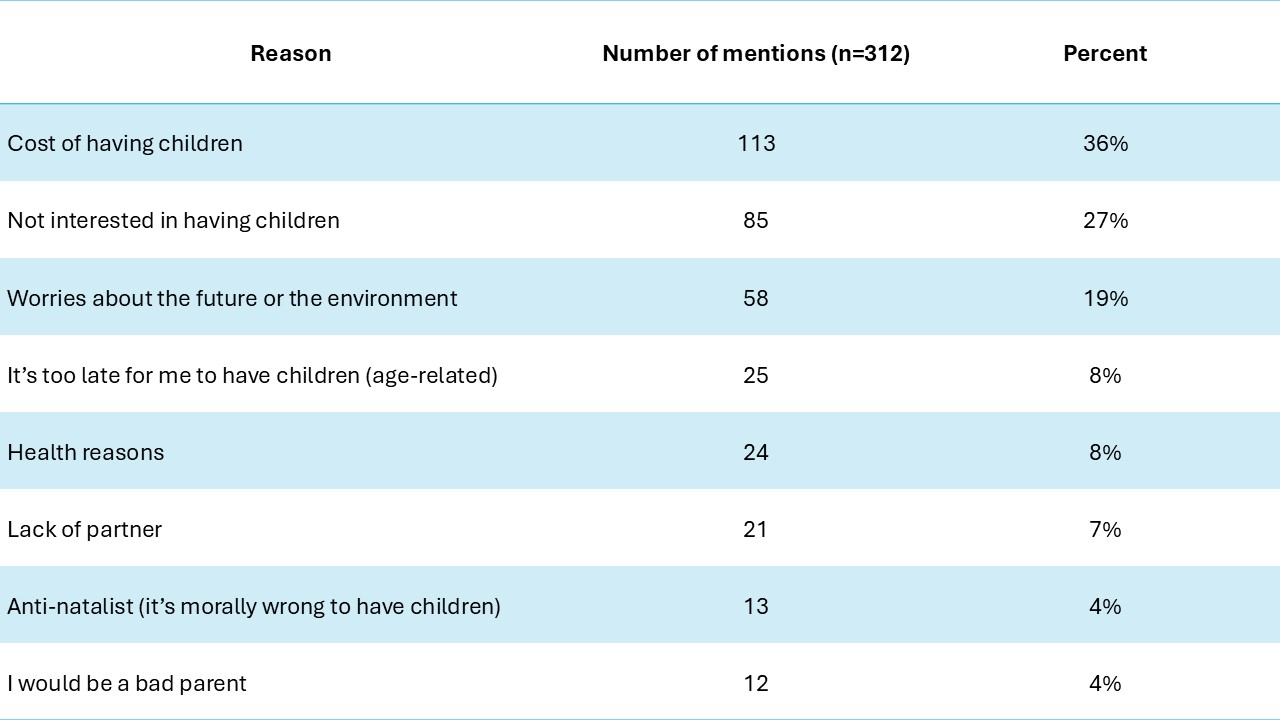
Cost issues stand out as the most frequently mentioned reason. At the same time, a majority mention a reason other than the cost of having children, including lack of interest and concerns about the future of the planet.
We then looked more closely at how mentions of these reasons vary across the population. Certainly, those who feel better about the economy (saying the Canadian economy is getting stronger) are less likely to cite cost as the reason for not having children. Economic optimism matters. What is less important, however, is household income. Compared to those who are more satisfied with their incomes, those who describe their incomes as being “not enough” for them are not much more likely to see cost as an obstacle to having children. And further testing shows that the level of household income itself is not a strong predictor of whether someone mentions cost as the reason for not wanting to have children (the likelihood of mentioning this reason differs very little among those with low, medium and high incomes).
Some other variations – including several relating to age – are less surprising. The likelihood of citing age (i.e. it’s too late to have children) as a factor jumps up among those in the oldest age group (age 40 to 44); it’s also a bit higher among women, compared to men. Those age 40 and older are also more likely to mention not having a partner as a reason for not expecting to have children. Health-related reasons are mentioned more frequently by those age 35 and older.
Lack of interest in having children, and worry about bringing children into a world facing a bleak future, also increase with age. More specifically, worry about the future is more likely to be mentioned by those age 30 and older, compared to those in their 20s. This is noteworthy mostly as a check on any assumption that concerns about climate change or global justice are always highest among youth.
The relationship between age and cost is less clear (there’s no single clear pattern): the likelihood of mentioning cost as the reason for not wanting to have children is higher among those in their early 40s (but not those in their 30s) and lower among those in their late 20s (but not those in their early 20s).
In the end, the survey results are a stark reminder of all the things that start to happen as people age into adulthood. The window of time in which to have children, or find a suitable partner to co-parent with, shrinks. Health issues creep in. And demands on your income increase (including the cost of housing) – so, you can feel more stretched even as your career advances and you start to earn more.
What relevance do these findings have for the wider public discussion currently unfolding about declining fertility rates (for two recent examples, see here and here in English and here in French)?
Our research, based on in-depth analyses of results from three different surveys, continues to point to the importance of taking as wide a view as possible. Yes, cost (or opportunity cost – the need to choose between spending on some things and not others) is a factor in explaining why some decide not to have children, but it’s far from the only one. Yes, some people are worried about the state of the world (and widening conflict in the Middle East, with news images of oil tankers and refineries on fire is hardly going to help). But the long-term trend toward waiting longer to get married (or to not get married) or finding a partner matters a lot as well. And, yes, the extent to which people feel connected to and supported by the wider community shouldn’t be overlooked.
The data in this post are from the YMCA-YWCA National Survey on Child Care Policy in Canada, conducted by the Environics Institute for Survey Research in partnership with YMCA Canada and YWCA Canada. The survey was conducted online between January 28 and February 19, 2025 with a sample of 4,004 adult Canadians. The unweighted sample included an over-representation of adults under age 45, as well as residents of smaller provinces. Survey results reported here are weighted by age, gender, region and education so as to be representative of the Canadian adult population. Complete survey results are available on the Environics Institute website. The authors would like to thank YMCA Canada for making this data available to them for this analysis. The authors remain solely responsible for the results and interpretation presented here.
What is the Environics Institute for Survey Research? Find out by clicking here.
Follow us on other platforms:
Bluesky: @parkinac.bsky.social or @environicsinst.bsky.social
Twitter: @Environics_Inst or @parkinac
Instagram and Threads: environics.institute
Cover photo credit: Thomas Ward
This represents 14 percent of all those in this age group (including both those who do and do not already have children).
Comments
Nothing yet. Say the first thing.
Sign in to join the conversation.