
This is our first Substack based on results from the 2026 Confederation of Tomorrow Survey of Canadians – the most comprehensive recurring study of how we see ourselves and our country. A big thank you to the survey partners: the Centre of Excellence on the Canadian Federation; the School of Public Policy at the University of Calgary; le Centre D’Analyse Politique – Constitution et Fédéralisme; the Brian Mulroney Institute of Government; the First Nations Financial Management Board; and the Environics Institute for Survey Research. You can expect a lot more material to come from this survey in the following weeks and months.
Canadians have often been divided over just how to manage particular issues that arise in our relationship with the United States. The most familiar modern example is the debate over free trade. In the run-up to the 1988 election, as many Canadians were in favour as were opposed to the newly negotiated agreement. Earlier in the 1980s, while the weight of public opinion leaned against allowing the Americans to test their cruise missiles in Canada, a sizeable minority thought we should. There was no consensus.
What we did agree on, however, was that the relationship itself was important. We could disagree with the American government on particular issues, but this didn’t mean we shouldn’t remain close friends and allies. Canadians didn’t expect their government to acquiesce to every American policy, but they did expect it to find a way to get along with whoever had been chosen to occupy the White House.
In fact, in a series of Environics Focus Canada surveys conducted from the late 1970s to the late 1980s, the total proportion of Canadians who said it’s not very or not at all important to maintain good relations with the United States never surpassed four percent. At least seven in ten said maintaining good relations is very important. The balance said it’s somewhat important – meaning that the combined total saying it’s either very or somewhat important for Canada to maintain good relations with the United States was typically at least 95 percent. In other words, almost everyone.
You’ll never guess what happened next.
Actually, the first thing that happened next was that the question was dropped. Space on survey questionnaires is always at a premium. Generally, once you establish that the vast majority of people agree about something, there’s no point in continuing to ask. It’s time to move on to ask about something more controversial.
But times have changed – and so, in 2026, we thought it was once again worth asking:
In your opinion, is it very important, somewhat important, not very important, or not at all important for Canada to maintain good relations with the United States?
Today, 29 percent Canadians say it’s very important to maintain good relations with the U.S. – a 40 percentage-point drop from the last time the question was asked in 1987 (and 58 points lower than the peak reached in 1983).
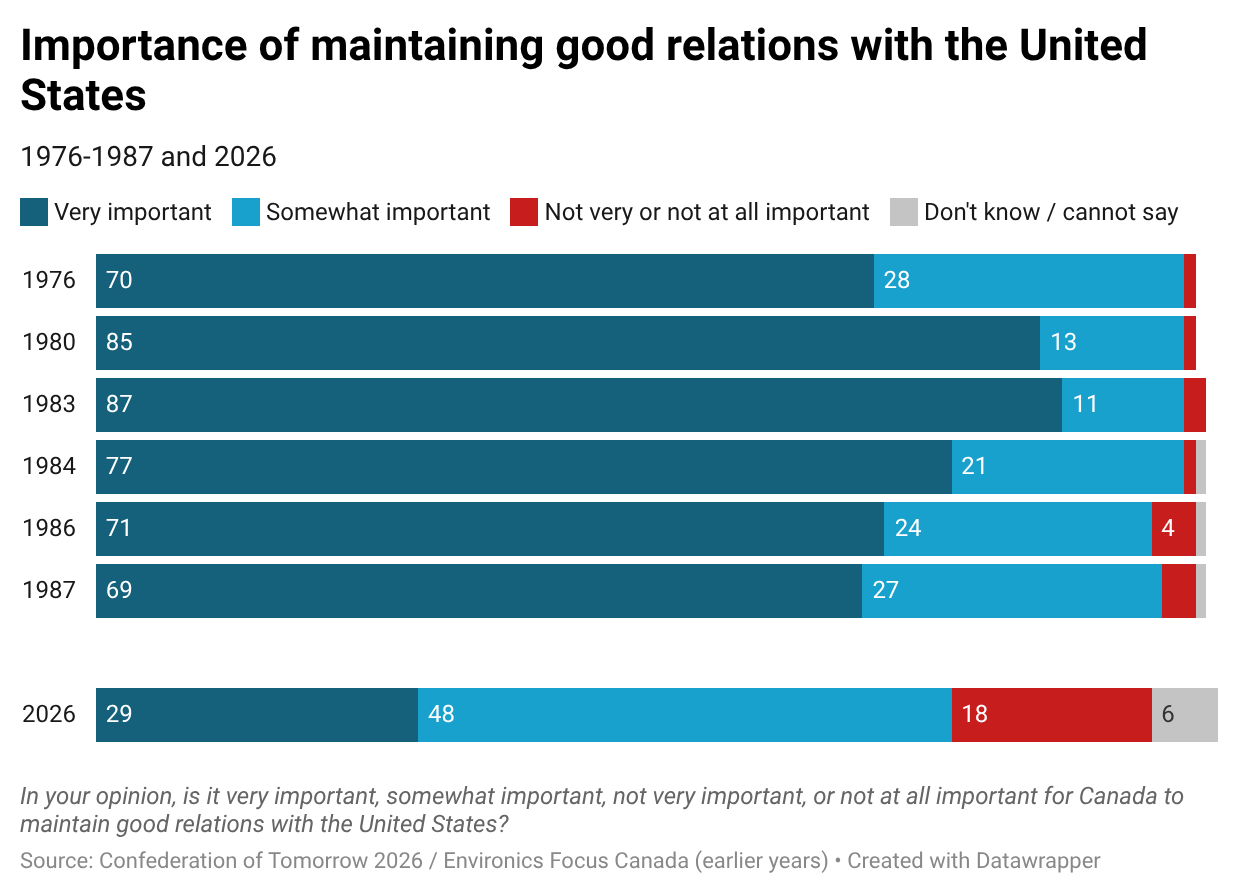
The big shift in responses is from “very important” to “somewhat important”: 48 percent now say that maintaining good relations is somewhat important, which represents a large increase from the earlier surveys. This means that most Canadians still say it’s either very or somewhat important: this figure now stands at 77 percent, which is still a very healthy majority, even if lower than the 95 percent (or more) who held this view before.
But there’s now a noticeable group of Canadians who don’t think it’s important at all: 18 percent say it’s not very or not at all important to maintain good relations with the United States.
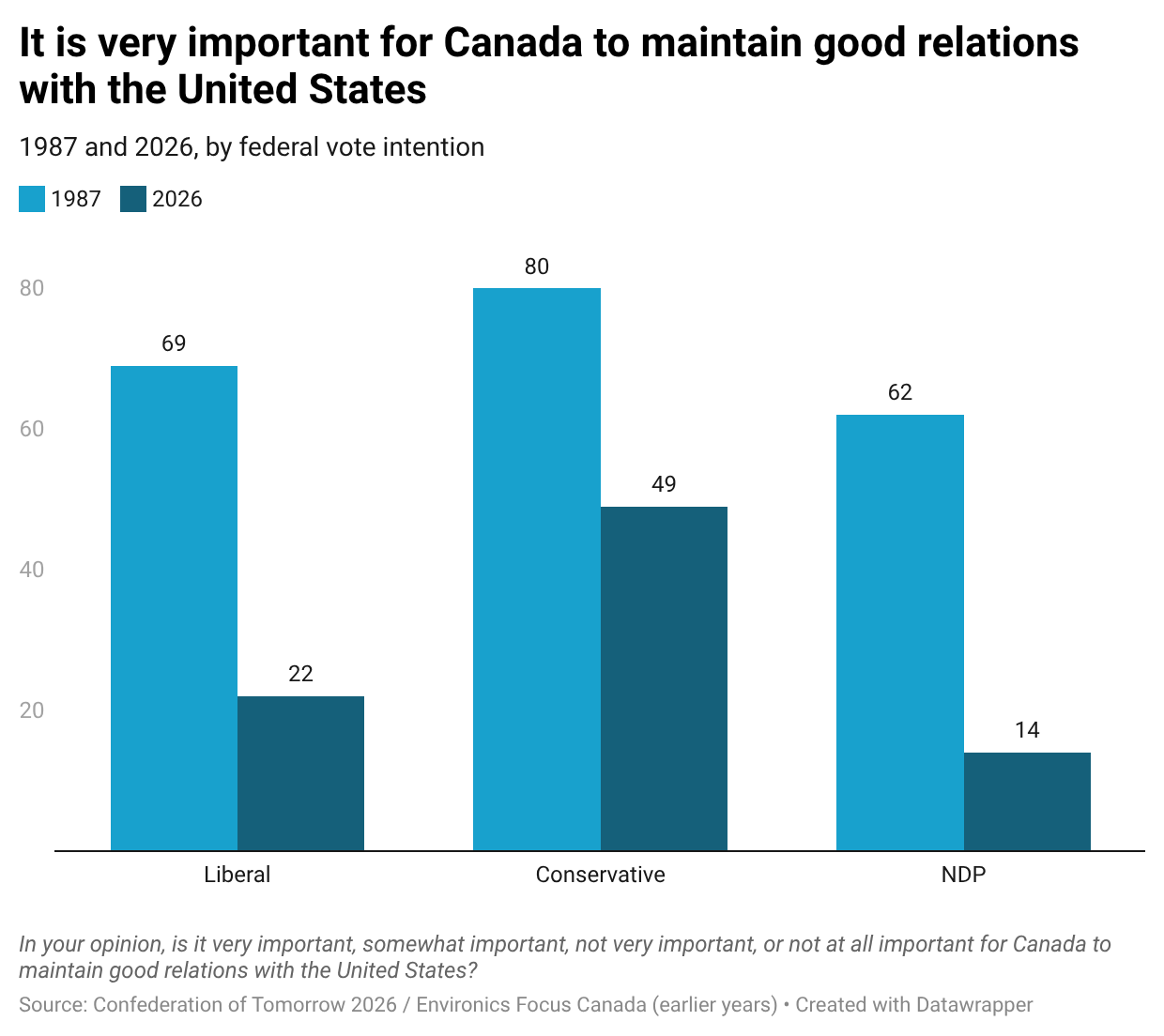
There’s a sizeable difference in opinions among supporters of the different political parties. Conservative Party supporters (49%) are twice as likely as Liberal Party supporters (22%) to say that it’s very important to maintain good relations with the United States. Only 14 percent of NDP supporters feel this way. But to focus on these differences risks missing the bigger story. What stands out for me is that this proportion has dropped significantly among supporters of all the main parties.
We revived a second question about Canada-U.S. relations – but, in this case, there’s been much less change. We asked:
In general, do you feel the current federal government is too close, too distant or about right in its relations with the United States?
This question was asked fairly regularly between 1986 and 2009. Each time, a plurality – if not a small majority – of Canadians said that relations were “about right.” The proportion feeling we were too close to the U.S. peaked in the late 1980s – in the era of Mulroney and free trade. The proportion saying we were too distant peaked in 2003, when Canada declined the invitation to join the U.S. invasion of Iraq. While those who disagreed with the Chrétien government’s decision to stay out of the war were in the minority, some no doubt shifted from feeling that our relations with our American allies were “about right” to feeling that they were “too distant.”
The pattern today is not too different. A plurality (41%) of Canadians is in the middle, saying relations are about right. Roughly equal proportions say the current federal government is too close (19%) in its relations with the United States or too distant (23%). A larger proportion is undecided today (17%), but that’s an effect of the change in survey method.1
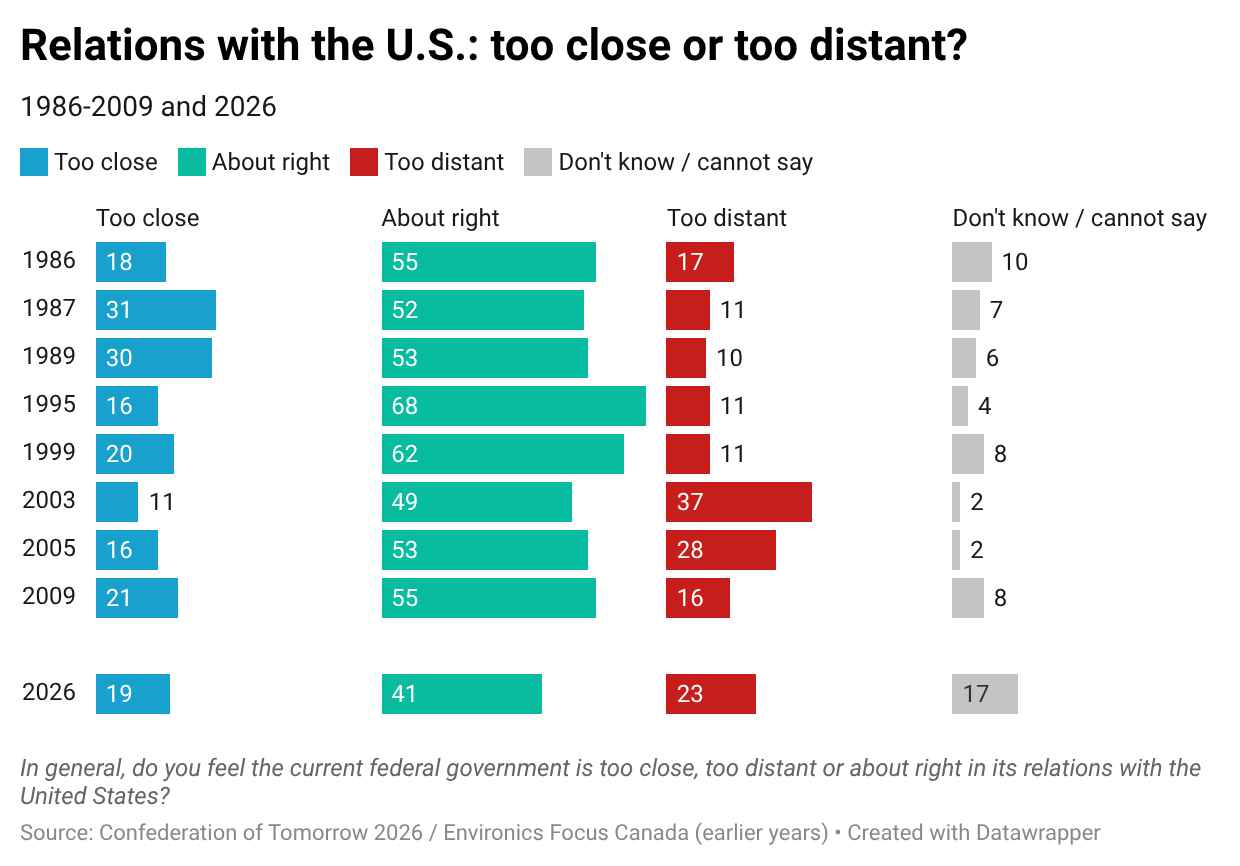
But, while the responses to the question are not too different from what they were in previous decades, the context certainly is. The question implicitly refers to how relations are at the moment. Saying that things are about right today, when elbows are up, means something quite different than saying it in the mid-1980s, when Irish eyes were smiling.
Who is more likely to say that the federal government is currently too distant in its relations with the U.S.? The proportion holding this view is a little higher than average in the Prairies (30%). It’s also much higher among those who maintain that it’s very important for Canada to maintain good relations with the U.S.: the proportion who see current relations as too distant is 47 percent among Canadians who say maintaining good relations is very important, compared to 17 percent who say it’s only somewhat important to maintain good relations.
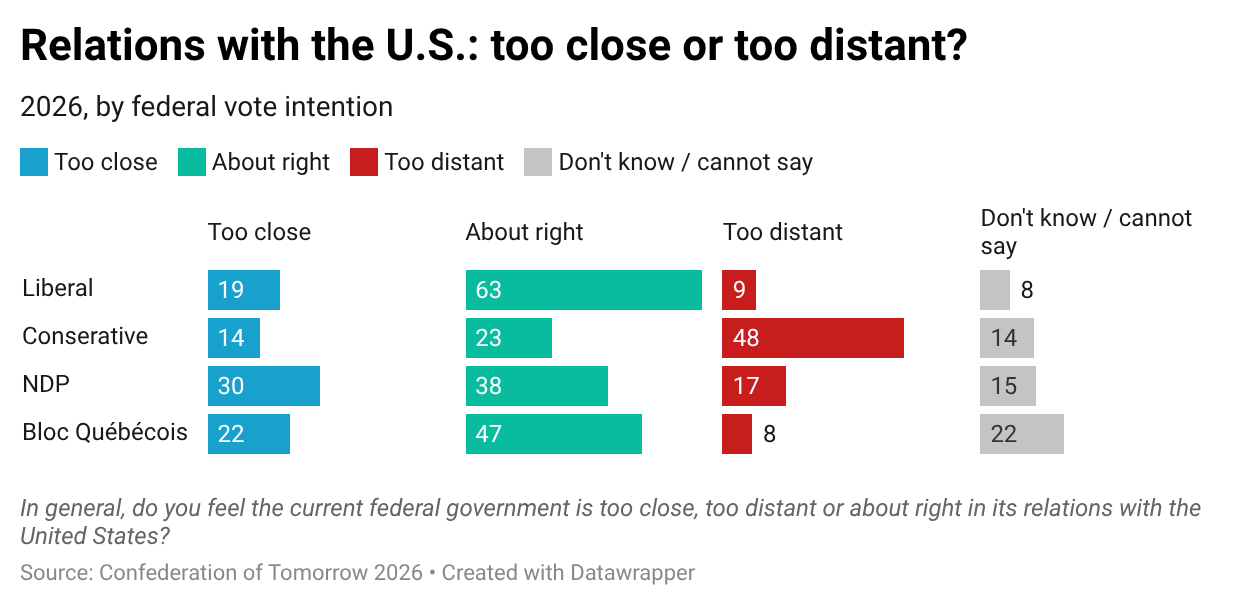
But, once again, the biggest difference is between those who support the federal Conservative Party and those who support the other main parties. One in two Conservative Party supporters (48%) say that relations are too distant, compared to 23 percent who describe relations as “about right.” By contrast, only eight percent of Bloc Québécois, nine percent of Liberal Party and 17 percent of NDP supporters think the federal government is currently too distant from the U.S.
Supporters of provincial conservative parties are also more likely to say that the current federal government is too distant in its relations with the U.S., including 55 percent who support the UCP in Alberta, 49 percent who support the B.C. Conservatives, and 36 percent who support the Progressive Conservative Party in Ontario.
See more results from this survey.
As these differences show, we’re a long way from the old era of near unanimity. There are sizeable minorities who disagree with giving the Americans the cold shoulder. Nonetheless, it would be fair for the federal government to take some encouragement from the survey results. Last year, the Prime Minister famously told Canadians that “the old relationship we had with the United States based on deepening integration of our economies and tight security and military cooperation is over.” Now, we see that Canadians’ opinions about the importance of our relationship with the U.S. have undergone a major shift, while a plurality continues to say that the current federal government’s approach is “about right.”
But maybe we won’t wait so long this time before we ask these questions again.
What is the Environics Institute for Survey Research? Find out by clicking here.
Follow us on other platforms:
Bluesky: @parkinac.bsky.social or @environicsinst.bsky.social
Twitter: @Environics_Inst or @parkinac
Instagram and Threads: environics.institute
Cover photo credit: Steven Kriemadis
The earlier surveys were conducted either in person or by telephone. This method generally results in fewer undecided responses compared with surveys conducted online, since “don’t know” option in response to a question is not initially offered by the interviewer.
Comments
Nothing yet. Say the first thing.
Sign in to join the conversation.