
Liberal democracies seek to balance the protection of individual freedoms with the maintenance of law and order. Suspected criminals can be arrested and imprisoned, but only subject to a myriad of conditions, including the presumption of innocence until proven guilty; protection from unreasonable search or seizure; the right to a fair and public trial; and the right not to be denied reasonable bail without just cause. These limits are pillars of a free society, ensuring that citizens can go about their business without fear of being locked up just because a law enforcement officer thinks they look suspicious.
The accepted balance between security and freedom can shift, however, in times of crisis. States typically allow for the temporary suspension of civil liberties under certain circumstances, such as war or insurrection, to ensure the government can retain control or restore order. In Canada, this occurred with the imposition of the War Measures Act in response to the October Crisis of 1970, and the Emergencies Act to clear out the convoy protestors in Ottawa in early 2022.
To what extent do Canadians support the suspension of civil liberties in response to a national emergency?
The decision to invoke the War Measures Act in 1970 was supported by almost 90 percent of the public, but that was in the midst of a genuine terrorist crisis and before the Charter of Rights and Freedoms was adopted in 1982. The first attempt to measure where Canadians stood after the Charter came into force appeared in the landmark Clash of Rights study, conducted in 1987.1 That survey asked:
If the cabinet says there is a national emergency, and a majority in Parliament agrees, is it all right or not to suspend the usual civil rights?
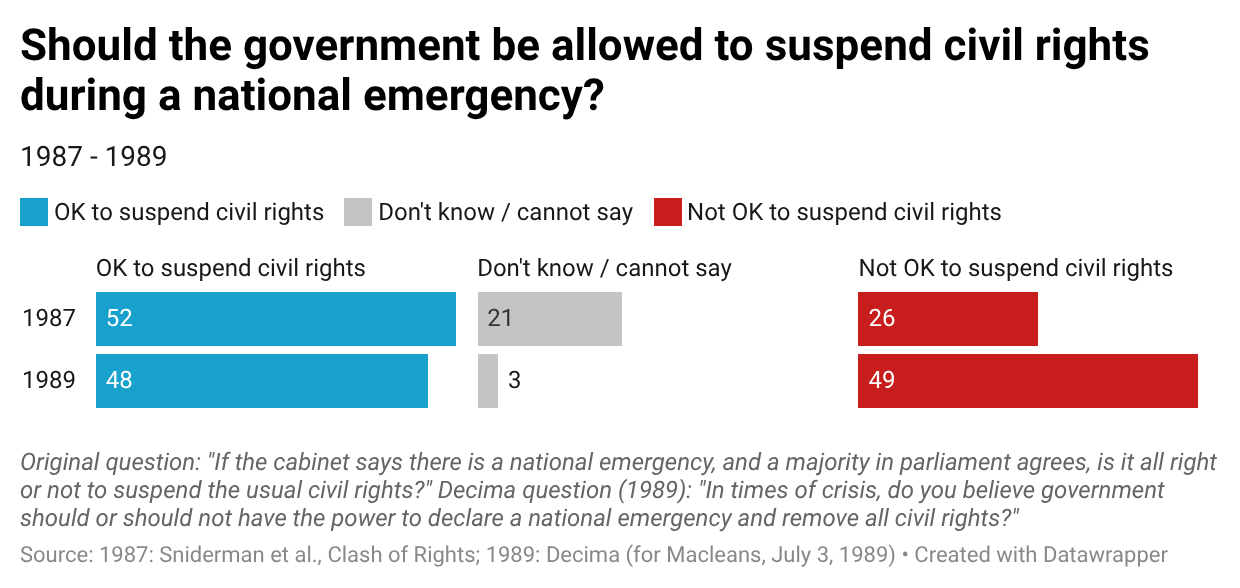
They found that one in two Canadians (52%) agreed that it’s all right to suspend civil liberties in times of national emergency, compared to only 26 percent who disagreed (an additional 21% were undecided).
Two years later, a Decima poll for Maclean’s asked a similar question, and got a similar answer (in terms of agreement): the public was evenly split, with one in two (48%) agreeing that governments should have the power to suspend civil liberties in an emergency and one in two (49%) disagreeing.2
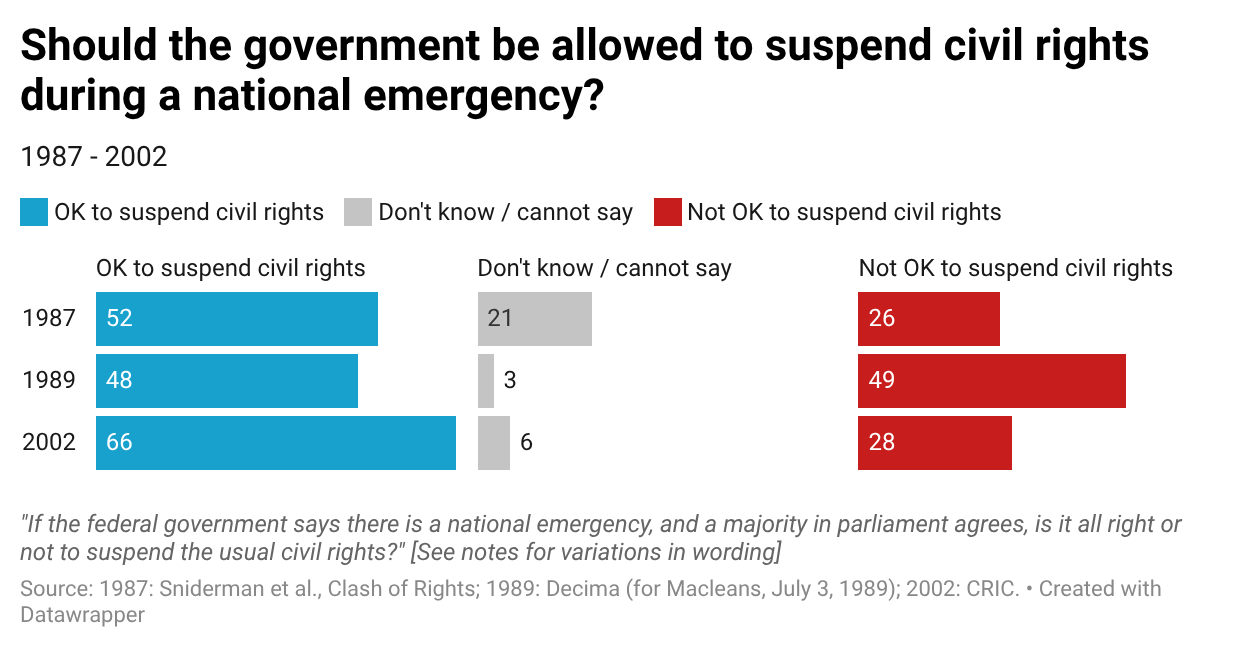
What happened next demonstrates the importance of context (events) in shaping public opinion on this issue. The question was asked again as part of the study I led on the occasion of the 20th anniversary of the Canadian Charter of Rights and Freedoms.3 But this survey, conducted in early 2002, came in the wake of the September 11, 2001 terrorist attacks in the United States. Once again, public discussion had turned to the question of whether governments had enough powers to ensure national security. Not surprisingly, in terms of public opinion, the pendulum swung away from the protection of civil liberties: two in three Canadians (66%) now agreed that it’s all right for governments to suspend civil liberties in the event of a national emergency.
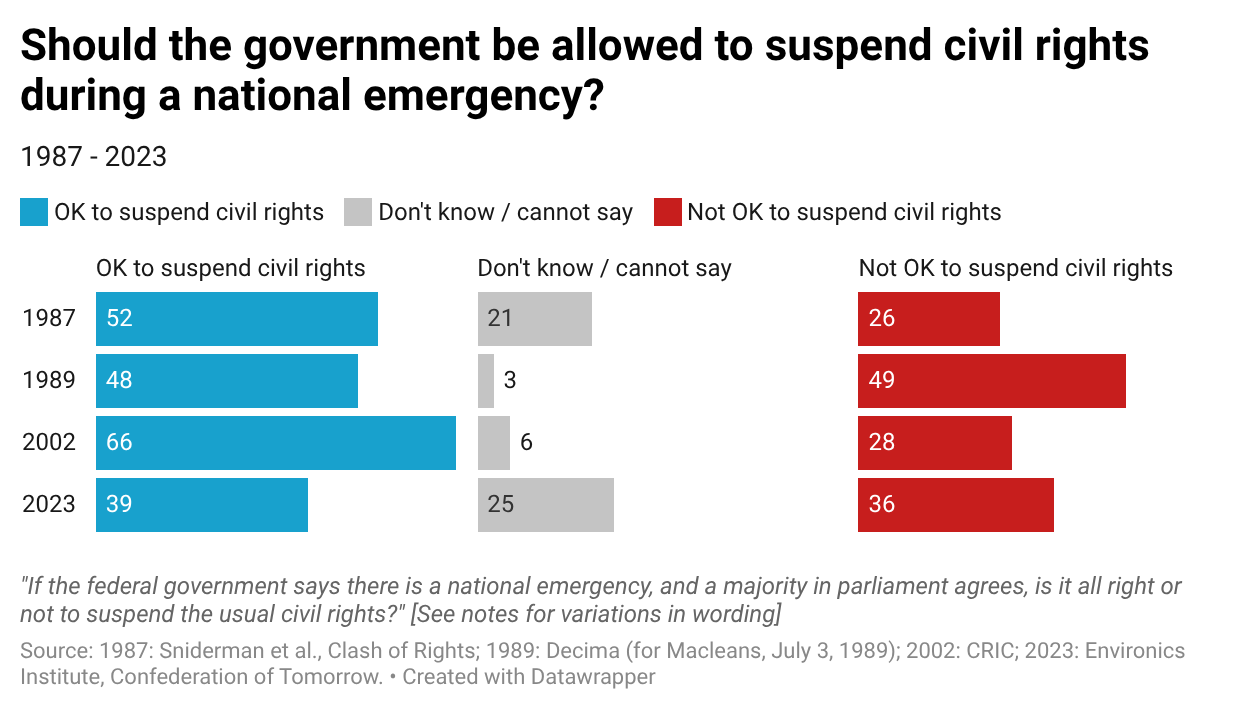
Twenty years passed before the question was asked again (as far as I know). We included it in the 2023 Confederation of Tomorrow survey – conducted a year after the government relied on the Emergencies Act to disperse the “freedom convoy” protesters. And, now, we see the pendulum swinging the other way: at that time, only 39 percent agreed with the suspension of civil liberties in response to an emergency.
The comparison across time is somewhat complicated at this point by the switch from telephone to online surveys; online surveys typically result in larger proportions of people declining to express an opinion either for or against.4 But it remains compelling that, in the immediate aftermath of the use of the Emergencies Act, the proportion of Canadians supporting the idea that governments can limit civil liberties during a crisis had fallen by 27 percentage points compared to 2002, and was 13 points lower than in 1987. (And this despite the fact that a majority of the public opposed both the aims and the methods of the protests against public health restrictions intended to limit the spread of COVID-19).
It now seems that this reset in public opinion didn’t last. We asked the question again at the end of last summer. According to the 2025 AmericasBarometer survey, the proportion of Canadians agreeing that governments should be allowed to suspend civil liberties in emergencies is back up to one in two (49%) – although just as many are now opposed (51%). Curiously, these latest results are almost exactly the same as those from the Decima-Maclean’s survey in 1989. We seem to have ended up back where we started.
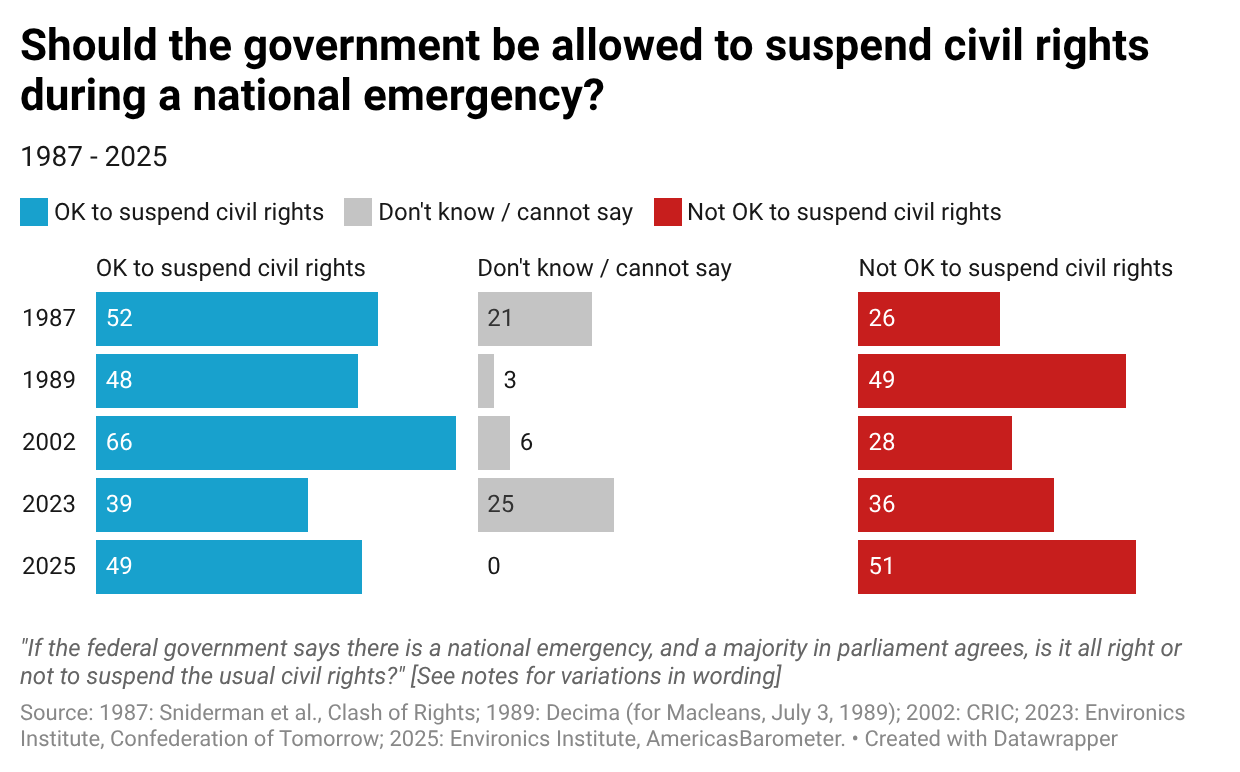
Once again, changes in survey method make the comparisons imperfect. The AmericasBarometer is conducted online, but with a technique that minimizes the number of undecided responses.5 These inconsistencies across surveys open the door to several different interpretations.
I’ve already suggested the one I favour: typically, about one in two Canadians are open to the idea that governments should be able to suspend civil liberties when a national emergency arises, but this openness can be expected to increase when events focus attention on threats from foreign terrorists (e.g., 9-11), and decrease when the threat to public order arises from disgruntled Canadians (e.g., protests against restrictions during the pandemic).
A second interpretation would point out that opposition to the suspension of civil liberties during emergencies has doubled, from 26 percent in 1987 to 51 percent today, and rose steadily across the last three surveys (since 2002 – with the 1989 Decima survey now appearing as an outlier). This interpretation would suggest that a pro-civil rights culture has been gradually establishing itself in Canada following the adoption of the Charter of Rights and Freedoms.
A third interpretation would observe that, in three of the five available surveys (1989, 2023 and 2025), opinion is more or less evenly split between those who say it’s all right, and those who say it’s not all right, for governments to suspend civil liberties when faced with a national emergency. This is an issue that often divides the public in two – an indication that the question of how to establish the right balance between freedom and security is not an easy one to answer. Typically, it is (and should be) hotly contested.
Beyond the changes over time, there are some variations in opinions across the country that are worth noting.6
The first observation is that stronger opposition to the idea of suspending civil liberties among Quebecers seems to have faded. In 1989, Maclean’s linked higher than average opposition in Quebec (63%, compared to the national average of 48%) to memories of the War Measures Act. Opposition was also a little higher than average in Quebec in 2002 (36%, compared to 28%). But there was no difference in 2023; and, in 2025, Quebecers are actually a little less likely than average to oppose the idea (46%, compared to 51%).
Second, I find it interesting that, in the three most recent surveys (the ones for which these breakdowns are available), those with a university education are more likely than others to say that governments should be able to suspend civil rights during an emergency. This is mostly worth noting as a sobering check on the assumption that “elites” might be more inclined to resist the urge to overreact in a crisis than the masses (an assumption that the authors of the earlier Clash of Rights study also ruled to be unfounded).
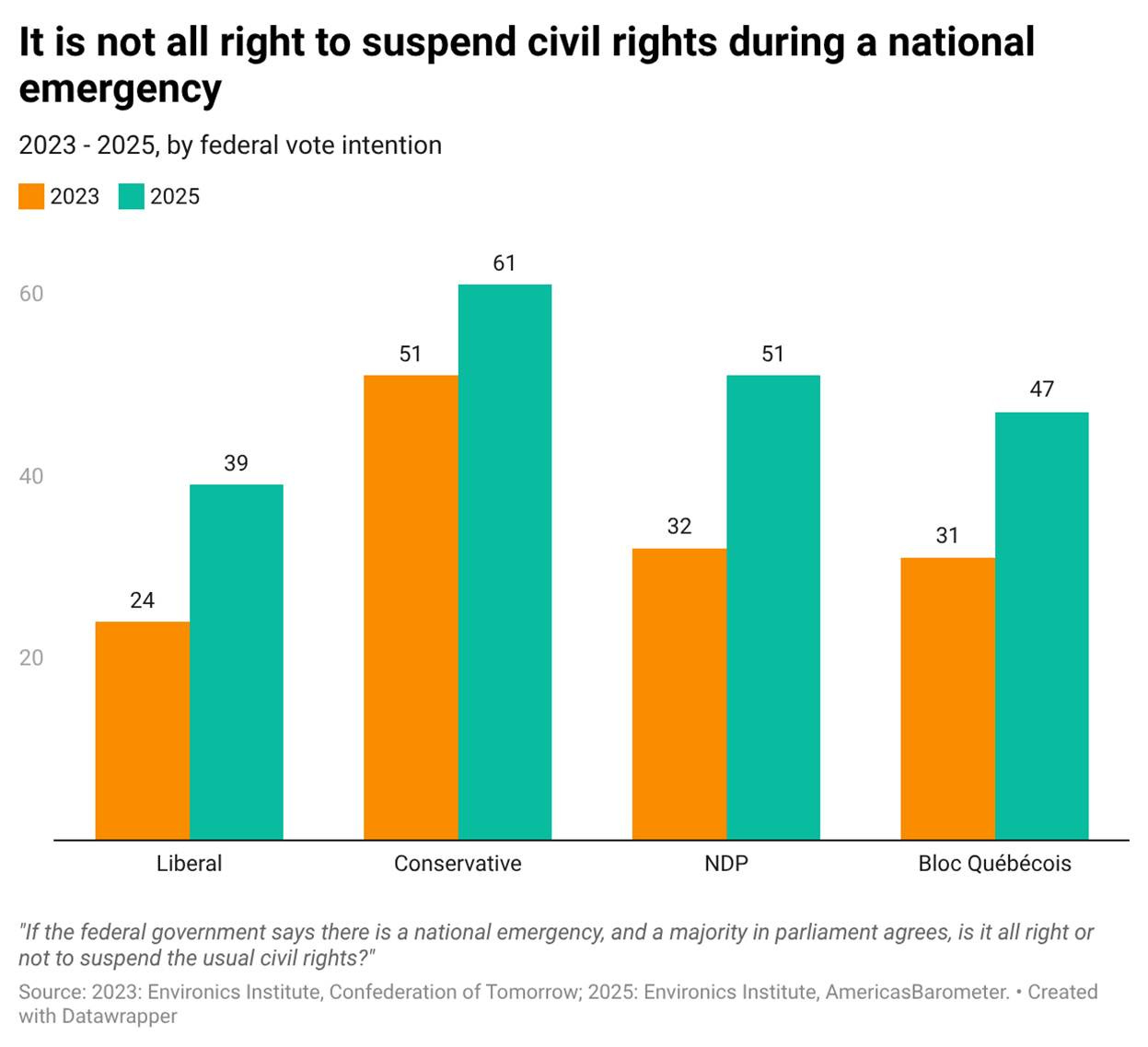
Finally, despite the Conservative Party’s current focus on law and order, its supporters in 2023 and 2025 are more likely than supporters of the other federal parties to oppose the idea that national security should trump civil liberties. Unfortunately, we don’t have breakdowns by party support prior to 2023, which means we can’t tell if it’s always been this way, or whether the pattern took shape in the context of the protest over the public health measures during the pandemic. Nonetheless, despite the history of the use of emergency powers in Quebec, and despite the fact that it was Tommy Douglas who famously likened the War Measures Act in 1970 to using a “sledgehammer to crack a peanut” and warned that “the Canadian people will look on this as a black Friday for civil liberties in Canada,” supporters of the Conservative Party are now more wary of the government using a national emergency as a pretext for suspending civil liberties than even supporters of the NDP or the Bloc Québécois.
This post features data from the AmericasBarometer 2025 Canadian survey. Additional results from this survey are posted on our website.
The AmericasBarometer is a regular comparative survey of democratic values and behaviours that covers countries in North, Central and South America, as well as a significant number of countries in the Caribbean (the 2025-26 study will cover 20 countries). The project is led by the LAPOP Lab at Vanderbilt University’s Center for Global Democracy (CGD). The Canadian and American surveys were conducted by the Environics Institute for Survey Research, in partnership with CGD’s LAPOP Lab at Vanderbilt University and with the support of the Max Bell Foundation. The author is solely responsible for any errors in presentation or interpretation.
The Canadian survey was conducted online with a sample of 3,550 Canadians (aged 18 and over) between July 30 and August 7, 2025. The results are weighted by region, age, gender, education and language so as to be fully representative of the Canadian population.
What is the Environics Institute for Survey Research? Find out by clicking here.
Follow us on other platforms:
Bluesky: @parkinac.bsky.social or @environicsinst.bsky.social
Twitter: @Environics_Inst or @parkinac
Instagram and Threads: environics.institute
Cover photo credit: Talha Güney
Paul M. Sniderman, Joseph F. Fletcher, Peter H. Russel and Philip E. Tetlock, The Clash of Rights: Liberty, Equality and Legitimacy in Pluralist Democracy (Yale University Press, 1996); see especially pages 37 - 39.
The Decima question was: “In times of crisis, do you believe government should or should not have the power to declare a national emergency and remove all civil rights?” The survey results were published in the July 3, 1989 edition of Maclean’s.
At this time, the question wording was updated to refer to the “federal government” declaring a national emergency, not the “cabinet.”
Although this was not the case in 1987, when one in five neither agreed nor disagreed. Without additional information about how that telephone survey was administered, I’m not able to say why this was the case.
A “decline to answer” option is not initially visible on screen; it only appears if the respondent tries to move on to the next question in the survey without providing a yes or no answer.
Unfortunately, this exercise is limited by the fact that I don’t have access to the detailed data from the 1987 and 1989 surveys.
Comments
Nothing yet. Say the first thing.
Sign in to join the conversation.