
It was on a hot, humid, 90-degree day in July 2021 that I attended the Saginaw Chippewa pow wow in Mount Pleasant, Michigan, looking for photographic subjects. Walking around the arena, my clothes were sticky and the weight of my cameras was oppressive. Then I spotted ninety-four year old Claudia Spicer. She was moving through the dance arena with unmistakable pride, competing in the Women’s Traditional category as though heat and age were secondary concerns.
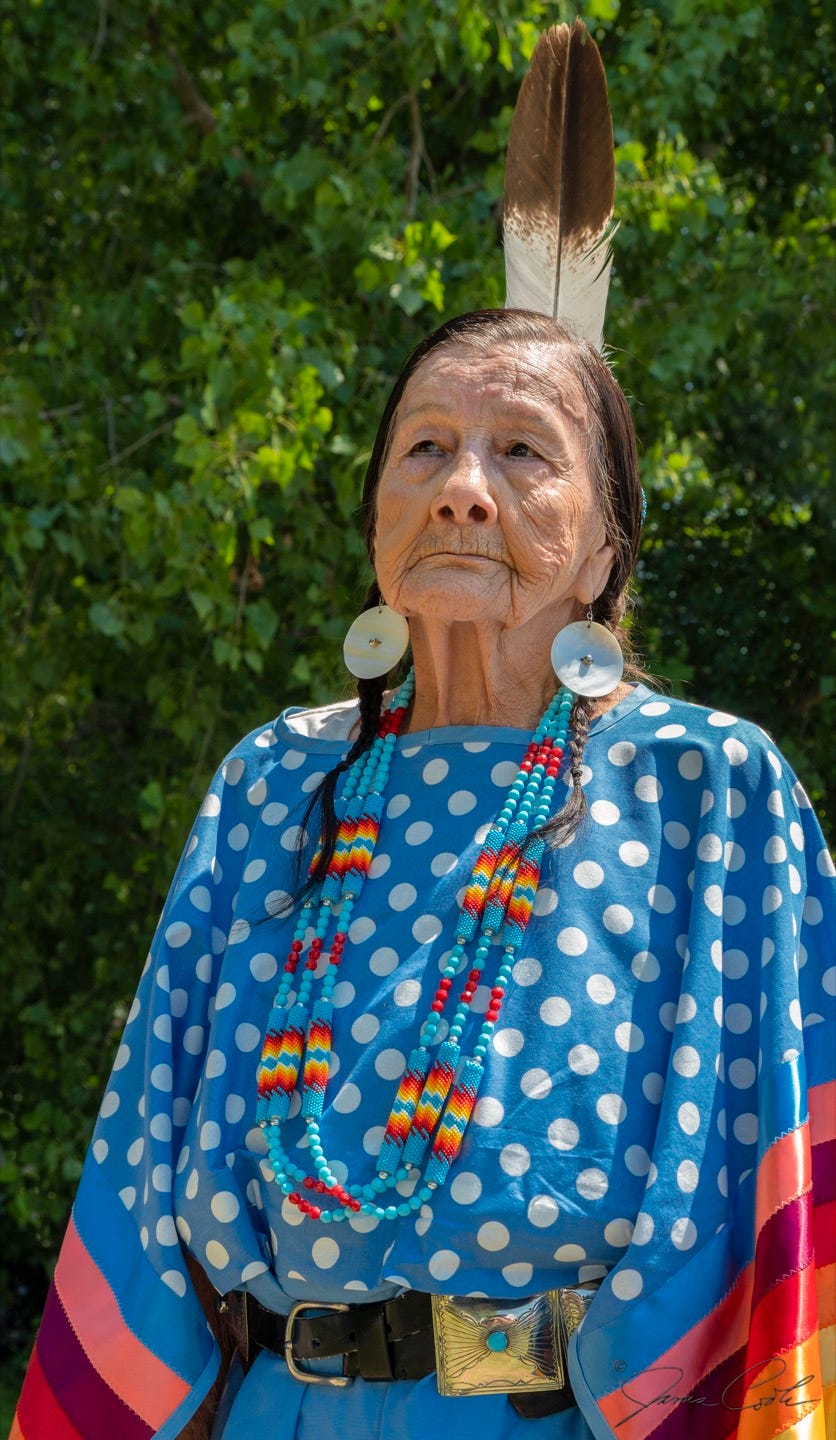
Claudia Brown NoEar Spicer was born in 1931 in Pawnee, Oklahoma, into a family already deeply involved in show business. From the 1930s through the 1950s, she traveled with Ringling Brothers, Barnum & Bailey, and other circuses as part of the Sugar Brown Dance Troupe, a family act with her parents and siblings, performing on the cloud swing and trapeze and as a dancer. The family wintered with the circus in Florida and lived the rest of the year in Los Angeles, where she studied opera.
In 1949, at eighteen, she became the first crowned princess of the Otoe-Missouria Tribe. She also worked as an extra in films directed by Cecil B. DeMille, appearing alongside actors like Gary Cooper in productions that, like many of their era, have since been criticized for their stereotypical portrayals of Native Americans. For decades afterward, she sang the Lord’s Prayer at Oklahoma gatherings and the National Anthem at the American Indian Exposition. When I met her, she described herself as one of the last full-blooded Otoe.
Claudia passed away in August 2023, roughly two years after I photographed her.
Meeting her led me to look into the history of her people. What I found was a story of remarkable contraction and survival.
The Otoe and Missouria were once part of a single Chiwere-speaking Siouan people who lived in the western Great Lakes region of what is now Wisconsin. Sometime in the 16th century, three groups, the Otoe, Missouria, and Iowa, broke away and migrated south and west, while the related Ho-Chunk remained behind. The Otoe eventually settled along what is now the Iowa–Minnesota border. The Missouria established themselves near the Missouri and Grand Rivers in present-day Missouri, where they gave the river, and later the state, its name.
In the centuries that followed, both nations were dramatically reduced by waves of epidemic disease introduced through European contact and by sustained conflict with neighboring groups, particularly the Sac and Fox. After a devastating defeat in the 1790s, the Missouria splintered: roughly eighty joined the Otoe along the Platte River in present-day Nebraska, while smaller numbers were absorbed into the Osage and Kaw.
Beginning in 1830, a series of treaties ceded most of their remaining territory, and in 1854, the combined Otoe-Missouria received a reservation along the Big Blue River on the Kansas-Nebraska border. They held it for barely a generation. In 1881, Congress authorized the sale of the rest of that land and forced the tribe to relocate to Indian Territory in what is now Oklahoma. By 1886, only 334 Otoe-Missouria remained. Today, the tribe numbers just over 3,000 enrolled members, headquartered in Red Rock, Oklahoma.
Comments
Nothing yet. Say the first thing.
Sign in to join the conversation.