
Originally published by Forbes on January 22, 2026
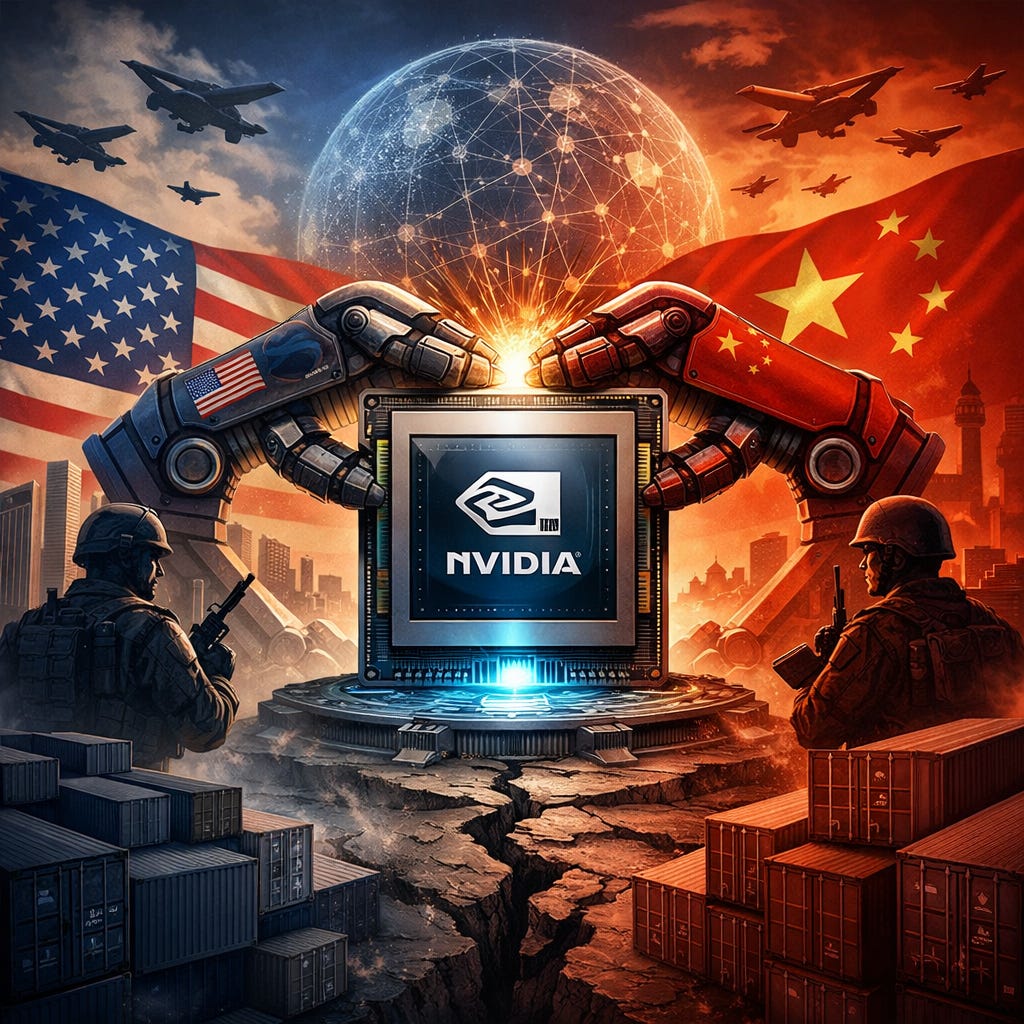
Speaking on the sidelines of the 2026 World Economic Forum in Davos this month, Dario Amodei, CEO and cofounder of Anthropic, said the U.S. decision to allow sales of Nvidia’s advanced AI chips to China was “like selling nuclear weapons to North Korea” and warned of “incredible national security implications” if the policy stood.
Having led technology businesses before researching AI policy, I understand both the commercial pressure to keep markets open and the strategic imperative to maintain technological leadership. This debate demands more than ideology; it requires recognizing what will sustain American advantage.
Sell the chips, and we risk arming a geopolitical competitor with the computational power to match our AI capabilities within years. Block the sales, and we push China to build a separate technology ecosystem where American influence and American companies become irrelevant. The paradox is acute: America’s lead in frontier AI models has narrowed to months, with capabilities constantly leapfrogging. Every restriction we impose to slow China’s progress simultaneously forces them to abandon our technology standards in favor of their own. The question isn’t only whether to control exports, it’s whether our controls are undermining the very influence we’re trying to preserve.
Nvidia Chief Executive Jensen Huang has been unambiguous about his view that U.S. policymakers are overstating the risks of selling advanced chips to China. He has publicly stated, while pushing for approval late last year, that the national security concerns are understandable, but that “China makes plenty of AI chips themselves.” From his perspective, cooperating in technology trade can be in everyone’s interest. He then added that “to the extent that American tech stack can run and operate those AI models is good for the United States around the world.”
This isn’t just corporate optimism. Nvidia sees China as the second-largest potential market on the planet. Export restrictions effectively pushed Nvidia out of that market, reducing, for a brief period, its share nearly to zero and weakening its competitive footprint in a region where it once enjoyed market dominance. If China develops its own AI stack at scale, it risks creating separate technical spheres where U.S. influence and standards are marginalized.
But Amodei’s reminder at Davos cuts through this logic: AI chips are not like other exports. America’s lead in AI confers a strategic advantage that should not be eroded by selling the very engines of computational power to a geopolitical competitor. Advanced chips are the primary input in training and running the most powerful AI models. If China gets access to chips nearly as capable as those available to U.S. firms, it narrows the window in which the United States holds a decisive competitive edge. The fear is twofold: that powerful AI chips could enable advances in military AI, autonomous systems and intelligence analytics for China’s defense apparatus, and that expanding China’s computing capacity will accelerate breakthroughs that alter the balance of economic and technological influence.
Yet the argument against sales faces its own critique. Some national security experts argue that export controls have, paradoxically, spurred China’s domestic innovation and reduced U.S. influence in one of the largest AI markets. The White House AI and crypto czar, David Sacks, has pointed to this dynamic, suggesting that over-restricting exports strengthens Chinese competition while weakening American firms’ ability to shape global technology standards.
The longer China is fenced off from American innovation, the more incentive its government and private sector have to build indigenous capabilities, with implications for global standards, interoperability and economic influence. Companies like Nvidia have invested deeply across the AI ecosystem. Their chips set the de facto hardware and software standards used by AI developers worldwide.
But national security officials counter that this underestimates what’s at stake. The Council on Foreign Relations notes that allowing even a chip like the H200 to enter the Chinese market represents a significant shift in U.S. technology policy toward China and could turbocharge China’s development of frontier AI.
Current policy tries to thread this needle. Many of the chips being discussed, including the H200, are not the absolute top tier like Nvidia’s latest Vera Rubin series, but they are powerful enough to fuel highly capable models and large-scale compute infrastructures.
At what point does opening a door for commerce inadvertently accelerate our competitor’s rise? How do we ensure that exported technology does not directly enhance adversarial military capabilities? And is exporting compute simply inevitable, given the global nature of AI research and development?
This post is public; feel free to share it.
Having recently spoken about this on the WBUR On Point podcast, I believe the answer lies not in a simple yes or no but in a calibrated strategy that aligns with broader U.S. interests. Chip sales alone do not determine leadership in AI. Leadership also depends on talent, data, research networks and the ability to attract global collaboration. In those areas, the United States still holds meaningful advantages.
That advantage also depends on what we build at home. As I noted on the podcast, we need to continue to invest in ourselves and build the capability to manufacture advanced semiconductors in the U.S. Export policy can slow or shape diffusion at the margins, but long-term leadership rests on strengthening domestic capacity. That means expanding production capability alongside the process engineering expertise and workforce depth that sustain an innovation ecosystem. Designing chips in the U.S. is not enough if we cannot scale their production or develop the talent needed to drive the next generation of breakthroughs.
At the same time, policymakers must be clear-eyed about the risks. Advanced semiconductors are not consumer goods with negligible strategic value. They are foundational infrastructure. Policy should require rigorous licensing that protects national security while avoiding counterproductive isolation that accelerates technological self-reliance abroad and erodes U.S. influence over time.
That requires reevaluating export controls through the lens of strategic resilience, not just commercial opportunity. Guardrails must prevent sensitive military applications without foreclosing legitimate economic engagement. This approach is not unprecedented. The U.S. has navigated similar tradeoffs in earlier eras of high-performance computing and technological competition.
In a world where generative AI will shape economic power, military capability and social systems, policy cannot be driven by ideology or fear. It must be grounded in a clear understanding of where American advantage truly comes from and how to sustain it over time. That balance, not absolutism, is how the U.S. will sustain leadership in the AI era.
No posts
Comments
Nothing yet. Say the first thing.
Sign in to join the conversation.