
This piece was originally published by Forbes on January 5, 2025.
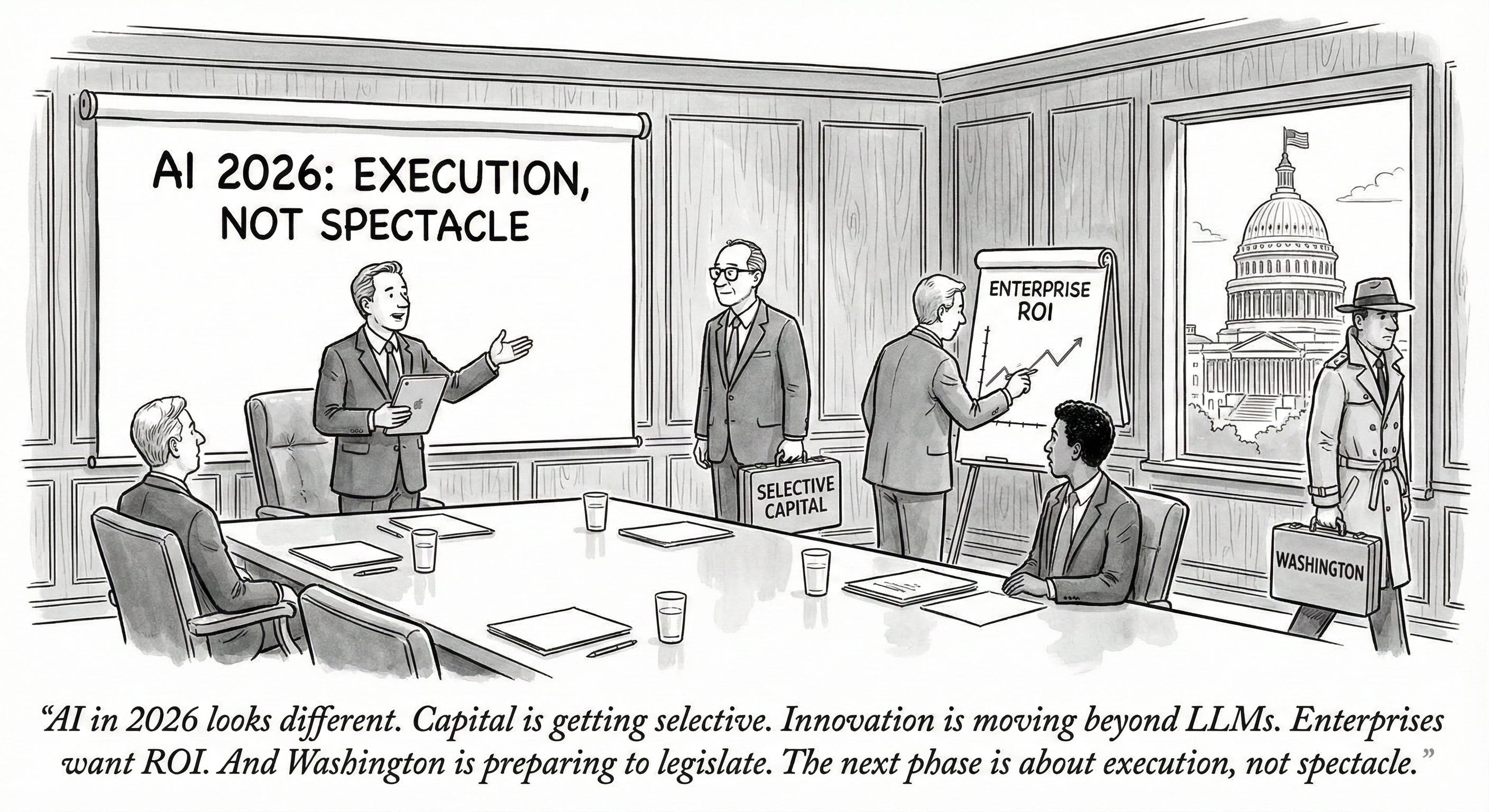
After three years of build first, ask questions later, AI in 2026 is entering a new phase. Deutsche Bank projects data center spending could reach $4 trillion by 2030, but the industry is already confronting hard limits on energy, talent and measurable returns. The era of pure scaling is giving way to something more complex: selective capital deployment, architectural innovation beyond large language models, enterprise buyers demanding ROI and Washington preparing to legislate.
In 2026, AI’s trajectory will be shaped by four realities: technical and economic limits, the need for new approaches beyond scaling, enterprise adoption moving from pilots to P&L scrutiny and AI becoming a voting issue in American politics.
Feel free to share this post to support my work
In 2026, AI may stop advancing on an unconstrained exponential curve. Three limits are already emerging and will become harder to ignore. The first is economic. Training and operating frontier models require capital expenditures in the trillions of dollars, approaching the scale of a G20 economy. Profitability is increasingly uncertain for frontier labs as marginal performance gains become more expensive. The second is physical. Energy availability, grid constraints and supply chain bottlenecks place hard ceilings on how quickly capacity can expand. The third is organizational. Integrating AI into business workflows exposes friction that scaling laws alone cannot resolve; human and domain expertise are required.
These limits are already reshaping expectations around infrastructure. Not all announced data center projects will be built. Some will be delayed, downsized or abandoned as financing conditions tighten and utilization assumptions are revised. The AI infrastructure race will not stop but it will become more selective.
The AI bubble is more likely to deflate than burst, think gradual corrections and startup failures rather than a 2000-style crash that takes down the broader economy. Risk is concentrated in individual companies, particularly heavily debt-leveraged startups and firms with uncertain revenue trajectories, rather than systemically distributed. Private markets will see consolidation. Public market valuations for leading AI firms may stabilize rather than collapse, reflecting a shift from narrative-driven pricing to revenue and margin scrutiny.
This adjustment does not signal the end of AI’s economic relevance. It signals the end of the idea that scale alone solves everything.
As the large language model-centric development model nears saturation, innovation will increasingly occur outside the dominant scaling paradigm. Performance gains from ever larger models are becoming incremental, costly and environmentally intensive. This reality is forcing researchers and founders to explore alternatives that emphasize efficiency, specialization and integration rather than raw size.
History suggests that moments of perceived slowdown often precede architectural shifts. Prior AI winters were less about the disappearance of demand than about the exhaustion of a dominant technical approach.
Frontier labs are already experimenting with alternatives: models that generate content through iterative refinement rather than prediction, systems purpose-built for specific tasks rather than general intelligence and multimodal architectures that combine text, vision, audio and action. These approaches trade brute force scaling for architectural diversity and task specificity.
If artificial general intelligence or superintelligence is achievable, the path will not be linear extrapolation from today’s models. It will require conceptual breakthroughs. The startup ecosystem is already reflecting this belief. Former AI lab executives are launching companies aimed at new model classes, novel training regimes and system-level intelligence. Yann LeCun’s new startup is explicitly framed around world models that learn the causal structure and physics of the real world, rather than predicting tokens. AI pioneer Fei-Fei Li’s World Labs startup launched Marble in November 2025 as the first commercially available world model product.
Innovation in 2026 will be less theatrical and more technically pluralistic.
The sustainability of the current AI economy depends on enterprise demand. Consumer adoption alone cannot absorb the scale of investment underway. In 2026, enterprise deployment will move from pilot projects to return on investment measurement.
AI vendors are explicitly repositioning toward enterprise buyers, emphasizing workflow integration, governance and return on investment rather than generalized capability. Human-centered design, workforce augmentation and trust frameworks are becoming core sales arguments.
Evidence suggests that companies are beginning to move beyond experimentation. Internal benchmarks, procurement standards and change management processes are forming. Adoption remains uneven but the direction is clear.
Financial services firms are deploying fraud detection with measurable accuracy gains. HSBC is detecting two to four times more financial crimes while reducing false positives by 60%. Healthcare systems using AI scribes that save physicians daily time on documentation. 98% of legal firms using a purpose-built AI contract review tool achieve immediate time savings, and 90% improve accuracy and risk detection.
But, in parallel to these successes, ROI calculation is exposing hard truths: companies that treat AI as plug-and-play software are hitting walls. Those succeeding recognize that technology represents only 30% of AI success; people and processes account for the remaining 70%.
Enterprise AI will not be uniform or instant. It will be incremental, uneven and shaped by sector-specific constraints. But it will determine which AI firms endure beyond the current investment cycle.
In 2026, AI will no longer be confined to policy white papers and expert panels. It will become a visible political issue during the midterm elections and the ramp-up to the 2028 presidential race. Labor impacts will dominate the public conversation. Automation anxiety, job displacement fears and skill polarization are already intersecting with signs of a softer labor market.
At the same time, lobbying efforts around AI policy are intensifying. Spending by technology firms and industry coalitions is shaping debates over liability, transparency and federal preemption of state laws.
Congress will face mounting pressure to act by summer 2026, as AI job displacement becomes a midterm campaign issue in Rust Belt states like Michigan and Pennsylvania. California’s transparency in AI law will serve as either a template or a cautionary tale. The administration has already moved, and its December 2025 executive order established a DOJ AI Litigation Task Force, directed Commerce to identify onerous state AI laws, and instructed federal agencies to withhold funding from states with unfavorable AI regulations. The order also directs the development of federal legislation that would preempt conflicting state AI laws.
AI in 2026 is settling into its role as a general-purpose technology, still marked by moments of spectacle but increasingly shaped by real-world deployment. Capital is becoming more selective, enterprises more demanding and policymakers more attentive. As hype gives way to operational reality, AI’s influence is extending across markets, organizations and public institutions. In 2026, the defining issue will not be how quickly AI can scale but how effectively it is integrated, which companies and institutions can translate capability into durable value and how Congress responds to growing public and economic pressure to set clearer rules of the road.
No posts
Comments
Nothing yet. Say the first thing.
Sign in to join the conversation.