
(Note: I read all my pieces out loud for you; I think they’re best that way—but feel free to read instead! And while I do love an em dash, rest assured every post is written by me—a human—not AI.)
This is Part 2 of my series on ADHD. If you haven’t yet, go back and read or listen to Part 1, then come back here and listen to Part 2.
My friendship hurts people, I thought.
But my knowing said that wasn’t right.
I’m not meant to write this book, I thought.
So why would the Universe give it to me?
Attention, for me, is like a spotlight lighting a stage.
The illuminated circle is small.
It can light up one object at a time.
Or a hobby or a project.
The boundaries of the light are distinct, a visible line where darkness ends and light begins.
When you’re in the spotlight, you know it just like you’d know if you weren’t in it.
I like this about myself because when I want to get shit done, I get it done.
Because my spotlight of focus only illuminates one thing at a time, the thing I’m hyper-focusing on, allowing me to disregard the rest as distraction. I can become obsessed with the thing and lose all sense of time passing when I’m engaging with it, often forgetting that I need to eat or go to the bathroom.
Those things aren’t in my spotlight.
Whatever I’m working on is.
My spotlight of attention also applies to people.
When you’re in my spotlight—nearly always a one-on-one interaction—
you’re all I see.
I want to understand you because you’re fascinating. Everyone is a unique blend of art and contradiction and perspective and nuance. I’ll never meet two people exactly alike, so there’s always something new to learn from someone.
I ask a lot of questions.
I know myself how good it feels to hold someone’s total attention.
Unfortunately, there’s another side to the spotlight.
I often don’t get to choose what my spotlight shines on.
And it will eventually shift away from someone to something else.
They’ll text, and I won’t text back.
Their email goes unanswered.
They’ll call me and find my voicemail is full.
I’ve been told that I leave people feeling “in the dark” and very confused by my lack of attention to communication within our relationship.
“You said you’re lonely,” a friend once told me. “But you won’t text back for a week.”
I’ve hurt people.
I hate when I hurt people.
The truth is that I care deeply for the people I love.
And also: I haven’t figured out how to show up consistently and hold other things in focus at the same time.
I look around at other people’s stages—they’re lit evenly like living rooms. Sure, more concentrated lighting pools around their children or work or best friends, but, in general, everything is illuminated. It seems like they’re able to hold all the things in focus across their stages.
They don’t forget about texting their friend back for three weeks.
They don’t forget to check their voicemail for eight months.
No one is exempt from my focus shifting issues—not my family, not my for-life best friends, and not even my own partner.
“I should be able to be like other people,” I’ve ranted to my partner, Seth.
Friendship is one of the parts of the human experience I long for the most.
To know and to be known.
I ache for connection.
So why can’t I make myself be someone who doesn’t continually hurt people?
If I can’t keep from hurting the people I love, why would I think I’m capable of sustaining focus on a long project—like writing my book? It’s the same loop: I build a friendship or I write an outline. I shift focus. And then, as with the friend, I ghost my own book.
“I just can’t write this book!” I yelled at the sky on another neighborhood walk with Seth. I wrung my hands as if they were covered in mud. If I had been feeling better, it would have thrilled me to imagine the invisible mud splattering in long, spotty strips all over the asphalt.
“Sorry,” I said to Seth, for the mud and for yelling which wasn’t at him but at our very irresponsible Universe for making people like me.
We had been talking about this book for the last 14 years, and after turning 40, I decided I was going to get serious about writing it.
This book was coming out of me if I had to pry it out.
But so far, prying hadn’t worked.
Fast forward to me at the coffee shop:
My phone was tucked away so as not to distract me. A decaf coffee to the upper right of my laptop. I had even taken a shower before I’d come, signifying I am very serious about doing something. (Showering requires a colossal amount of effort for me—more on that later!)
I was open to Inspiration, all my chakras conspicuously agape, waiting for the words to flow into me and out again onto the digital page.
Waiting.
Waiting.
And then—AHA!—a sentence!
And then another one.
And another!
The story I had outlined came rushing back to me like a faithful steed ripping up the landscape, and just like Legolas in the film version of The Lord of the Rings: The Two Towers, I’d mount that story from the front.

(By the way, according to physics experts, that move is nearly impossible.)
But you know what was possible?
Writing my book.
I was off to the races!
And then PEW: Have you paid the trash bill? You should probably check.
No, I thought. I’m writing now.
I know, my brain said. But how could you possibly write if you’re on the verge of going to collections because of an unpaid trash bill?
So, I paid the bill which wasn’t that late, and afterwords, I clicked back to my book. But now, it was feeling farther away.
And then PEW: If you collected all your pee and poop from your entire lifetime (past and future) into one room, what square footage would the room have to be to fill it to the top, assuming 8 foot ceilings?
There are just things I MUST know, Dear Reader. And if I don’t find the answer right away, I might implode with curiosity.
This was one such moment.
So I figured it out. (Long story short, it’s 221.25 square feet—the size of a one-car garage…doesn’t it feel like it should be more than that???)
Which led me to: I wonder how much horses poop…
Which led me to: Horse? Oh yeah, my story!
I’m back at the writing when I hear the woman at the next table say to her friend:
“I’ve never told anyone this secret before, but I’m going to tell you.”
PEW—I. MUST. KNOW.
By the time I’d taken sufficient notes on their conversation—possibly for a future book ; D—I realized I was looking at another story in the mouth—and not the one I’d come to write.
At this point, I was beyond frustrated with myself and my inability to just stay on target. Two hours had passed, and I had written a single paragraph—this wasn’t nothing, but it wasn’t where I could have been had I not been derailed by all the pews.
While I’m definitely taking some creative license here and leaning into the humor, the pews are demoralizing when all you want to do is get this creativity out of your body. It hurts to hold a book inside you—a sort of creative constipation. When creativity isn’t able to come out the way it wants, it will find other, more destructive way to leak out into our lives—like anxiety, depression, or anger.
I started suspecting there might be something wrong with me, that I might actually be broken, and that I’m so terribly alone in this—that everyone else around me can just make themselves make the things they want to make.
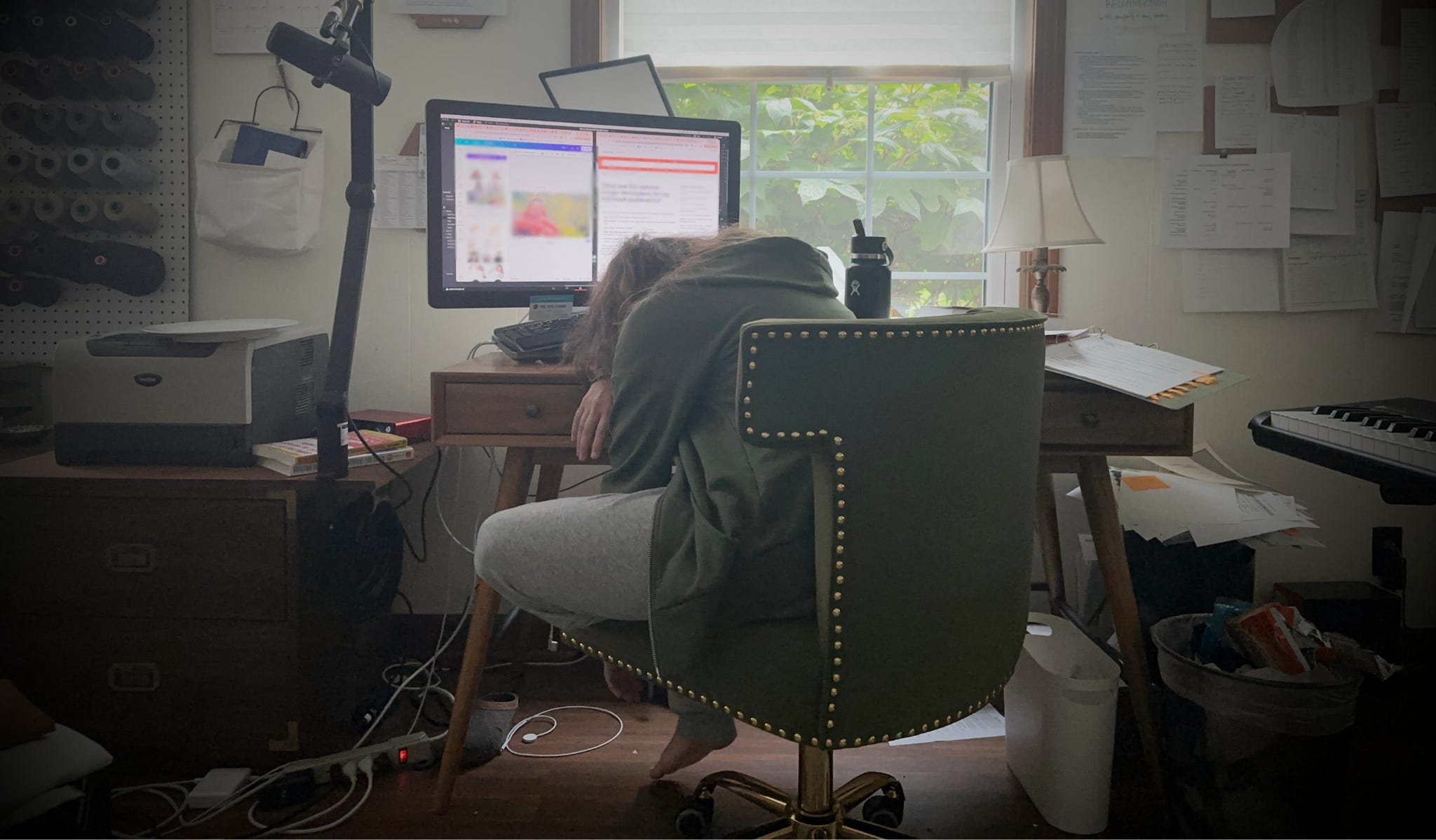
On top of feeling frustrated, I was also feeling chronically fatigued. The sleepiness had been happening for years; if I wasn’t in bed, I was thinking about when I could nap next.
I could take 2-3 naps a day and still sleep at night.
I could fall asleep anywhere.
We looked into sleep apnea; but my nightly oxygen levels were fine.
I suspected I had narcolepsy, but that didn’t quite fit either.
My brain CT came back normal.
In addition, the goal manifesto—>overwhelm—>shame shutdown—>repeat cycle ramped up to where I was beginning to lose faith in myself.
I didn’t feel like setting goals anymore.
I wanted bed. And once I got in bed, I stayed in bed.
I was sleeping my life away.
“What’s the point?” I asked Seth on one of our walks.
Oh boy, I thought. This isn’t my natural state.
Hopeless talk is an indicator for me that something is wrong.
“I think you should look into ADHD,” he said.
“That’s not me,” I said. “I got good grades in school.”
“I saw someone on social media saying that it looks different in women,” he said.
He started sending me videos of women talking about their ADHD experience, and the things these women were saying hit me like a freight train full of 6,564 unopened emails.
(Yes, that’s my current number).

Unlike men who tend to be more hyperactive and impulsive, women with ADHD present more as disorganized, forgetful, having a rich inner world, and…daydreamy. No wonder I related so hard to Anne Shirley of Anne of Green Gables growing up—she’s basically the queen of daydreamy ADHD.
“Don’t you ever imagine things differently from what they are?
Oh, Marilla. How much you miss!”~ Anne Shirley
As children, we’re socialized to please more than boys, causing many of us to trip over a lifetime of too many “I’m sorrys.” The frustration we feel at not being perfect causes us to turn shame inward instead of allowing ourselves to feel anger, an emotion more encouraged in little boys than little girls.
Because many of us don’t fit the typical criteria for ADHD (which, by the way, is coded for boys), we’re often misdiagnosed as having anxiety or depression which are often caused by ADHD. Since women are, generally speaking, better at masking our symptoms than men, we often fly under the radar until around 40 years old when we collapse, wring our hands, and finally get the help we need.
In short, female ADHD symptoms are less bouncing off the walls and more falling apart quietly inside.
The world of psychology is beginning to wake up to female ADHD; but until the male-coded diagnosing criteria changes (I’m looking at you, future versions of the DSM-V), many women will fall through the cracks and believe the lie that they are failures.
That was certainly me, crying alone in my car outside Sherwin Williams buying paint for a bedroom I wouldn’t paint for years *probably* because I already felt so damn buried under ADHD piles, a bottomless list of tasks, and 221.25 square feet of shame.
OK, maybe I had ADHD. But what did that mean?
And more importantly, what could I do about it?
Turns out, a lot.
I just had to reach out and ask for help.
In Part 3, we’ll get into my ADHD diagnosis, the tools I’m learning to work with my brain instead of against it, and what it’s been like dipping my toe into medication.
Until then, Dear Reader, here’s a thought:
If you relate to this struggle, you’re not lazy—and you’re definitely not alone.
There’s hope. I’ll see you in two weeks. —> Go to Part 3 here!
Comments
Nothing yet. Say the first thing.
Sign in to join the conversation.