
The main way I’m relieving stress during my PhD is to regularly make my own clothes. I try to have a sewing day at least once a fortnight, and I’m slowly working my way through my collection of patterns and my incredible fabric stash. I find it useful to be doing something that is completely different from research or writing. Something with my hands, where I’m concentrating, getting in the zone and using a different part of my brain. I’m still quite a novice sewist, so I learn new techniques with each make, and of course every completed garment is perfectly imperfect. Due to my unusual body shape post-surgeries (no breasts and swollen torso and leg) I have to adjust the patterns considerably, so I always make a toile before cutting into my precious fabric, much of which I’ve purchased while on holiday in far-flung places, so I’m reluctant to waste. A toile is a test version of the garment, made out of a simple calico, enabling me to test my pattern adjustments and practice any new techniques, so that (in theory at least) the final piece fits just right and I’ve had chance to iron out any mistakes.
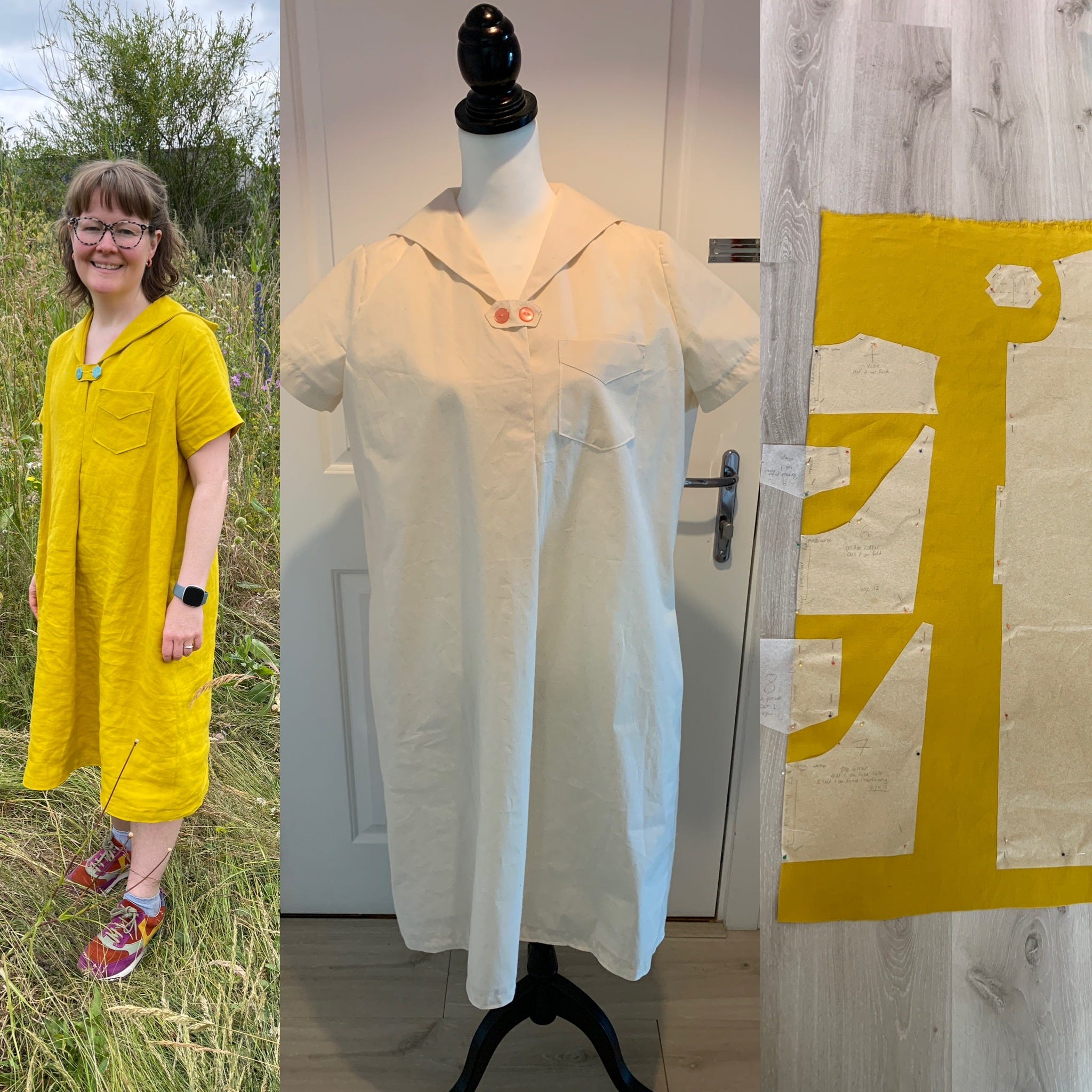
This week I finished my second toile of a Merchant and Mills dress called the Etta dress. The first one I made was too small up top, and too short in the waist, and I accidentally sewed on the top part inside out. Making this dress is quite an ‘involved’ process and uses a lot of fabric, so I definitely didn’t want to risk wasting the gorgeous fabric I bought in New York for it. Making a toile involves tracing all the pattern pieces with tracing paper (this one has 16 separate pieces!), making any size adjustments as you trace. Then you cut out the tracing paper pattern pieces, and pin them to the fabric, cut out the fabric pieces and add any notches or marks from the pattern. Next, you follow the pattern instructions sequentially, (all 22 of them), slowly building up the garment. For the Etta dress, this involved ironing on interfacing to strengthen the collar and sleeve holes; sewing the top together including a lining; making 4 separate ties, two for the inside, two for the outside; creating the voluminous skirts, including pockets; sewing the top to the gathered skirt and finally finishing off the hems and hand-sewing the inner lining to cover the join. All of this (doing the top part twice for my adjusted size) took me about 25 hours in total, spread over a couple of months. I finally finished my revised toile this afternoon, having sewn the top on the correct way this time, but somehow getting the inner ties in the wrong place!
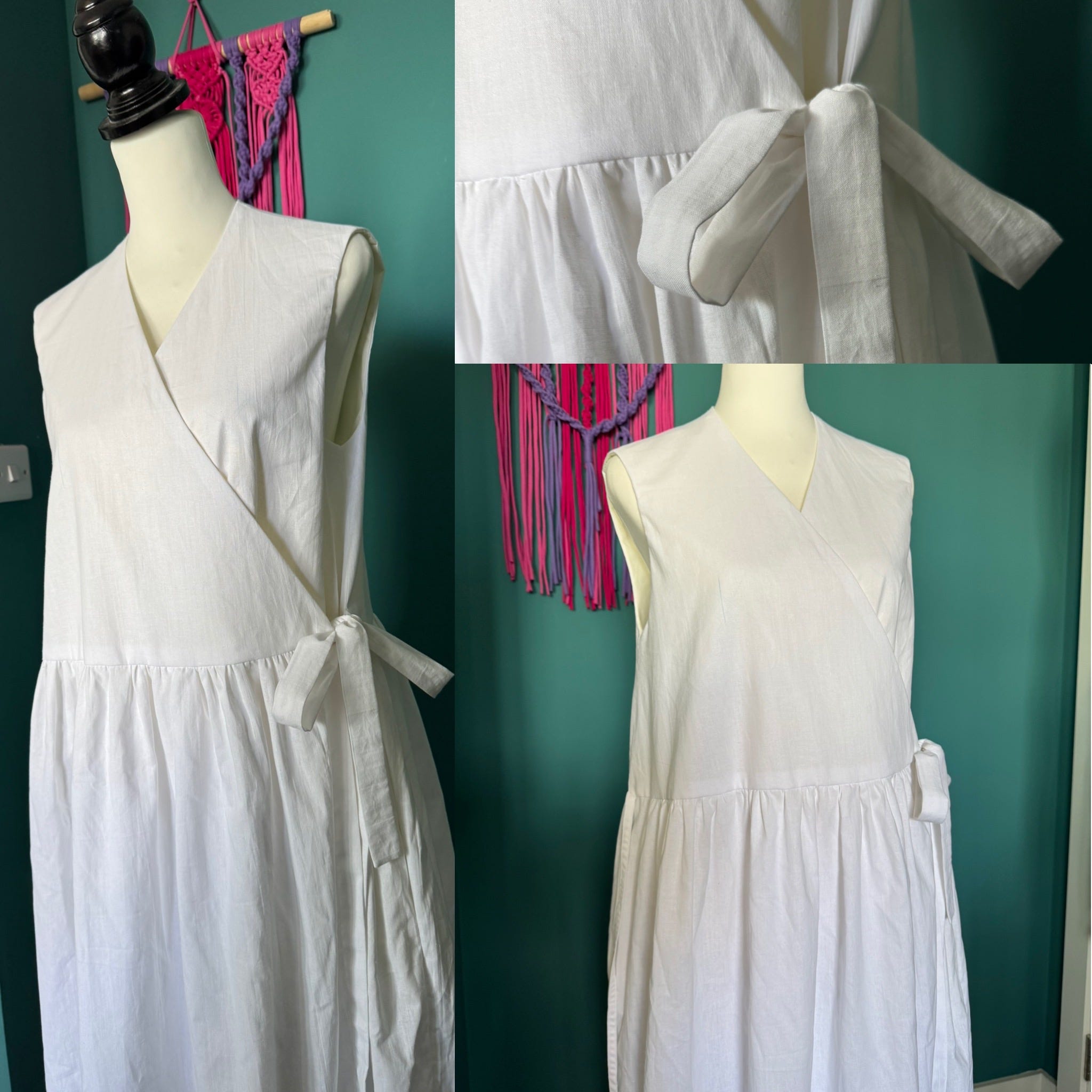
So I put the dress on, and… I really didn’t like it. It’s not just the fit, which is definitely better second time around, but I just think the design doesn’t suit my body shape. Perhaps I could have another go at it, and try to correct some of the places in which it’s still ill-fitting, but I’m pretty sure that I still wouldn’t like it. I think perhaps v-neck wraparound dress styles simply don’t suit my flat-chested, thick-hipped shape. Part of getting used to a new body shape is to re-learn what kinds of clothes fit me well, and not be drawn to the kinds of shapes that suited my former hourglass figure.
Now, instinctively, you might think that this has all been a terrible waste of time. Oh my goodness! I’m so time-poor right now! I need every possible moment to be writing my PhD. I’ve been refusing many invitations to social events and I’m carefully apportioning my time and energy to ensure I give my thesis the care it deserves. How can I be satisfied with 25 hours spent on something that has ultimately turned out to be a dead end?
This is reminiscent of how I felt after I handed in my last thesis chapter. My first chapter went so well, and I received some great feedback from my supervisors. But I was also lamenting how much time I spend planning each chapter, and how that eats into my writing time. I’m a natural planner: I love it. Each chapter requires lots of planning, sketching out the stucture, creating subheadings, deciding on quotes from participants and the literature before I’ve written a word. So instead, my supervisor encouraged me to try a different approach with my next chapter. To find a thread, a small thread, in the data — something that interested me, surprised me or excited me. Then, to gently pull on this thread, following my thoughts in the direction the writing took me, rather than planning it all in such a detailed way in advance. I know that sometimes you can’t plan everything in advance, and that writing is a form of thinking. Sometimes it takes writing about something to work out what you actually want to say. So I decided to follow her advice.
I found a quote from one of my participants. “It’s like dragging 15 pianos up a hill with dental floss.” A brilliant quote about self-advocacy in the cancer clinic. I then followed this thought and spent a month writing 8,500 words about the labour of self-advocacy, theorising this labour and tying in the words of my participants about the labour they had performed, with the wider literature. I spoke of self-advocacy in the context of the labour of navigating medical institutions, epistemic labour, relational labour, and identity labour. I hadn’t even thought about self-advocacy as a theme before, and here I was, synthesising and theorising about it for one of my chapters.
Except that, once I had a draft, and I read it back… I really didn’t like it. It didn’t advance my argument; it didn’t answer my research question. It was interesting, but I simply didn’t believe it had a place in my thesis. I didn’t think that the writing flowed as well as when I really believed in the subject and felt passionate about it. And the subject matter felt tangential to what I really wanted to say.
Instead of opening things up by pulling on a thread, I ended up at a dead end. So, have I just wasted a whole month?
I don’t see it like that. I’m really pleased that I tried a different way of working. I proved to myself that I could try a completely new research and writing process, one which definitely took me out of my comfort zone. Sure, it hasn’t yielded amazing results, but it has crystallised for me the fact that planning is a huge part of how I like to work, and in fact how I work best. If I get the planning part right, the writing flows much more easily. And I think the end result is better. So yes, I am going to throw away the chapter and I have nothing much to show for my month, word-count-wise. But I learned so much about my way of working, and really advanced my thinking. I also have a renewed excitement and clarity about the next chapter I want to write. And isn’t this the point of a PhD? It’s not about emerging as an Emeritus Professor, a fully-formed, seasoned academic. It’s a training ground, a place to play, experiment and find your own way within academia. (Some may call it a medieval guild but that’s a post for another day!)
I suppose it’s about focussing on the process rather than the outcome. If a couple are married for 25 years, then one day they announce that they are getting divorced, people describe this as a ‘failed marriage’. Focussing simply on the end outcome, rather than the previous 25 years of marriage, at least some of which must have been great! Or when researchers in the natural sciences spend years trying to solve a problem, only to reach dead end after dead end, finding things that aren’t the solution rather than something that is. They don’t see this as ‘failure’. Each discovery eliminates one possible outcome, bringing science as a whole closer towards the solution. And the process is the important part of this.
The thesis will not be my life’s work. It will just be the beginning.
So yes, I reached a dead end with my thesis chapter. I reached a dead end with my dress. But each has simply eliminated one of the possible paths out of the maze. Instead, I’m taking a different path. Next weekend I’m starting on a simple blouse pattern from Nani Iro. And I’ve already got 4,000 words of my next thesis chapter done. (After meticulouly planning it, of course.)
Thanks for reading Reclaiming pleasure after cancer! This post is public so feel free to share it.
Comments
Nothing yet. Say the first thing.
Sign in to join the conversation.