
After my last post about my abandoned thesis chapter, I’ve been thinking a lot about the writing process. Now, many good people have written many good books about writing, so I’m not going to claim any major prowess here, but part of the process of doing a PhD is to learn about yourself as a researcher and writer, so I will share some of the key insights I’ve had so far.
Percolation
One of the most important stages in my research process is what I call the ‘percolation’ stage. This doesn’t get much of a mention in any of the ‘How to write’ guides, especially those about doctoral work. But I’ve realised that it’s vital and needs to be given space and time. Most people assume that research is all about reading, gathering data, analysing the data and then writing. And to a certain degree, it is. But this misses out the process of ‘percolation’ — where you ruminate on the data, sit with it, allow the thoughts to percolate, until it starts to fit into place. For me, the optimal conditions for this part of the process are being away from my desk, ideally walking somewhere, like my regular 10k loop around Hackney Marshes. I don’t have to worry about where I’m going, my feet are on autopilot and the ideas are busy percolating at the back of my mind (and I record hundreds of voice notes). There are lots of cliches about when ideas hit you, or things fall into place, and in my experience these are born from reality. I’ve had some real light bulb moments in the shower, for example, or on my cycle into campus, and even when I wake at 3am and scribble furiously on my bedside notepad. What this illustrates is that sometimes, when you think you’re ‘not working’, your brain is actually doing the most important work — that of allowing the data to percolate. It has helped me to feel less guilty about taking a couple of hours out of my day to go for a walk, especially when I’m feeling stuck. It’s not procrastination, it’s percolation!
Focus time-blocks
When I first started writing I found it really difficult to focus and get a decent number of words under my belt each day. I was averaging 400 words per writing day, which I knew wouldn’t cut it when I finally embarked on my 100,000-word thesis. So I played around with my schedule and process to try to find some good tools and boundaries, to set the ideal conditions for writing. Two key things that have worked are being strict with my days, and working in focus time-blocks. I’m still doing a bit of my freelance consultancy work, coaching and training, and I’m limiting this work to Tuesdays and Thursdays. Where there is an exception that I can’t avoid, I will switch a whole day, so that I have at least 3 full days with no interruptions in my calendar each week. I find that I need time to get ‘into the zone’ of research and writing, and when I’m pulled out of it, such as for a meeting or a seminar, it takes me a really long time to get back into the zone. This is actually repeated labour, because I’m doing the same thing over and over to get ‘into the zone’. I don’t want to be doing this multiple times a day, it’s really a waste of my time. And my brain finds it really difficult to pivot from one world to another, so if I’m creating a training plan for something, then I have to switch to get my head back into thesis land, it’s really labour-intensive for my brain. So designating days and sticking to it really helps.
The other thing I’ve been doing is working in focus time-blocks. Each morning I draw 4 squares in my daily planner, and label them ‘20’, ‘30’, ‘45’, ‘60’. I have a small 12-sided yellow timer which marks out many different time blocks, but these 4 are my minimum non-negotiable blocks, and I can complete them in any order I like. When the timer has been flipped, I have to focus on whatever it is I’m doing, and not let myself get distracted by emails, messages, other interesting papers, etc. I can’t get up until the timer buzzes. Of course, I will often do more time blocks than these 4, but these are my minimum each day, and I find that even with just these 4 blocks of focus time, my productivity has massively increased, and I’m writing 1,000-2,000 words each day rather than a measly 400.
Writing retreats
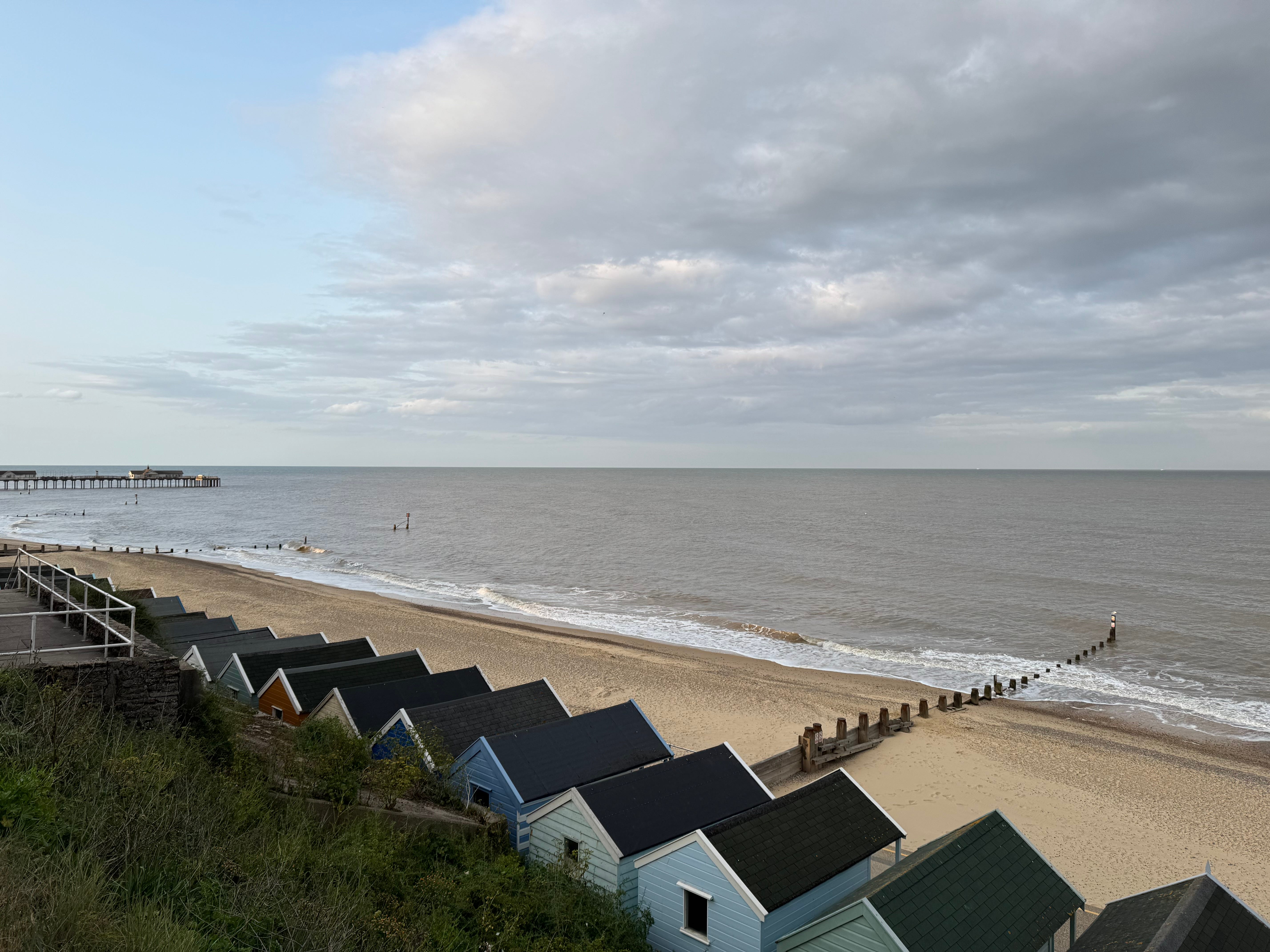
One of the best ways to manufacture focus time is to go on writing retreats. I’ve been lucky to go on a couple of great retreats in Suffolk with the Culture, Medicine and Power research group in our department, where I’ve done morning sea-swims, writing exercises and planning for my thesis chapters. But another trick I’ve employed is to house-sit for friends who don’t live in London, so I can get a decent chunk of time away from home, without the distractions of Life Admin and House Admin, and instead, to focus. Being in a new environment, with new walks in beautiful countryside, is so helpful for getting a fresh perspective on whatever it is I’m working on. My partner and I have even done a few ‘writing retreats’ at home, where we’ve structured our days around walks and meals, carving out time for big writing sprints, not getting distracted by the never-ending ‘to do’ lists around us. On Easter Weekend I think we got about 15,000 words written between us.
Pages
After years of saying I was going to do it, this year I finally completed Julia Cameron’s The Artist’s Way. I started in January and by March I’d worked through her book, answering her thought-provoking questions and diligently going on an ‘artist date’ each week. There were some things about the book and her approach that I found a bit irritating, but overall I found the process hugely useful, and the one thing that has stuck is doing my daily ‘pages’. Cameron calls them ‘morning pages’ but I rarely get chance to do them in the morning, they are usually a lunchtime or an evening thing, but I’m almost done with my second Leuchtturm1917 notebook (because the key to success is beautiful stationery), and this is most definitely a habit for life. This isn’t journalling, (I have a separate notebook for that), I’m writing about the project I’m working on (in my case, 3 projects: the thesis, the eventuating book, and another writing project I’m working on). The pages are not thoughtfully considered, carefully crafted pieces of writing, they are hastily scribbled, stream-of-consciousness style notes about what I’m thinking, where I’m stuck, what I’ve written that day, what I plan to write the next day. When I’m in the ‘messy middle’ of a chapter, the pages read as a repetitive ‘I really don’t know what it is I’m trying to say’. But as far as the actual writing process goes, I’m finding that the pages have been really useful for working certain things out. I write about how I am stuck with something, then I write about possible solutions, and sometimes the solutions just come out right there on the page. Sometimes writing about how I’m stuck kick-starts a percolation process which gives me the answer. So thanks Julia Cameron, this is one of the best habits I’ve ever taken up.
Iteration
As I embark on writing my third chapter, I’m realising that writing is most definitely not linear, but an iterative process. I re-read the transcripts of my research conversations, I pull out quotes relevant to my chapter theme, I ruminate on these quotes and sketch out a draft structure of the chapter, with its 4 sections and the arc of my argument. Then I go to the literature, reading key texts, or going back to notes on things I’ve already read. The literature can take me down rabbit holes, which I try to pull out of once I realise they’re not quite where I want to go. I decide which key concepts I want to tackle in the chapter, and which key theorists or scholars I want to be ‘in conversation’ with. Then I go back to the draft structure and edit. I look at the artworks my research participants created, and decide which ones best exemplify my argument in this chapter, and create some figures. I re-read the verbatim poems I wrote from my interview data, and decide which ones I want to include. I might start to get some dot points down in certain sections. I might get stuck — which section goes first? Which section does a particular case study belong in? Does the arc of my argument make sense? I write, trying not to be too precious about the words (this is a draft after all) and get some words down. I read, I synthesise the reading, I pull out citations from the literature and add them to the text. I write case studies, going back to the words of my participants. I reflect on my own experiences. I might get a good idea for a different chapter so I’ll open up my notes and write it down for later. I jump from one thing to another, keeping all the plates spinning. I go back to the draft structure and I edit. I write. Which leads me to…
Writing as thinking
The process of writing the chapter so far, this iterative process that I have described above, helps me to work out what it is that I’m actually trying to say. When your examiners are judging your PhD thesis, the big question they are asking is, what is the contribution to knowledge? I don’t embark on writing with a clear vision of this, but the process of writing helps me to gain clarity. Writing as thinking. For my last chapter, I carried out the iterative process above, and towards the end it all suddenly became clear. In my final 2 days of writing, I gathered all the loose ends together, the 4 sections of the chapter, and brought it to a conclusion. It’s a draft, and still needs work, but it makes sense, and it’s a great start. I’ve got 12,000 good words in that draft, and my supervisors actually think I could expand it into 2 chapters, so I’m happy with where I’m at with it. Now I’m writing the next chapter, and I’m in the ‘messy middle’, so don’t ask me what it is I’m actually trying to say! But I trust that it will come, I just have to keep going. Write, think, read, revise, and above all, enjoy the process.
Thanks for reading Reclaiming pleasure after cancer! This post is public so feel free to share it.
Comments
Nothing yet. Say the first thing.
Sign in to join the conversation.